
CON-385 · Lesson 4 of 12 · 20 min
Hazardous materials in existing buildings
Two weeks before demolition of level 2 was due to start, a drywall foreman named Andre lifted a ceiling tile in a corridor to check the route for a new cable tray and found gray, fibrous insulation wrapped around an old steam pipe. The hazardous materials survey in the bid documents listed asbestos pipe insulation in the mechanical rooms but showed this corridor as clear. Andre put the tile back, told Gareth Lowe, and Gareth closed the corridor ceiling and called Calloway Environmental, the hospital's hazardous materials consultant. A sample came back the next day at 40 % chrysotile asbestos. The survey had missed the corridor because the original surveyor had been unable to access it while the hospital was occupied. That one ceiling tile changed the schedule of phase 2, added an abatement contract and became the first lesson for every new worker on the project: if you are not sure what a material is, stop and ask.
Buildings constructed before the 1990s often contain materials that were legal and common when installed but are now known to harm health when disturbed. Renovation disturbs them. Cutting, drilling, sanding, demolishing and even moving ceiling tiles can release fibers, dust or vapors that workers and occupants breathe. The East Wing, built in 1974 and renovated several times, contained most of the common ones.
The usual suspects
| Material | Where it is found in buildings of this age | Main health concern |
|---|---|---|
| Asbestos | Pipe and boiler insulation, sprayed fireproofing, textured ceilings, floor tiles and mastic, drywall joint compound, cement board, roofing | Lung cancer, mesothelioma and asbestosis from inhaled fibers, often decades later |
| Lead | Paint, solder on old copper pipe, lead sheet in shielded rooms, some old pipes | Damage to nervous system, kidneys and blood; especially harmful to children and pregnancy |
| Crystalline silica | Concrete, masonry, mortar, tile, stone | Silicosis and lung cancer from fine dust created by cutting and grinding |
| PCBs | Older fluorescent light ballasts, some caulks and paints, old transformers | Toxic and persistent; regulated disposal |
| Mercury | Thermostats, switches, fluorescent tubes, some old gauges | Toxic vapor if broken; regulated disposal |
| Mold | Wet drywall, insulation and ceiling tiles from past leaks | Respiratory irritation and allergy; infection risk in patients |
| Refrigerants | Old cooling equipment | Ozone depletion and climate impact; regulated recovery |
Asbestos deserves particular attention because it was used so widely and because the harm it causes can appear thirty or forty years after exposure. It is generally safe when intact and undisturbed. It becomes dangerous when it is damaged, cut or removed and its fibers become airborne. Materials are often described as friable, meaning they can be crumbled by hand pressure and release fibers easily, or non-friable, meaning the fibers are bound in a hard material such as floor tile or cement board. Friable materials need the most stringent controls.
Finding hazards before the work starts
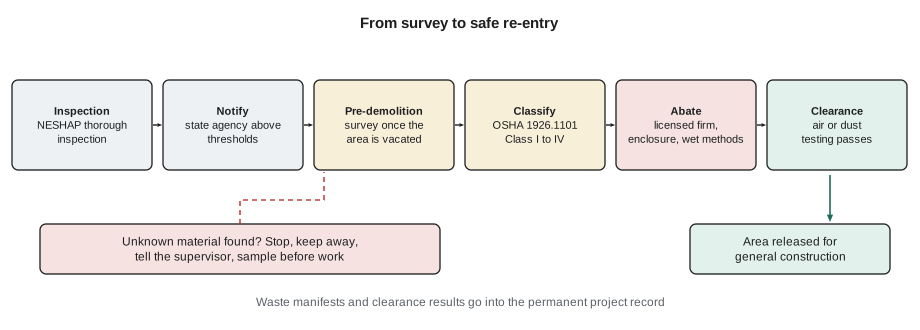
In the United States, the federal asbestos rules under the Clean Air Act, known as the asbestos NESHAP, require a thorough inspection for asbestos before renovation or demolition of most buildings other than small residences, and written notification to the state or local agency before demolition and before renovation that disturbs more than threshold quantities of regulated asbestos. OSHA's construction asbestos standard, 29 CFR 1926.1101, requires building owners and employers to determine the presence of asbestos in certain materials in buildings built before 1981 and to tell workers and contractors about it. Many states add their own licensing and notification rules. Owners usually meet these duties by hiring a consultant to prepare a hazardous materials survey.
A survey is only as good as its access. Surveys done while a building is occupied often cannot open every wall or ceiling, and many surveys state that further sampling is needed when areas become accessible. Calloway's original survey for the East Wing said exactly that, in a paragraph on page 31 that nobody on the bid team had read carefully. A pre-demolition survey, done after the hospital moved out of an area and before demolition starts, fills those gaps. On Ashgrove, after the corridor discovery, Harborline and the hospital agreed that Calloway would do a pre-demolition survey of each phase, opening walls, ceilings and floors as needed, before any demolition was released.
Classifying and controlling the work
OSHA's construction asbestos standard classifies work into Class I to Class IV. Class I covers removal of thermal system insulation and sprayed or troweled surfacing materials, the highest-risk work. Class II covers removal of other asbestos-containing materials such as floor tile, roofing and wallboard. Class III covers repair and maintenance work where asbestos may be disturbed, and Class IV covers custodial activities such as cleaning up small amounts. Higher classes need regulated areas, negative pressure enclosures, competent persons, trained workers, respiratory protection, decontamination and exposure monitoring. Abatement on Ashgrove was done by a state-licensed specialist subcontractor working to Calloway's specification.
Whatever the jurisdiction, high-risk asbestos removal follows a recognizable pattern: isolate the area, build a sealed enclosure under negative pressure with HEPA filtration, provide a decontamination unit for workers to change and shower, wet the material to keep fibers down, remove and bag it, clean the enclosure, test the air to confirm fiber levels are low enough, and only then take down the enclosure. The same negative pressure principles from lesson 2 apply, with stricter limits and independent air testing.
Lead
Lead in paint and other materials becomes a hazard when it is sanded, scraped, cut, burned or demolished. OSHA's construction lead standard, 29 CFR 1926.62, sets an action level and a permissible exposure limit for workers, with exposure assessment, controls, respirators, hygiene and medical surveillance. EPA's Renovation, Repair and Painting (RRP) rule applies to renovation that disturbs painted surfaces in housing and child-occupied facilities built before 1978, requiring certified firms, lead-safe work practices and cleaning verification. In the East Wing, Calloway found lead-based paint on door frames and in the stairwells, and lead sheet lining a former X-ray room on level 1. The childcare room was to be built in that part of level 1, so Ashgrove decided to treat the area as if the RRP rule applied, used an RRP-certified firm, removed the lead paint rather than painting over it and had the room dust-wipe tested before opening against EPA's lower dust-lead clearance levels for abatement, which a 2024 rule tightened.
Silica, mold and the rest
Crystalline silica is created by the trades themselves whenever concrete, block, tile or stone is cut, cored, ground or chipped. It is controlled by engineering methods at the tool: water delivery to the blade, shrouds with HEPA vacuum extraction, and enclosed cabs, backed by respirators where needed. On Ashgrove, every saw and core drill used water or vacuum extraction, and the concrete chipping on level 2 used vacuum-shrouded tools inside the containment described in lesson 2.
Mold usually shows up where water has leaked for years: behind old sinks, under windows, around roof drains. Small areas can be removed with containment and HEPA vacuums by trained workers; larger areas need an abatement approach similar to asbestos. In a hospital, mold also matters because of infection risk to patients, so Dr. Moreau's team reviewed every mold abatement plan. Light ballasts were checked for PCBs and bagged for regulated disposal, fluorescent tubes and mercury thermostats were collected for recycling, and refrigerant in the old cooling units was recovered by a licensed technician before removal.
Worked problem
Planning the level 2 abatement
Calloway's pre-demolition survey of level 2 found: 17,200 ft² of vinyl floor tile with asbestos-containing mastic; 1,380 linear ft of asbestos pipe insulation above corridor and room ceilings; and 130 ft² of textured ceiling with asbestos. The abatement contractor's crew can remove floor tile and mastic at 1,720 ft² per shift as Class II work, pipe insulation at 115 ft per shift as Class I work, and textured ceiling at 65 ft² per shift as Class I. Does the renovation exceed the NESHAP notification thresholds, and roughly how many shifts are needed?
Show solution
- NESHAP renovation thresholds are generally 260 linear ft on pipes, 160 ft² on other components or 35 ft³ where length or area cannot be measured.
- Pipe insulation is 1,380 linear ft, far above 260 ft, so written notification is required before work starts, usually at least 10 working days ahead.
- Thermal system insulation and surfacing material are Class I work; floor tile and mastic are Class II.
- Shifts: floor 17,200 ÷ 1,720 = 10; pipe 1,380 ÷ 115 = 12; ceiling 130 ÷ 65 = 2.
- Total about 24 crew-shifts, plus enclosure set-up, cleaning and clearance air testing.
Answer: About 24 crew-shifts of abatement, with the pipe insulation and textured ceiling done in full negative pressure enclosures and the required advance notice given.
# Abatement shifts, OSHA class and NESHAP check (US units)
items = [  # name, quantity, unit, class, rate per shift
    ('Floor tile and mastic', 17200, 'ft2', 'II', 1720),
    ('Pipe insulation',        1380, 'ft',  'I',   115),
    ('Textured ceiling',        130, 'ft2', 'I',    65),
]
total = 0
for name, qty, unit, cls, rate in items:
    shifts = -(-qty // rate)        # round up
    total += shifts
    print(f'{name:22s} {qty:6,} {unit:3s} Class {cls:3s} {shifts:3d} shifts')
print('Total crew-shifts:', total)
pipe_ft = 1380; surface_ft2 = 17200 + 130
print('NESHAP notification needed:', pipe_ft >= 260 or surface_ft2 >= 160)Floor tile and mastic 17,200 ft2 Class II 10 shifts Pipe insulation 1,380 ft Class I 12 shifts Textured ceiling 130 ft2 Class I 2 shifts Total crew-shifts: 24 NESHAP notification needed: True
When an unknown material turns up
No survey finds everything. Workers on renovation projects need a simple rule they can follow without thinking: if you uncover a material you are not sure about, stop, leave it alone, keep others away, and tell your supervisor. The supervisor arranges sampling before work in that area continues. Harborline's orientation showed pictures of the common materials, and every work area had a laminated card with the stop-work rule and the phone number of Calloway's site representative. The corridor insulation that Andre found was the first of nine unexpected finds during the project, and in every case work stopped before anything was disturbed.
Unexpected hazardous materials also have contract consequences. Most contracts treat the discovery of hazardous materials that were not disclosed as the owner's responsibility: the contractor must stop work in the affected area and notify the owner, and is entitled to an adjustment of time and price for the delay and extra work, provided it did not cause or knowingly disturb the material. Lesson 5 shows how the corridor discovery was priced and scheduled.
Clearance and records
An area is not safe for general construction, or for occupants, until testing shows it is clean. After asbestos removal, independent air samples are taken inside the enclosure and compared with clearance criteria before the enclosure comes down. After lead work, dust wipe samples are compared with clearance levels. Clearance results are signed by the consultant, kept in the project file and given to the owner, because they may be needed decades later to show that the work was done properly.
The hazardous materials records for the East Wing filled three binders by the end of the project: surveys, abatement plans, notifications, worker training and medical records summaries, daily logs, air and dust sampling results, waste manifests showing that material went to licensed disposal sites, and clearance certificates. Harborline's closeout package, covered in lesson 11, included a full copy, and the hospital updated its asbestos management records to show which materials had been removed and which remained in other parts of the campus.
Common mistakes
MistakeAssuming the survey in the bid documents found everything.
InsteadRead its limits, arrange pre-demolition surveys of inaccessible areas and keep a stop-and-ask rule for unknown materials.
MistakeLetting general trades disturb suspect materials.
InsteadStop, isolate and sample; use trained abatement workers under the right classification.
MistakePainting over lead paint in areas young children will use.
InsteadRemove or stabilize it properly and test dust before the area is occupied.
MistakeCutting concrete without dust controls.
InsteadUse water or vacuum extraction at the tool, backed by respirators where needed.
MistakeDiscarding hazardous waste with general debris.
InsteadBag, label and send it to licensed disposal with manifests kept in the project file.
Summary and key terms
- Buildings from before the 1990s commonly contain asbestos, lead, PCBs, mercury and mold, and renovation creates silica dust.
- The asbestos NESHAP requires inspection and notification above thresholds, and OSHA classifies asbestos work as Class I to IV.
- Surveys done in occupied buildings have access limits, so pre-demolition surveys fill the gaps.
- High-risk asbestos work uses sealed negative pressure enclosures, decontamination, wet methods, trained workers and clearance air testing.
- Lead work follows OSHA's lead standard, and the RRP rule applies to pre-1978 housing and child-occupied facilities.
- Workers must stop and report unknown materials, and undisclosed hazards usually entitle the contractor to time and money.
- Clearance results, manifests and abatement records are kept permanently and handed to the owner.
- Friable
- Able to be crumbled by hand pressure, releasing fibers easily.
- NESHAP
- The federal asbestos emission standard requiring inspection and notification before renovation or demolition.
- Class I asbestos work
- OSHA's highest-risk class: removal of thermal system insulation and surfacing material.
- RRP rule
- EPA's rule for lead-safe renovation in pre-1978 housing and child-occupied facilities.
- Clearance testing
- Air or dust sampling to confirm an area is clean before it is reoccupied.
- Waste manifest
- A document tracking hazardous waste from the site to licensed disposal.
Practice problems
Work each problem on paper first, then reveal the answer to check.
Why can asbestos harm appear decades after exposure?
Show answer
Diseases such as mesothelioma and lung cancer develop many years after fibers are inhaled.
Above what pipe length does NESHAP renovation notification generally apply?
Show answer
260 linear feet of regulated asbestos on pipes.
Removing pipe insulation is which OSHA class?
Show answer
Class I, because it is thermal system insulation.
What should a worker do on finding an unknown material?
Show answer
Stop, leave it alone, keep others away and tell the supervisor so it can be sampled.
Which buildings does the RRP rule cover?
Show answer
Housing and child-occupied facilities built before 1978.
Lesson quiz · 5 questions
Score 60% or more to complete this lesson.
Create a free account to save your progress, take quizzes and earn a certificate.