
CON-385 · Lesson 6 of 12 · 21 min
The commissioning process: requirements, plans and roles
In 2009, the hospital opened a new day surgery unit in the Main Building. It looked finished. Within a month, operating room temperatures drifted out of range every afternoon, two isolation rooms ran at positive instead of negative pressure, and the building automation system sent so many nuisance alarms that the night operators stopped reading them. It took the hospital eighteen months and several hundred thousand dollars to sort out. Nobody had checked, in a structured way, that the systems worked together as the hospital needed before the keys were handed over. When Helen Achterberg became director of facilities, she made one rule for every capital project: an independent commissioning authority, hired by the hospital, from the start of design to the end of the warranty year. On the East Wing that was Kwame Asante of Kestrel Commissioning Group.
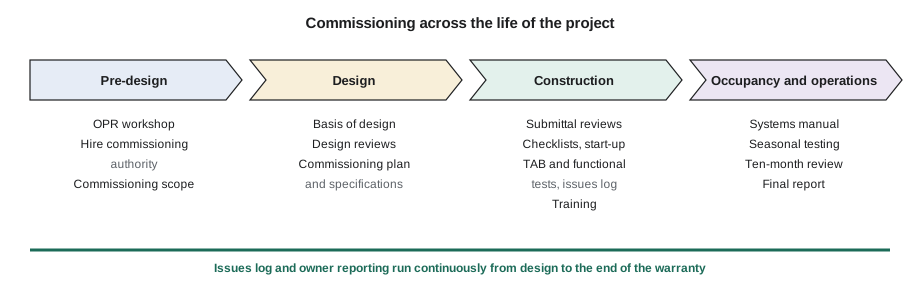
Commissioning is a quality-focused process for verifying and documenting that a building and its systems are planned, designed, installed, tested, operated and maintained to meet the owner's project requirements. The definition is long because the process is long. Commissioning is not a test at the end of a project. It begins when the owner writes down what it needs and continues until the owner's staff can operate the systems confidently, usually through the first year of occupancy.
In the United States, the main references are ASHRAE Guideline 0, The Commissioning Process, last fully revised in 2019, and ANSI/ASHRAE/IES Standard 202, Commissioning Process for Buildings and Systems, whose current edition is 2024. Guideline 0 explains how to carry out commissioning; Standard 202 states the minimum acceptable process in language suitable for contracts and codes. Energy codes, federal building requirements and green building programs such as LEED include commissioning requirements, and many owners write their own. Ashgrove's specification required commissioning in accordance with ASHRAE Standard 202 and Guideline 0.
Why commissioning matters, especially in renovations
Modern buildings depend on systems that interact: air handling units controlled by a building automation system, fed by heating and cooling plants, interlocked with fire alarms, smoke dampers and generators. Each piece can be installed correctly and the whole can still fail, because a control sequence was misunderstood, a sensor was placed in the wrong spot or a setting was never adjusted. Commissioning looks at the systems as the owner will use them, not trade by trade.
Renovations add a further layer: the new systems must work with old ones. On Ashgrove, the new air handling unit had to connect to the hospital's existing building automation system, the new fire alarm system had to report to the hospital's existing network and switchboard, and the new heating and cooling distribution had to draw from the Main Building's central plant without upsetting the other buildings it served. Each interface was a place where two sets of assumptions met. The commissioning plan named every interface and assigned someone to test it.
- Fewer problems at handover, because issues are found during design and construction.
- Lower energy use and better comfort, because systems run as designed.
- Safer buildings, because life safety interlocks are proven to work together.
- Better-prepared operators, because training and documentation are part of the process.
- Fewer disputes, because expectations are written down at the start.
The owner's project requirements and the basis of design
Commissioning rests on two documents. The owner's project requirements, or OPR, set out what the owner needs in its own terms: functions, occupancy, environmental conditions, reliability, energy targets, maintenance expectations, training needs. The basis of design, or BOD, written by the designers, explains how the design will meet those requirements: the systems chosen, design conditions, assumptions, codes and standards used. The OPR says what and why; the BOD says how.
| Topic | Owner's project requirements (OPR) | Basis of design (BOD) |
|---|---|---|
| Dialysis unit temperature | Patients comfortable in chairs for four-hour sessions; 21 to 24 °C year-round | Dedicated zone with reheat; design 22 °C, outdoor design conditions per local climate data |
| Reliability | No loss of ventilation to the dialysis unit for more than 15 minutes | Air handling unit with redundant supply fans in a fan array; emergency power to fans and controls |
| Infection control | Treatment areas at positive pressure to corridors; soiled utility rooms negative | Airflow offsets set by design; pressure monitors at key rooms |
| Energy | At least 25 % better than the reference energy code building | Heat recovery wheel, variable speed fans, demand-controlled ventilation in classrooms |
| Operations | Facilities staff able to operate and troubleshoot without the contractor | Graphics on existing automation system, full sequences, training plan |
Kwame facilitated the OPR workshop in the first month of design. Helen's operators, Dr. Moreau's team, the dialysis unit manager and the hospital's energy manager all attended, and the session turned up requirements no one had written down: dialysis nurses needed to be able to adjust temperature in each treatment bay by about two degrees Fahrenheit; the energy manager wanted every major meter connected to the existing energy dashboard. Those requirements went into the OPR, then into the design, and later into the tests.
The commissioning team and its roles
| Role | Who on Ashgrove | Main responsibilities |
|---|---|---|
| Owner | Ashgrove Health, through Helen Achterberg | Writes and approves the OPR, hires the commissioning authority, accepts the systems |
| Commissioning authority | Kwame Asante, Kestrel Commissioning Group | Leads the process, reviews design and submittals, writes test procedures, witnesses tests, keeps the issues log, reports to the owner |
| Designers | Pell & Strand, Coldwater Engineering | Write the BOD, respond to commissioning comments, write sequences, attend tests |
| General contractor | Harborline, through Tomas Reyes as commissioning coordinator | Schedules commissioning, makes sure trades complete checklists and start-up, fixes issues |
| Trade contractors and suppliers | Mechanical, electrical, controls, fire alarm, testing and balancing | Install, start up, complete checklists, perform tests, correct problems |
| Operations staff | Helen's operators and technicians | Review designs for maintainability, attend tests and training, take over the systems |
The independence of the commissioning authority matters. Kwame worked for the hospital, not for the designers or the contractor, so his reports went straight to Helen. That independence let him say uncomfortable things, such as telling the design team that a control sequence could not meet the OPR, or telling Harborline that a system was not ready for testing, without a conflict of interest.
The commissioning plan and specifications
The commissioning plan is the project's roadmap for commissioning: which systems are commissioned, who does what, which documents are produced, how issues are tracked and how commissioning fits into the schedule. Kwame wrote the first version during design and updated it when Harborline came on board. The contract specifications turned the plan into obligations, with a commissioning section in the general requirements and commissioning paragraphs in each mechanical, electrical, controls and fire protection section.
| Commissioning document | Prepared by | When |
|---|---|---|
| Owner's project requirements | Owner with commissioning authority | Pre-design, updated in design |
| Basis of design | Designers | Design |
| Commissioning plan | Commissioning authority | Design, updated in construction |
| Design review comments | Commissioning authority | Each design stage |
| Construction checklists | Commissioning authority drafts; trades complete | Construction |
| Functional test procedures | Commissioning authority | Before testing |
| Issues log | Commissioning authority | Throughout |
| Systems manual and training records | Contractor and commissioning authority | Construction and handover |
| Commissioning report | Commissioning authority | Handover, updated after warranty review |
Commissioning during design
The cheapest time to fix a problem is before it is built. Kwame reviewed the East Wing design at 50 % and 95 % stages against the OPR, looking for maintainability, controllability and conflicts with existing systems. His 95 % review produced 112 comments. Among them: the new air handling unit's filters could only be changed by removing a duct section; the sequence of operation did not say what the unit should do if the hospital's existing automation network lost communication; and the design showed new smoke dampers but no way to test them from the fire alarm panel. Each comment was answered by the designers and tracked to closure. Fixing those three on paper cost a few hours of design time; fixing them after installation would have cost weeks.
The issues log
Every problem found during commissioning goes into one issues log, with a number, a description, the system, who found it, who must fix it, the date found, the date resolved and how it was verified. The log is the commissioning authority's main management tool and the owner's best indicator of readiness. Kwame reviewed it at every weekly commissioning meeting, and Helen read the summary every Friday.
Worked problem
Reading the issues log
At the end of phase 2, the issues log for the dialysis unit had 86 entries: 54 closed and verified, 20 open for less than 14 days, 9 open for 14 to 30 days and 3 open for more than 30 days. The three oldest issues were a reheat valve that would not close fully, a missing graphic on the automation system and a pressure monitor wired to the wrong room. The unit is due to open in three weeks. What does the log say about readiness?
Show solution
- Closure rate: 54 ÷ 86 = 63 % closed.
- Open issues: 20 + 9 + 3 = 32.
- Aging: 12 of the 32 open issues, or 38 %, have been open more than two weeks.
- The oldest three each affect the OPR: comfort in treatment bays, operator control and infection control pressure.
- Readiness depends less on the percentage closed than on whether any open issue affects patient safety or a requirement the owner cannot accept at opening.
Answer: The unit is not ready to open until the pressure monitor is fixed and the reheat valve is resolved, and the old issues need named owners and dates this week.
Tomas kept a short program that turned the log export into the weekly summary, grouping open issues by system and age so the meeting could focus on what was stuck.
# Weekly summary of a commissioning issues log
from collections import Counter
open_issues = [  # (system, days open, affects safety or OPR?)
    ('AHU-3', 35, True), ('BAS', 42, False), ('Pressure monitors', 31, True),
    ('AHU-3', 20, False), ('Reheat', 18, True), ('BAS', 16, False),
    ('Plumbing', 15, False), ('Lighting', 22, False), ('BAS', 25, False),
    ('Reheat', 9, False), ('Lighting', 5, False), ('Plumbing', 3, False),
]
bands = Counter('over 30' if d > 30 else '14-30' if d >= 14 else 'under 14' for _, d, _ in open_issues)
print('Open issues by age:', dict(bands))
print('Open issues by system:', dict(Counter(s for s, _, _ in open_issues)))
critical = [(s, d) for s, d, c in open_issues if c]
print('Affecting safety or the OPR:', critical)Open issues by age: {'over 30': 3, '14-30': 6, 'under 14': 3}
Open issues by system: {'AHU-3': 2, 'BAS': 3, 'Pressure monitors': 1, 'Reheat': 2, 'Plumbing': 2, 'Lighting': 2}
Affecting safety or the OPR: [('AHU-3', 35), ('Pressure monitors', 31), ('Reheat', 18)]Commissioning a phased renovation
On a new building, commissioning usually builds to one climax before handover. On a phased renovation it happens several times. The East Wing had three handovers: the rooftop mechanical room and risers at the end of phase 1, the dialysis unit at the end of phase 2, and the clinic, childcare room and level 3 at the end of phase 4. Each needed its own checklists, functional tests, training and acceptance, and each changed the conditions for the next. When the dialysis unit opened, the new air handling unit was serving occupied patients while also being extended to areas still under construction, so later tests had to be planned around live treatment sessions. Kwame's plan treated each handover as a separate commissioning milestone, with the systems serving the opened area tested in full and the systems still under construction tested again when their areas were finished. Seasonal testing, covered in lesson 12, picked up conditions that could not be tested at any single handover.
Paying for commissioning
Commissioning costs money: the commissioning authority's fees, the contractor's coordination, the trades' time for checklists and testing, the designers' time to respond. Published estimates of the cost vary widely with building type and scope, but they are usually a small fraction of construction cost, and studies of commissioned buildings have repeatedly found that energy savings and avoided problems repay the cost within a few years. Owners who have lived through a bad handover, as Ashgrove had in 2009, rarely need the business case explained twice.
Common mistakes
MistakeTreating commissioning as a test at the end of construction.
InsteadStart with the OPR before design and continue through the first year of operation.
MistakeLetting the designer or contractor act as the commissioning authority.
InsteadHire an independent commissioning authority who reports to the owner.
MistakeWriting an OPR without the operators and users.
InsteadRun an OPR workshop with operations, clinical users, infection control and energy staff.
MistakeIgnoring interfaces with existing systems.
InsteadName every interface in the commissioning plan and assign tests to each.
MistakeMeasuring readiness only by the percentage of issues closed.
InsteadLook at aging and at whether open issues affect safety or the OPR.
Summary and key terms
- Commissioning verifies that systems are planned, designed, installed, tested, operated and maintained to meet the owner's project requirements.
- ASHRAE Guideline 0 explains the process and Standard 202-2024 states the minimum requirements in contract language.
- The OPR states what the owner needs and why; the BOD explains how the design meets it.
- An independent commissioning authority leads the process and reports to the owner.
- The commissioning plan and specifications set roles, documents, schedule and issue tracking.
- Design reviews catch maintainability, control and interface problems when they are cheap to fix.
- The issues log tracks every problem to verified closure and shows readiness through aging and severity.
- Commissioning
- A quality-focused process to verify that systems meet the owner's project requirements.
- Owner's project requirements
- The owner's written statement of what the project must achieve and why.
- Basis of design
- The designers' explanation of how the design meets the OPR.
- Commissioning authority
- The independent party who leads commissioning for the owner.
- Commissioning plan
- The document setting out commissioning scope, roles, schedule and procedures.
- Issues log
- The single record of commissioning problems tracked to verified closure.
Practice problems
Work each problem on paper first, then reveal the answer to check.
What is the difference between the OPR and the BOD?
Show answer
The OPR says what the owner needs and why; the BOD says how the design will meet it.
Why should the commissioning authority be independent?
Show answer
So it can report problems to the owner without a conflict of interest with designers or contractors.
Give an example of an interface with an existing system on Ashgrove.
Show answer
The new air handling unit on the existing automation system, or the new fire alarm on the hospital network.
An issues log has 120 entries and 84 are closed. What is the closure rate?
Show answer
70 %.
Why are design reviews valuable?
Show answer
Problems found on paper are much cheaper to fix than after installation.
Lesson quiz · 5 questions
Score 60% or more to complete this lesson.
Create a free account to save your progress, take quizzes and earn a certificate.