
CON-385 · Lesson 5 of 12 · 20 min
Managing surprises: concealed conditions, changes and contingency
By the end of phase 2, the Ashgrove change order log ran to forty-one items. Some were small: a door relocated at the hospital's request, an extra data outlet at a nursing station. Others were large: the corridor asbestos that Andre found, a cracked steel lintel over a level 2 window opening, a buried foundation for a long-demolished chimney that sat exactly where the new elevator pit was planned. Every renovation has surprises. What separates a well-run renovation from a troubled one is not whether surprises happen but how quickly they are recognized, recorded, notified, priced and decided, and whether the owner set aside enough money to pay for them.
Why renovations generate changes
New construction produces changes because owners change their minds and designers make mistakes. Renovation produces those changes too, plus a steady stream caused by the building itself. The causes on Ashgrove fell into five groups, and the pattern is typical.
| Cause | Ashgrove examples | Share of change value |
|---|---|---|
| Concealed or unknown conditions | Chimney foundation, cracked lintel, slab thinner than drawn | 34 % |
| Hazardous materials not disclosed | Corridor asbestos, mold behind old sinks | 22 % |
| Owner-requested changes | Extra outlets, relocated doors, added medical gas outlet | 19 % |
| Design errors and omissions | Duct clash with beam, missing fire damper | 15 % |
| Authority requirements | Fire department asked for an extra standpipe connection | 10 % |
Owners who plan a renovation as if it were new construction are regularly surprised by the size of that first group. Owners who have renovated before set aside more money and invest in investigation during design, as lesson 3 described.
The concealed conditions process
The concealed or unknown conditions provision in the AIA A201-2017 sets out a sequence that Harborline followed for every surprise. If the contractor encounters concealed or unknown physical conditions that differ materially from those indicated in the contract documents, or unknown physical conditions of an unusual nature that differ materially from those ordinarily found, it must promptly give notice to the owner and the Architect before the conditions are disturbed, and in no event later than 14 days after first observing them. The Architect investigates and, if the conditions differ materially and cause a change in cost or time, recommends an equitable adjustment. Harborline's practice was to send the written notice the same day as the discovery, with photographs and a sketch, and to leave the condition undisturbed until the Architect had seen it, unless leaving it posed a safety risk.
- Discover: the crew stops work at the condition and tells the superintendent.
- Record: photographs with a scale, measurements, a sketch, the location on the drawings and the time.
- Notify: a written notice under the named clause, the same day, describing the condition and stating that it differs from the documents.
- Protect: make the area safe, keep the condition undisturbed for inspection and work elsewhere if possible.
- Investigate: the design team inspects, and further tests or openings are made if needed.
- Decide and price: the design team issues a solution; the contractor prices it; the parties agree a change order or the owner issues a directive so work can continue.
When the parties cannot agree on price quickly, the A201-2017 allows the owner and Architect to issue a Construction Change Directive, which instructs the contractor to proceed while the adjustment is determined later, often from the actual cost of the work plus an allowance for overhead and profit. On a renovation, where stopping work can disrupt hospital operations, construction change directives are essential: Ashgrove used nine of them in phase 2.
Tools for known unknowns
Some surprises can be anticipated in type if not in size. Everyone on Ashgrove expected some deteriorated concrete, some extra abatement and some damaged drywall to repair; nobody knew how much. Contracts have several tools for this kind of risk, each with a different effect on who pays.
| Tool | How it works | Best used for |
|---|---|---|
| Cash allowance | A stated sum included in the contract price for defined work; the price is adjusted to actual cost | Items that cannot be designed yet, such as signage or hardware |
| Unit prices | Prices per unit quoted in the bid and applied to actual quantities | Repeatable work of unknown quantity, such as concrete repair by area or abatement by length |
| Owner contingency | Money the owner holds outside the contract to pay for changes | Concealed conditions, owner changes, design errors |
| Contractor contingency | Money the contractor includes in its price for its own risks | Productivity, coordination, small items the contractor is responsible for |
| Provisional items | Work described and priced in the bid but carried out only if instructed | Options the owner may or may not take up |
Ashgrove's bid form included unit prices for six repeatable items: concrete slab repair per ft², masonry repair per ft², removal of asbestos pipe insulation per linear foot, removal of mold-affected drywall per ft², additional cores per core, and replacement of corroded steel lintels per linear foot. Because they were bid competitively, the unit prices were fair, and because they were fixed in the contract, each occurrence could be priced in minutes rather than argued about for weeks. More than half of the concealed-condition changes on Ashgrove were priced entirely from unit prices.
How much contingency is enough?
An owner's contingency is the owner's reserve for the cost of the unexpected. For new buildings with complete designs, owners often carry around 5 % of the construction cost. For renovations, especially of old buildings with poor records and occupied neighbors, owners and cost consultants commonly carry 10 % to 15 % or more, and some public owners carry separate allowances for hazardous materials. The right number depends on how much investigation was done, how complete the design is, the age of the building and the owner's tolerance for asking its board for more money.
Ashgrove carried an owner's construction contingency of 10 % of the contract price, about $1.54 million, plus a separate hazardous materials allowance of $200,000. By the end of phase 2 the project was about 45 % complete by value and had spent $845,000 of contingency. That looked alarming at first: more than half the contingency spent with less than half the work done. Simone Dufresne and Helen Achterberg went through the remaining risks together to see whether the money would last.
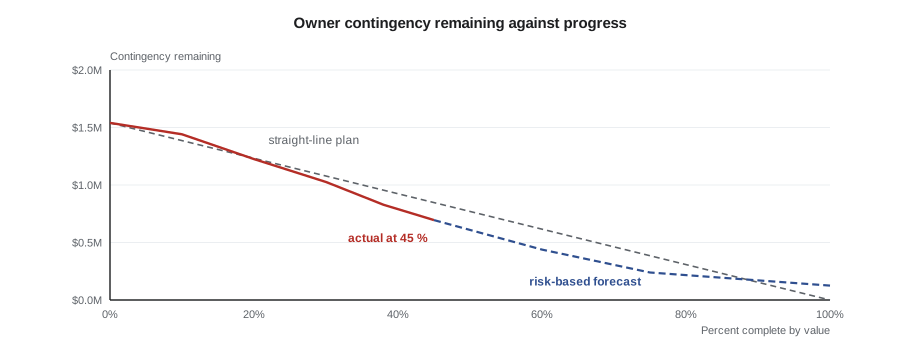
A straight-line comparison is misleading on renovations, because most concealed conditions are found during demolition, early in each phase. Later work, in already-opened areas, has fewer surprises. A better forecast lists the remaining risks, estimates the likely cost and probability of each, and compares the expected total with the money left.
Worked problem
Forecasting the remaining contingency
Ashgrove has $695,000 of owner contingency left. The remaining risk register lists: demolition of level 1 and level 3 still to come (expected concealed-condition cost $415,000, probability 80 %); possible owner changes to the clinic layout ($205,000, 60 %); integration problems with the existing fire alarm network ($100,000, 40 %); and a possible delay claim from the phase 2 asbestos discovery ($150,000, 50 %). Is the contingency enough?
Show solution
- Expected value of each risk is cost × probability.
- Demolition: $415,000 × 0.80 = $332,000.
- Owner changes: $205,000 × 0.60 = $123,000.
- Fire alarm integration: $100,000 × 0.40 = $40,000.
- Delay claim: $150,000 × 0.50 = $75,000.
- Total expected cost: $570,000, leaving an expected $125,000 of the $695,000.
- If every risk happens in full, the cost is $870,000, which would exceed the contingency by $175,000.
Answer: On expected values the contingency is enough with a modest margin, but there is a real chance of overrun if most risks occur, so owner changes should be controlled tightly.
Helen took the result to Ashgrove's capital committee with a recommendation: approve owner changes only if they were needed for patient care or regulatory reasons, and hold the remaining hazardous materials allowance as a backstop. The committee agreed, and the clinic layout changes were reduced to two essential items.
# Risk-based forecast of remaining contingency
remaining = 695000
risks = [  # name, cost if it happens, probability
    ('Level 1 and 3 demolition finds', 415000, 0.80),
    ('Owner layout changes',           205000, 0.60),
    ('Fire alarm integration',         100000, 0.40),
    ('Phase 2 delay claim',            150000, 0.50),
]
expected = sum(c * p for _, c, p in risks)
worst = sum(c for _, c, _ in risks)
for name, c, p in risks:
    print(f'{name:31s} ${c:>9,.0f} x {p:.0%} = ${c * p:>9,.0f}')
print(f'Expected total ${expected:,.0f}; margin ${remaining - expected:,.0f}')
print(f'Worst case ${worst:,.0f}; margin ${remaining - worst:,.0f}')Level 1 and 3 demolition finds $ 415,000 x 80% = $ 332,000 Owner layout changes $ 205,000 x 60% = $ 123,000 Fire alarm integration $ 100,000 x 40% = $ 40,000 Phase 2 delay claim $ 150,000 x 50% = $ 75,000 Expected total $570,000; margin $125,000 Worst case $870,000; margin $-175,000
Time as well as money
Surprises cost time as well as money, and on an occupied-building project time has its own price: temporary facilities stay longer, the hospital pays for borrowed space, staff work in disrupted conditions for more weeks. A delay is only compensable if it affects the completion date or a contractual milestone, which usually means it falls on the critical path, and the contract's notice rules were followed. Harborline used time impact analysis for significant surprises: a small network of new activities, often called a fragnet, was inserted into the current schedule at the date of the event, and the schedule was recalculated to show the effect on milestones.
The corridor asbestos discovery inserted three new activities into the phase 2 schedule: a pre-demolition survey of all corridor ceilings, notification and set-up for the enclosure, and the abatement itself. Together they added 19 working days to the corridor ceiling work. Because the corridor work was not on the critical path at the time, the impact on the phase 2 milestone was only 6 working days. Harborline's notice and the analysis together supported a 6-day extension and payment for the extended site costs, rather than the 19 days that a simple count might have claimed. Being accurate made the claim easy for the owner to accept.
The weekly surprise review
Surprises are cheapest when they are found early, and on a renovation the best way to find them early is to look for them deliberately. Every Thursday, Gareth Lowe, Tomas Reyes, the design team's site representative and Helen's facilities coordinator walked the areas that would be opened in the next two weeks. They lifted ceiling tiles, looked behind access panels, checked the as-found model and the scan reports, and asked the trade foremen what they expected to find. Anything suspicious went onto a short list with an owner and a date: sample this material, open this wall, confirm this pipe is dead. The walk took an hour. In phase 3 it found the second chimney foundation two weeks before the excavation crew would have hit it, which turned a stoppage into a planned change with a design already issued. The review also kept the owner informed: Helen's coordinator reported each Friday to the hospital's project steering group on what had been found and what it might cost, so that no surprise reached the capital committee without warning.
Records that make changes easy to settle
Change disputes on renovations are usually about facts: how big the condition was, what it took to fix, how long the crew spent. Disputes are shorter when the records are good. On Ashgrove, every surprise generated the same file: the discovery photographs and sketch, the notice, the design team's instruction, daily records of labor and equipment on the extra work under a separate cost code, material invoices, subcontractor tickets signed daily by the owner's representative, and the schedule analysis. Helen's team signed time-and-material tickets each afternoon, while memories were fresh, which meant arguments about hours were rare.
Common mistakes
MistakeDisturbing a concealed condition before the owner has seen it.
InsteadRecord, notify in writing and keep it undisturbed for inspection unless safety requires otherwise.
MistakeWaiting until the cost is known before giving notice.
InsteadGive prompt written notice of the condition and follow with pricing.
MistakeComparing contingency spent with percent complete on a straight line.
InsteadForecast remaining risks with cost and probability; renovation surprises cluster early in each phase.
MistakeClaiming every day of extra work as delay.
InsteadUse time impact analysis to show the effect on the critical path and milestones.
MistakeMixing extra work costs with base contract costs.
InsteadUse separate cost codes and daily signed tickets for every change.
Summary and key terms
- Renovations produce changes from concealed conditions and undisclosed hazards as well as owner changes, design errors and authority requirements.
- The A201-2017 requires notice of materially different concealed conditions before they are disturbed and within 14 days, followed by investigation and a recommendation by the Architect.
- Change directives let work continue while price is settled, which matters in occupied buildings.
- Unit prices, allowances and contingencies handle known unknowns; unit prices turn repeatable surprises into quick, fair changes.
- Renovation owners commonly carry 10 % to 15 % contingency and should forecast it from a risk register, not a straight line.
- Delays are measured by their effect on the critical path using time impact analysis.
- Separate cost codes, signed daily tickets and photographs make changes easy to settle.
- Concealed conditions
- Hidden physical conditions that differ materially from those indicated or ordinarily found.
- Construction change directive
- An A201 instruction to proceed with a change before its adjustment is agreed.
- Unit price
- A price per unit of work quoted in the bid and applied to actual quantities.
- Owner contingency
- Money held by the owner outside the contract to pay for changes.
- Fragnet
- A small network of activities inserted into a schedule to model the effect of an event.
- Time impact analysis
- A method of measuring the effect of an event on the critical path and completion date.
Practice problems
Work each problem on paper first, then reveal the answer to check.
List the six steps Harborline followed for a concealed condition.
Show answer
Discover, record, notify, protect, investigate, and decide and price.
Why are unit prices useful on renovations?
Show answer
Repeatable surprises of unknown quantity can be priced quickly and fairly from rates bid competitively.
A risk costs $200,000 with a 30 % chance. What is its expected value?
Show answer
$60,000.
Why is a straight-line contingency comparison misleading on renovations?
Show answer
Concealed conditions are mostly found during demolition early in each phase, so spending is front-loaded.
An event adds 15 working days to an activity with 10 days of float. What is the likely effect on completion?
Show answer
About 5 working days, if nothing else changes.
Lesson quiz · 5 questions
Score 60% or more to complete this lesson.
Create a free account to save your progress, take quizzes and earn a certificate.