
CRE-330 · Lesson 10 of 12 · 30 min
Sales tax, 1099s, gifted products and cross-border income
Income tax is not the only tax a creator business deals with. Creators who sell merchandise or some digital products must deal with state sales taxes, which differ from state to state. Brands, platforms and payment apps report payments on Forms 1099, and creators who pay freelancers must issue them too. Free products and trips received for content raise their own tax questions, and income from foreign brands and platforms can bring withholding and reporting requirements. CRE-302 introduced economic nexus and marketplace facilitator laws; this lesson explains how they work in practice, along with information reporting and cross-border issues.
How sales tax works
The US has no national sales tax. Forty-five states and the District of Columbia impose sales taxes, and thousands of local jurisdictions add their own rates; Alaska has no state sales tax but allows local ones, and Delaware, Montana, New Hampshire and Oregon have no general state sales tax. Sales tax is charged to the final buyer on taxable sales, collected by the seller and remitted to the state. Each state decides what is taxable. Tangible goods, such as merchandise, are usually taxable. Services, including creating sponsored content and advertising services, are generally not taxable in most states, although some states tax certain services. Digital products, such as downloadable presets, e-books and online courses, are taxable in some states and exempt in others.
| Item | Typical treatment |
|---|---|
| Sponsored content and brand services | Not taxable in most states |
| Platform ad revenue | Not a sale to a consumer; not subject to sales tax |
| Physical merchandise | Taxable in states with a sales tax, with some exemptions such as clothing in a few states |
| Digital downloads (presets, e-books) | Taxable in some states, exempt in others |
| Online courses and memberships | Varies; often exempt, taxable in some states |
| Speaking and consulting | Generally not taxable |
Nexus: where you must collect
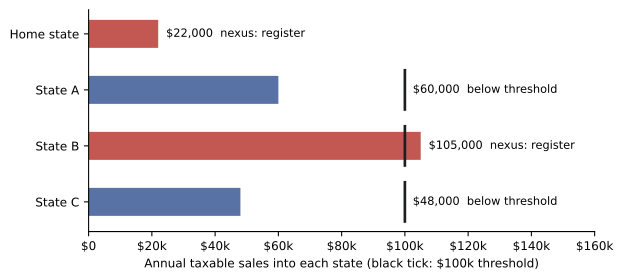
A seller must collect a state's sales tax if it has "nexus" with that state. Physical presence, such as living, working or storing inventory there, creates nexus. Since the Supreme Court's 2018 decision in South Dakota v. Wayfair, every state with a sales tax also applies economic nexus: remote sellers must collect once their sales into the state exceed a threshold, most commonly $100,000 in a year, while large states such as California, New York and Texas use $500,000. Several states have dropped a separate test based on 200 transactions, but some still use one. Your home state is almost always a nexus state if you sell taxable items there.
Worked problem
Checking nexus
A creator in Ohio sells hoodies through their own online store. Annual sales are: Ohio $22,000; California $140,000; Texas $60,000; Florida $105,000; Pennsylvania $48,000. Assume Ohio, Florida and Pennsylvania use a $100,000 threshold and California and Texas $500,000. Where must the creator register to collect sales tax?
Show solution
- Ohio: physical presence nexus as the home state, so register regardless of the amount.
- California: $140,000 is below $500,000, so no economic nexus.
- Texas: $60,000 is below $500,000.
- Florida: $105,000 exceeds $100,000, so economic nexus applies.
- Pennsylvania: $48,000 is below $100,000.
Answer: Ohio and Florida. The creator should register in Florida before collecting there, monitor California and the others, and remember that sales through a marketplace that collects tax may be counted differently in some states.
Marketplace facilitators and collecting tax
Most states have marketplace facilitator laws requiring large online marketplaces, such as Amazon, Etsy, eBay and TikTok Shop, to collect and remit sales tax on sales they facilitate. If you sell only through such marketplaces, the marketplace usually handles collection in those states, although you may still need to register in some states or count those sales toward thresholds. Print-on-demand services and merch partners may also collect tax on your behalf, depending on how the sale is structured. If you sell through your own store, you are responsible for collecting the correct rate, which often depends on the buyer's address, filing returns with each state where you are registered and remitting the tax. Sales tax software that calculates rates and prepares returns is worth its cost once you are registered in several states.
Worked problem
Collecting and remitting sales tax
The Ohio creator registers in Florida. In a quarter, they sell $30,000 of hoodies to Florida buyers through their own store, with an average combined state and local rate of 7 %. They also sell $12,000 through a marketplace that collects Florida tax. How much tax should the creator collect and remit for the quarter, and is the tax income?
Show solution
- Own-store sales: 7 % × $30,000 = $2,100 collected from buyers.
- Marketplace sales: the marketplace collects and remits the tax, so the creator collects nothing on them.
- Remit $2,100 to Florida with the quarterly or monthly return.
- The $2,100 is not income: it is held for the state.
Answer: The creator collects and remits $2,100. Sales tax collected never belongs to the business; keep it in a separate account so it is not spent.
Forms 1099 you receive
Clients and platforms report payments to the IRS on information returns, and you receive copies. Form 1099-NEC reports nonemployee compensation, such as brand fees. Its threshold was $600 for decades; under the One Big Beautiful Bill Act it rises to $2,000 for payments made after December 31, 2025, with inflation indexing after 2026. Form 1099-K is issued by payment card companies, payment apps and online marketplaces; the law restored its threshold to more than $20,000 and more than 200 transactions in a year. Form 1099-MISC reports royalties of $10 or more and certain other payments. Platforms that pay ad revenue may issue a 1099-MISC or 1099-NEC. Whatever forms you receive, you must report all business income, including amounts below the thresholds, and reconcile the forms with your own records so that income is not reported twice.
Worked problem
Reconciling 1099s
A creator's books show $96,000 of business income. They received Forms 1099-NEC totaling $61,000 from brands, a 1099-K for $24,500 from a payment app that includes $4,000 already reported on one of the 1099-NECs, and no forms for $14,500 of other income. What should they report on Schedule C?
Show solution
- 1099-NEC income: $61,000.
- 1099-K income not on a 1099-NEC: $24,500 − $4,000 = $20,500.
- Income with no form: $14,500.
- Total: $61,000 + $20,500 + $14,500 = $96,000, which matches the books.
- Keep a reconciliation showing the $4,000 overlap in case the IRS matching program queries it.
Answer: Report the full $96,000. Forms help the IRS match income; they do not define what is taxable, and duplicated amounts should be explained, not reported twice.
Forms 1099 you must issue
If your business pays a freelancer, such as an editor or designer, $2,000 or more for services in 2026, you generally must file Form 1099-NEC and give them a copy by January 31 of the following year. Collect a Form W-9 before paying anyone, so you have their legal name and taxpayer identification number. If a payee will not provide a valid number, you may be required to apply backup withholding of 24 %. Payments to corporations are generally exempt, except for certain payments such as legal fees. Payments made through a card or payment app are reported by the processor on Form 1099-K, so you do not issue a 1099-NEC for them.
Gifted products, trips and barter
The IRS treats property or services received in exchange for services as income at fair market value. Influencers who receive free products, trips, event tickets or services in exchange for content must generally include their value in income, and the value is also subject to self-employment tax. Genuinely unsolicited items with no obligation are less clear, but if a brand expects coverage, treat them as income. Items you must return, or that are used only to make the content and handed back, are not income. Brands may report the value on Form 1099-NEC. Keep a log recording each item, the date, its fair market value and what you posted.
Worked problem
The tax cost of free products
Over a year, a creator receives products worth $6,500 at retail in exchange for posts, plus a trip valued at $2,800. They keep all of it. Their combined marginal rate, including pension or self-employment contributions, is 40 %. What is the tax cost, and what should they consider?
Show solution
- Fair market value received: $6,500 + $2,800 = $9,300.
- Tax at 40 %: 0.40 × $9,300 = $3,720.
- If the creator would not have bought these items, the tax may feel like paying for things they did not want.
Answer: About $3,720 of tax on items that brought in no cash. Creators should decline gifts they do not need, negotiate cash fees instead of product-only deals, and set aside tax on barter income just as they do on cash.
Cross-border income
US citizens and residents are taxed on worldwide income, so foreign income must be reported, converted to US dollars. Foreign clients and platforms may withhold tax at source in their own countries, and the foreign tax can usually be claimed as a foreign tax credit. If you perform services in Canada, such as appearing at an event, the payer is generally required under Regulation 105 to withhold 15 % of fees for services performed in Canada and remit it to the CRA, unless you obtain a waiver in advance based on the Canada–US tax treaty; you may then need to file a Canadian return to recover it. US persons with foreign financial accounts whose combined value exceeds $10,000 at any time during the year must file an FBAR (FinCEN Form 114), and larger holdings may require Form 8938.
Paying foreign freelancers can create obligations too. Payments to foreign persons for services performed entirely outside the US are generally not subject to US withholding, but you should collect Form W-8BEN to document their foreign status. Payments of US-source royalties to foreign persons are generally subject to 30 % withholding, often reduced by treaty. Seek advice before making such payments.
Keeping sales tax under control
Sales tax compliance becomes a recurring workload once you are registered in several states. Each state sets its own filing frequency, often monthly, quarterly or annually depending on the amount collected, and some require returns even when no tax is due. Missing a return can bring penalties even when the tax itself is small. Use software or a marketplace to calculate rates by address, set reminders for every filing date, keep copies of returns and exemption certificates, and review your nexus position at least once a year as sales grow. If you discover that you should have been collecting in a state for some time, a voluntary disclosure agreement can often limit back taxes and penalties.
Common mistakes
MistakeIgnoring sales tax because you only sell "a few" hoodies online.
InsteadRegister in your home state and monitor economic nexus thresholds in each state.
MistakeAssuming marketplace sales never matter for thresholds.
InsteadCheck how each state counts marketplace sales.
MistakeSpending sales tax collected as if it were income.
InsteadHold it in a separate account until it is remitted.
MistakeTreating free products and trips as tax-free.
InsteadRecord fair market value of items received for content and report it as income.
MistakeReporting only income that appears on a 1099.
InsteadReport all income and reconcile forms with your books.
Summary and key terms
- Sales tax is set by each state; services are usually exempt, merchandise usually taxable.
- Physical presence or economic nexus, often $100,000 of sales, creates a duty to collect.
- Marketplace facilitators collect tax on sales they facilitate in most states.
- Form 1099-NEC thresholds rise to $2,000 for 2026 payments; Form 1099-K applies above $20,000 and 200 transactions.
- Report all income whether or not a form is issued, and issue 1099-NECs to your own freelancers.
- Products and trips received in exchange for content are income at fair market value.
- Foreign income is taxable; Canadian services can trigger Regulation 105 withholding, and foreign accounts may require an FBAR.
- Sales tax
- A state or local tax on retail sales, collected by sellers.
- Nexus
- A connection with a state that requires a seller to collect its tax.
- Economic nexus
- Nexus created by sales above a state's threshold.
- Marketplace facilitator
- A platform required to collect tax on sales it facilitates.
- Form 1099-NEC
- A form reporting nonemployee compensation.
- Form 1099-K
- A form reporting payment card and third-party network payments.
- Form W-9
- A form giving a payee's name and taxpayer identification number.
- Backup withholding
- Withholding of 24 % when a payee does not provide a valid number.
- Fair market value
- The price a willing buyer would pay a willing seller.
- FBAR
- The report of foreign bank and financial accounts, FinCEN Form 114.
Practice problems
Work each problem on paper first, then reveal the answer to check.
Sales into a state of $120,000 with a $100,000 threshold. Nexus?
Show answer
Yes, economic nexus.
Sales tax at 6.5 % on $18,000 of merchandise?
Show answer
$1,170.
A brand pays $1,500 in 2026. Must it issue a 1099-NEC?
Show answer
No; the threshold is $2,000, but the income is still reportable.
When must a 1099-K be issued under current law?
Show answer
Above $20,000 and 200 transactions.
Backup withholding rate?
Show answer
24 %.
You paid an editor $3,200 by bank transfer. What must you file?
Show answer
Form 1099-NEC by January 31.
Tax on $4,000 of gifted products at a 35 % marginal rate?
Show answer
$1,400.
Is sales tax collected business income?
Show answer
No; it is held for the state.
Withholding on fees for services performed in Canada?
Show answer
15 % under Regulation 105 unless waived.
When is an FBAR required?
Show answer
When foreign accounts exceed $10,000 combined at any time in the year.
Lesson quiz · 5 questions
Score 60% or more to complete this lesson.
Create a free account to save your progress, take quizzes and earn a certificate.