
CRE-330 · Lesson 7 of 12 · 28 min
Bookkeeping, cash flow and financial statements
Bookkeeping is the habit of recording every money movement in the business in an organized way. It is not exciting, but it is the foundation of almost every good financial decision: you cannot price for profit, plan taxes, survive a slow month or prove your expenses in an audit without accurate books. This lesson covers how to set up and maintain books for a creator business, how to treat equipment and other large purchases, how to read the three main financial statements and how to forecast cash so that irregular creator income does not turn into a crisis.
Setting up a bookkeeping system
A creator business needs four things to keep good books:
- A separate business bank account and card, so business transactions are easy to identify.
- A recording tool: accounting software that imports bank transactions, or a well-structured spreadsheet for very small businesses.
- A chart of accounts: the list of categories used to classify income and expenses.
- A routine: a regular time, ideally weekly or monthly, to record, categorize and reconcile transactions.
Accounting software is worth considering early. It connects to bank feeds, matches receipts photographed on a phone, sends invoices, tracks unpaid invoices and produces financial statements and tax reports. The subscription is a deductible business expense, and the time it saves usually exceeds its cost.
A chart of accounts for creators
A chart of accounts groups transactions in a way that is useful for decisions and matches the categories on tax forms. Too few categories hides useful information; too many makes bookkeeping tedious.
| Group | Example accounts |
|---|---|
| Revenue | Brand partnerships; platform revenue; affiliate commissions; memberships; digital products; merchandise sales; services and speaking |
| Cost of goods sold | Merchandise production, printing and fulfillment; payment processing on product sales |
| Production expenses | Freelance editors and crew; props and wardrobe for content; music and stock licenses; studio rental |
| Software and subscriptions | Editing software; cloud storage; scheduling and analytics tools; accounting software |
| Equipment | Cameras, lenses, lighting, audio and computers (often capital assets) |
| Travel and meals | Transport, accommodation and business meals for shoots and events |
| Professional fees | Accountant, lawyer, bookkeeper |
| Representation | Manager and agent commissions |
| Marketing | Paid promotion of the creator's own channels and products |
| Office and home office | Supplies, phone and internet (business share), workspace in the home |
| Bank and payment fees | Bank charges, wire fees, payout fees, currency conversion |
| Insurance | Equipment, liability and media liability insurance |
Matching these accounts to the lines on Schedule C (or the business return) makes tax time much easier. Keep owner draws (money you transfer to yourself as a sole proprietor) out of expenses: they are not deductible, because a sole proprietor is taxed on profit, not on what they withdraw.
The monthly routine
- Import or enter all bank and card transactions for the month.
- Categorize each transaction and attach a receipt or invoice.
- Record platform payouts at gross, with fees and any withholding shown separately.
- Mark invoices paid and review the aging report (lesson 6).
- Reconcile: confirm that the bank balance in the books equals the actual bank statement.
- Move money into a tax savings account (lesson 9).
- Review the month's profit and cash position against the budget (lesson 8).
Reconciliation is the step people skip and regret. If the books do not match the bank, something is missing, duplicated or miscategorized, and errors compound month after month.
What counts as a business expense
In the US, an expense is generally deductible if it is ordinary and necessary for the business: common in your type of business and helpful and appropriate for it. Mixed-use costs, such as a phone used for both business and personal purposes, are deductible only for the business share, which should be documented. Business meals are generally 50 % deductible, and entertainment is not deductible. Clothing is deductible only if it is required for work and not suitable for everyday wear, such as costumes. Fines and penalties are generally not deductible.
The test is about purpose and records, not about whether something appears on camera. A creator who buys a designer jacket to wear in a video will usually struggle to deduct it; a creator who buys props used only for sets, or a ring light used only for filming, can. When in doubt, ask an accountant and document the business purpose at the time of purchase.
Home office expenses can be deducted if part of the home is used regularly and exclusively for business and is your principal place of business. You can use the regular method, deducting the business percentage of actual home costs, or the simplified method of $5 per square foot for up to 300 square feet. The deduction is limited by business income. Vehicle expenses can be deducted using actual costs times the business-use percentage or the standard mileage rate, which is 72.5 cents per mile for 2026, supported by a mileage log.
Equipment and other capital purchases
Some purchases provide benefits over several years, such as cameras, computers and lighting. Tax rules usually treat these as capital assets and spread the deduction over time rather than deducting the full cost immediately.
In the US, capital assets are generally depreciated over several years under MACRS, with computers and most camera equipment in the 5-year class. However, small businesses can often deduct the full cost in the first year. The de minimis safe harbor lets taxpayers without audited financial statements expense items costing up to $2,500 each if they follow a consistent policy. Section 179 lets businesses elect to expense qualifying equipment up to a high annual limit, which the One Big Beautiful Bill Act raised to $2.5 million for 2025, indexed for inflation. And 100 % bonus depreciation was restored permanently for qualifying property acquired after January 19, 2025. Assets used for business more than 50 % qualify, in proportion to business use.
Worked problem
Expensing or depreciating a camera
A creator buys a camera kit for $6,000 in 2026, used 100 % for business, and has net profit of $80,000 before this purchase. Compare deducting it fully in 2026 using bonus depreciation or Section 179 with depreciating it over 5 years, assuming a 22 % federal income tax bracket and 15.3 % self-employment tax on 92.35 % of profit.
Show solution
- Full deduction in 2026 reduces profit by $6,000.
- Income tax saving: about 22 % × $6,000 = $1,320 (simplified, ignoring the deduction for half of SE tax).
- Self-employment tax saving: 15.3 % × 0.9235 × $6,000 ≈ $848.
- Total 2026 saving: about $2,168.
- With 5-year MACRS instead, the 2026 deduction under the half-year convention would be 20 % × $6,000 = $1,200, with the rest spread over later years.
Answer: Expensing saves about $2,170 of tax in 2026, compared with roughly $430 in the first year under regular depreciation. The total deduction is the same, but taking it earlier helps cash flow, unless income is expected to be much higher in later years.
The three financial statements
Financial statements summarize the books. Even a small creator business benefits from reading them monthly or quarterly.
- The income statement, also called the profit and loss statement (P&L), shows revenue, expenses and profit over a period, such as a month or a year.
- The balance sheet shows what the business owns (assets, such as cash, receivables and equipment), what it owes (liabilities, such as credit card balances, loans and tax payable) and the owner's equity at a point in time.
- The cash flow statement shows how cash moved during the period: from operations, from investing in equipment and from financing, such as loans or owner contributions and draws.
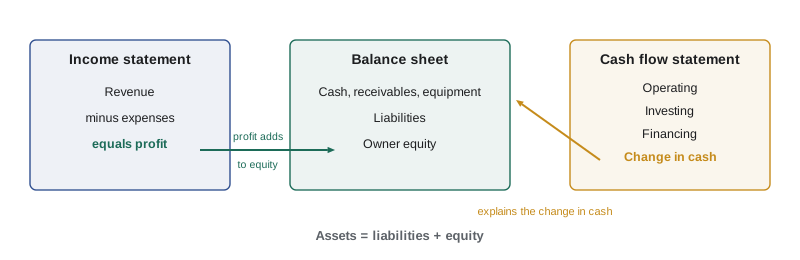
Profit and cash are not the same. A business can be profitable but short of cash if clients pay slowly, if it buys equipment, or if the owner withdraws heavily. It can also have plenty of cash in a loss-making month if a big deposit arrives for work not yet done. Watching both is essential.
Worked problem
Profit versus cash
In March, a creator completes and invoices $15,000 of brand work, of which $4,000 is paid in March and the rest in May. March expenses paid are $5,000, and the creator also buys a $3,000 computer. Ignoring depreciation of the computer, what is March accrual profit, and what is the change in cash?
Show solution
- Accrual profit: revenue earned $15,000 − expenses $5,000 = $10,000.
- Cash in: $4,000.
- Cash out: $5,000 + $3,000 = $8,000.
- Change in cash: $4,000 − $8,000 = −$4,000.
Answer: Profit is $10,000 but cash falls by $4,000. Without a cash reserve or forecast, a profitable month can still leave the creator unable to pay bills.
Key numbers to watch
- Gross margin on products: (sales − cost of goods sold) ÷ sales.
- Operating margin: operating profit ÷ revenue.
- Revenue concentration: the share of revenue from the largest client or platform. A share above about 30 % to 40 % is a risk.
- Cash runway: cash available ÷ monthly fixed costs, in months.
- DSO: how quickly clients pay (lesson 6).
Forecasting cash
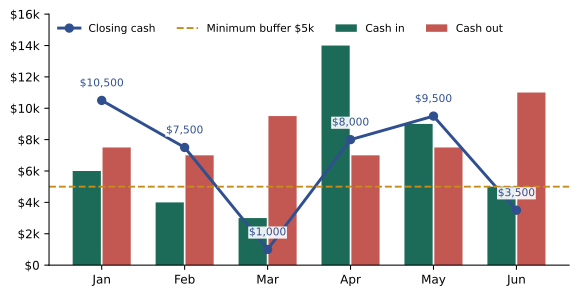
Creator income is lumpy: a large deal one month, nothing the next, and a busy fourth quarter when brands spend their holiday budgets. A cash forecast projects money in and out, month by month, so you can see shortfalls before they happen and plan around them.
| Month | Opening cash | Cash in | Cash out | Closing cash |
|---|---|---|---|---|
| January | $12,000 | $6,000 | $7,500 | $10,500 |
| February | $10,500 | $4,000 | $7,000 | $7,500 |
| March | $7,500 | $3,000 | $9,500 | $1,000 |
| April | $1,000 | $14,000 | $7,000 | $8,000 |
| May | $8,000 | $9,000 | $7,500 | $9,500 |
| June | $9,500 | $5,000 | $11,000 | $3,500 |
Worked problem
Using the forecast
The creator in the table wants to keep a minimum buffer of $5,000. In which months does closing cash fall below the buffer, by how much, and what actions could fix it?
Show solution
- March closing cash is $1,000, which is $4,000 below the buffer.
- June closing cash is $3,500, which is $1,500 below the buffer.
- Possible actions: ask for a deposit on an April deal, invoice faster, delay a planned purchase from March to April, set aside more money in January, or arrange a line of credit as a backstop.
Answer: March is $4,000 short and June $1,500 short. Spotting this months ahead lets the creator fix it calmly rather than in a panic.
A rule of thumb for creators is to hold a cash reserve of three to six months of fixed costs and personal living expenses, separate from money set aside for tax. Because sponsorship income can disappear quickly if a platform changes its algorithm or a recession cuts marketing budgets, many experienced creators aim for the higher end.
A small habit makes the monthly routine far easier: when you buy something for the business, photograph the receipt immediately and add a note about its purpose, such as "lens for client shoot, BrandCo campaign." Months later, that note is the difference between a confident deduction and a guess.
Common mistakes
MistakeDoing a year of bookkeeping in a panic before the tax deadline.
InsteadRecord, categorize and reconcile monthly.
MistakeDeducting personal clothing or meals because they appeared on camera.
InsteadDeduct only business-purpose costs, documented at the time.
MistakeTreating owner draws as business expenses.
InsteadRecord draws separately; sole proprietors are taxed on profit.
MistakeLooking only at profit.
InsteadWatch cash, receivables and runway too, and forecast monthly.
MistakeKeeping no cash reserve because income is good right now.
InsteadHold three to six months of fixed costs and living expenses.
Summary and key terms
- Good books need a separate account, a recording tool, a chart of accounts and a regular routine.
- Reconcile the books to the bank every month.
- Expenses must have a business purpose; mixed-use costs are deductible only for the business share.
- Capital assets can often be expensed immediately through the de minimis safe harbor, Section 179 or bonus depreciation.
- The income statement, balance sheet and cash flow statement fit together; profit and cash differ.
- Watch margins, revenue concentration, runway and DSO.
- A monthly cash forecast and a reserve of three to six months protect against lumpy income.
- Chart of accounts
- The list of categories used to classify transactions.
- Reconciliation
- Matching the books to bank statements.
- Owner draw
- Money a sole proprietor withdraws for personal use.
- Depreciation
- Spreading the cost of a capital asset over its useful life.
- Section 179
- An election to expense qualifying equipment immediately.
- Income statement
- A report of revenue, expenses and profit over a period.
- Balance sheet
- A report of assets, liabilities and equity at a point in time.
- Cash flow statement
- A report of cash movements over a period.
- Runway
- Months of fixed costs covered by available cash.
- Revenue concentration
- The share of revenue from the largest source.
Practice problems
Work each problem on paper first, then reveal the answer to check.
Assets $40,000 and liabilities $12,000. What is equity?
Show answer
$28,000.
Runway with $18,000 cash and $4,500 monthly fixed costs?
Show answer
4 months.
Merch sales $10,000, cost of goods $6,200. Gross margin?
Show answer
38 %.
Largest client $27,000 of $90,000 revenue. Concentration?
Show answer
30 %.
A phone bill of $1,200 with 60 % business use. Deductible amount?
Show answer
$720.
A $500 business meal is deductible up to?
Show answer
50 %, or $250.
Why reconcile monthly?
Show answer
To catch missing, duplicated or miscategorized transactions early.
Opening cash $5,000, cash in $8,000, cash out $9,500. Closing cash?
Show answer
$3,500.
Is an owner draw a deductible expense for a sole proprietor?
Show answer
No.
Name the three financial statements.
Show answer
Income statement, balance sheet, cash flow statement.
Lesson quiz · 5 questions
Score 60% or more to complete this lesson.
Create a free account to save your progress, take quizzes and earn a certificate.