
CRE-330 · Lesson 9 of 12 · 27 min
Income tax, self-employment tax and estimated payments
No employer withholds tax from a self-employed creator's income. Brands and platforms usually pay the full fee, and the creator is responsible for calculating, saving and paying federal income tax, self-employment tax and usually state income tax. The most common financial crisis for new creators is a large tax bill in April that they have not saved for, plus penalties for missing quarterly estimated payments. This lesson explains how creator income is taxed in the US, how self-employment tax and the qualified business income deduction work, how to estimate tax and set money aside, and how estimated payments and filing deadlines work. Figures are for 2026; confirm current amounts with the IRS or an accountant.
How creator income is taxed
A sole proprietor or single-member LLC owner reports business income and expenses on Schedule C and carries the net profit to Form 1040, along with any wages, investment or other income. Self-employment tax is calculated separately on Schedule SE. Adjustments such as half of self-employment tax, self-employed health insurance and retirement contributions reduce gross income to adjusted gross income (AGI). The standard deduction or itemized deductions, and the qualified business income (QBI) deduction, then reduce AGI to taxable income, on which progressive federal rates apply. All business income, including platform revenue, brand fees, affiliate commissions and the value of products received for content (lesson 10), is taxable whether or not you receive a Form 1099.
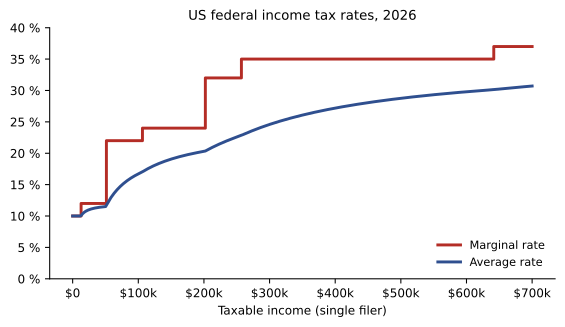
| 2026 taxable income (single) | Federal rate |
|---|---|
| Up to $12,400 | 10 % |
| $12,400 to $50,400 | 12 % |
| $50,400 to $105,700 | 22 % |
| $105,700 to $201,775 | 24 % |
| $201,775 to $256,225 | 32 % |
| $256,225 to $640,600 | 35 % |
| Over $640,600 | 37 % |
Two rates matter. The marginal rate is the rate on the next dollar of income; it is what you use to evaluate a deduction or an extra deal. The average or effective rate is total tax divided by income; it is what you use to estimate how much of your profit to set aside. Because rates are progressive, the effective rate is always lower than the top marginal rate you reach.
Self-employment tax
Employees and employers each pay half of Social Security and Medicare taxes. A self-employed person pays both halves through self-employment tax. It applies to net earnings from self-employment, which are 92.35 % of net profit, at 12.4 % for Social Security up to the 2026 wage base of $184,500 and 2.9 % for Medicare on all earnings, for a combined 15.3 % below the wage base. An additional 0.9 % Medicare tax applies to earnings above $200,000 for single filers ($250,000 married filing jointly). Self-employment tax applies if net earnings are $400 or more. Half of self-employment tax is deductible in computing AGI, which reduces income tax but not self-employment tax itself.
Self-employment tax is not lost money: it earns Social Security credits toward retirement, disability and survivor benefits, and Medicare eligibility. But it is a large cash cost, and creators must budget for it. Creators with low profit should note that it applies from the first dollar above $400, even when no income tax is owed.
The qualified business income deduction
The QBI deduction, under section 199A, lets owners of sole proprietorships, partnerships, S corporations and many LLCs deduct up to 20 % of their qualified business income, limited to 20 % of taxable income before the deduction. The One Big Beautiful Bill Act made it permanent and, from 2026, widened the income range over which limits phase in and added a minimum deduction of $400 for taxpayers with at least $1,000 of QBI from businesses in which they materially participate. Below a threshold of roughly $200,000 of taxable income for single filers (about $400,000 joint, indexed), most creators can take the full deduction. Above it, limits apply, and a specified service trade or business loses the deduction entirely at higher incomes. Importantly for creators, the regulations treat income from endorsing products, licensing one's name, image or likeness, and appearance fees as a specified service based on "reputation or skill." High-earning creators should get advice on how their income is classified.
Worked problem
Self-employment tax and QBI
A single creator has 2026 net profit of $70,000 and no other income. Calculate self-employment tax, the deduction for half of it, and the QBI deduction, assuming the standard deduction.
Show solution
- Net earnings from self-employment: 0.9235 × $70,000 = $64,645.
- SE tax: 15.3 % × $64,645 = $9,890.69.
- Deduction for half of SE tax: $4,945.34. AGI: $70,000 − $4,945.34 = $65,054.66.
- Taxable income before QBI: $65,054.66 − $16,100 = $48,954.66.
- QBI is profit less the SE tax deduction: $65,054.66; 20 % is $13,010.93. The limit is 20 % of $48,954.66 = $9,790.93, so the deduction is $9,790.93.
- Taxable income: $48,954.66 − $9,790.93 = $39,163.73.
Answer: SE tax is about $9,891, and taxable income falls to about $39,164 after the half-SE-tax deduction, the standard deduction and a QBI deduction of about $9,791.
Estimating your tax and setting money aside
The single most useful tax habit is to move a percentage of every payment into a separate savings account reserved for tax. The percentage should come from an estimate of your effective rate, including contributions, and be reviewed as the year progresses.
Worked problem
Estimating total tax and a set-aside rate
Continue the previous example: the creator has taxable income of $39,163.73 and SE tax of $9,890.69. Their state has a flat income tax of 4 % on AGI after a $5,000 exemption. Estimate federal income tax, total tax and a sensible set-aside percentage.
Show solution
- Federal income tax: 10 % × $12,400 = $1,240, plus 12 % × ($39,163.73 − $12,400) = 12 % × $26,763.73 = $3,211.65, total $4,451.65.
- State tax: 4 % × ($65,054.66 − $5,000) = 4 % × $60,054.66 ≈ $2,402.
- Total: SE tax $9,890.69 + federal $4,451.65 + state $2,402 ≈ $16,744.
- Effective rate: $16,744 ÷ $70,000 ≈ 23.9 %.
Answer: About $16,700, or 24 % of profit. Setting aside about 28 % to 30 % of each payment of profit gives a margin for error. In a state with no income tax, the figure would be lower; in a high-tax state, higher.
Notice that the set-aside percentage applies to profit, not gross revenue. A simple approach is to apply it to each payment after deducting the share that will go to expenses, or to apply a lower percentage to gross receipts if expenses are a stable share of revenue.
Estimated tax payments
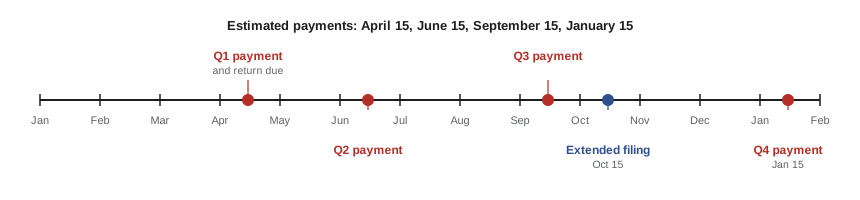
Because no tax is withheld, the IRS expects self-employed people to pay estimated tax during the year using Form 1040-ES if they expect to owe $1,000 or more for the year after withholding and credits. Estimated payments cover both income tax and self-employment tax. For 2026, payments are due on April 15, June 15 and September 15, 2026, and January 15, 2027, moved to the next business day when a date falls on a weekend or holiday. Most states with an income tax have similar quarterly requirements.
You avoid the underpayment penalty if your total withholding and timely estimated payments are at least the smaller of 90 % of this year's tax and 100 % of last year's tax, or 110 % of last year's tax if last year's AGI was above $150,000. These are the "safe harbor" rules. Paying a quarter of last year's tax each quarter is therefore a simple way to avoid penalties when income is rising, as long as you save the balance for April. The penalty is calculated like interest, at the federal short-term rate plus 3 percentage points, on each late or short payment for the time it is outstanding.
Worked problem
Estimated payments under the safe harbor
A creator's total 2025 federal tax, including SE tax, was $12,800, with AGI of $72,000. They expect 2026 federal tax of about $16,800. What quarterly payments avoid the federal underpayment penalty, and what will be due in April 2027?
Show solution
- Prior-year AGI is below $150,000, so the safe harbor is 100 % of last year's tax: $12,800.
- Quarterly payment: $12,800 ÷ 4 = $3,200.
- Total paid: $12,800, which is less than 90 % of $16,800 ($15,120) but meets the prior-year safe harbor.
- Balance due by April 15, 2027: $16,800 − $12,800 = $4,000.
Answer: $3,200 on each estimated payment date avoids the federal penalty, with about $4,000 due in April 2027. The creator should save that extra $4,000 during the year. State estimated payments are calculated separately.
Filing deadlines
The federal individual return and any balance are due April 15. An extension (Form 4868) gives until October 15 to file, but not to pay; interest and late-payment penalties apply to unpaid tax from April 15. The failure-to-file penalty is 5 % of unpaid tax per month, up to 25 %, and is much larger than the failure-to-pay penalty, so file on time even if you cannot pay in full and set up a payment plan. Partnerships and S corporations file by March 15 for calendar-year entities. Check your state's deadlines, which usually follow the federal ones.
Other taxes and situations to watch
- States: income tax rates range from zero in states such as Texas, Florida, Nevada, Washington and Wyoming to more than 10 % at the top in California. Moving states mid-year usually means filing part-year returns in both.
- Local taxes: some cities, such as New York City and Philadelphia, levy their own income or business taxes.
- Employees as well: if you have a job too, you can increase withholding on your Form W-4 to cover creator income instead of making estimated payments; withholding is treated as paid evenly through the year.
- Prizes, gifts and free trips received for content are usually income (lesson 10).
- Foreign income: US citizens and residents are taxed on worldwide income, with credits for foreign tax withheld.
After you file
After you file, the IRS may send notices if its records, such as Forms 1099, do not match your return. Respond promptly and keep your reconciliations. Keep your tax savings in a high-yield savings account or Treasury bills, so the money earns interest while it waits; the interest is taxable, but it is better than leaving the money idle. An IRS online account shows payments and balances.
Common mistakes
MistakeSpending the whole payment and hoping to deal with tax in April.
InsteadMove a set percentage of each payment into a separate tax account.
MistakeForgetting self-employment tax and budgeting only for income tax.
InsteadBudget about 14 % of profit for SE tax below the wage base, on top of income tax.
MistakeUsing the top marginal rate to estimate total tax, or the average rate to evaluate a deduction.
InsteadUse the effective rate for saving and the marginal rate for decisions.
MistakeSkipping estimated payments and paying everything in April.
InsteadPay at least the safe harbor amount each quarter.
MistakeFiling late because you cannot pay.
InsteadFile on time to avoid large late-filing penalties, and arrange a payment plan.
Summary and key terms
- Sole proprietors report on Schedule C and pay income tax at progressive rates plus self-employment tax.
- For 2026, federal rates run from 10 % to 37 %, and the single standard deduction is $16,100.
- Self-employment tax is 15.3 % on 92.35 % of profit up to the $184,500 wage base, and half is deductible.
- The QBI deduction of up to 20 % is permanent, but endorsement and likeness income can be a specified service.
- Use the effective rate to set aside money and the marginal rate to evaluate decisions.
- Estimated payments are due April 15, June 15, September 15 and January 15; safe harbors avoid penalties.
- Returns are due April 15; an extension delays filing, not payment.
- AGI
- Adjusted gross income: income after adjustments such as half of SE tax.
- Marginal rate
- The tax rate on the next dollar of income.
- Effective rate
- Total tax divided by income.
- Standard deduction
- A fixed deduction in place of itemizing: $16,100 single for 2026.
- Self-employment tax
- Social Security and Medicare tax on self-employment earnings.
- Wage base
- Earnings subject to Social Security tax: $184,500 for 2026.
- QBI deduction
- A deduction of up to 20 % of qualified business income.
- Specified service trade or business
- A business whose QBI deduction is limited at higher incomes.
- Estimated tax
- Quarterly prepayments of income and SE tax.
- Safe harbor
- A payment level that avoids the underpayment penalty.
Practice problems
Work each problem on paper first, then reveal the answer to check.
SE tax on $40,000 of net profit?
Show answer
15.3 % × 0.9235 × 40,000 ≈ $5,652.
Deduction for half of $5,652 of SE tax?
Show answer
$2,826.
Federal tax on $30,000 of taxable income (single)?
Show answer
1,240 + 12 % × 17,600 = $3,352.
QBI of $50,000 and taxable income before QBI of $30,000. QBI deduction?
Show answer
The lesser of $10,000 and $6,000: $6,000.
Safe harbor quarterly payment if last year's tax was $10,000 and AGI $90,000?
Show answer
$2,500.
Safe harbor if last year's AGI was $180,000 and tax $40,000?
Show answer
110 % × 40,000 = $44,000, or $11,000 a quarter.
Total tax $15,000 on $60,000 of profit. Effective rate?
Show answer
25 %.
Name the four estimated payment dates for 2026 income.
Show answer
April 15, June 15, September 15, January 15.
Does an extension give more time to pay?
Show answer
No; only to file.
What income can be a specified service for QBI?
Show answer
Endorsement, name, image or likeness licensing and appearance fees.
Lesson quiz · 5 questions
Score 60% or more to complete this lesson.
Create a free account to save your progress, take quizzes and earn a certificate.