
CRE-330 · Lesson 5 of 12 · 27 min
Reviewing, redlining and signing contracts
Knowing what contract clauses mean is only half the job. The other half is a reliable process for reviewing a draft, deciding what to change, proposing changes in a way the other side can accept, signing correctly and then managing the contract until it ends. CRE-310 covered the commercial side of negotiation: anchors, alternatives and trade-offs on price. This lesson focuses on the document itself: how to review it systematically, how to redline it, which positions to treat as red lines, when to bring in a lawyer, and how to keep track of obligations and deadlines after signing.
A systematic review process
A consistent process catches problems that a quick read misses. One effective approach has five passes.
- Pass 1, the deal check: compare the parties, fee, payment schedule, deliverables, dates and usage against what was agreed in negotiation. Mistakes here are common, often because the brand reused a template from another campaign.
- Pass 2, definitions: read every defined term and note how each changes the meaning of later clauses. A broad definition of "Content" or "Competitor" can expand obligations without anyone noticing.
- Pass 3, high-risk clauses: rights and licenses, exclusivity, morals, indemnity, limitation of liability, termination and payment conditions.
- Pass 4, boilerplate: governing law, dispute resolution, assignment, notices, confidentiality and survival.
- Pass 5, gaps: what is missing? Common omissions are a late-payment clause, a kill fee, a revision cap, deemed approval, a liability cap and a carve-out for existing partnerships.
Keep a checklist with your standard positions on each clause. Over time it becomes a playbook that makes every review faster and more consistent, and it is invaluable when a manager or assistant starts reviewing contracts for you.
Scoring risk
Not every problem is worth fighting over. A simple way to prioritize is to estimate, for each issue, the likelihood that it will cause a problem and the cost if it does. Multiplying the two gives an expected cost, which can be compared with the effort of negotiating a change.
Worked problem
Prioritizing contract issues
A creator reviewing a $6,000 agreement finds three issues. (1) Payment is net 90 instead of net 30; the creator estimates a 100 % chance of the delay and a cost of about $90 in extra interest on a line of credit. (2) A one-sided indemnity with no cap; the creator estimates a 2 % chance of a claim costing $40,000. (3) Exclusivity covers "beverages" instead of "energy drinks"; there is a 30 % chance this blocks a $5,000 deal with a juice brand. Rank the issues by expected cost.
Show solution
- Payment terms: 1.00 × $90 = $90.
- Indemnity: 0.02 × $40,000 = $800.
- Exclusivity: 0.30 × $5,000 = $1,500.
Answer: Exclusivity ($1,500) comes first, then the indemnity ($800), then payment terms ($90). The indemnity also carries a small chance of a catastrophic loss, so it deserves attention beyond its expected cost; payment terms matter more if cash is tight.
Expected cost is a guide, not a rule. Low-probability, high-impact risks such as uncapped indemnities can be ruinous, so many creators treat them as red lines regardless of the arithmetic.
Must-haves, nice-to-haves and red lines
Before proposing changes, sort your issues into three groups.
- Red lines: terms you will not accept under any circumstances, such as assigning your entire back catalog, an uncapped indemnity for the brand's own product claims, or permission to create AI replicas of your voice. If the brand will not move, you walk away.
- Must-haves: important changes you will push hard for but could trade, such as narrowing exclusivity or adding a kill fee.
- Nice-to-haves: improvements you will raise but concede readily, such as shorter payment terms or extra credit lines.
Writing these down before negotiating prevents you from conceding a must-have under time pressure and helps you trade nice-to-haves for must-haves.
| Clause | Typical brand draft | Creator counter-proposal | Priority |
|---|---|---|---|
| Ownership | Brand owns all content | Creator owns; brand gets a defined license | Red line or must-have |
| Usage | Perpetual, all media, worldwide | 6 months paid social in campaign markets; priced extensions | Must-have |
| Exclusivity | "Competitors," 6 months | Named competitors in one category, 60 days | Must-have |
| Indemnity | Creator indemnifies brand for all claims | Mutual; each covers its own materials; capped at fees | Red line if uncapped |
| Termination | Brand may terminate any time | Kill fee scaled to progress; mutual for cause | Must-have |
| Payment | Net 90 after campaign end | Net 30 from invoice; 50 % deposit | Nice-to-have or must-have |
| Revisions | Until brand is satisfied | 2 rounds; deemed approval after 3 business days | Must-have |
| AI | Silent, or broad modification rights | No synthetic use or training without consent and fee | Red line |
Redlining: how to propose changes
Redlining means marking proposed changes on the other side's draft so they can see exactly what you want. Word processors do this with tracked changes: deletions appear struck through and insertions underlined, usually in red. Comments explain the reasons.
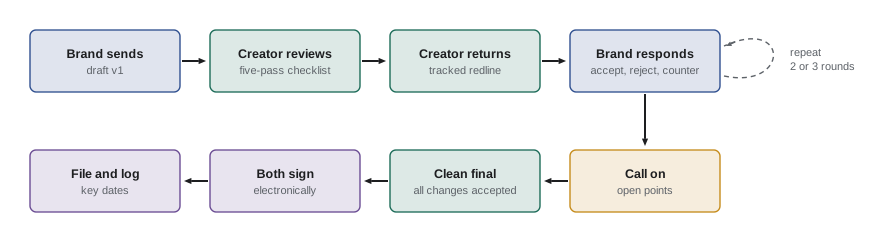
Good redlining practice:
- Always work on the latest version and name files clearly, for example "BrandCo Agreement v3 Creator redline 2026-04-02."
- Never make untracked changes. Changing text silently destroys trust and can lead to disputes about what was agreed.
- Explain the reason in a short, business-like comment: "Creator owns content created independently; we propose a 6-month paid license, which covers the campaign plan you shared."
- Offer specific replacement wording rather than just deleting clauses. Lawyers find it easier to accept language than objections.
- Group related changes and limit the number of asks to what matters; a draft covered in red signals that the deal will be hard work.
- When the other side responds, compare versions carefully. Document comparison tools reveal changes that were not tracked.
Brands sometimes say their template "cannot be changed." In practice, most templates can be changed for the right reasons, especially on commercial terms. If the legal department will not edit the template, ask for a short amendment or side letter that overrides specific clauses, signed at the same time.
Working with the other side's lawyers
Large brands and agencies have legal teams who review many creator contracts. They respond best to concise, reasoned requests that align with market practice. Phrases such as "this is standard for creator agreements" carry weight only if true, so build evidence: past agreements, industry templates and guidance from creator organizations. Stay polite and patient; legal teams often take several days per round, so start contract review early in the deal timeline. If a brand pushes you to post before a contract is signed, insist at least on a signed short-form agreement or an email confirming the key terms.
When to use a lawyer
Not every contract needs a lawyer, but some do. Consider legal review when:
- The deal is large relative to your income, such as a long-term ambassadorship.
- The contract asks for ownership of content, broad name and likeness rights, AI rights or long exclusivity.
- You are signing a management, agency or network agreement that will affect years of income.
- The contract includes unusual clauses you do not understand, or the other side refuses reasonable changes.
- A dispute is brewing.
Many lawyers offer flat-fee reviews for standard agreements, and some creator organizations provide templates or referral services. As with any professional fee, compare the cost with the value at risk.
Worked problem
Is legal review worth it?
A creator is offered a 12-month ambassadorship worth $48,000 that includes perpetual usage rights and a broad morals clause. A lawyer quotes a flat $1,200 to review and redline it. The creator estimates that negotiating the usage rights to 12 months would be worth at least $15,000 in future licensing value, with a 40 % chance of success, and that fixing the morals clause reduces a 5 % risk of losing $24,000 of remaining fees to near zero. Is the review worth it?
Show solution
- Expected value of better usage terms: 0.40 × $15,000 = $6,000.
- Expected value of the morals clause fix: 0.05 × $24,000 = $1,200.
- Total expected benefit: $6,000 + $1,200 = $7,200.
- Compare with the fee of $1,200, which is also a deductible business expense.
Answer: Yes. The expected benefit of about $7,200 is six times the fee, before counting the value of understanding the contract properly.
Standard-form and platform contracts
Some contracts cannot be negotiated: platform terms of service, partner program terms, marketplace agreements and many agency onboarding terms. You can still read them strategically. Focus on how you get paid and when payments can be withheld, what rights you grant the platform in your content, how accounts can be suspended, how disputes are resolved and how the terms can change.
US law offers limited protection against unfair standard terms. Courts can refuse to enforce unconscionable terms, usually requiring both procedural unfairness (such as hidden terms or no real choice) and substantive unfairness (terms that are unreasonably one-sided). Arbitration clauses and class action waivers in standard-form contracts are generally enforceable under the Federal Arbitration Act, following Supreme Court decisions such as AT&T Mobility v. Concepcion (2011) and Epic Systems v. Lewis (2018). Some platform terms let users opt out of arbitration within a short window after accepting, usually 30 days, by sending notice. These doctrines are a backstop, not a substitute for reading the terms.
Signing correctly
Before signing, confirm that the version you are signing is the final agreed text, with all changes accepted and no stray comments. Check that the correct legal entity is named, that the person signing for the brand has authority, and that any schedules or statements of work are attached. Electronic signature platforms create an audit trail and are widely accepted. Sign in your business name if the contract is with your company, for example "Maple Studio Inc., by Jordan Lee, President," so that it is clear you are signing for the company and not personally.
After signing, save the fully executed copy, with all signatures, in a contracts folder. A contract you cannot find is a contract you cannot enforce.
Managing contracts after signing
Most contract problems arise after signing, when deadlines and obligations are forgotten. A contract register, which can be a spreadsheet, tracks each agreement and its key dates.
| Field | Example |
|---|---|
| Counterparty and contract name | BrandCo, Spring Campaign SOW 3 |
| Fee and payment schedule | $6,000: 50 % on signing, 50 % net 30 after posting |
| Deliverables and due dates | 1 video, draft April 10, live April 20 to 25 |
| Usage expiry | October 25 (6 months paid social) |
| Exclusivity window | April 6 to June 24, energy drinks only |
| Renewal or notice dates | Auto-renews unless notice by September 1 |
| Invoices and payments | INV-2026-014 paid April 4; INV-2026-021 due |
| Notes | Brand legal contact; approval SLA 3 business days |
Set calendar reminders for usage expiry, exclusivity end dates and renewal notice deadlines. When usage expires, check whether the brand is still running your content; unpaid use after expiry is a breach you can invoice for. When an agreement auto-renews unless notice is given, missing the notice date can lock you into another term.
If something changes during a project, such as an extra deliverable or a new posting date, document it with a written change order or amendment that states the change and any additional fee. A friendly email confirming the change, accepted by the brand, is better than nothing, but follow the contract's amendment clause where possible.
If the other side breaches, start with a polite reminder, then a formal notice that refers to the clause, states the breach and sets a deadline for a cure. Keep records of every communication. Escalate to mediation, small claims or a lawyer only if needed, considering the cost, the relationship and the strength of your position.
Common mistakes
MistakeReading a contract once, quickly, the night before posting.
InsteadUse a five-pass review with a checklist, starting early in the deal.
MistakeFighting every clause with equal energy.
InsteadPrioritize by expected cost and protect red lines.
MistakeMaking untracked edits or deleting clauses without explanation.
InsteadTrack every change and propose specific wording with brief reasons.
MistakeSigning the wrong version or in your personal name for your company.
InsteadCheck the final text and sign on behalf of the correct entity.
MistakeForgetting usage expiry, exclusivity end and renewal notice dates.
InsteadKeep a contract register and calendar reminders.
Summary and key terms
- A five-pass review checks the deal, definitions, high-risk clauses, boilerplate and gaps.
- Expected cost (probability × impact) helps prioritize issues, but catastrophic risks deserve extra weight.
- Sort issues into red lines, must-haves and nice-to-haves before negotiating.
- Redline with tracked changes, clear version names, specific wording and brief reasons.
- Use a lawyer when the value at risk justifies the fee, especially for long-term or rights-heavy deals.
- Standard-form terms cannot be negotiated but should still be read for payment, rights, suspension and disputes.
- After signing, keep executed copies, a contract register, reminders and written change orders.
- Redline
- A marked-up draft showing proposed changes.
- Tracked changes
- A word-processor feature that records insertions and deletions.
- Playbook
- A set of standard positions on common clauses.
- Red line
- A term a party will not accept under any circumstances.
- Expected cost
- Probability multiplied by impact.
- Side letter
- A separate signed document that modifies a main agreement.
- Contract of adhesion
- A standard-form contract imposed by one party.
- Unconscionability
- A doctrine allowing courts to refuse grossly unfair terms.
- Contract register
- A record of contracts, obligations and key dates.
- Change order
- A written agreement to change scope, timing or fees.
Practice problems
Work each problem on paper first, then reveal the answer to check.
Expected cost of a 10 % chance of losing $8,000?
Show answer
$800.
Name the five review passes.
Show answer
Deal check, definitions, high-risk clauses, boilerplate, gaps.
Give two examples of red lines.
Show answer
Assigning the back catalog; uncapped indemnity; AI replicas without consent.
What should accompany a redlined deletion?
Show answer
Specific replacement wording and a brief reason.
A brand says its template cannot change. What can you propose?
Show answer
A side letter or amendment overriding specific clauses.
Expected benefit: 50 % chance of $4,000 plus 10 % chance of $10,000?
Show answer
$2,000 + $1,000 = $3,000.
Name four fields in a contract register.
Show answer
Counterparty, fee and schedule, deliverables, usage expiry, exclusivity, renewal dates.
How should you sign for your corporation?
Show answer
In the company's name, by you, with your title.
What should you do when usage expires but the ad is still running?
Show answer
Notify the brand and invoice or require removal.
What are the first two steps when a brand breaches?
Show answer
A polite reminder, then a formal notice with a cure deadline.
Lesson quiz · 5 questions
Score 60% or more to complete this lesson.
Create a free account to save your progress, take quizzes and earn a certificate.