
CRE-330 · Lesson 2 of 12 · 26 min
Sole proprietorship, LLC or S corporation in the US
The legal structure of a business decides who owns it, who is responsible for its debts, how its profit is taxed and how much paperwork it needs. Many creators start without choosing anything, which by default makes them sole proprietors. That is often the right place to start. The question is when, and whether, a different structure begins to pay for itself.
In the US the main choices are a sole proprietorship, a limited liability company (LLC), a partnership, an S corporation election and a C corporation. Most creators choose between a sole proprietorship, a single-member LLC and an LLC or corporation taxed as an S corporation. This lesson explains each option, how the choice changes tax, the costs and traps involved, and a method for deciding when to change.
The sole proprietorship
A sole proprietorship is simply an individual carrying on business. There is no separate legal entity: the business's income and expenses are reported on Schedule C with the owner's Form 1040, and net profit is subject to both income tax and self-employment tax on Schedule SE. Setup is cheap: you may need to file a DBA if you use a name other than your own, obtain any local business license, and get an EIN so clients do not need your Social Security number. Many creators operate this way for years.
The big disadvantage of a sole proprietorship is unlimited personal liability. If the business is sued or cannot pay its debts, creditors can pursue the owner's personal assets, such as savings, a car or a home. Insurance and careful contracts reduce this risk, but they do not remove it.
Limited liability companies
An LLC is a state-law entity that gives its owners, called members, protection from the business's debts and lawsuits, while allowing flexible tax treatment. By default, a single-member LLC is "disregarded" for federal income tax: its income still goes on the owner's Schedule C and is subject to self-employment tax, exactly as for a sole proprietor. A multi-member LLC is taxed by default as a partnership, filing Form 1065 and issuing Schedule K-1s to members. An LLC can also elect to be taxed as a corporation and then as an S corporation. Forming an LLC requires filing articles of organization with a state and paying fees, and many states charge annual fees or taxes; California, for example, imposes an $800 minimum annual franchise tax on most LLCs. A written operating agreement is strongly recommended, especially when there is more than one member.
An LLC's liability protection is not absolute. Courts can "pierce the veil" if the owner mixes personal and business money, ignores formalities or uses the LLC to commit fraud, and a member is always liable for their own wrongful acts, such as defamation in their own videos. Keeping separate accounts and signing contracts in the LLC's name are essential.
The S corporation election
An S corporation is not a type of entity but a federal tax election. An eligible corporation or LLC files Form 2553 with the IRS; it must be a domestic entity with no more than 100 shareholders, only one class of stock and only eligible shareholders such as US individuals. The S corporation files Form 1120-S each year and issues a Schedule K-1 to each owner, whose share of profit flows through to their personal return. The key difference for creators is how self-employment tax works. An owner who works in the business must be paid a reasonable salary through payroll, subject to Social Security and Medicare taxes withheld and matched by the company. Remaining profit can be distributed without those payroll taxes. That is where the potential savings come from.
The IRS expects the salary to be what the business would pay someone else to do the same work, considering duties, time, experience and market rates. Paying an unreasonably low salary to avoid payroll taxes invites the IRS to reclassify distributions as wages, with back taxes, interest and penalties. An S corporation also brings costs: payroll processing, quarterly payroll returns, state unemployment insurance, a separate tax return and often state-level taxes or fees. Some states and cities do not recognize S corporation status or tax it differently, so check your state before electing.
Comparing self-employment tax
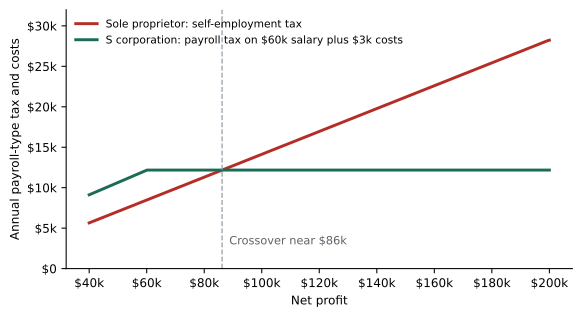
For a sole proprietor or single-member LLC, self-employment tax applies to 92.35 % of net earnings: 12.4 % for Social Security up to the annual wage base, which is $184,500 for 2026, and 2.9 % for Medicare on all earnings, plus an additional 0.9 % Medicare tax on earnings above $200,000 for single filers. Half of self-employment tax is deductible in computing income tax. With an S corporation, payroll taxes apply only to the salary; distributions avoid them. The difference can be significant once profit is well above a reasonable salary, but the extra costs and complexity eat into it at lower profit levels.
Worked problem
Estimating S corporation savings
A creator's single-member LLC has net profit of $120,000. They are considering an S corporation election with a reasonable salary of $60,000. Extra costs for payroll, the 1120-S return and state fees are about $3,000 a year. Ignoring the income tax effects of the deductible half of self-employment tax and of the employer payroll taxes, estimate the annual saving.
Show solution
- Sole proprietor self-employment tax: 0.9235 × $120,000 = $110,820; 15.3 % × $110,820 = $16,955.
- S corporation payroll taxes on a $60,000 salary: employee 7.65 % plus employer 7.65 % = 15.3 % × $60,000 = $9,180.
- Payroll-tax difference: $16,955 − $9,180 = $7,775.
- Less extra costs: $7,775 − $3,000 = $4,775.
- The S corporation may also slightly change the qualified business income deduction, because wages paid to the owner are not qualified business income.
Answer: About $4,800 a year before refinements. With profit of $60,000 the same salary would leave almost nothing to save after costs, which is why the election is usually considered only when profit is well above a reasonable salary.
Paying yourself from each structure
A sole proprietor or single-member LLC owner does not take a salary; they simply draw money from the business, and the draws are not deductible because tax is based on profit. An S corporation owner receives a salary through payroll with Form W-2, plus distributions of remaining profit reported on Schedule K-1. A partnership pays its members guaranteed payments and allocates profit. A C corporation pays salaries, which are deductible, and dividends, which are taxed twice: first at the 21 % corporate rate and again in the shareholder's hands. That double tax is why few creators choose a C corporation unless they plan to raise investment or retain large amounts in the business.
| Structure | Liability protection | Federal tax treatment | Self-employment or payroll tax | Typical extra cost |
|---|---|---|---|---|
| Sole proprietorship | None | Schedule C on Form 1040 | SE tax on all profit | Minimal |
| Single-member LLC | Yes, if respected | Disregarded: Schedule C | SE tax on all profit | State filing and annual fees |
| Multi-member LLC | Yes, if respected | Partnership: Form 1065, K-1s | SE tax on members' active shares | Partnership return |
| S corporation | Yes, if respected | Form 1120-S, K-1s | Payroll tax on salary only | Payroll, return, state taxes |
| C corporation | Yes | 21 % corporate tax plus dividend tax | Payroll tax on salary | Corporate return, double tax |
Liability: what a structure can and cannot do
An LLC or corporation protects owners from the entity's debts, but the protection has limits. Lenders and landlords often require personal guarantees. Responsible persons can be personally liable for unpaid payroll taxes through the trust fund recovery penalty. Courts can pierce the veil when owners ignore formalities or commingle funds. And everyone remains liable for their own wrongful acts: a creator who defames someone in a video can be sued personally even if an LLC published it. Insurance and good practices remain essential.
Traps to know about
- Unreasonable salary: paying an S corporation owner too little invites the IRS to reclassify distributions as wages.
- State rules: some states and cities tax LLCs or S corporations directly or ignore the S election, which can erase the federal savings.
- QBI effects: the 20 % qualified business income deduction is calculated differently for S corporation owners, and endorsement and likeness income can be treated as a specified service, limiting the deduction at higher incomes (lesson 9).
- Mixing funds: paying personal expenses from the business account, or business expenses personally without records, undermines both the liability shield and the tax filings.
- Moving assets: transferring an existing channel, equipment or trademarks into a new entity has tax and legal consequences and should be done with professional advice and proper documents.
Deciding when to change structure
A sensible decision process compares annual benefits with annual costs and considers non-tax factors:
- Estimate profit for the next two or three years and what a reasonable salary for your work would be.
- Estimate the payroll-tax saving from an S corporation election and any state-level effects.
- Subtract extra accounting, legal, payroll and government costs.
- Consider liability protection, how brands and platforms will pay the new entity, and the time needed to manage it.
- Ask a professional to check the estimate before acting, and revisit the decision every year.
A common rule of thumb is that an S corporation election becomes worth considering when net profit is comfortably above a reasonable salary plus the extra costs, often somewhere above $60,000 to $80,000 of profit, depending on the state. A single-member LLC can make sense earlier for liability and professionalism, with no change to federal tax.
Worked problem
A decision score
A creator rates a change of structure on four factors from 1 to 5, with weights: annual net financial benefit (40 %), liability protection (25 %), administrative burden where 5 means little burden (20 %), and fit with future plans (15 %). The scores are 4, 4, 2 and 5. Is the weighted score above their threshold of 3.5?
Show solution
- 0.40 × 4 = 1.60.
- 0.25 × 4 = 1.00.
- 0.20 × 2 = 0.40.
- 0.15 × 5 = 0.75.
- Total: 1.60 + 1.00 + 0.40 + 0.75 = 3.75.
Answer: The weighted score is 3.75, above 3.5, so the change is worth investigating with an accountant and a lawyer.
Making a change in practice
Changing structure is a project, not a single form. Before the change takes effect, plan the date, ideally the start of a month or year; open new bank accounts in the entity's name; update contracts, invoices and payment details with brands, platforms and agencies; transfer or license equipment, trademarks and the channel itself to the new entity with proper documents; set up payroll if needed; and tell your accountant early, because the first year after a change usually involves extra filings. Expect some clients to take a few weeks to update their vendor records, and keep the old account open until every payment has arrived.
Common mistakes
MistakeChanging structure because a friend did, without running the numbers.
InsteadCompare annual benefits with annual costs for your own profit and spending.
MistakePaying an S corporation owner an unreasonably low salary.
InsteadSet a defensible market salary and keep evidence of how it was chosen.
MistakeAssuming a company protects you from your own defamation or negligence.
InsteadKeep insurance and careful practices; personal wrongdoing stays personal.
MistakeRunning personal spending through the business account.
InsteadKeep funds separate to protect the liability shield and the books.
MistakeRunning a channel with a friend without a written agreement.
InsteadAgree on ownership, money, decisions and exits in writing.
Summary and key terms
- A sole proprietorship is simple and cheap but gives no liability protection; profit goes on Schedule C.
- A single-member LLC adds liability protection but is disregarded for federal income tax.
- Multi-member LLCs are taxed as partnerships by default and need operating agreements.
- An S corporation election lets owners pay payroll tax only on a reasonable salary, not on distributions.
- Self-employment tax is 15.3 % on 92.35 % of net earnings up to the $184,500 wage base for 2026.
- C corporations pay 21 % tax and dividends are taxed again, so few creators choose them.
- An S election is worth considering when profit is well above a reasonable salary plus the extra costs.
- Sole proprietorship
- An individual carrying on business with no separate entity.
- Schedule C
- The form for reporting sole proprietor profit or loss.
- LLC
- A limited liability company formed under state law.
- Disregarded entity
- An LLC ignored for federal income tax purposes.
- S corporation
- A corporation or LLC that has elected pass-through tax treatment under Subchapter S.
- Reasonable salary
- Market-rate pay an S corporation owner must take through payroll.
- Self-employment tax
- Social Security and Medicare tax on self-employment earnings.
- Wage base
- The maximum earnings subject to Social Security tax: $184,500 for 2026.
- Piercing the veil
- A court disregarding an entity to reach its owners.
- Operating agreement
- The contract among LLC members.
Practice problems
Work each problem on paper first, then reveal the answer to check.
SE tax on $80,000 of net profit (below the wage base)?
Show answer
0.9235 × 80,000 × 15.3 % ≈ $11,304.
What form makes an S corporation election?
Show answer
Form 2553.
What is the 2026 Social Security wage base?
Show answer
$184,500.
How is a single-member LLC taxed by default?
Show answer
As a disregarded entity on Schedule C.
Payroll tax on a $50,000 S corporation salary?
Show answer
15.3 % × 50,000 = $7,650.
Name two costs of an S corporation.
Show answer
Payroll processing, Form 1120-S, state taxes or fees.
What federal rate applies to C corporations?
Show answer
21 %.
What is piercing the veil?
Show answer
A court disregarding the entity to reach the owner's assets.
Weighted score: 0.5 × 4 + 0.3 × 3 + 0.2 × 5?
Show answer
3.9.
What document should LLC members sign?
Show answer
An operating agreement.
Lesson quiz · 5 questions
Score 60% or more to complete this lesson.
Create a free account to save your progress, take quizzes and earn a certificate.