
CHEM-263 · Lesson 11 of 12 · 25 min
Amines: basicity, preparation and reactions
▶ Video coming soon A video version of this lesson is on the way.
Amines are organic derivatives of ammonia in which one, two or three hydrogens are replaced by carbon groups. They are the principal organic bases. Amines are everywhere in biology: the amino acids that make proteins, the nucleotide bases of DNA and RNA, the vitamins thiamine and niacin, and many hormones and alkaloids, the nitrogen-containing compounds of plants such as caffeine and nicotine. In industry, amines are made on a large scale for polyurethanes, nylon, dyes, rubber chemicals, corrosion inhibitors and the scrubbing of carbon dioxide from gas streams. This lesson explains what controls the basicity of amines, how they are made by routes that avoid overalkylation, and their reactions as nucleophiles, including the diazonium chemistry of aromatic amines that underlies azo dyes. The examples are kept to simple teaching molecules and industrial intermediates.
Structure and classification
Amines are classified by the number of carbon groups on nitrogen: primary amines, RNH₂, have one; secondary amines, R₂NH, two; and tertiary amines, R₃N, three. Note that this differs from the classification of alcohols, which depends on the carbon bearing the OH. tert-Butylamine, (CH₃)₃CNH₂, is a primary amine. A nitrogen with four carbon groups carries a positive charge and is a quaternary ammonium ion, R₄N⁺. Simple amines are named with the suffix -amine: methylamine, diethylamine, propan-2-amine; the aromatic amine C₆H₅NH₂ is aniline. When other groups have higher priority, the NH₂ is named as an amino substituent.
The nitrogen of an alkylamine is sp³ hybridized and pyramidal, with bond angles near 108° and its lone pair in the fourth position. An amine with three different groups on nitrogen is therefore chiral in principle, but the two enantiomers interconvert rapidly by nitrogen inversion, which passes through a planar transition state with a barrier of only about 25 kJ/mol, as CHEM-261 lesson 6 noted. Such amines cannot be resolved. Quaternary ammonium ions with four different groups have no lone pair to invert and can be resolved.
Primary and secondary amines form hydrogen bonds, though weaker ones than alcohols because nitrogen is less electronegative: propan-1-amine boils at 48 °C, propan-1-ol at 97 °C and butane at −1 °C. Tertiary amines cannot donate hydrogen bonds and boil lower. Small amines are water-soluble. Many have unpleasant fishy or decaying smells; the odour of rotting fish comes from trimethylamine, and the descriptive names putrescine and cadaverine belong to diamines produced as proteins decay.
Basicity
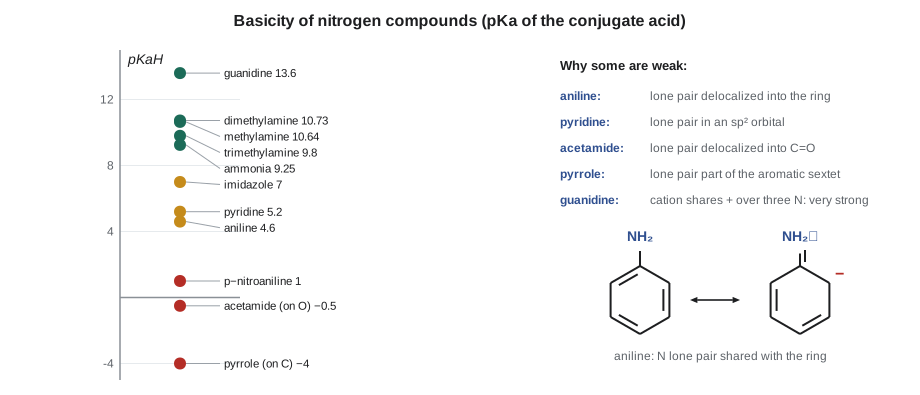
The lone pair on nitrogen makes amines bases. Their basicity is usually expressed by the pKa of the conjugate acid, the ammonium ion, written pKaH: the larger the pKaH, the stronger the base. Ammonia has pKaH 9.25. Alkylamines are somewhat stronger, about 10.6 to 10.8, because alkyl groups donate electron density and stabilize the positive ammonium ion. The order among primary, secondary and tertiary amines in water is not simple: dimethylamine (10.73) is a little stronger than methylamine (10.64), but trimethylamine (9.80) is weaker. In the gas phase the order is tertiary > secondary > primary, as inductive donation predicts; in water, the ammonium ions with more N–H bonds are better stabilized by hydrogen bonding to the solvent, which partly reverses the trend for tertiary amines. Solvation effects of this kind were met for alkoxides in lesson 5.
Delocalization of the lone pair lowers basicity dramatically. In aniline, the nitrogen lone pair is conjugated with the aromatic ring, and protonation would remove that delocalization; aniline's pKaH is 4.6, about a million times less basic than cyclohexylamine (10.6). Electron-withdrawing groups on the ring weaken it further: p-nitroaniline has a pKaH of 1.0. In amides the lone pair is delocalized into the carbonyl, and amides are not basic at nitrogen at all, as lesson 10 explained. Hybridization matters too: the lone pair of pyridine is in an sp² orbital, and its pKaH is 5.2; that of a nitrile is in an sp orbital, and nitriles are scarcely basic. When protonation would destroy aromaticity, as in pyrrole (lesson 3), basicity nearly disappears.
At the other extreme, some nitrogen compounds are much stronger bases than alkylamines because their conjugate acids are stabilized by resonance. Guanidine, (H₂N)₂C=NH, has a pKaH of about 13.6: its protonated form, the guanidinium ion, shares the positive charge equally over three nitrogens. The side chain of the amino acid arginine is a guanidine and is always protonated at physiological pH. Amidines such as DBU are strong, non-nucleophilic organic bases used in elimination reactions.
| Base | Conjugate acid pKaH | Main factor |
|---|---|---|
| Guanidine | about 13.6 | resonance-stabilized cation |
| Dimethylamine | 10.73 | alkyl donation, solvation |
| Methylamine | 10.64 | alkyl donation |
| Trimethylamine | 9.80 | alkyl donation, poorer solvation of the cation |
| Ammonia | 9.25 | reference |
| Imidazole | 7.0 | sp² lone pair, cation delocalized |
| Pyridine | 5.2 | sp² lone pair |
| Aniline | 4.6 | lone pair delocalized into the ring |
| p-Nitroaniline | 1.0 | delocalization plus withdrawing NO₂ |
| Acetamide | about −0.5 (on O) | lone pair delocalized into C=O |
| Pyrrole | about −4 (on C) | lone pair part of the aromatic sextet |
Separating amines by extraction
Basicity gives a simple way to separate amines from neutral compounds and acids. Amines dissolve in dilute aqueous hydrochloric acid as their ammonium salts, which are ionic and water-soluble; neutral organic compounds stay in the organic layer. Making the aqueous layer basic with sodium hydroxide converts the ammonium salt back to the free amine, which separates or can be extracted into an organic solvent. Combined with bicarbonate and hydroxide extractions for acids and phenols, this lets a mixture of an acid, a phenol, an amine and a neutral compound be separated into four fractions, a standard exercise in the teaching laboratory. Many amine medicines are sold as hydrochloride salts for the same reason: the salts are water-soluble and stable solids, while the free amines may be oily or volatile.
Making amines
The obvious route, SN2 alkylation of ammonia or an amine with an alkyl halide, works poorly for primary and secondary amines. The product amine is at least as nucleophilic as the starting one, so it competes for the alkyl halide, and the reaction gives a mixture of primary, secondary and tertiary amines and the quaternary ammonium salt. Overalkylation is useful only when the goal is the quaternary salt, made with excess alkyl halide, or when a large excess of ammonia is used to make a primary amine. Better routes control the number of carbon groups added.
The Gabriel synthesis, reported by Siegmund Gabriel in 1887, makes primary amines cleanly. Phthalimide, a cyclic imide whose N–H is acidic (pKa 8.3) because the nitrogen is flanked by two carbonyls, is deprotonated and alkylated once with a primary alkyl halide. The product cannot be alkylated again, because its nitrogen has no hydrogen left and its lone pair is delocalized into two carbonyls. Heating with hydrazine then releases the primary amine.
Reduction routes avoid overalkylation entirely. Nitriles, from cyanide and a primary halide, are reduced by LiAlH₄ or catalytic hydrogenation to primary amines with one more carbon, RCH₂NH₂. Amides are reduced by LiAlH₄ to amines with the same number of carbons, as lesson 10 described; a secondary amide gives a secondary amine, a tertiary amide a tertiary amine. Aromatic nitro compounds, made by nitration (lesson 4), are reduced to anilines by iron or tin with hydrochloric acid or by catalytic hydrogenation, the industrial route to aniline from nitrobenzene.
Reductive amination combines the imine formation of lesson 7 with reduction. An aldehyde or ketone and ammonia or an amine form an imine or iminium ion, which is reduced as it forms, by catalytic hydrogenation or by a mild hydride reagent such as sodium triacetoxyborohydride or sodium cyanoborohydride that reduces iminium ions faster than the carbonyl compound itself. Cyclohexanone and ammonia with hydrogen and a nickel catalyst give cyclohexylamine; cyclohexanone and dimethylamine give N,N-dimethylcyclohexylamine. Reductive amination is the most widely used method of making amines in industry and in living cells, where transaminase enzymes and the amino acid glutamate move amino groups between keto acids and amino acids through imines of pyridoxal phosphate.
| Route | Starting material | Product | Advantage |
|---|---|---|---|
| Direct alkylation | NH₃ or amine + RX | mixture | only for R₄N⁺ or with large excess of NH₃ |
| Gabriel synthesis | potassium phthalimide + RX, then N₂H₄ | RNH₂ | stops at one alkyl group |
| Nitrile reduction | RX + CN⁻, then LiAlH₄ | RCH₂NH₂ | adds one carbon |
| Amide reduction | RCONR′₂ + LiAlH₄ | RCH₂NR′₂ | any class of amine |
| Nitro reduction | ArNO₂ + Fe/HCl or H₂/Pd | ArNH₂ | route to anilines |
| Reductive amination | R₂C=O + amine + reductant | R₂CH–NR′₂ | one alkyl group at a time |
Reactions of amines
As nucleophiles, amines react with acid chlorides and anhydrides to give amides (lesson 10), with sulfonyl chlorides to give sulfonamides, with aldehydes and ketones to give imines and enamines (lesson 7) and with epoxides and alkyl halides by SN2. Acylating an aniline also tames its reactivity in electrophilic aromatic substitution. Aniline is so strongly activated that bromine water gives 2,4,6-tribromoaniline at once, and nitration oxidizes the ring. Converting it to acetanilide moderates the NH group: the amide nitrogen still directs ortho and para, but its lone pair is shared with the carbonyl, so monosubstitution is possible, and the bulky acetamido group favours para. Hydrolysis then returns the amino group.
Quaternary ammonium hydroxides undergo the Hofmann elimination on heating, described in CHEM-261 lesson 10. The bulky trialkylamine leaving group makes the E2 reaction remove a hydrogen from the least substituted β-carbon, so the least substituted alkene, the Hofmann product, dominates. August Wilhelm von Hofmann used the reaction, together with exhaustive methylation, to work out the structures of alkaloids in the nineteenth century.
Diazonium salts
Primary aromatic amines react with nitrous acid, made in the cold from sodium nitrite and hydrochloric acid, to form arenediazonium salts, ArN₂⁺ Cl⁻. The reaction, discovered by Peter Griess in 1858, passes through an N-nitrosoamine that loses water. Arenediazonium salts are stable in cold aqueous solution, but they are never isolated dry in the teaching laboratory, because dry diazonium salts can decompose violently; they are made at 0 to 5 °C and used at once. Their value is that N₂ is an excellent leaving group, and the diazonium group can be replaced by many others.
In the Sandmeyer reaction, discovered by Traugott Sandmeyer in 1884, copper(I) salts replace the diazonium group with Cl, Br or CN. Heating in water gives a phenol; potassium iodide gives an aryl iodide; fluoroboric acid followed by heating gives an aryl fluoride; and hypophosphorous acid replaces the group with hydrogen. Together with the directing effects of lesson 4, diazonium chemistry lets chemists place a substituent where electrophilic substitution could not. For example, 1,3,5-tribromobenzene, with three bromines meta to each other, is made by brominating aniline (the NH₂ directs all three bromines ortho and para to itself, which places them 1,3,5) and then removing the NH₂ through the diazonium salt with hypophosphorous acid.
Arenediazonium ions are also weak electrophiles. They attack strongly activated rings such as phenols and anilines, usually at the para position, in an azo coupling reaction that forms an azo compound, Ar–N=N–Ar′. The extended conjugation through the N=N bond makes azo compounds intensely coloured, and they are the largest class of synthetic dyes, used for textiles, inks and food. Methyl orange, a pH indicator from CHEM-211, is an azo dye that changes from red to yellow as its protonation state changes the conjugated system. Many common food colourings, such as tartrazine and Allura Red, are azo dyes, regulated by Health Canada.
Worked problem
Planning a synthesis through a diazonium salt
Show how to make m-bromochlorobenzene from benzene, given that Cl and Br are both ortho, para directors.
Show solution
- Neither halogen can direct the other meta, so use a meta director that can later be turned into a halogen.
- Nitrate benzene to nitrobenzene; brominate (Br₂, FeBr₃): the nitro group directs bromine meta, giving m-bromonitrobenzene.
- Reduce the nitro group to NH₂ (Fe, HCl, then base): m-bromoaniline.
- Diazotize (NaNO₂, HCl, 0 to 5 °C) and treat with CuCl (Sandmeyer): the diazonium group is replaced by Cl.
Answer: Nitration, bromination, reduction, diazotization and a Sandmeyer reaction with CuCl give 1-bromo-3-chlorobenzene.
Amines in industry and the environment
Hexane-1,6-diamine for nylon-6,6 and the aromatic diamines and diisocyanates for polyurethane foams are among the largest-volume amine products. Ethanolamines, from ammonia and ethylene oxide (lesson 6), absorb acidic gases: an aqueous amine solution captures carbon dioxide and hydrogen sulfide at low temperature as ammonium carbamates and bicarbonates and releases them on heating, regenerating the amine. This reversible acid–base chemistry is the basis of most carbon capture plants, including the Boundary Dam power station in Saskatchewan and the Quest project at Scotford, Alberta. Quaternary ammonium salts with long alkyl chains are disinfectants and fabric softeners.
A program: basicity and acid–base extraction
def fraction_protonated(pkah, ph):
    """Fraction of an amine present as the ammonium ion at a given pH."""
    return 1 / (1 + 10 ** (ph - pkah))

amines = {'cyclohexylamine': 10.6, 'trimethylamine': 9.80, 'ammonia': 9.25,
          'imidazole': 7.0, 'pyridine': 5.2, 'aniline': 4.6, 'p-nitroaniline': 1.0}
print(f'{"base":16s} pKaH   protonated at pH 1    pH 7.4    pH 13')
for name, pk in amines.items():
    print(f'{name:16s} {pk:5.2f}  {fraction_protonated(pk, 1):12.4f} {fraction_protonated(pk, 7.4):10.4f}'
          f' {fraction_protonated(pk, 13):9.2e}')

# separating a four-component mixture by extraction
mixture = {'benzoic acid': ('acid', 4.20), 'phenol': ('acid', 10.0),
           'aniline': ('base', 4.6), 'naphthalene': ('neutral', None)}
steps = [('5 per hundred NaHCO3', 8.3), ('5 per hundred NaOH', 13.0), ('5 per hundred HCl', 0.5)]
left = dict(mixture)
for reagent, ph in steps:
    moved = []
    for name, (kind, pk) in list(left.items()):
        if kind == 'acid' and ph - pk > 2:
            moved.append(name)
        if kind == 'base' and pk - ph > 2:
            moved.append(name)
    for m in moved:
        left.pop(m)
    print(f'extract with {reagent:20s} (pH {ph:4.1f}): into water -> {", ".join(moved) or "nothing"}')
print('left in the organic layer:', ', '.join(left))

# overalkylation: competition when the product amine is as reactive as the starting one
def alkylation_mixture(nh3_equiv, k_ratio=1.0, steps=4000):
    """Simple stepwise model with equal second-order rate constants (relative)."""
    a, p, s, t, q = nh3_equiv, 0.0, 0.0, 0.0, 0.0
    rx = 1.0; dt = 1.0 / steps
    for _ in range(steps * 20):
        r1, r2, r3, r4 = a * rx, k_ratio * p * rx, k_ratio * s * rx, k_ratio * t * rx
        a -= r1 * dt; p += (r1 - r2) * dt; s += (r2 - r3) * dt; t += (r3 - r4) * dt; q += r4 * dt
        rx -= (r1 + r2 + r3 + r4) * dt
        if rx < 1e-6:
            break
    tot = p + s + t + q
    return p / tot, s / tot, t / tot, q / tot

for eq in (1, 10):
    p, s, t, q = alkylation_mixture(eq)
print(f'NH3:RX = {eq:2d}:1 primary {p:.2f} secondary {s:.2f} tertiary {t:.2f} quaternary {q:.2f}')base pKaH protonated at pH 1 pH 7.4 pH 13 cyclohexylamine 10.60 1.0000 0.9994 3.97e-03 trimethylamine 9.80 1.0000 0.9960 6.31e-04 ammonia 9.25 1.0000 0.9861 1.78e-04 imidazole 7.00 1.0000 0.2847 1.00e-06 pyridine 5.20 0.9999 0.0063 1.58e-08 aniline 4.60 0.9997 0.0016 3.98e-09 p-nitroaniline 1.00 0.5000 0.0000 1.00e-12 extract with 5 per hundred NaHCO3 (pH 8.3): into water -> benzoic acid extract with 5 per hundred NaOH (pH 13.0): into water -> phenol extract with 5 per hundred HCl (pH 0.5): into water -> aniline left in the organic layer: naphthalene NH3:RX = 1:1 primary 0.58 secondary 0.29 tertiary 0.10 quaternary 0.03 NH3:RX = 10:1 primary 0.95 secondary 0.05 tertiary 0.00 quaternary 0.00
The extraction sequence separates the four components exactly as the pKa values predict: bicarbonate takes the carboxylic acid, hydroxide the phenol, and hydrochloric acid the aniline, leaving the neutral hydrocarbon. The overalkylation model shows why direct alkylation is a poor route to primary amines: with equal amounts of ammonia and alkyl halide, a large share of the product is overalkylated, and only a tenfold excess of ammonia makes the primary amine the main product.
Common mistakes
Mistaketert-Butylamine is a tertiary amine.
InsteadAmines are classified by the number of carbon groups on nitrogen; it has one, so it is primary.
MistakeAniline is about as basic as cyclohexylamine.
InsteadIts lone pair is delocalized into the ring; its pKaH is 4.6 against 10.6.
MistakeTertiary amines are always the most basic in water.
InsteadTrimethylamine (9.80) is weaker than dimethylamine (10.73) in water because its cation is less well solvated.
MistakeAlkylating ammonia with one equivalent of RX gives a clean primary amine.
InsteadThe product is as nucleophilic as ammonia, so mixtures form; use the Gabriel synthesis, a reduction or reductive amination.
MistakeChiral amines with three different groups can be resolved.
InsteadNitrogen inversion interconverts the enantiomers rapidly; quaternary ammonium ions can be resolved.
MistakeArenediazonium salts are stable solids to store.
InsteadThey are made cold and used in solution at once; dry salts can decompose violently.
Summary and key terms
- Amines are primary, secondary or tertiary by the number of carbon groups on nitrogen; the nitrogen is pyramidal and inverts rapidly.
- Alkylamines (pKaH about 10.6 to 10.8) are stronger bases than ammonia (9.25); delocalization (aniline 4.6, amides, pyrrole) and sp² hybridization (pyridine 5.2) weaken basicity; guanidine is very strong.
- Amines are separated from neutral compounds by extraction into aqueous acid and recovered with base.
- Direct alkylation overalkylates; the Gabriel synthesis, nitrile, amide and nitro reductions and reductive amination give controlled products.
- Amines are acylated to amides; acetylation moderates aniline in EAS; quaternary ammonium hydroxides undergo Hofmann elimination.
- Aromatic amines give diazonium salts, replaced by Cl, Br, CN, I, F, OH or H, and coupled with phenols and anilines to azo dyes.
- Amine
- A derivative of ammonia with one to three carbon groups on nitrogen.
- pKaH
- The pKa of the conjugate acid of a base; larger means a stronger base.
- Quaternary ammonium ion
- A nitrogen cation bearing four carbon groups, R₄N⁺.
- Gabriel synthesis
- Alkylation of phthalimide followed by release of a primary amine.
- Reductive amination
- Formation of an imine from a carbonyl compound and an amine, with reduction to an amine.
- Arenediazonium salt
- ArN₂⁺ X⁻, formed from an aromatic amine and nitrous acid.
- Azo coupling
- Electrophilic substitution of an activated ring by a diazonium ion, giving Ar–N=N–Ar′.
Practice problems
Work each problem on paper first, then reveal the answer to check.
Rank in order of increasing basicity: aniline, cyclohexylamine, pyridine, acetamide.
Show answer
Acetamide < aniline (4.6) < pyridine (5.2) < cyclohexylamine (10.6).
Propose two ways to make butan-1-amine without overalkylation.
Show answer
Gabriel synthesis with 1-bromobutane, then hydrazine; or propyl bromide with NaCN to butanenitrile, then LiAlH₄. Reductive amination of butanal with ammonia also works.
Give the product of cyclohexanone with methylamine and NaBH(OAc)₃.
Show answer
N-Methylcyclohexylamine, by reductive amination.
Why is aniline acetylated before nitration?
Show answer
Free aniline is oxidized by nitric acid and, protonated in the strong acid, becomes a meta director; acetanilide is moderately activating, gives mainly the para product and survives the conditions.
Show how to make m-chlorotoluene from toluene, using an amino group as a temporary director.
Show answer
Nitrate toluene and separate p-nitrotoluene; reduce to p-toluidine; acetylate; chlorinate (ortho to the acetamido group, meta to CH₃); hydrolyse; diazotize and remove the amino group with H₃PO₂.
At pH 7.4, what fraction of imidazole (pKaH 7.0) is protonated, and why does this matter for histidine in enzymes?
Show answer
1/(1 + 10^0.4) ≈ 0.28, so both the protonated and neutral forms are present, letting histidine act as either acid or base.
Lesson quiz · 5 questions
Score 60% or more to complete this lesson.
Create a free account to save your progress, take quizzes and earn a certificate.