
CHEM-263 · Lesson 2 of 12 · 26 min
Conjugation, resonance and dienes: the Diels–Alder reaction and UV-visible absorption
▶ Video coming soon A video version of this lesson is on the way.
When two double bonds are separated by exactly one single bond, as in buta-1,3-diene, CH₂=CH–CH=CH₂, the p orbitals on all four carbons line up side by side and overlap continuously. The π electrons are no longer confined to two separate bonds; they are delocalized over the whole system. Such double bonds are said to be conjugated. Conjugation lowers the energy of a molecule, changes its shape and bond lengths, makes new reactions possible, and shifts its light absorption to longer wavelengths. Extended conjugation is why carrots are orange, why tomatoes are red and why many dyes have colour. This lesson develops conjugation with resonance and with simple molecular orbital theory, then applies it to two reactions characteristic of dienes, 1,2- versus 1,4-addition and the Diels–Alder reaction, and to ultraviolet-visible spectroscopy.
Conjugated, isolated and cumulated dienes
Dienes are classified by the relationship between their double bonds. In a conjugated diene the double bonds alternate with one single bond, C=C–C=C. In an isolated diene, such as penta-1,4-diene, at least one sp³ carbon separates them, so their p orbitals cannot overlap and they behave as two independent alkenes. In a cumulated diene, or allene, the two double bonds share a carbon, C=C=C; the central carbon is sp hybridized and the two π bonds are perpendicular, so they are not conjugated either.
Heats of hydrogenation measure the extra stability of conjugation. Hydrogenating penta-1,4-diene to pentane releases 254 kJ/mol, almost exactly twice the value for pent-1-ene (126 kJ/mol). Hydrogenating (E)-penta-1,3-diene releases only 226 kJ/mol, although it ends at the same alkane. The conjugated diene is therefore about 28 kJ/mol more stable than expected for two isolated double bonds, part of which comes from conjugation and part from the more substituted double bond. For buta-1,3-diene the measured value is about 239 kJ/mol against 252 for twice but-1-ene, a stabilization of about 13 kJ/mol. These numbers are modest compared with the 150 kJ/mol aromatic stabilization of benzene in lesson 3, but they have real chemical consequences.
Conjugation also changes structure. The central C2–C3 bond of butadiene is 146 pm long, shorter than the 154 pm of a typical C–C single bond, partly because it joins two sp² carbons and partly because of partial double-bond character. Rotation about it is hindered: butadiene exists mainly in the s-trans conformation, with the double bonds on opposite sides of the central bond, in equilibrium with a few per hundred of the s-cis conformation, in which they point the same way. The letter s stands for the single bond. The s-cis form matters because it is the only one that can undergo the Diels–Alder reaction.
Resonance and molecular orbitals of butadiene
A resonance picture explains the partial double-bond character of the central bond: a minor contributor with a charge on each end carbon and a double bond in the middle. A molecular orbital picture is more informative. Combining four p orbitals gives four π molecular orbitals. In Hückel theory, a simple model that treats only the π electrons, each MO has energy E = α + xβ, where α is the energy of an isolated p electron and β, a negative quantity, measures the interaction between neighbouring p orbitals. For a linear chain of N carbons, the energies are given by
For butadiene, N = 4, and the four orbitals ψ₁ to ψ₄ have energies α + 1.618β, α + 0.618β, α − 0.618β and α − 1.618β. The four π electrons fill ψ₁ and ψ₂. The total π energy is 4α + 4.472β, compared with 4α + 4β for two isolated ethene π bonds, so Hückel theory predicts a delocalization energy of 0.472β. With β around −75 kJ/mol for this purpose, that is about 35 kJ/mol, larger than the measured stabilization, which is typical of this simple model. ψ₁ has no nodes and bonds across all three C–C links. ψ₂, the highest occupied molecular orbital (HOMO), has one node at the centre, bonding between C1 and C2 and between C3 and C4 but antibonding between C2 and C3. ψ₃, the lowest unoccupied molecular orbital (LUMO), has two nodes and is bonding between C2 and C3.
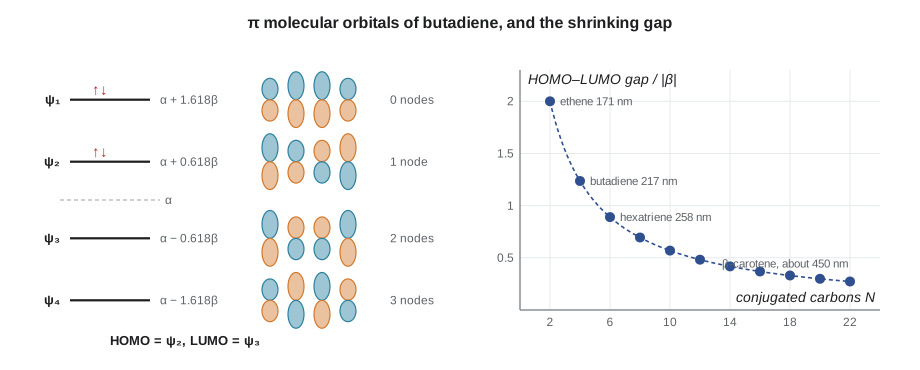
Two patterns from this model run through the rest of the course. First, the number of nodes increases by one with each orbital, and the lowest orbitals are bonding, the highest antibonding. Second, as the conjugated chain grows, the orbitals crowd closer together and the gap between HOMO and LUMO shrinks. Since absorbing a photon of light promotes an electron from the HOMO to the LUMO, longer conjugated systems absorb light of lower energy, that is, longer wavelength.
Addition to conjugated dienes: 1,2 and 1,4
Adding one equivalent of HBr to buta-1,3-diene gives two products: 3-bromobut-1-ene, from 1,2-addition, and 1-bromobut-2-ene, from 1,4-addition. Both come from the same intermediate. Protonation of C1 gives an allylic carbocation, CH₃–CH⁺–CH=CH₂ ↔ CH₃–CH=CH–CH₂⁺, whose positive charge is shared between C2 and C4 by resonance. Bromide can attack either end. Protonating C1 rather than C2 is preferred precisely because it gives this resonance-stabilized allylic cation.
The product ratio depends on temperature, a classic example of the kinetic and thermodynamic control introduced in CHEM-261 lesson 8. At −80 °C the reaction gives about 80 parts of the 1,2-product to 20 of the 1,4-product. At 40 °C the ratio is reversed, about 15 to 85. At low temperature the products do not interconvert, so the ratio reflects the rates of formation: bromide attacks C2, the carbon nearer to it in the ion pair and the one carrying more of the positive charge, faster. At higher temperature the addition becomes reversible, the products equilibrate through the carbocation, and the ratio reflects their stabilities: the 1,4-product, with a more substituted internal double bond, is more stable. Warming the low-temperature mixture converts it to the high-temperature mixture, which confirms the explanation.
Worked problem
Predicting kinetic and thermodynamic products
Buta-1,3-diene reacts with one equivalent of HCl. Predict the major product at −80 °C and at 40 °C, and explain why warming the cold product mixture changes it.
Show solution
- Protonate C1 to form the allylic cation; the charge is shared by C2 and C4.
- At low temperature, chloride attacks fastest at C2 (proximity in the ion pair, larger positive charge): 3-chlorobut-1-ene, the kinetic product.
- At higher temperature, the C–Cl bond ionizes back to the allylic cation and the system equilibrates.
- The more stable product has the disubstituted internal C=C: 1-chlorobut-2-ene, the thermodynamic product.
Answer: 3-Chlorobut-1-ene at −80 °C (kinetic), 1-chlorobut-2-ene at 40 °C (thermodynamic); warming allows re-ionization and equilibration.
The Diels–Alder reaction
In 1928 Otto Diels and Kurt Alder reported that conjugated dienes react with alkenes and alkynes to form six-membered rings. The diene supplies four carbons and the alkene, called the dienophile, supplies two. Three π bonds are broken and two new σ bonds and one new π bond are formed, all in a single step through a cyclic transition state. Diels and Alder shared the 1950 Nobel Prize in Chemistry. The reaction is the most important example of a pericyclic reaction, and it builds a ring with up to four new stereocentres in one step, which makes it one of the most powerful reactions in synthesis.
The simplest example, butadiene with ethene, gives cyclohexene but needs high temperature and pressure. The reaction is much faster when the dienophile carries electron-withdrawing groups such as C=O, CN or CO₂R. Butadiene and maleic anhydride react smoothly in warm xylene, and cyclopentadiene reacts with maleic anhydride at room temperature. In molecular orbital terms, the reaction is fastest when the HOMO of the diene and the LUMO of the dienophile are close in energy. Electron-withdrawing groups lower the dienophile's LUMO; electron-donating groups on the diene raise its HOMO. Both narrow the gap and speed the reaction.
The Diels–Alder reaction has strict structural requirements and gives predictable stereochemistry.
First, the diene must adopt the s-cis conformation, because only then are its ends close enough to bond to the dienophile. Dienes locked in s-cis, such as cyclopentadiene, are especially reactive; cyclopentadiene is so reactive that it dimerizes with itself on standing and must be freshly cracked by heating the dimer before use. Dienes that cannot reach s-cis, because bulky groups clash or because a ring holds them s-trans, do not react.
Second, the reaction is stereospecific. Both new bonds form on the same face of each component, a suprafacial addition, so the relative configuration of the dienophile is kept in the product. A cis-dienophile such as dimethyl maleate gives a product with its two ester groups cis on the new ring; the trans isomer, dimethyl fumarate, gives the trans product.
Third, when the diene is cyclic, the endo product is usually formed faster. In the endo transition state, the electron-withdrawing substituent of the dienophile points toward the diene's π system, under the forming ring, rather than away from it (exo). The endo rule, formulated by Alder, is usually explained by favourable secondary overlap between the p orbitals of the substituent's carbonyl and the central carbons of the diene. The endo product is often the less stable one, so it is a kinetic product, and at high temperature the exo product can come to dominate.
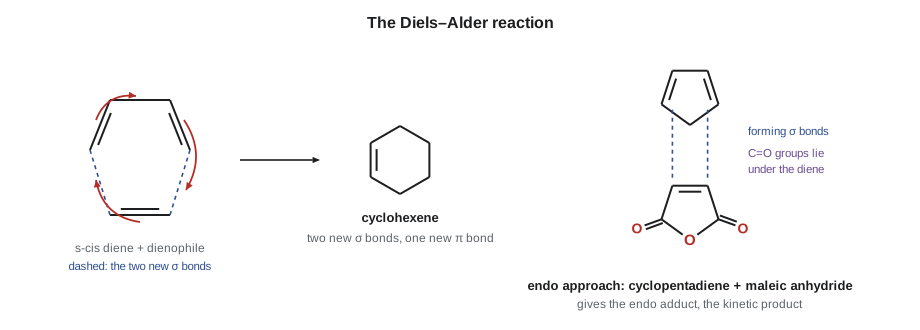
Fourth, the regiochemistry with unsymmetrical partners follows a simple pattern. A diene with a donor group at C1 and a dienophile with an acceptor group give mainly the 1,2 (ortho-like) product; a donor at C2 gives mainly the 1,4 (para-like) product. These preferences follow from the sizes of the HOMO and LUMO coefficients at the reacting atoms, and in practice you can predict them by drawing the charge-separated resonance forms of each partner and matching the electron-rich end of the diene with the electron-poor end of the dienophile.
The Diels–Alder reaction has a reverse, the retro-Diels–Alder reaction, favoured at high temperature because it increases the number of molecules and so the entropy. Cracking dicyclopentadiene is a retro-Diels–Alder reaction. Diels–Alder reactions are used in industry, for example to make some fragrance compounds and polymer building blocks, and in total synthesis of natural products. A related reaction class, the click reactions recognized by the 2022 Nobel Prize in Chemistry to Carolyn Bertozzi, Morten Meldal and Barry Sharpless, includes other cycloadditions that join molecules quickly and selectively, even inside living cells.
Ultraviolet-visible spectroscopy
Molecules with conjugated π systems absorb ultraviolet or visible light by promoting an electron from the HOMO to the LUMO, a π → π* transition. A UV-visible spectrometer passes light of each wavelength through a dilute solution and records the absorbance. The wavelength of maximum absorbance, λmax, measures the HOMO–LUMO gap, through E = hc/λ. The intensity follows the Beer–Lambert law, A = εcl, introduced in CHEM-211; ε, the molar absorptivity, is large for π → π* transitions, often 10,000 to 100,000 L mol⁻¹ cm⁻¹.
Conjugation shifts λmax to longer wavelengths. Ethene absorbs at 171 nm, buta-1,3-diene at 217 nm, hexa-1,3,5-triene at 258 nm and octa-1,3,5,7-tetraene at about 290 nm. With about eight conjugated double bonds absorption reaches the visible region. β-Carotene, with eleven conjugated double bonds, absorbs strongly at about 450 to 480 nm, the blue part of the spectrum, so it transmits and reflects the remaining light and looks orange. Lycopene, the red pigment of tomatoes, has eleven conjugated double bonds in an open chain plus two isolated ones and absorbs at slightly longer wavelength. The colour we see is the complementary colour of the light absorbed.
In the 1940s Robert Burns Woodward, and later Louis and Mary Fieser, collected empirical rules that predict λmax for conjugated dienes and enones from their structure. For dienes, start from a base value, 214 nm for an acyclic or heteroannular diene (the two double bonds in different rings) or 253 nm for a homoannular diene (both in one ring), and add 30 nm for each extra conjugated double bond, 5 nm for each alkyl substituent or ring residue on the diene carbons, and 5 nm for each double bond exocyclic to a ring. For α,β-unsaturated ketones, start from 215 nm and add 10 nm for an α-alkyl group, 12 nm for each β-alkyl group, 30 nm for each extra conjugated double bond and 5 nm for each exocyclic double bond. Predictions are usually within about 5 nm. Before nuclear magnetic resonance became routine, these rules were a powerful tool for deducing the structures of steroids and terpenes.
import math

def jacobi_eigs(a, sweeps=50):
    """Eigenvalues of a small symmetric matrix by the cyclic Jacobi method."""
    n = len(a); a = [row[:] for row in a]
    for _ in range(sweeps):
        off = sum(a[i][j] ** 2 for i in range(n) for j in range(n) if i != j)
        if off < 1e-20:
            break
        for p in range(n):
            for q in range(p + 1, n):
                if abs(a[p][q]) < 1e-15:
                    continue
                th = 0.5 * math.atan2(2 * a[p][q], a[q][q] - a[p][p])
                c, s = math.cos(th), math.sin(th)
                for k in range(n):
                    akp, akq = a[k][p], a[k][q]
                    a[k][p], a[k][q] = c * akp - s * akq, s * akp + c * akq
                for k in range(n):
                    apk, aqk = a[p][k], a[q][k]
                    a[p][k], a[q][k] = c * apk - s * aqk, s * apk + c * aqk
    return sorted(a[i][i] for i in range(n))

def chain(n):
    """Hückel matrix in units of beta for a linear polyene (x values)."""
    return [[1.0 if abs(i - j) == 1 else 0.0 for j in range(n)] for i in range(n)]

print('carbons  occupied x values (E = alpha + x beta)        HOMO-LUMO gap')
for n in (2, 4, 6, 8):
    x = sorted(jacobi_eigs(chain(n)), reverse=True)
    occ = x[: n // 2]
    gap = x[n // 2 - 1] - x[n // 2]
    print(f'{n:4d}     {", ".join(f"{v:.3f}" for v in occ):42s}  {gap:.3f} |beta|')

x = sorted(jacobi_eigs(chain(4)), reverse=True)
deloc = 2 * (x[0] + x[1]) - 4.0
print(f'butadiene delocalization energy: {deloc:.3f} beta')

def woodward_diene(homoannular, extra_db, alkyl, exocyclic):
    return (253 if homoannular else 214) + 30 * extra_db + 5 * alkyl + 5 * exocyclic

def woodward_enone(alpha_alkyl, beta_alkyl, extra_db, exocyclic):
    return 215 + 10 * alpha_alkyl + 12 * beta_alkyl + 30 * extra_db + 5 * exocyclic

print('predicted lambda max:')
print('  2,3-dimethylbuta-1,3-diene', woodward_diene(False, 0, 2, 0), 'nm (observed 226)')
print('  mesityl oxide (CH3)2C=CHCOCH3', woodward_enone(0, 2, 0, 0), 'nm (observed 237)')
print(' 3-methylcyclohex-2-enone', woodward_enone(0, 2, 0, 0), 'nm (observed 234)')carbons occupied x values (E = alpha + x beta) HOMO-LUMO gap 2 1.000 2.000 |beta| 4 1.618, 0.618 1.236 |beta| 6 1.802, 1.247, 0.445 0.890 |beta| 8 1.879, 1.532, 1.000, 0.347 0.695 |beta| butadiene delocalization energy: 0.472 beta predicted lambda max: 2,3-dimethylbuta-1,3-diene 224 nm (observed 226) mesityl oxide (CH3)2C=CHCOCH3 239 nm (observed 237) 3-methylcyclohex-2-enone 239 nm (observed 234)
The program reproduces the Hückel energies of the linear polyenes and the steady fall of the HOMO–LUMO gap: 2.000|β| for ethene, 1.236 for butadiene, 0.890 for hexatriene and 0.695 for octatetraene. In 3-methylcyclohex-2-enone the ring supplies one β-substituent (the ring residue) and the methyl a second, giving 239 nm against 234 observed. The rules are empirical, and their agreement within a few nanometres is good enough to distinguish between candidate structures.
Conjugation in pigments and dyes
Natural pigments rely on conjugation. Chlorophyll's extended ring absorbs red and blue light and reflects green. The retinal in your eye is a conjugated polyene attached to the protein opsin through an imine; absorbing a photon converts one of its cis double bonds to trans, the first step in vision, an example of a photochemical isomerization possible only because the π* state has a lower barrier to rotation. Synthetic dyes from the nineteenth century onward, beginning with William Perkin's mauveine in 1856, are extended conjugated aromatic systems, many of them azo compounds made from aromatic amines, which lesson 11 describes.
Common mistakes
MistakeAny diene is conjugated.
InsteadOnly dienes with alternating double and single bonds are; isolated and cumulated dienes are not.
MistakeThe Diels–Alder diene reacts in its s-trans conformation.
InsteadIt must be s-cis so that its ends can reach the dienophile.
MistakeThe 1,4-addition product always dominates.
InsteadIt dominates under thermodynamic control; at low temperature the 1,2-product forms faster.
MistakeEndo means the more stable product.
InsteadEndo describes the orientation of the dienophile substituent; the endo product is usually the kinetic, not the thermodynamic, product.
MistakeLonger conjugation absorbs at shorter wavelengths.
InsteadLonger conjugation narrows the HOMO–LUMO gap and shifts λmax to longer wavelengths.
MistakeA cis-dienophile can give a trans-substituted ring.
InsteadThe reaction is suprafacial and stereospecific: cis stays cis.
Summary and key terms
- Conjugated double bonds alternate with single bonds; their p orbitals overlap continuously and delocalize the π electrons.
- Conjugation stabilizes dienes by roughly 15 to 30 kJ/mol and shortens the central C–C bond.
- In Hückel theory, the π MOs of a linear chain have E = α + 2β cos(kπ/(N + 1)); the HOMO–LUMO gap shrinks as N grows.
- HX adds to dienes through an allylic cation: 1,2-addition under kinetic control, 1,4-addition under thermodynamic control.
- The Diels–Alder reaction is a concerted [4 + 2] cycloaddition of an s-cis diene and a dienophile; it is stereospecific and usually endo selective.
- UV-visible λmax increases with conjugation; Woodward–Fieser rules predict it for dienes and enones.
- Conjugation
- Continuous overlap of p orbitals across alternating multiple and single bonds.
- s-cis and s-trans
- Conformations of a diene about its central single bond, with the double bonds on the same or opposite sides.
- HOMO and LUMO
- The highest occupied and lowest unoccupied molecular orbitals.
- Allylic cation
- A carbocation next to a C=C, stabilized by resonance over three carbons.
- Diels–Alder reaction
- A concerted cycloaddition of a conjugated diene and a dienophile forming a six-membered ring.
- Endo rule
- The preference for the dienophile substituent to lie under the diene in the transition state.
- λmax
- The wavelength of maximum absorbance in a UV-visible spectrum.
Practice problems
Work each problem on paper first, then reveal the answer to check.
Predict the product of (E,E)-hexa-2,4-diene with dimethyl maleate, including the relative stereochemistry.
Show answer
A cyclohexene with methyl groups at C3 and C6 cis to each other (the E,E-diene's two outside groups) and the two ester groups at C4 and C5 cis to each other (from the cis-dienophile). In the endo product the outside groups of the diene and the endo groups of the dienophile end up on the same face, so all four substituents are cis.
Why does (Z)-penta-1,3-diene react much more slowly in Diels–Alder reactions than the E isomer?
Show answer
In the s-cis conformation of the Z isomer, the C4 methyl points into the space between the diene ends and clashes with the C1 hydrogen, so the reactive conformation is hard to reach.
Using Woodward–Fieser rules, predict λmax for 2-methylbuta-1,3-diene (isoprene).
Show answer
214 + 5 (one alkyl) = 219 nm; observed about 220 nm.
Calculate the Hückel HOMO–LUMO gap of hexatriene in units of β and explain why it absorbs at longer wavelength than butadiene.
Show answer
0.890|β| from the program, smaller than butadiene's 1.236|β|, so the photon needed has lower energy and longer wavelength.
Explain why HBr adds to buta-1,3-diene at C1 rather than C2.
Show answer
Protonating C1 gives a resonance-stabilized allylic secondary cation; protonating C2 gives a primary cation not conjugated with the other double bond.
Which partner in a fast Diels–Alder reaction should carry electron-withdrawing groups, and why?
Show answer
The dienophile: withdrawing groups lower its LUMO, bringing it closer to the diene's HOMO.
Lesson quiz · 5 questions
Score 60% or more to complete this lesson.
Create a free account to save your progress, take quizzes and earn a certificate.