
CHEM-263 · Lesson 6 of 12 · 28 min
Ethers, epoxides and sulfur analogues
▶ Video coming soon A video version of this lesson is on the way.
An ether has an oxygen atom bonded to two carbon groups, R–O–R′. Replace the hydrogen of an alcohol with a carbon group and you have an ether. The change removes the O–H bond, and with it most of the reactivity of alcohols: ethers do not donate hydrogen bonds, are not acidic and survive strong bases, Grignard reagents and hydride reagents. That chemical calm makes ethers excellent solvents. Diethyl ether and tetrahydrofuran (THF) are the standard solvents for Grignard and organolithium reactions, and 1,4-dioxane and 1,2-dimethoxyethane are common in the laboratory. Three-membered cyclic ethers, epoxides, are the exception: their ring strain makes them highly reactive electrophiles, and they are among the most useful intermediates in synthesis. This lesson also covers the sulfur analogues of alcohols and ethers, thiols and sulfides, whose chemistry differs from that of oxygen compounds in instructive ways.
Structure, properties and naming
The C–O–C bond angle of dimethyl ether is about 112°, close to tetrahedral, with two lone pairs on the oxygen. The C–O bonds are polar, so ethers have dipole moments, about 1.3 D for diethyl ether, but because they cannot donate hydrogen bonds to each other their boiling points are close to those of alkanes of similar mass: diethyl ether boils at 35 °C, pentane at 36 °C and butan-1-ol, an isomer of diethyl ether, at 118 °C. Ethers can accept hydrogen bonds from water, so small ethers are moderately soluble in water, about 7 g of diethyl ether per 100 mL. Their lone pairs also coordinate to metal ions, which is why ethers stabilize Grignard reagents: two ether molecules bind to each magnesium.
Simple ethers are named by listing the two groups and adding ether, as in ethyl methyl ether, or systematically as alkoxyalkanes, such as methoxyethane. Methoxybenzene is called anisole. Cyclic ethers have their own names: oxirane (ethylene oxide) for the three-membered ring, oxetane for four, oxolane or tetrahydrofuran (THF) for five, and oxane or tetrahydropyran for six. Epoxides are often named from the alkene they come from, for example cyclohexene oxide.
Making ethers
The Williamson ether synthesis, reported by Alexander Williamson in 1850 and met in CHEM-261 lesson 9, remains the general laboratory method. An alkoxide ion displaces a halide or sulfonate from an alkyl substrate by SN2. Because the substitution is SN2, the alkyl halide should be methyl or primary; secondary halides give mixtures with elimination, and tertiary halides give only alkenes. To make an unsymmetrical ether, therefore, choose the disconnection that puts the more hindered group on the alkoxide. For tert-butyl methyl ether, use potassium tert-butoxide with iodomethane, not sodium methoxide with tert-butyl bromide, which gives 2-methylpropene by E2.
Phenyl ethers are made the same way from phenoxide ions, which form easily from phenols with sodium hydroxide because phenols are acidic. Anisole is made from sodium phenoxide and dimethyl sulfate or iodomethane. The reverse disconnection, an alkoxide attacking an aryl halide, does not work, because aryl halides do not undergo SN2.
Alkenes can be converted to ethers by alkoxymercuration–demercuration, which gives Markovnikov ethers without rearrangement, and acid-catalysed addition of alcohols to alkenes gives tert-alkyl ethers through a tertiary carbocation. The fuel additive methyl tert-butyl ether, MTBE, was made on a huge scale this way from methanol and 2-methylpropene. Because MTBE is water-soluble and leaks from fuel tanks contaminated groundwater, it was phased out across the United States in the 2000s and largely abandoned in Canada as well; ethanol replaced it as the main oxygenate in gasoline. Symmetrical primary ethers form when primary alcohols are heated with acid: the industrial route to diethyl ether is the acid-catalysed dehydration of ethanol at about 140 °C, which competes with elimination to ethene at higher temperatures.
Worked problem
Choosing a Williamson disconnection
Plan Williamson syntheses of (a) benzyl ethyl ether, C₆H₅CH₂OCH₂CH₃; (b) cyclohexyl methyl ether; (c) tert-butyl ethyl ether.
Show solution
- (a) Both groups are primary; either works. Sodium ethoxide with benzyl bromide is ideal because benzylic halides are excellent SN2 substrates.
- (b) The cyclohexyl carbon is secondary, so put it on the oxygen: sodium cyclohexoxide (from cyclohexanol and NaH) with iodomethane.
- (c) The tert-butyl group must be the alkoxide: potassium tert-butoxide with bromoethane. Ethoxide with tert-butyl bromide would give only 2-methylpropene.
Answer: (a) NaOEt + C₆H₅CH₂Br; (b) C₆H₁₁ONa + CH₃I; (c) (CH₃)₃COK + CH₃CH₂Br.
Reactions of ethers: cleavage by strong acid
Ethers are cleaved only under harsh conditions, by hot concentrated HBr or HI. The acid protonates the oxygen, making an alcohol a good leaving group, and halide attacks. With methyl or primary groups the attack is SN2 at the less hindered carbon; with tertiary groups the C–O bond ionizes to a carbocation first (SN1). Excess acid converts the alcohol produced into a second alkyl halide. Aryl alkyl ethers always cleave at the alkyl–oxygen bond, giving a phenol and an alkyl halide, because halide cannot attack an sp² aromatic carbon. HCl is generally too weak a nucleophile to cleave ethers.
Peroxides: a safety note
Ethers with hydrogens on the carbon next to oxygen, including diethyl ether, THF and diisopropyl ether, slowly react with oxygen in air, in a radical chain reaction promoted by light, to form hydroperoxides. These accumulate when ethers are stored for long periods in opened containers and can explode when the ether is distilled or evaporated, because the peroxides are concentrated in the residue. Commercial ethers contain a radical inhibitor such as BHT, and laboratory practice is to date containers when opened, test old ethers for peroxides before use, never distil them to dryness and dispose of expired stock according to institutional rules. This is a good example of how understanding a mechanism, here radical autoxidation at the weak C–H bond next to oxygen, leads directly to a safety rule.
Crown ethers
In 1967 Charles Pedersen, a chemist at DuPont, discovered that large cyclic polyethers bind metal cations tightly. 18-Crown-6, a ring of eighteen atoms including six oxygens, fits the potassium ion; 15-crown-5 fits sodium and 12-crown-4 fits lithium. The cation sits in the centre, held by the inward-pointing oxygen lone pairs, while the hydrocarbon exterior makes the complex soluble in nonpolar solvents. Potassium permanganate dissolved in benzene with 18-crown-6, purple benzene, is a powerful oxidant, and potassium fluoride with the crown ether becomes a source of reactive, unsolvated fluoride. Pedersen shared the 1987 Nobel Prize with Donald Cram and Jean-Marie Lehn, who extended the idea to host–guest and supramolecular chemistry. Natural antibiotics such as valinomycin transport potassium ions across membranes in the same way.
Epoxides
An epoxide is a three-membered ring containing an oxygen. Its bond angles are close to 60°, far from the 109.5° of sp³ atoms, so the ring carries about 110 kJ/mol of strain energy, similar to cyclopropane. Opening the ring releases that strain. As a result, epoxides react with nucleophiles under mild conditions, while ordinary ethers do not react at all.
Epoxides are made in two main ways. Peroxyacids such as meta-chloroperoxybenzoic acid (mCPBA) transfer an oxygen atom to an alkene in one concerted step, a syn addition that keeps the alkene's stereochemistry, as CHEM-261 lesson 12 described. Halohydrins, made from alkenes with bromine or chlorine in water, close to epoxides when treated with base: the alkoxide formed by deprotonating the OH displaces the neighbouring halide by an intramolecular SN2 reaction, which requires the O⁻ and the halide to be anti to each other. Industrially, ethylene oxide is made by oxidizing ethene with oxygen over a silver catalyst, more than 30 million tonnes a year, and propylene oxide by oxidizing propene with hydroperoxides or hydrogen peroxide.
Ring opening: regiochemistry and stereochemistry
The direction in which an unsymmetrical epoxide opens depends on whether the conditions are basic or acidic.
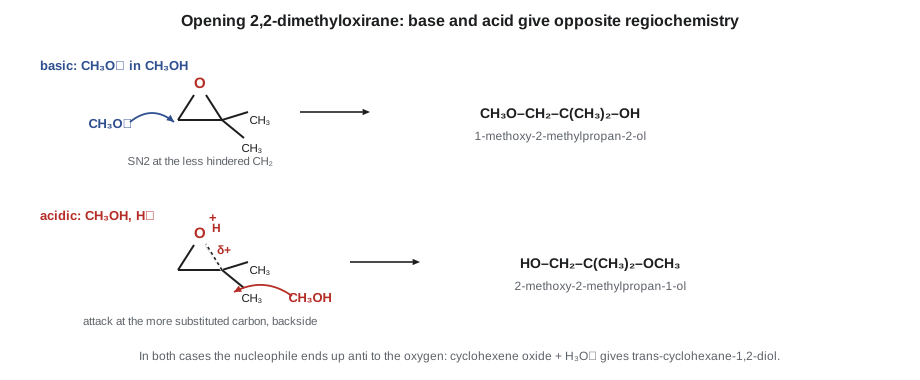
Under basic or neutral conditions, with a strong nucleophile such as hydroxide, an alkoxide, cyanide, an amine, a Grignard reagent or hydride from LiAlH₄, the epoxide opens by SN2. The nucleophile attacks the less hindered carbon, from the side opposite the oxygen, with inversion of configuration there. The alkoxide that results is protonated in the workup. For 2,2-dimethyloxirane with sodium methoxide, methoxide attacks the CH₂ carbon, giving 1-methoxy-2-methylpropan-2-ol.
Under acidic conditions the oxygen is protonated first, making a good leaving group and weakening the C–O bonds. The bond to the more substituted carbon is weakened most, because that carbon can best carry a partial positive charge, so a weak nucleophile such as water or methanol attacks the more substituted carbon. The reaction is not a full SN1: no free carbocation forms, the nucleophile still attacks from the back side, and inversion still occurs. It is best described as SN2-like with a transition state of considerable carbocation character. For 2,2-dimethyloxirane in methanol with acid, methanol attacks the tertiary carbon, giving 2-methoxy-2-methylpropan-1-ol, the opposite regiochemistry from the basic reaction.
In both cases the nucleophile and the oxygen end up anti to each other. Cyclohexene oxide opened by aqueous acid gives trans-cyclohexane-1,2-diol, the complement to the cis-diol made by osmium tetroxide in CHEM-261 lesson 12. Comparing the two is a classic way to set relative stereochemistry.
Epoxide opening is important industrially and biologically. Ethylene oxide reacts with water to give ethylene glycol, used in antifreeze and as a monomer of polyester, and with ammonia to give the ethanolamines used to scrub carbon dioxide and hydrogen sulfide from natural gas. Epoxy resins are made by reacting bisphenol A with epichlorohydrin to give a resin with epoxide end groups, which is cured by an amine hardener that opens the epoxides and cross-links the chains, the chemistry in two-part epoxy glues. In the body, liver enzymes oxidize some aromatic compounds to epoxides, usually as part of detoxification; the epoxides are then opened by water or by glutathione. For a few compounds, such as the benzo[a]pyrene of lesson 3, the epoxide reacts with DNA instead, which is the origin of their carcinogenicity.
Worked problem
Predicting epoxide opening
Predict the product of (R)-2-methyloxirane (propylene oxide) with (a) sodium ethoxide in ethanol, (b) ethanol with a trace of H₂SO₄, (c) methylmagnesium bromide followed by H₃O⁺.
Show solution
- (a) Basic, strong nucleophile: SN2 at the less hindered CH₂. Product: 1-ethoxypropan-2-ol, with the stereocentre untouched, still (R) in configuration.
- (b) Acidic, weak nucleophile: attack at the more substituted secondary carbon, with inversion. Product: 2-ethoxypropan-1-ol, now (S) by inversion at the stereocentre.
- (c) The Grignard reagent attacks the less hindered CH₂. Product after workup: butan-2-ol, the configuration of the original stereocentre retained.
- For a monosubstituted epoxide such as propylene oxide the acid regioselectivity is less complete than for a 2,2-disubstituted one, because a secondary carbon carries positive charge less well than a tertiary carbon, so mixtures can form.
Answer: (a) 1-Ethoxypropan-2-ol; (b) mainly 2-ethoxypropan-1-ol with inversion; (c) butan-2-ol.
Thiols and sulfides
Sulfur sits below oxygen in the periodic table, and its compounds parallel those of oxygen with important differences. Thiols, R–SH, are the sulfur analogues of alcohols, also called mercaptans because they bind mercury. Sulfides, R–S–R′, are the analogues of ethers, also called thioethers.
Thiols are more acidic than alcohols. Ethanethiol has a pKa of about 10.6, compared with 16 for ethanol, because the S–H bond is weaker and the larger sulfur atom spreads the negative charge of the thiolate over a bigger volume. Thiols are therefore deprotonated by hydroxide. Thiolates, RS⁻, are excellent nucleophiles but relatively weak bases, so they give clean SN2 substitution even on secondary halides with little elimination. Sulfides are made by reacting thiolates with alkyl halides, the sulfur version of the Williamson synthesis.
Thiol hydrogen bonds are weak, so thiols boil lower than alcohols of similar mass: methanethiol boils at 6 °C, methanol at 65 °C. Their most famous property is smell. Low-molecular-mass thiols have powerful, unpleasant odours detectable at extraordinarily low concentrations. Natural gas, which is odourless, is deliberately mixed with small amounts of thiols such as tert-butylthiol or ethanethiol so that leaks can be detected; Canadian distribution utilities odorize gas at a level designed to be noticed long before it could burn. Skunk spray contains thiols such as (E)-but-2-ene-1-thiol and 3-methylbutane-1-thiol, and the smell of garlic and onions comes from sulfides and disulfides formed when their tissues are cut.
Thiols are oxidized easily, by mild oxidants such as iodine or even air, to disulfides, R–S–S–R, and disulfides are reduced back to thiols. In proteins, the thiol side chains of two cysteine residues can join in a disulfide bridge, which cross-links the chain and fixes its folded shape. Hair is rich in disulfide bridges; a permanent wave reduces them, reshapes the hair and reoxidizes them in the new arrangement. The tripeptide glutathione, which contains cysteine, is the cell's main thiol reductant and protects against oxidative damage.
Sulfides are oxidized to sulfoxides, R₂S=O, and then to sulfones, R₂SO₂. Dimethyl sulfoxide, DMSO, is a widely used polar aprotic solvent, the solvent of many SN2 reactions in CHEM-261, and the oxidant in the Swern oxidation of lesson 5. Sulfur can also form sulfonium ions, R₃S⁺, which are good alkylating agents; in cells, S-adenosylmethionine (SAM), a sulfonium ion, transfers methyl groups to DNA, proteins and small molecules, an SN2 reaction carried out by enzymes. The sulfa drugs of the 1930s and modern sulfonamides contain sulfonyl groups.
| Property | Oxygen compound | Sulfur compound |
|---|---|---|
| Acidity of R–XH | ethanol pKa 16 | ethanethiol pKa 10.6 |
| Boiling point | methanol 65 °C | methanethiol 6 °C |
| Nucleophilicity of RX⁻ | good | excellent, and less basic |
| Oxidation | alcohols → C=O compounds | thiols → disulfides; sulfides → sulfoxides → sulfones |
| Smell | mild | very strong at low concentration |
A program: regiochemistry of epoxide opening and thiol ionization
def epoxide_opening(c1, c2, conditions):
    """Predict which carbon a nucleophile attacks.
    c1, c2: number of carbon substituents on each ring carbon (0 to 2).
    Basic: SN2 at the less substituted carbon.
    Acidic: attack at the more substituted carbon if it can carry positive charge
    (tertiary, or benzylic/allylic flagged as 3); a mixture if both are equal or only secondary."""
    if conditions == 'basic':
        if c1 == c2:
            return 'either carbon (symmetrical)'
        return 'C1' if c1 < c2 else 'C2'
    hi = max(c1, c2)
    if c1 == c2:
        return 'either carbon (symmetrical)'
    if hi >= 2:
        return 'C1' if c1 > c2 else 'C2'
    return 'mainly the more substituted carbon, with some mixture'

cases = [('2,2-dimethyloxirane (C1=CH2, C2=CMe2)', 0, 2),
         ('2-methyloxirane (C1=CH2, C2=CHMe)', 0, 1),
         ('2,3-dimethyloxirane', 1, 1)]
for name, a, b in cases:
    print(name)
    for cond in ('basic', 'acidic'):
        print(f'   {cond:6s}: nucleophile attacks {epoxide_opening(a, b, cond)}')

def fraction_ionized(pka, ph):
    return 1 / (1 + 10 ** (pka - ph))

for name, pka in (('ethanol', 16.0), ('ethanethiol', 10.6), ('cysteine side-chain thiol', 8.3), ('phenol', 10.0)):
    print(f'{name:26s} pKa {pka:5.1f}: ionized at pH 7.4 = {fraction_ionized(pka, 7.4):.2e}')

def williamson(alkoxide_carbon, halide_carbon):
    """Rate the two disconnections of an ether R-O-R' by the halide's class."""
    risk = {'methyl': 'SN2, good', 'primary': 'SN2, good', 'secondary': 'SN2 with E2 competition',
            'tertiary': 'E2 only, fails', 'aryl': 'no SN2, fails'}
    return risk[halide_carbon]

for ether, groups in (('tert-butyl methyl ether', ('tertiary', 'methyl')),
                      ('cyclohexyl methyl ether', ('secondary', 'methyl')),
                      ('anisole (phenyl methyl ether)', ('aryl', 'methyl'))):
    g1, g2 = groups
print(f'{ether}: {g1}-O(-) + {g2}-X -> {williamson(g1, g2)}; {g2}-O(-) + {g1}-X -> {williamson(g2, g1)}')2,2-dimethyloxirane (C1=CH2, C2=CMe2) basic : nucleophile attacks C1 acidic: nucleophile attacks C2 2-methyloxirane (C1=CH2, C2=CHMe) basic : nucleophile attacks C1 acidic: nucleophile attacks mainly the more substituted carbon, with some mixture 2,3-dimethyloxirane basic : nucleophile attacks either carbon (symmetrical) acidic: nucleophile attacks either carbon (symmetrical) ethanol pKa 16.0: ionized at pH 7.4 = 2.51e-09 ethanethiol pKa 10.6: ionized at pH 7.4 = 6.31e-04 cysteine side-chain thiol pKa 8.3: ionized at pH 7.4 = 1.12e-01 phenol pKa 10.0: ionized at pH 7.4 = 2.51e-03 tert-butyl methyl ether: tertiary-O(-) + methyl-X -> SN2, good; methyl-O(-) + tertiary-X -> E2 only, fails cyclohexyl methyl ether: secondary-O(-) + methyl-X -> SN2, good; methyl-O(-) + secondary-X -> SN2 with E2 competition anisole (phenyl methyl ether): aryl-O(-) + methyl-X -> SN2, good; methyl-O(-) + aryl-X -> no SN2, fails
The thiol of cysteine, with a pKa near 8.3, is about one tenth ionized at physiological pH, enough to make it a strong nucleophile in enzyme active sites, while alcohols are essentially un-ionized. The Williamson comparison shows that for every ether with one hindered or aryl group, only one disconnection works.
Common mistakes
Mistaketert-Butyl methyl ether can be made from sodium methoxide and tert-butyl bromide.
InsteadThe tertiary halide gives only E2 elimination; use potassium tert-butoxide with iodomethane.
MistakeEthers are cleaved by HCl.
InsteadCleavage needs HBr or HI; chloride is too weak a nucleophile.
MistakeAcid-catalysed epoxide opening is SN1 with racemization.
InsteadIt is SN2-like with backside attack and inversion, but at the more substituted carbon.
MistakeBase opens epoxides at the more substituted carbon.
InsteadStrong nucleophiles attack the less hindered carbon by SN2.
MistakeThiols are less acidic than alcohols because sulfur is less electronegative.
InsteadThe larger sulfur atom and weaker S–H bond make thiols about a million times more acidic.
MistakeOld ether bottles are safe to distil to dryness.
InsteadPeroxides concentrate in the residue and can explode; test for them and never distil to dryness.
Summary and key terms
- Ethers, R–O–R′, lack an O–H bond; they boil like alkanes, dissolve modestly in water and are unreactive, which makes them good solvents.
- The Williamson synthesis joins an alkoxide and a methyl or primary halide by SN2; put the hindered group on the oxygen.
- Ethers are cleaved by hot HBr or HI; they slowly form explosive peroxides in air.
- Crown ethers bind metal cations selectively by size and carry them into nonpolar solvents.
- Epoxides, strained by about 110 kJ/mol, open under basic conditions at the less hindered carbon and under acidic conditions at the more substituted carbon, with anti stereochemistry in both cases.
- Thiols (pKa about 10.6) are more acidic than alcohols, thiolates are excellent nucleophiles, and thiols oxidize to disulfides; sulfides oxidize to sulfoxides and sulfones.
- Ether
- A compound with oxygen bonded to two carbon groups, R–O–R′.
- Williamson ether synthesis
- SN2 reaction of an alkoxide with an alkyl halide to form an ether.
- Epoxide
- A three-membered cyclic ether; also called an oxirane.
- Crown ether
- A cyclic polyether that binds metal cations in its central cavity.
- Thiol
- The sulfur analogue of an alcohol, R–SH.
- Disulfide
- A compound with an S–S bond, R–S–S–R, formed by oxidizing thiols.
- Sulfoxide
- A sulfide oxidized once, R₂S=O, such as DMSO.
Practice problems
Work each problem on paper first, then reveal the answer to check.
Give the products of heating anisole with excess HI.
Show answer
Phenol and iodomethane: iodide attacks the methyl carbon; the aryl–oxygen bond does not break.
Predict the product of cyclopentene oxide with sodium azide, then H₂O, and give the relative stereochemistry.
Show answer
trans-2-Azidocyclopentan-1-ol: azide attacks by SN2 from the face opposite the oxygen.
Show how to make 2-ethoxy-2-methylpropan-1-ol from 2-methylpropene.
Show answer
Epoxidize with mCPBA to 2,2-dimethyloxirane, then open with ethanol and a trace of acid, which attacks the tertiary carbon.
Explain why ethanethiolate reacts with 2-bromopropane mainly by substitution while ethoxide gives much elimination.
Show answer
Thiolate is a highly polarizable, strong nucleophile but a weak base (conjugate acid pKa 10.6), so it favours SN2; ethoxide is a strong base (pKa 16) and promotes E2.
Which crown ether would best carry sodium ions into toluene, and why?
Show answer
15-Crown-5, whose cavity matches the size of Na⁺.
Why does a sample of THF that has stood open on a shelf for two years need testing before you evaporate it?
Show answer
Autoxidation at the C–H bonds next to oxygen forms hydroperoxides, which concentrate on evaporation and can explode.
Lesson quiz · 5 questions
Score 60% or more to complete this lesson.
Create a free account to save your progress, take quizzes and earn a certificate.