
CHEM-263 · Lesson 3 of 12 · 26 min
Aromaticity: benzene, Hückel's rule and aromatic ions
▶ Video coming soon A video version of this lesson is on the way.
In 1825 Michael Faraday isolated a liquid from the oily residue of the illuminating gas used to light London's streets. It had the empirical formula CH, and Eilhard Mitscherlich later made the same compound from benzoic acid and named it benzin, from which comes benzene. Its molecular formula, C₆H₆, implies a degree of unsaturation of four, yet benzene does not behave like an alkene. It does not decolourize bromine water, it resists oxidation by permanganate, and it adds hydrogen only under forcing conditions. When it does react with electrophiles, it substitutes a hydrogen rather than adding across a double bond. The word aromatic was first used for compounds with pleasant smells, many of which turned out to contain benzene rings. It now means something quite different: a special stability that arises from a particular arrangement of π electrons. This lesson explains that stability, gives the rules for recognizing it, and applies them to ions, heterocycles and fused rings.
The structure of benzene
In 1865 August Kekulé proposed that benzene is a ring of six carbons with alternating single and double bonds. The proposal explained why there is only one monobromobenzene but raised a problem: there should be two different 1,2-dibromobenzenes, one with the bromines across a single bond and one across a double bond. Only one exists. Kekulé suggested that the double bonds shift rapidly back and forth. The modern picture replaces his oscillation with resonance. The two Kekulé structures are resonance forms of a single molecule, and the real benzene is a hybrid in which every C–C bond is identical, 139 pm long.
Each carbon is sp² hybridized. Its three hybrid orbitals form σ bonds to two neighbouring carbons and one hydrogen, all in a plane, with 120° bond angles that fit a regular hexagon without strain. The remaining p orbital on each carbon is perpendicular to the plane. The six p orbitals overlap equally with their neighbours all around the ring, producing a continuous doughnut of π electron density above and below the plane of the ring.
Measuring aromatic stability
Heats of hydrogenation put a number on benzene's stability. Hydrogenating cyclohexene to cyclohexane releases 120 kJ/mol. If benzene were a cyclohexatriene with three independent double bonds, hydrogenating it should release three times as much, about 360 kJ/mol. The measured value is 208 kJ/mol. Benzene is therefore about 150 kJ/mol more stable than a hypothetical cyclohexatriene, a quantity called its resonance energy or aromatic stabilization energy. For comparison, cyclohexa-1,3-diene, a conjugated but not aromatic diene, releases 232 kJ/mol, only 8 kJ/mol less than twice cyclohexene. Conjugation in an open chain is worth a little; closing six p orbitals into a ring with six electrons is worth a great deal.
| Compound | Heat of hydrogenation to cyclohexane (kJ/mol) | Expected from isolated C=C (kJ/mol) | Extra stability (kJ/mol) |
|---|---|---|---|
| Cyclohexene | 120 | 120 | 0 |
| Cyclohexa-1,3-diene | 232 | 240 | 8 |
| Cyclohexa-1,4-diene | 240 | 240 | 0 |
| Benzene | 208 | 360 | 152 |
This stability explains benzene's chemistry. Adding an electrophile across one double bond would destroy the aromatic system and give up about 150 kJ/mol. Substitution, in which a hydrogen is replaced and the aromatic ring is restored, keeps it. Lesson 4 develops this electrophilic aromatic substitution.
Molecular orbitals of benzene
Combining the six p orbitals gives six π molecular orbitals. In Hückel theory for a ring of N carbons, the energies are
For benzene this gives one orbital at α + 2β, a degenerate pair at α + β, a degenerate pair at α − β and one at α − 2β. Since β is negative, the first three levels are bonding. Benzene's six π electrons fill exactly the three bonding orbitals, ψ₁ and the pair ψ₂ and ψ₃, leaving no electrons in nonbonding or antibonding orbitals. The total π energy is 6α + 8β, compared with 6α + 6β for three isolated ethene π bonds: a delocalization energy of 2β, larger than for any open-chain triene.
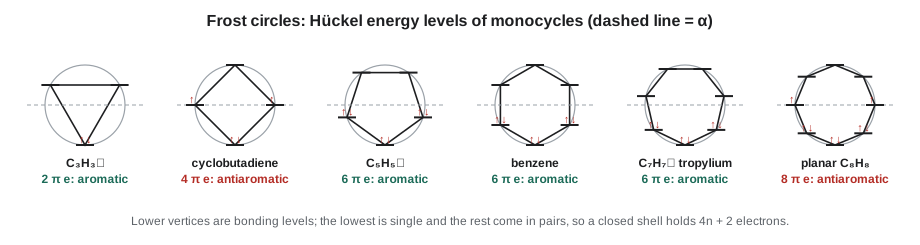
Arthur Frost and Boris Musulin found a simple way to draw these energy levels in 1953. Inscribe the ring polygon in a circle of radius 2β with one vertex pointing straight down. The height of each vertex gives the energy of one molecular orbital, with the centre of the circle at α. For benzene, a hexagon on its point gives the pattern 1, 2, 2, 1. The Frost circle, as it is called, makes the electron-count rule easy to see: the lowest orbital is single and every bonding level above it is a pair, so filling all the bonding orbitals needs 2 + 4n electrons.
Hückel's rule
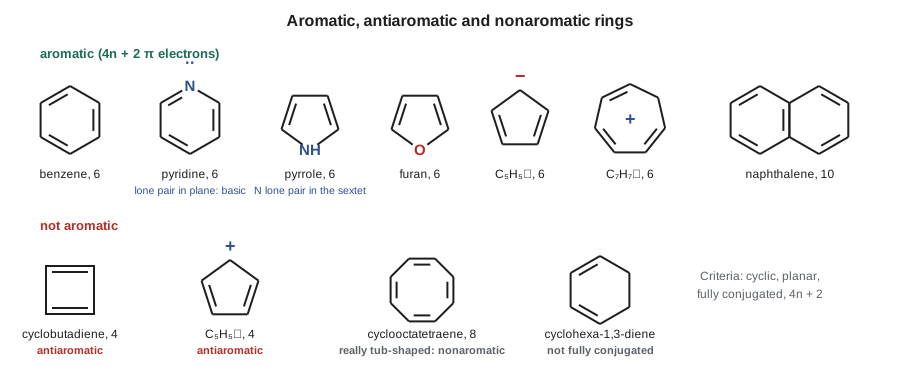
In 1931 Erich Hückel concluded from this kind of analysis that a monocyclic, planar, fully conjugated system is especially stable when it contains 4n + 2 π electrons, where n = 0, 1, 2 and so on: 2, 6, 10, 14 electrons. Such a system is aromatic. A cyclic, planar, fully conjugated system with 4n π electrons, 4, 8, 12, is antiaromatic: it has two electrons in a pair of degenerate nonbonding orbitals, is less stable than an open-chain analogue, and is highly reactive. A ring that is not planar or not fully conjugated is simply nonaromatic. The full set of criteria is:
| Criterion | What it requires |
|---|---|
| Cyclic | The π system forms a closed ring. |
| Fully conjugated | Every ring atom has a p orbital (sp² or sp hybridized, or a lone pair or empty orbital in a p orbital). |
| Planar | The ring is flat enough for all the p orbitals to overlap. |
| 4n + 2 π electrons | Aromatic; 4n π electrons in a planar ring is antiaromatic. |
Cyclobutadiene, with four π electrons, is the classic antiaromatic compound. It has never been isolated at room temperature; it was observed only in the early 1970s, trapped in a frozen argon matrix at a few kelvin, and it distorts into a rectangle with distinct single and double bonds that reduces the antiaromatic interaction. Cyclooctatetraene, C₈H₈, with eight π electrons, avoids antiaromaticity a different way: it is not planar but tub-shaped, so its double bonds do not overlap and it behaves as an ordinary polyene. It adds bromine and is oxidized by permanganate. Its Frost diagram would apply only if it were flat.
Aromatic ions
Hückel's rule applies to ions as well as neutral molecules, and the predictions have been tested quantitatively.
Cyclopentadiene, C₅H₆, has an sp³ CH₂ group, so it is not fully conjugated and not aromatic. Its pKa, however, is about 16, astonishingly low for a hydrocarbon; ordinary alkane C–H bonds have pKa values near 50. Removing a proton from the CH₂ gives the cyclopentadienyl anion, in which the carbon that lost the proton becomes sp² and its lone pair occupies a p orbital. The anion is planar, fully conjugated and has six π electrons: it is aromatic, and its stability drives the acidity. Sodium cyclopentadienide is a common reagent, and the cyclopentadienyl anion is the ligand in ferrocene, the sandwich compound discovered in 1951 whose structure earned Geoffrey Wilkinson and Ernst Otto Fischer the 1973 Nobel Prize.
Cycloheptatriene, C₇H₈, behaves the opposite way. Removing a proton would give an eight-electron antiaromatic anion, and its pKa is about 36. Removing a hydride ion instead gives the cycloheptatrienyl or tropylium cation, C₇H₇⁺, a planar seven-membered ring with six π electrons and an empty p orbital. Tropylium salts such as tropylium bromide are stable, ionic solids that dissolve in water. Removing hydride from cyclopentadiene would give a four-electron antiaromatic cation, which is exceptionally unstable. The smallest aromatic ion is the cyclopropenyl cation, C₃H₃⁺, with two π electrons (n = 0), whose salts were made by Ronald Breslow in 1957.
Worked problem
Applying Hückel's rule
Classify as aromatic, antiaromatic or nonaromatic: (a) the cyclopentadienyl cation; (b) cyclononatetraenyl anion, C₉H₉⁻ (planar); (c) cyclohexa-1,3-diene; (d) [18]annulene, a planar ring of 18 carbons with nine alternating double bonds.
Show solution
- (a) Five p orbitals in a planar ring with four π electrons (4n, n = 1): antiaromatic.
- (b) Nine p orbitals with ten π electrons (four double bonds plus the lone pair): 4n + 2 with n = 2, aromatic if planar.
- (c) Two sp³ carbons break the conjugation: nonaromatic.
- (d) Eighteen π electrons is 4n + 2 with n = 4, and the large ring can be planar: aromatic.
Answer: (a) antiaromatic; (b) aromatic; (c) nonaromatic; (d) aromatic. [18]Annulene, made by Franz Sondheimer and Reuven Wolovsky in 1959, shows the ring current expected of an aromatic compound in its NMR spectrum.
Aromatic heterocycles
Rings that contain atoms other than carbon can also be aromatic, and these heterocycles are among the most important structures in biology and medicine. The key question is what each heteroatom contributes to the π system.
In pyridine, C₅H₅N, nitrogen replaces one CH of benzene. Nitrogen is sp² hybridized and contributes one electron in its p orbital to the π system, exactly as carbon does, giving six π electrons. Its lone pair lies in an sp² orbital in the plane of the ring, pointing outward, and is not part of the π system. That lone pair is free to accept a proton, so pyridine is a base, with a pKaH of 5.2, a weaker base than alkylamines because the lone pair is in an sp² orbital with more s character, held closer to the nucleus.
In pyrrole, C₄H₄NH, a five-membered ring, the nitrogen carries a hydrogen and is also sp² hybridized, but its lone pair occupies the p orbital and is part of the aromatic sextet: four electrons from the two C=C bonds plus two from nitrogen make six. Protonating pyrrole's nitrogen would remove those two electrons from the π system and destroy the aromaticity, so pyrrole is an extremely weak base; its conjugate acid has a pKa of about −4, and when it is protonated, it is protonated on carbon. The difference between pyridine and pyrrole, one lone pair outside the ring and one inside it, is the single most useful idea for understanding heterocycles.
Furan and thiophene are the oxygen and sulfur analogues of pyrrole. Oxygen and sulfur each have two lone pairs: one in the p orbital, part of the aromatic sextet, and one in an sp² orbital in the plane. Imidazole, in the amino acid histidine, contains both kinds of nitrogen: a pyrrole-like N–H and a pyridine-like N with a basic lone pair, giving a pKaH of about 7.0, close to physiological pH, which is why histidine so often acts as a proton shuttle in enzymes. The bases of DNA and RNA are aromatic heterocycles: pyrimidines (cytosine, thymine, uracil) and purines (adenine, guanine).
Polycyclic aromatic compounds
Rings can share edges. Naphthalene, C₁₀H₈, is two fused benzene rings with ten π electrons; anthracene and phenanthrene, C₁₄H₁₀, are three rings with fourteen. Their resonance energies are large in total, about 255 kJ/mol for naphthalene, but smaller per ring than benzene's, and they react more readily: naphthalene undergoes substitution faster than benzene, and anthracene adds reagents across its central ring because doing so leaves two intact benzene rings. Hückel's rule strictly applies to monocyclic systems; for fused rings, the perimeter electron count is a useful guide but not a rigorous test.
Larger polycyclic aromatic hydrocarbons form when organic matter burns incompletely, in vehicle exhaust, wood smoke, grilled food and cigarette smoke. Some, such as benzo[a]pyrene, are converted in the body to reactive epoxides that bind to DNA and cause mutations; it was one of the first chemical carcinogens identified. At the other extreme of size, graphene is a single sheet of fused aromatic rings, isolated by Andre Geim and Konstantin Novoselov in 2004 and recognized with the 2010 Nobel Prize in Physics. Its delocalized π system makes it an excellent conductor.
Evidence for aromaticity from NMR
Nuclear magnetic resonance spectroscopy, covered in CHEM-282, gives the most widely used experimental test of aromaticity. When an aromatic ring is placed in a magnetic field, its delocalized π electrons circulate around the ring, a ring current, which produces a small magnetic field of its own. Outside the ring this induced field adds to the applied field, so protons on the outside of an aromatic ring appear at unusually high chemical shift: benzene's protons appear at 7.3 ppm, compared with about 5.5 ppm for the protons of an ordinary alkene. Inside the ring the induced field opposes the applied field. The six inner protons of [18]annulene appear at −3 ppm, below the reference compound, while its twelve outer protons appear at about 9 ppm. Antiaromatic rings show the opposite pattern, a paratropic ring current.
A program: Hückel energies and aromaticity
import math

def ring_levels(n):
    # Hückel energies x (E = alpha + x beta) for a monocycle of n atoms, grouped by degeneracy
    xs = sorted((round(2 * math.cos(2 * math.pi * k / n), 6) for k in range(n)), reverse=True)
    groups = []
    for x in xs:
        if groups and abs(groups[-1][0] - x) < 1e-6:
            groups[-1][1] += 1
        else:
            groups.append([x, 1])
    return groups

def fill(n, electrons):
    # fill pairwise, lowest level first; report total energy and the open shell, if any
    left, total, open_shell = electrons, 0.0, None
    for x, deg in ring_levels(n):
        put = min(2 * deg, left)
        total += put * x
        if 0 < put < 2 * deg:
            open_shell = (x, put, 2 * deg)
        left -= put
    return total, open_shell

def verdict(e):
    return 'aromatic' if e % 4 == 2 else 'antiaromatic' if e % 4 == 0 else 'radical'

cases = [('cyclopropenyl cation', 3, 2), ('cyclobutadiene', 4, 4),
         ('cyclopentadienyl cation', 5, 4), ('cyclopentadienyl anion', 5, 6),
         ('benzene', 6, 6), ('tropylium cation', 7, 6), ('cycloheptatrienyl anion', 7, 8),
         ('planar cyclooctatetraene', 8, 8), ('cyclooctatetraene dianion', 8, 10)]
print(f'{"species":26s} pi e  total x  {"shell":34s}  verdict')
for name, n, e in cases:
    total, op = fill(n, e)
    if op is None:
        shell = 'closed: every level full or empty'
    else:
        x, put, cap = op
        kind = 'bonding' if x > 1e-6 else 'nonbonding' if abs(x) < 1e-6 else 'antibonding'
        shell = f'open: {put} e in {cap // 2} {kind} levels'
    print(f'{name:26s} {e:3d}  {total:7.3f}  {shell:34s}  {verdict(e)}')

benzene_pi, three_ethenes = fill(6, 6)[0], 6.0
print(f'benzene delocalization energy: {benzene_pi - three_ethenes:.3f} beta')
cyclohexene, benzene = 120, 208          # heats of hydrogenation, kJ/mol
print('benzene resonance energy from hydrogenation:', 3 * cyclohexene - benzene, 'kJ/mol')species pi e total x shell verdict cyclopropenyl cation 2 4.000 closed: every level full or empty aromatic cyclobutadiene 4 4.000 open: 2 e in 2 nonbonding levels antiaromatic cyclopentadienyl cation 4 5.236 open: 2 e in 2 bonding levels antiaromatic cyclopentadienyl anion 6 6.472 closed: every level full or empty aromatic benzene 6 8.000 closed: every level full or empty aromatic tropylium cation 6 8.988 closed: every level full or empty aromatic cycloheptatrienyl anion 8 8.098 open: 2 e in 2 antibonding levels antiaromatic planar cyclooctatetraene 8 9.657 open: 2 e in 2 nonbonding levels antiaromatic cyclooctatetraene dianion 10 9.657 closed: every level full or empty aromatic benzene delocalization energy: 2.000 beta benzene resonance energy from hydrogenation: 152 kJ/mol
The program reproduces the pattern of the Frost circles. Every species with 4n + 2 π electrons has a closed shell: each of its occupied levels is completely full. Every species with 4n π electrons has an open shell, two electrons spread over a degenerate pair of levels, which by Hund's rule are unpaired. For cyclobutadiene and planar cyclooctatetraene that pair is nonbonding, as the Frost circles show. The cyclooctatetraene dianion, C₈H₈²⁻, made by reducing cyclooctatetraene with potassium, fills that nonbonding pair completely; it is planar and aromatic with ten π electrons, a striking confirmation of the rule. The delocalization energy of benzene comes out at 2β, as calculated above.
Aromaticity in biology and materials
Aromatic rings provide rigid, flat scaffolds. In proteins, the side chains of phenylalanine, tyrosine and tryptophan stack against each other and against nucleotide bases through attractive π-stacking interactions. In DNA, base stacking contributes as much to the stability of the double helix as hydrogen bonding between base pairs. Many drugs contain aromatic rings because they provide a flat surface that fits into binding sites and because their substitution chemistry, described in lesson 4, makes them easy to modify. In materials, aromatic backbones give polymers stiffness and heat resistance, from the polyester of drink bottles to aramid fibres used in protective clothing.
Common mistakes
MistakeBenzene's double bonds flip back and forth between two positions.
InsteadThe Kekulé structures are resonance forms; real benzene has six equal bonds at all times.
MistakeAny ring with 4n + 2 π electrons is aromatic.
InsteadIt must also be cyclic, planar and fully conjugated.
MistakeCyclooctatetraene is antiaromatic.
InsteadIt escapes antiaromaticity by adopting a nonplanar tub shape; it is nonaromatic.
MistakePyrrole's nitrogen lone pair is basic like pyridine's.
InsteadPyrrole's lone pair is part of the aromatic sextet; pyridine's lies in the ring plane, outside the π system.
MistakeCyclopentadiene is acidic because carbon is electronegative.
InsteadIts conjugate base, the cyclopentadienyl anion, is aromatic with six π electrons.
MistakeFused rings are always more stable per ring than benzene.
InsteadNaphthalene and anthracene have smaller resonance energies per ring and are more reactive than benzene.
Summary and key terms
- Benzene is a planar hexagon of sp² carbons with six equal 139 pm bonds and a continuous π system above and below the ring.
- Its heat of hydrogenation, 208 kJ/mol against 360 expected, shows an aromatic stabilization of about 150 kJ/mol.
- Hückel MOs of a ring follow E = α + 2β cos(2πk/N); Frost circles show the pattern of levels.
- Hückel's rule: cyclic, planar, fully conjugated rings with 4n + 2 π electrons are aromatic; with 4n they are antiaromatic.
- Ions obey the rule: cyclopentadienyl anion, tropylium and cyclopropenyl cations are aromatic.
- In heterocycles, a lone pair in the ring plane (pyridine) is basic; a lone pair in the p orbital (pyrrole, furan) is part of the sextet.
- Aromatic ring currents shift outer protons downfield in NMR, the main experimental test.
- Resonance energy
- The extra stability of a delocalized system compared with a localized model.
- Hückel's rule
- Planar cyclic conjugated rings with 4n + 2 π electrons are aromatic.
- Antiaromatic
- Planar cyclic conjugated with 4n π electrons; destabilized.
- Frost circle
- A polygon inscribed in a circle whose vertices give Hückel MO energies.
- Heterocycle
- A ring containing at least one atom other than carbon.
- Annulene
- A monocyclic fully conjugated hydrocarbon, named [n]annulene for n ring atoms.
- Ring current
- Circulation of delocalized π electrons in a magnetic field, detected by NMR.
Practice problems
Work each problem on paper first, then reveal the answer to check.
Explain why cycloheptatriene is far less acidic (pKa about 36) than cyclopentadiene (pKa about 16).
Show answer
Deprotonating cyclopentadiene gives an aromatic six-electron anion; deprotonating cycloheptatriene gives an eight-electron antiaromatic anion, so it does not stabilize the base.
How many π electrons are in imidazole, and which nitrogen is basic?
Show answer
Six: four from the two C=C bonds and two from the N–H nitrogen's lone pair. The other nitrogen's lone pair lies in the ring plane and is basic (pKaH about 7.0).
Predict whether the cyclopropenyl anion, C₃H₃⁻, is aromatic.
Show answer
Four π electrons in a planar ring: antiaromatic; it is highly unstable.
Use the table of heats of hydrogenation to show that cyclohexa-1,4-diene has no conjugation stabilization.
Show answer
It releases 240 kJ/mol, exactly twice cyclohexene, because its double bonds are separated by sp³ carbons.
Why does furan undergo electrophilic substitution faster than benzene?
Show answer
Oxygen's p-orbital lone pair raises the energy of the π system and stabilizes the cationic intermediate by resonance, and furan's aromatic stabilization is smaller than benzene's.
Using Hückel energies, calculate the delocalization energy of benzene in units of β.
Show answer
Total π energy 2(2β) + 4(β) = 8β against 6β for three isolated π bonds: 2β.
Lesson quiz · 5 questions
Score 60% or more to complete this lesson.
Create a free account to save your progress, take quizzes and earn a certificate.