
CHEM-263 · Lesson 7 of 12 · 24 min
Aldehydes and ketones: nucleophilic addition
▶ Video coming soon A video version of this lesson is on the way.
Aldehydes and ketones both contain the carbonyl group. In an aldehyde, the carbonyl carbon carries at least one hydrogen, R–CHO; in a ketone it carries two carbon groups, R–CO–R′. They are among the most important compounds in synthesis because the carbonyl group reacts with a wide range of nucleophiles at carbon, and because, as lessons 8 and 9 show, the carbon next to it can itself become a nucleophile. Formaldehyde is made on a scale of tens of millions of tonnes a year for resins and plastics; acetone is a solvent and a chemical feedstock; benzaldehyde, cinnamaldehyde and vanillin are flavours; and the sugar glucose is an aldehyde that spends most of its time as a cyclic hemiacetal. This lesson develops the central reaction of aldehydes and ketones, nucleophilic addition, and applies it to water, alcohols, amines, carbon nucleophiles and phosphorus ylides.
Naming and properties
Aldehydes are named by replacing the -e of the parent alkane with -al: methanal (formaldehyde), ethanal (acetaldehyde), propanal. The aldehyde carbon is always C1. Ketones replace -e with -one and need a locant: propanone (acetone), butan-2-one, pentan-3-one. Aldehydes attached to rings use the suffix -carbaldehyde, as in cyclohexanecarbaldehyde, and C₆H₅CHO is benzaldehyde. As a substituent, a ketone oxygen is called oxo.
The polar carbonyl group gives aldehydes and ketones dipole–dipole attractions and boiling points between those of alkanes and alcohols: propanal boils at 48 °C, butane at −1 °C and propan-1-ol at 97 °C. They accept hydrogen bonds from water, so the small ones are water-soluble; acetone mixes with water in all proportions.
The general mechanism of nucleophilic addition
Lesson 1 described why the carbonyl carbon is electrophilic. A nucleophile adds to it, the π electrons move onto oxygen, and a tetrahedral alkoxide intermediate forms; protonation gives the addition product. With strong, negatively charged nucleophiles such as hydride, carbanions and cyanide, addition comes first and protonation afterwards. With weak, neutral nucleophiles such as water, alcohols and amines, the reaction is usually catalysed by acid, which protonates the carbonyl oxygen first and makes the carbon much more electrophilic. The two versions are mirror images of each other: base catalysis makes the nucleophile stronger, acid catalysis makes the electrophile stronger.
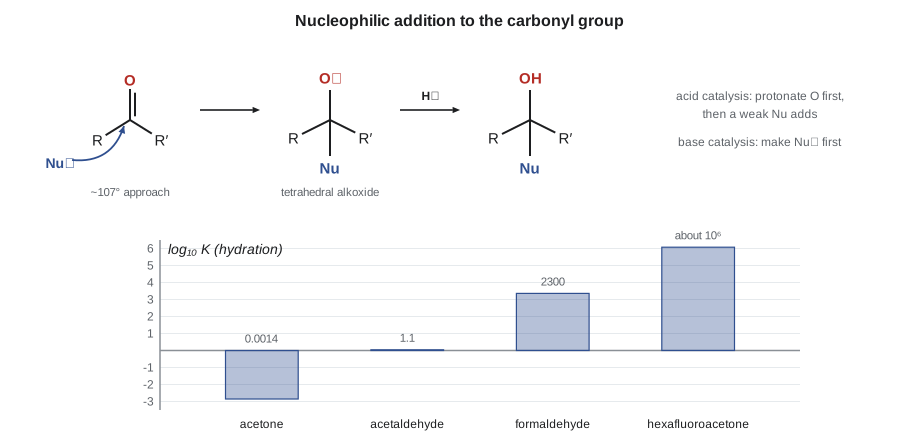
Aldehydes are more reactive than ketones for two reasons. Sterically, an aldehyde has a small hydrogen on the carbonyl carbon, so the crowded tetrahedral product is less strained. Electronically, the two alkyl groups of a ketone donate electron density and stabilize the partial positive charge on the carbonyl carbon, making it less electrophilic. Electron-withdrawing groups have the opposite effect and make the carbonyl more reactive. Aromatic aldehydes such as benzaldehyde are somewhat less reactive than aliphatic ones because conjugation with the ring stabilizes the carbonyl.
Addition of water: hydrates
Water adds reversibly to aldehydes and ketones to form hydrates, also called gem-diols, R₂C(OH)₂. The reaction is catalysed by both acid and base. For most compounds the equilibrium lies on the carbonyl side, and the position of the equilibrium is a sensitive measure of how electrophilic the carbonyl group is. The hydration constant, K = [hydrate]/[carbonyl], is about 0.0014 for acetone, about 1 for acetaldehyde and about 2,300 for formaldehyde, which in water is almost entirely the hydrate, methanediol. Hexafluoroacetone, with two strongly withdrawing CF₃ groups, has K of about a million. Hydrates explain why aqueous oxidants convert primary alcohols to carboxylic acids, as lesson 5 described: the aldehyde formed first is hydrated, and the hydrate, an alcohol, is oxidized again.
| Carbonyl compound | Hydration constant K (25 °C) | Hydrate at equilibrium |
|---|---|---|
| Acetone, (CH₃)₂C=O | 0.0014 | about 0.1 per hundred |
| Acetaldehyde, CH₃CHO | 1.1 | about half |
| Formaldehyde, H₂C=O | 2300 | almost all |
| Hexafluoroacetone, (CF₃)₂C=O | about 10⁶ | essentially all |
Addition of alcohols: hemiacetals and acetals
Alcohols add to aldehydes and ketones in the same way as water. One equivalent gives a hemiacetal, which carries an OH and an OR on the same carbon. Like hydrates, most open-chain hemiacetals are unstable and revert to the carbonyl compound and the alcohol. Under acid catalysis with excess alcohol, however, the hemiacetal reacts further. Its OH is protonated and leaves as water, giving an oxocarbenium ion stabilized by the lone pair of the remaining OR, which is captured by a second molecule of alcohol. The product, with two OR groups on one carbon, is an acetal. Older texts call acetals derived from ketones ketals.
Acetal formation is an equilibrium, and each step can run backward. To drive it toward the acetal, chemists use a large excess of the alcohol or remove the water as it forms, for example with a Dean–Stark trap, in which the water distils out with toluene and is collected in a side arm. To reverse it, they add excess water and acid: acetals are hydrolysed back to the carbonyl compound and the alcohol. Under neutral or basic conditions, acetals are completely stable, because there is no way to make the OR group leave without acid.
That combination of properties makes acetals ideal protecting groups. Suppose you want to reduce the ester group of a molecule that also contains a ketone, using LiAlH₄, which would reduce both. Convert the ketone to a cyclic acetal with ethane-1,2-diol and an acid catalyst; reduce the ester; then remove the acetal with aqueous acid. The ketone survives untouched. Cyclic acetals from diols form especially easily, because the second OH is already attached to the same molecule, an intramolecular step that costs little entropy.
Worked problem
Using an acetal protecting group
Convert ethyl 4-oxocyclohexanecarboxylate into 4-(hydroxymethyl)cyclohexan-1-one.
Show solution
- The target keeps the ketone but reduces the ester to CH₂OH. LiAlH₄ would reduce the ketone too.
- Step 1: protect the ketone as a cyclic acetal with ethane-1,2-diol and a catalytic amount of p-toluenesulfonic acid, removing water.
- Step 2: reduce the ester with LiAlH₄ in THF, then a careful aqueous workup; the acetal is unaffected by the basic hydride.
- Step 3: remove the acetal with dilute aqueous acid, regenerating the ketone.
Answer: Protect (HOCH₂CH₂OH, H⁺), reduce (LiAlH₄), deprotect (H₃O⁺).
Sugars use the same chemistry. Glucose has an aldehyde at C1 and OH groups along its chain. The OH at C5 adds to the aldehyde intramolecularly, forming a six-membered cyclic hemiacetal, and in water all but a tiny fraction of glucose, well under one part in a thousand, exists in these ring forms. The new stereocentre at C1, called the anomeric carbon, can have its OH either axial or equatorial, giving the α and β anomers, which interconvert through the open chain. In starch and cellulose, the anomeric carbons are joined to OH groups of the next sugar as acetals, called glycosidic bonds; in cellulose they are β, in starch α, a single stereochemical difference that decides whether humans can digest the polymer.
Addition of amines: imines and enamines
Primary amines, RNH₂, add to aldehydes and ketones to form a carbinolamine, which loses water under acid catalysis to give an imine, R₂C=NR′, also called a Schiff base after Hugo Schiff, who described them in 1864. The reaction is fastest at a mildly acidic pH of about 4 to 5. At higher pH there is too little acid to protonate the OH of the carbinolamine and make it leave; at lower pH the amine itself is protonated to an ammonium ion and is no longer a nucleophile. The rate therefore passes through a maximum, a bell-shaped curve that the program at the end of this lesson models.
Secondary amines, R₂NH, add in the same way, but the resulting iminium ion has no N–H to lose. Instead a proton is lost from the neighbouring carbon, giving an enamine, R₂N–C=C. Enamines are nucleophilic at carbon, like the enolates of lesson 8, and Gilbert Stork developed them in the 1950s and 1960s as mild alternatives to enolates for alkylating ketones. Imines and enamines, like acetals, are hydrolysed back to the carbonyl compound by aqueous acid.
Imines are central to biochemistry. The retinal of vision is bound to its protein as an imine of a lysine side chain. Many enzymes use pyridoxal phosphate, derived from vitamin B6, which forms imines with amino acids to move amino groups between molecules. And reductive amination, the reduction of an imine as it forms, is a general route to amines, described in lesson 11.
Carbon nucleophiles
Lesson 5 covered the addition of Grignard and organolithium reagents and of hydride, which are irreversible because the nucleophiles are such strong bases that they cannot be expelled again. Two further carbon nucleophiles complete the picture.
Cyanide adds to aldehydes and unhindered ketones to form cyanohydrins, which carry OH and CN on the same carbon. The reaction is reversible and base-catalysed. Because hydrogen cyanide and cyanide salts are highly toxic, cyanohydrin chemistry is carried out industrially with strict controls, notably in the manufacture of methyl methacrylate, the monomer of acrylic glass, from acetone cyanohydrin. In plants, cyanohydrins stored as glycosides, such as amygdalin in bitter almonds and apricot kernels, release HCN when the tissue is damaged, a chemical defence against grazing animals.
The Wittig reaction, discovered by Georg Wittig in 1954, converts the C=O bond into a C=C bond. A phosphorus ylide, Ph₃P⁺–C⁻HR, made by deprotonating a phosphonium salt, adds to an aldehyde or ketone to form a four-membered ring containing phosphorus and oxygen, an oxaphosphetane. This collapses to the alkene and triphenylphosphine oxide, whose very strong P=O bond drives the reaction. Unlike the elimination reactions of CHEM-261, the Wittig reaction puts the new double bond exactly where the carbonyl was, with no ambiguity about its position. Wittig shared the 1979 Nobel Prize with Herbert Brown. The reaction is used industrially in the synthesis of vitamin A.
Reductions of the carbonyl group to CH₂
Two methods remove the oxygen completely and reduce C=O to CH₂. The Wolff–Kishner reduction, from 1911–1912, heats the carbonyl compound with hydrazine and a strong base in a high-boiling solvent; the hydrazone formed first loses nitrogen gas to give the alkane. The Clemmensen reduction uses zinc amalgam and hydrochloric acid. One works in strong base and the other in strong acid, so between them they handle most substrates. Both complete the Friedel–Crafts acylation–reduction sequence of lesson 4. Catalytic hydrogenation also reduces aryl ketones to CH₂ when the carbonyl is benzylic.
| Nucleophile or reagent | Product | Reversible? |
|---|---|---|
| H₂O (acid or base catalyst) | Hydrate (gem-diol) | yes |
| ROH, 1 equiv. | Hemiacetal | yes |
| ROH excess, H⁺, remove water | Acetal | yes (hydrolysed by H₃O⁺) |
| RNH₂, pH 4–5 | Imine | yes |
| R₂NH, H⁺ | Enamine | yes |
| CN⁻ (from HCN) | Cyanohydrin | yes |
| NaBH₄ or LiAlH₄, then H₃O⁺ | Alcohol | no |
| RMgX or RLi, then H₃O⁺ | Alcohol with a new C–C bond | no |
| Ph₃P=CHR (Wittig) | Alkene | no |
| N₂H₄, KOH, heat (Wolff–Kishner) | Alkane (C=O → CH₂) | no |
Oxidation of aldehydes and tests
Aldehydes, unlike ketones, are easily oxidized to carboxylic acids, because they carry a hydrogen on the carbonyl carbon. Even mild oxidants do it. Tollens' reagent, silver ammonia complex in aqueous base, oxidizes aldehydes and is itself reduced to metallic silver, which deposits as a mirror on the inside of a clean test tube: the classic qualitative test for an aldehyde, and the way mirrors were silvered in the nineteenth century. Many aldehydes are slowly oxidized by air on standing, so a bottle of benzaldehyde gradually deposits crystals of benzoic acid around its cap.
A program: hydrate, acetal and imine equilibria
import math
R, T = 8.314, 298.15

# 1. hydration: fraction hydrated from K, and the free energy of hydration
for name, K in (('acetone', 0.0014), ('acetaldehyde', 1.1),
                ('formaldehyde', 2300.0), ('hexafluoroacetone', 1.2e6)):
    frac = K / (1 + K)
    dG = -R * T * math.log(K) / 1000
    print(f'{name:18s} K = {K:9.4g}  hydrated fraction = {frac:.4f}  dG = {dG:+6.1f} kJ/mol')

# 2. acetal formation, aldehyde + 2 ROH <=> acetal + H2O, with K = 5 (concentration units)
def acetal_fraction(K, alcohol_equiv, water_removed):
    """Fraction of 1 M aldehyde converted, by bisection on the equilibrium expression."""
    lo, hi = 0.0, 1.0
    for _ in range(80):
        x = (lo + hi) / 2
        water = 0.0 if water_removed else x
        alcohol = alcohol_equiv - 2 * x
        if alcohol <= 0:
            hi = x; continue
        q = (x * max(water, 1e-12)) / ((1 - x) * alcohol ** 2) if not water_removed else 0.0
        if water_removed or q < K:
            lo = x
        else:
            hi = x
    return lo

for eq in (2.0, 10.0, 50.0):
    print(f'acetal, {eq:4.0f} equiv alcohol, water left in: {acetal_fraction(5.0, eq, False):.3f} converted')
print(f'acetal, water removed (Dean-Stark): {acetal_fraction(5.0, 2.0, True):.3f} converted')

# 3. imine formation rate versus pH: two steps in series.
#    addition needs the free amine (pKaH 10.6); dehydration of the carbinolamine needs acid.
#    The slower step at each pH controls the overall rate: 1/rate = 1/r_add + 1/r_dehyd.
def relative_rate(ph, pkah=10.6, k_add=4.0e5, k_dehyd=1.0e4):
    free_amine = 1 / (1 + 10 ** (pkah - ph))
    r_add = k_add * free_amine
    r_dehyd = k_dehyd * 10 ** (-ph)
    return 1 / (1 / r_add + 1 / r_dehyd)

rates = {ph: relative_rate(ph) for ph in [x / 2 for x in range(2, 21)]}
best = max(rates, key=rates.get)
print('imine formation, relative rate (max = 1):')
for ph in (1, 2, 3, 4, 5, 6, 7, 8, 9):
print(f' pH {ph}: {"#" * round(40 * rates[ph] / rates[best]):40s} {rates[ph] / rates[best]:.2f}')acetone K = 0.0014 hydrated fraction = 0.0014 dG = +16.3 kJ/mol acetaldehyde K = 1.1 hydrated fraction = 0.5238 dG = -0.2 kJ/mol formaldehyde K = 2300 hydrated fraction = 0.9996 dG = -19.2 kJ/mol hexafluoroacetone K = 1.2e+06 hydrated fraction = 1.0000 dG = -34.7 kJ/mol acetal, 2 equiv alcohol, water left in: 0.707 converted acetal, 10 equiv alcohol, water left in: 0.997 converted acetal, 50 equiv alcohol, water left in: 1.000 converted acetal, water removed (Dean-Stark): 1.000 converted imine formation, relative rate (max = 1): pH 1: 0.00 pH 2: 0.01 pH 3: ### 0.06 pH 4: ####################### 0.58 pH 5: ####################### 0.57 pH 6: ### 0.06 pH 7: 0.01 pH 8: 0.00 pH 9: 0.00
The hydration numbers translate the equilibrium constants into free energies: acetone's hydration is uphill by about 16 kJ/mol, formaldehyde's downhill by about 19. The acetal calculation shows Le Chatelier's principle at work: with only two equivalents of alcohol and water left in the flask, conversion is incomplete, but removing the water drives it essentially to completion. The imine model treats the reaction as two steps in series: addition, which needs the free amine and so slows in strong acid, and dehydration of the carbinolamine, which needs acid and so slows in base. Whichever step is slower controls the rate, and the result is the bell-shaped curve with its maximum near pH 4.5 found experimentally by William Jencks in the 1950s and 1960s.
Common mistakes
MistakeKetones are more reactive than aldehydes because they have more alkyl groups.
InsteadAlkyl groups donate electrons and add steric bulk; aldehydes are more reactive.
MistakeAcetals are hydrolysed by aqueous base.
InsteadAcetals are stable to base; only aqueous acid cleaves them back to the carbonyl compound, which is why they make good protecting groups.
MistakeImine formation is fastest in strong acid.
InsteadStrong acid protonates the amine; the optimum is about pH 4 to 5.
MistakeA secondary amine and a ketone give an imine.
InsteadThe iminium ion has no N–H to lose, so it loses a C–H proton to give an enamine.
MistakeThe Wittig reaction gives a mixture of alkene positions like E1.
InsteadThe new C=C forms exactly where the C=O was.
MistakeKetones give a silver mirror with Tollens' reagent.
InsteadOnly aldehydes are oxidized; ketones lack the aldehyde C–H.
Summary and key terms
- Nucleophiles add to the carbonyl carbon to form a tetrahedral intermediate; acid activates the carbonyl, base activates the nucleophile.
- Aldehydes are more reactive than ketones for steric and electronic reasons; withdrawing groups increase reactivity.
- Water gives hydrates and alcohols give hemiacetals and, with acid and water removal, acetals, which are stable to base and serve as protecting groups.
- Primary amines give imines (fastest near pH 4 to 5); secondary amines give enamines.
- Hydride and organometallic additions are irreversible; cyanide gives cyanohydrins; Wittig ylides convert C=O to C=C.
- Wolff–Kishner (base) and Clemmensen (acid) reduce C=O to CH₂; aldehydes are oxidized by Tollens' reagent.
- Hydrate
- A gem-diol, R₂C(OH)₂, formed by adding water to a carbonyl group.
- Hemiacetal
- A compound with an OH and an OR on the same carbon.
- Acetal
- A compound with two OR groups on the same carbon, formed from a carbonyl compound and two alcohols.
- Protecting group
- A temporary modification that hides a functional group during another reaction.
- Imine
- A C=N compound formed from a carbonyl compound and a primary amine.
- Enamine
- An alkene bearing an amino group, formed from a carbonyl compound and a secondary amine.
- Wittig reaction
- The reaction of a phosphorus ylide with a carbonyl compound to give an alkene.
Practice problems
Work each problem on paper first, then reveal the answer to check.
Rank in order of increasing hydration constant: acetone, chloroacetone, acetaldehyde, formaldehyde.
Show answer
Acetone < chloroacetone < acetaldehyde < formaldehyde: withdrawing chlorine and fewer alkyl groups both raise K.
Draw the mechanism of acid-catalysed acetal formation from cyclohexanone and methanol, naming each intermediate.
Show answer
Protonate C=O; methanol adds; deprotonate to the hemiacetal; protonate OH; lose water to the oxocarbenium ion; second methanol adds; deprotonate to 1,1-dimethoxycyclohexane.
Give the product of cyclohexanone with (a) methylamine at pH 5; (b) pyrrolidine with an acid catalyst; (c) Ph₃P=CH₂.
Show answer
(a) The N-methyl imine; (b) the pyrrolidine enamine, 1-(cyclohex-1-en-1-yl)pyrrolidine; (c) methylenecyclohexane.
Why does a Grignard reaction on a molecule containing both a ketone and an ester need a protecting group if you want to react only the ester?
Show answer
The Grignard reagent attacks ketones faster than esters; protect the ketone as an acetal, which is inert to RMgX, then deprotect.
Explain why glucose in water exists mainly as a ring.
Show answer
The C5 OH adds intramolecularly to the C1 aldehyde to form a six-membered cyclic hemiacetal, favoured because the ring forms with little loss of entropy.
Suggest a way to convert benzophenone, (C₆H₅)₂C=O, into diphenylmethane.
Show answer
Wolff–Kishner (hydrazine, KOH, heat) or Clemmensen (Zn(Hg), HCl), or catalytic hydrogenation of the benzylic carbonyl.
Lesson quiz · 5 questions
Score 60% or more to complete this lesson.
Create a free account to save your progress, take quizzes and earn a certificate.