
CHEM-263 · Lesson 4 of 12 · 25 min
Electrophilic aromatic substitution and substituent effects
▶ Video coming soon A video version of this lesson is on the way.
Aromatic rings are rich in π electrons, so they react with electrophiles, but they react in a characteristic way. An alkene adds an electrophile and a nucleophile across its double bond. Benzene, under the right conditions, replaces one of its hydrogens with the electrophile and keeps its aromatic ring intact. This reaction, electrophilic aromatic substitution, is how almost every substituted benzene ring in industry and the laboratory is made: nitrobenzene for aniline and dyes, alkylbenzenes for detergents, cumene for phenol and acetone, sulfonic acids for surfactants. This lesson develops the general mechanism, the five standard reactions, and the rules by which a substituent already on the ring controls both the rate of a second substitution and where it goes.
The general mechanism
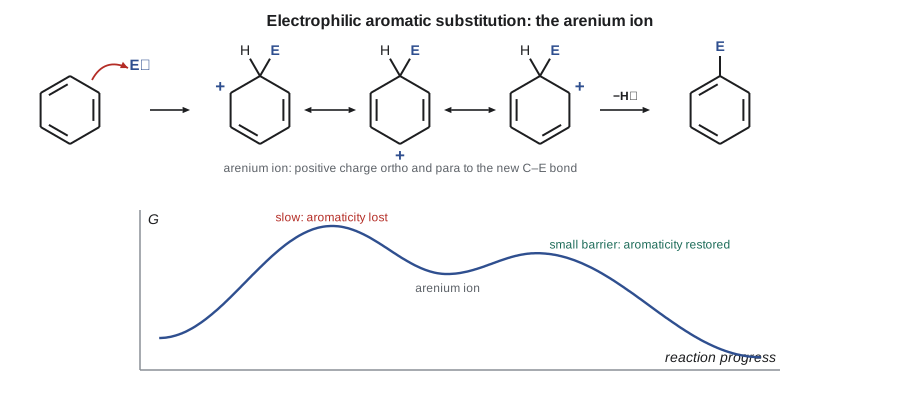
Electrophilic aromatic substitution takes place in two steps. In the first, slow step, the π electrons of the ring attack the electrophile, E⁺, forming a new C–E σ bond. The carbon that bonds to E becomes sp³, and the ring loses its aromaticity. The result is a carbocation called an arenium ion, σ complex or Wheland intermediate, after George Wheland, who proposed it in 1942. Its positive charge is delocalized by resonance over the three carbons ortho and para to the sp³ carbon. In the second, fast step, a base removes the proton from the sp³ carbon, and its electron pair returns to the ring, restoring aromaticity.
The first step is rate-determining because it sacrifices the aromatic stabilization. The second step is fast because it regains it. An alkene's carbocation, by contrast, is captured by a nucleophile; an arenium ion loses a proton instead, because adding the nucleophile would give a nonaromatic cyclohexadiene, while losing the proton gives back an aromatic ring. Evidence for the two-step mechanism comes from isotope effects: replacing the hydrogen being substituted by deuterium usually does not change the rate, which shows that the C–H bond is broken in a fast step after the slow one. Arenium ions have even been observed directly, as stable salts at low temperature and in very strong acids, notably by George Olah.
The five standard reactions
The reactions differ in how the electrophile is generated. Benzene is a weak nucleophile, so the electrophile must be strong, and each reaction uses a catalyst or reagent to create one.
Halogenation. Bromine alone does not react with benzene, but with a Lewis acid catalyst such as iron(III) bromide it gives bromobenzene. FeBr₃ accepts a bromide from Br₂, polarizing the molecule so that the terminal bromine behaves as Br⁺. Chlorination uses Cl₂ with FeCl₃ or AlCl₃. Fluorine is too reactive to control and iodine too unreactive without an oxidant. Note the contrast with alkenes, which add bromine with no catalyst at all.
Nitration. A mixture of concentrated nitric and sulfuric acids generates the nitronium ion, NO₂⁺, by protonation of nitric acid and loss of water. Nitronium attacks benzene to give nitrobenzene, which is reduced on a large scale to aniline, the starting material for polyurethane foams and many dyes. The nitronium ion was identified by Christopher Ingold and colleagues in the 1940s from its Raman spectrum in these acid mixtures.
Sulfonation. Fuming sulfuric acid, sulfuric acid containing dissolved SO₃, sulfonates benzene to benzenesulfonic acid. The electrophile is SO₃ or its protonated form, HSO₃⁺. Sulfonation is reversible: heating the sulfonic acid in dilute aqueous acid removes the sulfonic acid group again, a property chemists use to block a position temporarily. Long-chain alkylbenzenesulfonates are the main surfactants in laundry detergents.
Friedel–Crafts alkylation. In 1877 Charles Friedel and James Crafts discovered that alkyl halides react with benzene in the presence of aluminium chloride to give alkylbenzenes. AlCl₃ removes the halide, generating a carbocation or a polarized complex that behaves like one. The reaction has three limitations. The carbocation can rearrange, as in CHEM-261 lesson 11, so 1-chloropropane gives mainly isopropylbenzene. The product alkylbenzene is more reactive than benzene, because alkyl groups are activating, so polyalkylation occurs unless benzene is used in large excess. And the reaction fails on rings carrying strongly deactivating groups. Industry uses the closely related reaction of benzene with propene over an acid catalyst to make cumene, which is then oxidized to phenol and acetone.
Friedel–Crafts acylation. Acid chlorides or anhydrides with AlCl₃ generate acylium ions, RC≡O⁺, which are stabilized by resonance and do not rearrange. Acylation gives aryl ketones, such as acetophenone from benzene and acetyl chloride. Because the ketone product is deactivated, acylation stops cleanly after one substitution. The ketone can then be reduced to a CH₂ group, so acylation followed by reduction is the reliable way to attach a straight alkyl chain. AlCl₃ binds to the product ketone, so at least one full equivalent is needed, and water is added at the end to release the product.
| Reaction | Reagents | Electrophile | Product from benzene |
|---|---|---|---|
| Bromination | Br₂, FeBr₃ | Br⁺ (Br₂·FeBr₃) | Bromobenzene |
| Chlorination | Cl₂, FeCl₃ or AlCl₃ | Cl⁺ (Cl₂·FeCl₃) | Chlorobenzene |
| Nitration | HNO₃, H₂SO₄ | NO₂⁺ | Nitrobenzene |
| Sulfonation | SO₃, H₂SO₄ | SO₃ or HSO₃⁺ | Benzenesulfonic acid |
| Friedel–Crafts alkylation | RCl, AlCl₃ | R⁺ (may rearrange) | Alkylbenzene |
| Friedel–Crafts acylation | RCOCl, AlCl₃ | RCO⁺ (acylium) | Aryl ketone |
Substituent effects on rate: activating and deactivating groups
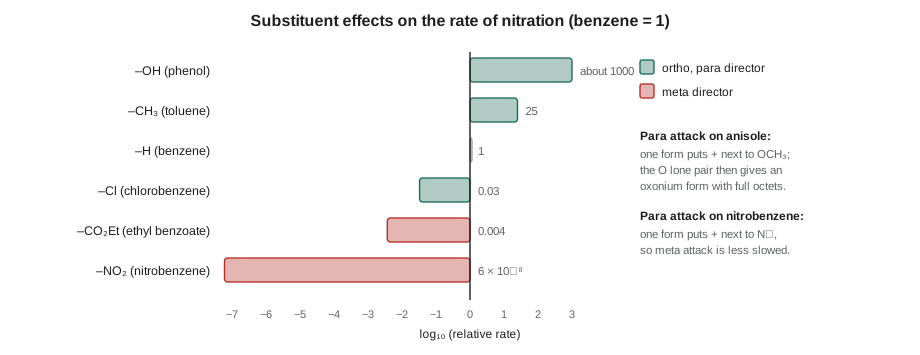
A substituent already on the ring changes how fast the ring reacts. Nitration of toluene, methylbenzene, is about 25 times faster than nitration of benzene; nitration of nitrobenzene is about 10 million times slower. Phenol and anisole react with bromine water instantly without a catalyst, while benzene needs FeBr₃. Groups that make the ring react faster than benzene are activating; groups that make it slower are deactivating.
Two effects explain these rates, both familiar from CHEM-261. The inductive effect is the pull or push of electrons through σ bonds, set by electronegativity. Alkyl groups donate weakly; halogens, carbonyl groups, nitro groups and positively charged groups withdraw. The resonance effect is the donation or withdrawal of electrons through the π system. A substituent with a lone pair on the atom attached to the ring, such as –OH, –OR, –NH₂ or a halogen, can donate that lone pair into the ring. A substituent with a π bond to an electronegative atom, such as –CHO, –COR, –CO₂H, –CN or –NO₂, withdraws π electrons from the ring.
Where the two effects compete, the outcome depends on their relative strengths. For –OH, –OR and –NH₂, resonance donation wins strongly over inductive withdrawal, and these are powerful activators. For the halogens, inductive withdrawal wins, so halobenzenes react somewhat more slowly than benzene, but resonance donation still controls where the electrophile goes. Groups that withdraw by both effects, such as –NO₂, –CN and carbonyl groups, are strong deactivators.
Substituent effects on orientation
A substituent also controls where the second group goes: ortho (the adjacent carbons, 2 and 6), meta (3 and 5) or para (4). The explanation lies in the arenium ion. When the electrophile attacks ortho or para to the substituent, one resonance form of the arenium ion puts the positive charge on the carbon that carries the substituent. When it attacks meta, no resonance form does.
If the substituent donates electrons, that form is especially stabilized. For an alkyl group, the cation it stabilizes is tertiary. For a group with a lone pair, such as –OCH₃, the lone pair can form a fourth resonance form in which every atom has an octet, an oxonium ion. Ortho and para attack are therefore favoured, and these groups are ortho, para directors. If the substituent withdraws electrons, the form with positive charge next to it is especially destabilized. A nitro group, with a positive nitrogen, places two positive charges side by side. Ortho and para attack are disfavoured, so meta attack, which avoids that form, wins by default: these groups are meta directors. They are not attracting the electrophile to the meta position; they are slowing the other positions more.
| Effect on rate | Groups | Directing effect |
|---|---|---|
| Strongly activating | –NH₂, –NHR, –NR₂, –OH, –O⁻ | ortho, para |
| Moderately activating | –OR, –NHCOR (amide nitrogen) | ortho, para |
| Weakly activating | –R (alkyl), –C₆H₅ | ortho, para |
| Weakly deactivating | –F, –Cl, –Br, –I | ortho, para |
| Moderately deactivating | –CHO, –COR, –CO₂R, –CO₂H, –CONH₂ | meta |
| Strongly deactivating | –CN, –SO₃H, –NO₂, –NR₃⁺, –CF₃ | meta |
Ortho or para? Partial rate factors
For ortho, para directors, the ratio of ortho to para product depends on steric hindrance and on statistics. There are two ortho positions but only one para position, so if they reacted equally, ortho would outnumber para two to one. In practice, bulky groups favour para. Nitration of toluene gives about 58 parts ortho, 5 meta and 37 para; nitration of tert-butylbenzene gives about 12 ortho, 8 meta and 80 para.
Ingold quantified these effects with partial rate factors. A partial rate factor f is the rate of substitution at one position of the substituted ring divided by the rate at one position of benzene, measured in competition experiments. For nitration of toluene in acetic anhydride at 25 °C, the partial rate factors are about fo = 42, fm = 2.5 and fp = 58. Even the meta position of toluene is more reactive than a position on benzene, because the methyl group donates inductively everywhere, but ortho and para are much more strongly activated. The program at the end of the lesson turns these factors into product ratios.
Synthesis with substituted benzenes
Directing effects make the order of reactions crucial. To make m-bromonitrobenzene, nitrate first and then brominate: the nitro group directs meta. To make p-bromonitrobenzene, brominate first and then nitrate: the bromine directs ortho and para, and the para isomer is separated from the ortho. Friedel–Crafts reactions fail on rings with meta directors, so an acyl group must be introduced before a nitro group, not after.
Some groups can be converted after they have done their directing work. A nitro group, a meta director, can be reduced to an amino group, an ortho, para director, with iron or tin and hydrochloric acid or by catalytic hydrogenation. An acyl group, a meta director, can be reduced to an alkyl group, an ortho, para director. A sulfonic acid group can block the para position and then be removed by heating with dilute acid. These tricks let chemists place substituents almost anywhere.
Worked problem
Planning a synthesis of a disubstituted benzene
Propose a synthesis of m-chloropropylbenzene (1-chloro-3-propylbenzene) from benzene.
Show solution
- The two groups are meta to each other, but propyl and chlorine are both ortho, para directors, so neither can be put on first to direct the other meta.
- A propyl group cannot be added by Friedel–Crafts alkylation with 1-chloropropane, which rearranges to give isopropylbenzene.
- Instead, acylate first: benzene + propanoyl chloride, AlCl₃ gives propiophenone, C₆H₅COCH₂CH₃. The acyl group is a meta director.
- Chlorinate: Cl₂, FeCl₃ puts chlorine meta to the acyl group, giving 3-chloropropiophenone.
- Reduce the ketone C=O to CH₂ (for example by the Wolff–Kishner reduction, lesson 7), giving 1-chloro-3-propylbenzene.
Answer: Friedel–Crafts acylation with propanoyl chloride, then chlorination (meta to the acyl group), then reduction of the ketone to CH₂.
Nucleophilic aromatic substitution and benzyne
Electron-poor aromatic rings can undergo the opposite kind of substitution, in which a nucleophile replaces a leaving group. 1-Chloro-2,4-dinitrobenzene reacts with hydroxide or amines at room temperature by addition–elimination: the nucleophile adds to the carbon bearing chlorine, forming a resonance-stabilized anion called a Meisenheimer complex, with the negative charge delocalized onto the nitro groups ortho and para to the site of attack, and chloride is then expelled. This SNAr reaction needs strong withdrawing groups ortho or para to the leaving group. Frederick Sanger used 1-fluoro-2,4-dinitrobenzene in this way to label the end of a protein chain in determining the structure of insulin, work that earned him the 1958 Nobel Prize. Unactivated aryl halides react with very strong bases such as sodium amide by a different route, elimination to a short-lived, highly strained intermediate called benzyne, followed by addition.
The Hammett equation
In 1937 Louis Hammett found a way to put numbers on substituent effects for meta and para substituents. He defined a substituent constant σ from the acidity of substituted benzoic acids in water at 25 °C: σ = log(Ka/Ka⁰), where Ka⁰ is the acid constant of benzoic acid itself. Electron-withdrawing groups stabilize the benzoate anion and have positive σ; donating groups have negative σ. For another reaction of the same family of substituted rings, the rate or equilibrium constants follow
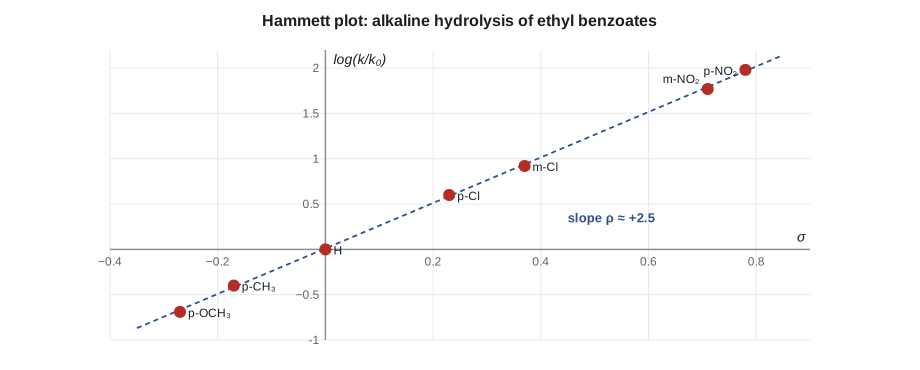
where ρ, the reaction constant, measures how sensitive that reaction is to substituents. A positive ρ means the reaction is helped by withdrawing groups, so negative charge builds up in the transition state, as in the alkaline hydrolysis of ethyl benzoates, ρ = +2.5. A negative ρ means positive charge builds up, as in electrophilic aromatic substitution, where ρ is large and negative. Linear free energy relationships of this kind, discussed further in CHEM-363, were among the first quantitative tools for deducing mechanisms.
import math

# partial rate factors for nitration of toluene (relative to one benzene position)
f = {'ortho': 42.0, 'meta': 2.5, 'para': 58.0}
positions = {'ortho': 2, 'meta': 2, 'para': 1}
total = sum(f[p] * positions[p] for p in f)
print('nitration of toluene, predicted isomer distribution (parts per hundred):')
for p in f:
    print(f'  {p:5s} {100 * f[p] * positions[p] / total:5.1f}')
print(f'  toluene/benzene rate ratio: {total / 6:.1f}')

# Hammett: substituent constants (benzoic acid ionization, water, 25 C)
sigma = {'p-OCH3': -0.27, 'p-CH3': -0.17, 'H': 0.00, 'p-Cl': 0.23,
         'm-Cl': 0.37, 'm-NO2': 0.71, 'p-NO2': 0.78}
# illustrative rate data for alkaline hydrolysis of ethyl benzoates (log k/k0)
logk = {'p-OCH3': -0.69, 'p-CH3': -0.40, 'H': 0.00, 'p-Cl': 0.60,
        'm-Cl': 0.92, 'm-NO2': 1.77, 'p-NO2': 1.98}

xs = [sigma[s] for s in sigma]; ys = [logk[s] for s in sigma]
n = len(xs); mx = sum(xs) / n; my = sum(ys) / n
sxx = sum((x - mx) ** 2 for x in xs); sxy = sum((x - mx) * (y - my) for x, y in zip(xs, ys))
rho = sxy / sxx; b = my - rho * mx
ss_res = sum((y - (rho * x + b)) ** 2 for x, y in zip(xs, ys))
ss_tot = sum((y - my) ** 2 for y in ys)
print(f'Hammett fit: rho = {rho:.2f}, intercept = {b:.2f}, r^2 = {1 - ss_res / ss_tot:.3f}')
print('p-NO2 ester reacts', round(10 ** logk['p-NO2']), 'times faster than the parent')nitration of toluene, predicted isomer distribution (parts per hundred): ortho 57.1 meta 3.4 para 39.5 toluene/benzene rate ratio: 24.5 Hammett fit: rho = 2.51, intercept = 0.01, r^2 = 1.000 p-NO2 ester reacts 95 times faster than the parent
The partial rate factors reproduce the observed distribution of toluene nitration, about 57 ortho, 3 meta and 39 para, and show that toluene reacts about 25 times faster than benzene overall. The Hammett fit returns ρ close to +2.5 with a straight line, the signature of a reaction in which negative charge develops at the carbonyl carbon in the rate-determining step; the hydroxide adds to the ester carbonyl, as lesson 10 describes.
Common mistakes
MistakeBenzene adds bromine across a double bond like an alkene.
InsteadWith FeBr₃ it substitutes, keeping the aromatic ring; addition would sacrifice about 150 kJ/mol.
MistakeMeta directors attract the electrophile to the meta position.
InsteadThey deactivate every position, but ortho and para more, so meta is the least slowed.
MistakeHalogens are deactivating, so they must be meta directors.
InsteadHalogens deactivate by induction but direct ortho, para by resonance donation of their lone pairs.
MistakeFriedel–Crafts alkylation with 1-chloropropane gives propylbenzene.
InsteadThe primary carbocation rearranges; isopropylbenzene is the main product. Use acylation then reduction.
MistakeFriedel–Crafts reactions work on nitrobenzene.
InsteadStrongly deactivated rings do not react; introduce the acyl group first.
MistakeA positive Hammett ρ means positive charge builds in the transition state.
InsteadPositive ρ means withdrawing groups help, so negative charge builds up.
Summary and key terms
- Electrophilic aromatic substitution proceeds by slow attack of the ring on E⁺ to form an arenium ion, then fast loss of H⁺.
- Halogenation (X₂, FeX₃), nitration (HNO₃, H₂SO₄), sulfonation (SO₃), Friedel–Crafts alkylation (RX, AlCl₃) and acylation (RCOCl, AlCl₃) generate the electrophile in different ways.
- Alkylation suffers rearrangement and polyalkylation; acylation does not and is followed by reduction to install alkyl chains.
- Donors (–NH₂, –OH, –OR, alkyl) activate and direct ortho, para; strong acceptors (–NO₂, –CN, C=O) deactivate and direct meta; halogens deactivate but direct ortho, para.
- Partial rate factors quantify positional reactivity; the order of steps controls substitution patterns in synthesis.
- Electron-poor rings undergo SNAr through a Meisenheimer complex; the Hammett equation log(k/k₀) = ρσ quantifies substituent effects.
- Arenium ion
- The cyclohexadienyl cation formed when an electrophile adds to an aromatic ring; also called a σ complex or Wheland intermediate.
- Activating group
- A substituent that makes the ring more reactive than benzene toward electrophiles.
- Ortho, para director
- A substituent that directs incoming electrophiles to positions 2, 4 and 6.
- Meta director
- A substituent that directs incoming electrophiles to positions 3 and 5.
- Partial rate factor
- The rate of substitution at one ring position relative to one position of benzene.
- Meisenheimer complex
- The anionic intermediate of nucleophilic aromatic substitution.
- Hammett equation
- log(k/k₀) = ρσ, relating rates or equilibria of substituted aromatic compounds.
Practice problems
Work each problem on paper first, then reveal the answer to check.
Predict the major product(s) of nitrating (a) anisole, (b) benzoic acid, (c) chlorobenzene.
Show answer
(a) o- and p-nitroanisole, faster than benzene; (b) m-nitrobenzoic acid, slower than benzene; (c) o- and p-chloronitrobenzene, mostly para, slower than benzene.
Outline a synthesis of p-nitrotoluene from benzene.
Show answer
Friedel–Crafts methylation (CH₃Cl, AlCl₃) to toluene, using excess benzene to limit polyalkylation, then nitration; separate the para isomer from the ortho.
Why does acylation need a full equivalent of AlCl₃ while bromination needs only a catalytic amount of FeBr₃?
Show answer
The aryl ketone product binds AlCl₃ through its carbonyl oxygen, removing it from the cycle; FeBr₃ is regenerated after each bromination.
Draw the resonance forms of the arenium ion from para attack on aniline and explain why aniline brominates so fast.
Show answer
One form puts the positive charge on the carbon bearing NH₂; the nitrogen lone pair then forms a fourth form, an iminium ion, in which every atom has an octet, strongly stabilizing the intermediate.
Using the partial rate factors in the program, what fraction of toluene nitration occurs meta?
Show answer
2 × 2.5 = 5 out of a total of 2 × 42 + 5 + 58 = 147: about 3.4 parts per hundred.
A reaction of substituted benzenes has ρ = −4. Do electron donors speed it up or slow it down, and what does this tell you about the transition state?
Show answer
Donors (negative σ) give positive log(k/k₀), so they speed it up; positive charge develops in the transition state, as in electrophilic aromatic substitution.
Lesson quiz · 5 questions
Score 60% or more to complete this lesson.
Create a free account to save your progress, take quizzes and earn a certificate.