
LES-104 · Lesson 10 of 12 · 24 min
Verbal communication: listening, tone and communicating across barriers
▶ Video coming soon A video version of this lesson is on the way.
Marco DiSanto spent six years in the army reserve, where orders were given loudly and obeyed quickly. On his ride-along with Sergeant Haddad, he watched her handle a call about a man shouting at people outside the Port Ardent library. Marco expected a firm order to move along. Instead she walked up slowly, stopped a few steps away, introduced herself by her first name and asked the man what was going on. He told her, at length, about a dispute with the library over a lost card. She listened for nearly four minutes, repeated his complaint back to him in a sentence, said she understood why he was frustrated and explained what she could and could not do. He walked away on his own. 'I could have ordered him to leave,' she told Marco afterward. 'Then I'd have been arresting him for not leaving. This way we both got to go home.'
Most police work is done by talking, and the way officers speak and listen shapes almost every outcome. This lesson covers the spoken side of police communication: listening, tone and non-verbal signals, giving clear directions, and communicating with people who face barriers, such as people in crisis, people with disabilities, people who do not speak English and young people. It also covers two especially difficult conversations: delivering bad news and speaking for the agency in public. The skills of de-escalation and crisis intervention are covered in depth in a later course; this lesson lays the foundation.
More than words
Spoken communication carries meaning through three channels at once: the words themselves, the voice (tone, volume, pace and pitch) and the body (facial expression, posture, gestures, distance and movement). A popular claim holds that words account for only a small fraction of meaning. That claim is a misreading of narrow laboratory studies from the 1960s and should not be repeated. What is true is that when words and non-verbal signals conflict, listeners tend to believe the non-verbal signals. An officer who says 'I'm here to help' while standing with arms crossed, frowning and speaking sharply is unlikely to be believed.
Officers must also be careful reading other people's non-verbal signals. Popular ideas about 'signs of lying', such as avoiding eye contact, fidgeting or touching the face, are not supported by research. Studies consistently find that people, including police officers, are only slightly better than chance at detecting lies from demeanour, and that training in such cues does not improve accuracy and may increase overconfidence. Nervousness is a normal reaction to being questioned by police, especially for people who have had bad experiences with police, and eye contact norms differ between cultures. Behaviour that matters for safety, such as clenched fists, scanning for exits or reaching for a pocket, is a different matter and is covered in the officer safety course.
Active listening
Active listening is a set of techniques for showing a person that they are being heard and understood, and for drawing out information. It is used in interviews, in crisis negotiation, in conflict resolution and in ordinary conversations with the public. The FBI's crisis negotiators describe it as the foundation of a staircase of influence: listening builds empathy, empathy builds rapport, and only with rapport can an officer influence what the person does. The techniques are simple to describe and hard to do well under pressure.
| Technique | Example |
|---|---|
| Minimal encouragers | "Mm-hmm." "Okay." "Go on." |
| Open questions | "What happened then?" "Tell me about that." |
| Paraphrasing | "So the library says you owe them for a book you returned." |
| Emotional labelling | "It sounds like you feel nobody is listening to you." |
| Mirroring | Repeating the last few words as a question: "Nobody believes you?" |
| Summarizing | "Let me make sure I have this right..." followed by the main points |
| Effective pauses | Staying silent to let the person continue or think |
| "I" messages | "I can't help you while you're shouting, but I want to hear what happened." |
Emotional labelling is often the most powerful and the most uncomfortable for new officers. Naming the emotion a person seems to be feeling ('You sound really angry about this') can seem risky, as if it might make things worse. In practice it usually does the opposite: people who feel their emotions have been recognized tend to calm down, and if the label is wrong, they correct it, which is itself useful information. The key is to label tentatively ('It sounds like...', 'It seems...') rather than telling people how they feel.
Active listening is also, quite simply, how officers get accurate information. Sergeant Haddad's four minutes of listening at the library revealed that the man was not threatening anyone, that his grievance was real if small, and that he lived nearby and could be found if needed. A quick order to leave would have revealed none of that.
Tone, respect and procedural justice
Lesson 1 described the four elements of procedural justice: voice, neutrality, respect and trustworthy motives. In conversation they become concrete habits. Introduce yourself and explain why you are there. Address people by their names and titles, asking how they prefer to be addressed. Explain what you are doing and why, especially before touching anyone or searching anything. Let people tell their side, even if it will not change the outcome. Explain what will happen next. Thank people for their cooperation. None of these takes long, and research in several countries shows they improve people's views of the police and their willingness to comply, both in the moment and in the future.
Tone matters as much as content. The same words, 'I need you to step back', can be a calm request or a threat, depending on volume, pace and facial expression. Officers are taught to match their tone to the situation: calm and conversational in most encounters, firm and clear when they need compliance, and loud and commanding only when there is an immediate threat. Starting at the top of the scale leaves nowhere to go. Officers who habitually speak to members of the public with sarcasm, condescension or profanity generate complaints and, more seriously, escalate encounters that could have been resolved peacefully.
Giving clear directions
When officers do need people to do something, clear directions make compliance easier and safer for everyone. A person who is frightened, intoxicated, injured or confused may not process complicated instructions. Good directions are short, specific and given one at a time: 'Put the bag on the ground.' Then: 'Step back toward me.' Each instruction should be given in plain words, with an explanation if time allows, and the officer should check that it was understood. An instruction to 'show me your hands' is clear; a stream of instructions such as 'get down, don't move, hands up, get on the ground, don't move' gives the person no possible way to comply with all of them.
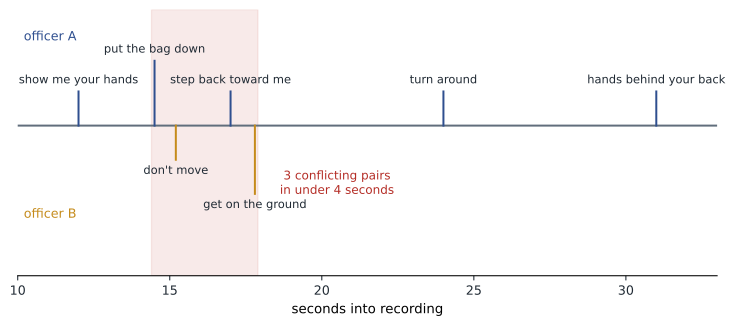
A related problem arises when several officers give instructions at once. If one officer shouts 'Get on the ground' while another shouts 'Don't move', the person cannot obey both, and any movement may be interpreted as resistance. Many agencies teach a 'one voice' rule: one officer gives directions and the others stay silent unless there is an emergency. Video reviews of incidents in both countries have shown how conflicting commands contributed to injuries and deaths. Training officers now use body-worn camera recordings to review exactly this. The program below shows how a reviewer might flag moments when two officers gave different commands within a few seconds of each other in a transcript.
# Flag conflicting commands from different officers within a short window
commands = [   # (seconds into the recording, speaker, command)
    (12.0, "officer A", "show me your hands"),
    (14.5, "officer A", "put the bag down"),
    (15.2, "officer B", "don't move"),
    (17.0, "officer A", "step back toward me"),
    (17.8, "officer B", "get on the ground"),
    (24.0, "officer A", "turn around"),
    (31.0, "officer A", "hands behind your back"),
]
moves = {"put the bag down", "step back toward me", "get on the ground", "turn around", "hands behind your back"}
WINDOW = 3.0
flags = []
for i, (t1, s1, c1) in enumerate(commands):
    for t2, s2, c2 in commands[i + 1:]:
        if t2 - t1 > WINDOW:
            break
        if s1 != s2 and c1 != c2:
            conflict = (c1 in moves) != (c2 in moves) or (c1 in moves and c2 in moves)
            if conflict:
                flags.append((t1, s1, c1, t2, s2, c2))
for t1, s1, c1, t2, s2, c2 in flags:
    print(f"{t1:5.1f}s {s1}: '{c1}'  vs  {t2:5.1f}s {s2}: '{c2}'  ({t2 - t1:.1f}s apart)")
print(f"{len(commands)} commands, {len(flags)} conflicting pairs within {WINDOW:.0f} seconds")14.5s officer A: 'put the bag down' vs 15.2s officer B: 'don't move' (0.7s apart) 15.2s officer B: 'don't move' vs 17.0s officer A: 'step back toward me' (1.8s apart) 17.0s officer A: 'step back toward me' vs 17.8s officer B: 'get on the ground' (0.8s apart) 7 commands, 3 conflicting pairs within 3 seconds
The review flags three conflicting pairs in less than four seconds. At about fifteen seconds, the person was told to put the bag down and, less than a second later, not to move, two instructions that cannot both be obeyed. Under two seconds after that, the first officer told the person to step back, contradicting the order not to move, and less than a second later the second officer said to get on the ground. Neither conflict led to harm in this training scenario, but either could have in a real one. The lesson the training officer draws is simple: decide before the encounter who will give directions, and have everyone else stay quiet unless they see a danger the speaker has not.
Communicating across barriers
Many of the people officers deal with face barriers to communication. Recognizing them and adapting is a legal duty as well as good practice. Provincial human rights codes and the Accessible Canada Act require public services, including police, to accommodate people with disabilities, and the Charter guarantees equality.
- People in mental health crisis may be frightened, confused or hearing things others cannot. Speak slowly and calmly, keep a safe distance, reduce noise and lights, avoid arguing about what the person believes, and allow time. Many agencies have crisis intervention trained officers and co-response teams with mental health workers, and many calls can be referred to crisis lines.
- People who are deaf or hard of hearing may rely on sign language, lip reading, written notes or hearing aids. Written notes may be enough for simple exchanges, but for an interview, an arrest or anything complex a qualified sign language interpreter is required. Never assume a person who does not respond to commands is refusing; they may not have heard.
- Autistic people may avoid eye contact, repeat words, react strongly to noise, lights or touch, and take language literally. These behaviours are easily misread as evasion or defiance. Speak plainly, give time to respond, avoid touching without warning and reduce sensory stimulation where possible.
- People with intellectual disabilities may not understand complex questions or legal rights, and may agree with whatever is suggested to please the officer. Use simple language, check understanding by asking the person to explain in their own words, and involve a support person. This is especially important before any interview about an offence.
- People with dementia may be disoriented and frightened. Approach calmly, introduce yourself repeatedly if needed and avoid correcting or arguing.
- Intoxicated people may have impaired understanding and judgment. Keep instructions very simple, repeat them, and remember that intoxication can mask medical emergencies such as head injuries or diabetic crises.
- People who do not speak English fluently need a qualified interpreter for anything important, as lesson 7 explained. Telephone interpretation is available in many languages at any hour.
- Children and youth need language suited to their age and should be told clearly what is happening. Youth have additional legal protections when questioned about offences, covered in the youth justice course.
Difficult conversations
Some of the hardest things officers do are conversations. Notifying a family that someone has died is among the most important. It must be done in person whenever possible, by two people, after the identity of the deceased has been confirmed, and as soon as possible so the family does not learn it from the media or social media. The officer should confirm they are speaking with the right person, ask to go inside and sit down, and then say clearly and directly what has happened, using the words 'died' or 'dead' rather than euphemisms such as 'passed' or 'we lost him', which can leave a shocked person unsure what they heard. Then the officer should stay, answer questions honestly, help the family contact support and leave written information about next steps.
Professor Desjardins tells the class about the worst night of his career, when he delivered news of a child's death after a collision, and about the mistake he made: he spent so long trying to soften the news that the mother had to ask him three times what he was saying. 'Kindness is being clear,' he says. 'The softening is for us, not for them.' Officers also deliver other bad news: that a stolen car has been found destroyed, that there is not enough evidence to lay a charge, that a missing person has not been found. The same principles apply: be direct, be honest, explain what happens next, and treat people with dignity.
Speaking for the agency in public is a different kind of difficult conversation. Officers at a scene are often approached by journalists, bystanders filming on their phones and people posting on social media. Most agencies have a public information officer who speaks for the agency, and policies that limit what other officers may say about an ongoing investigation, to protect the investigation, the privacy of victims and the fairness of any trial. Officers should be courteous to journalists and the public, refer questions to the designated spokesperson, never share personal information about victims or suspects, and assume that anything they say or do in public may be recorded and published. In both countries, members of the public generally have the right to film police in public places, provided they do not interfere.
Worked problem
Responding with active listening
Outside Lakeshore Hardware at 3:40 a.m., the owner, Ruth Lindqvist, says to the probationary officer: 'This is the third time in two years. Third time. Nobody ever gets caught and the insurance goes up every time. I don't know why I bother calling you people.' Write a response using active listening.
Show solution
- Begin with an emotional label: 'It sounds like you're exhausted and frustrated, and I don't blame you.'
- Paraphrase to show understanding: 'Three break-ins in two years, nobody caught, and it's costing you every time.'
- Give honest information without overpromising: 'Tonight is different in one way: we have a man in custody who was carrying tools that may be yours. I can't tell you how the case will turn out, but I can tell you what happens next.'
- Explain next steps and invite questions: 'An investigator will contact you today to go through the inventory. Here is the report number for your insurer. What questions do you have?'
Answer: The response recognizes her frustration instead of arguing with it, shows that the officer heard her, gives honest information and practical next steps, and invites her to keep talking. It is also likely to make her more willing to help with the investigation and to call police again.
Common mistakes
MistakeLies can be detected from body language such as avoiding eye contact.
InsteadResearch shows such cues are unreliable; nervousness is normal when speaking to police and eye contact norms vary.
MistakeA strong command voice should be used from the start to establish control.
InsteadStart calm and conversational; raise firmness only as the situation requires, leaving room to escalate.
MistakeWhen several officers are present, all should give commands to show strength.
InsteadUse one voice: one officer gives directions to avoid conflicting commands.
MistakeUsing gentle euphemisms makes death notifications kinder.
InsteadSay clearly that the person has died; euphemisms confuse people in shock.
Summary and key terms
- Meaning travels through words, voice and body; when they conflict, listeners believe the non-verbal signals.
- Demeanour cues are poor indicators of lying; nervousness is normal and culturally variable.
- Active listening (encouragers, open questions, paraphrasing, emotional labelling, mirroring, summarizing, pauses) builds rapport and gathers information.
- Procedural justice becomes concrete through introductions, explanations, listening, respect and next steps; tone should match the situation.
- Give short, specific directions one at a time, and use one voice when several officers are present.
- Adapt communication for people in crisis, with disabilities, intoxicated, with limited English and young people; deliver bad news directly and refer media questions to the spokesperson.
- Active listening
- Techniques that show a person they are heard and understood, and draw out information.
- Emotional labelling
- Tentatively naming the emotion a person appears to feel.
- Paraphrasing
- Restating what a person said in one's own words to confirm understanding.
- One voice
- The practice of having one officer give directions while others remain silent.
- Effective communication
- Communication with people with disabilities that is as effective as with others, which may require interpreters or aids.
- Public information officer
- The person designated to speak to the media for an agency.
Practice problems
Work each problem on paper first, then reveal the answer to check.
Give an example of emotional labelling.
Show answer
'It sounds like you're really worried about your son.'
Why should officers not rely on eye contact to judge honesty?
Show answer
Because research shows it is not a reliable cue, nervousness is normal with police and eye contact norms differ between cultures.
Rewrite as clear, single directions: 'Get down, hands up, don't move, drop it!'
Show answer
'Drop the bag.' Then: 'Show me your hands.' Then: 'Stay where you are.'
A deaf man is being arrested for a serious offence. Are written notes enough?
Show answer
No. For an arrest, rights advisement or interview, a qualified sign language interpreter is required for effective communication.
Why should death notifications use the word 'died'?
Show answer
Because euphemisms can leave a person in shock unsure of what they have been told.
Lesson quiz · 5 questions
Score 60% or more to complete this lesson.
Create a free account to save your progress, take quizzes and earn a certificate.