
LES-104 · Lesson 5 of 12 · 23 min
Plain language, accuracy and objectivity
▶ Video coming soon A video version of this lesson is on the way.
Priya Sandhu spent five years writing fraud reports for a bank before she enrolled in the program, and she thought report writing would be the easy part. Her first assignment comes back from Professor Desjardins covered in red ink. 'Upon arrival at the location, the writer proceeded to make contact with the complainant, who advised that she had observed an unknown male exiting the premises at a high rate of speed.' He has circled almost every phrase. In the margin he has written: 'I got there and spoke with Ms. Osei. She told me she saw a man run out of the store. Same facts. Half the words. And nobody has to translate.'
Police writing has a reputation for a peculiar language of its own, full of phrases that nobody uses in ordinary speech. This lesson argues that the reputation is deserved but the habit is unnecessary, and often harmful. Reports are read by people who are not police: prosecutors, judges, juries, victims, journalists and the public. Clear, plain writing serves all of them. The lesson then turns to two qualities that matter even more than style: accuracy and objectivity.
Why plain language
Plain language means writing so that the intended reader can find what they need, understand it the first time and use it. It is not simplistic or informal writing. Legal documents, medical instructions and government forms in both countries have moved toward plain language over the past thirty years, because research consistently shows that readers understand plain documents faster and more accurately. The Government of Canada's writing guidelines, and the plain language policies of several provinces, encourage short sentences, familiar words and the active voice. Police agencies have been slower to follow, but many now teach plain language in their academies.
Plain language matters in police reports for practical reasons. A judge reading a report at a bail hearing has a few minutes and many files. A juror must understand the officer's account without any background in policing. A victim reading the report later wants to recognize what happened to them. Jargon also creates risk. Phrases like 'the subject became combative' or 'the male was uncooperative' are vague, and in cross-examination a defence lawyer will ask exactly what they mean. An officer who wrote what actually happened, 'He pulled his arm away and swung his fist at my face', has nothing to explain.
Police jargon and its plain equivalents
Much police jargon comes from an understandable wish to sound official and neutral. Words like 'proceeded', 'observed' and 'advised' feel more formal than 'went', 'saw' and 'told'. But formality adds nothing to accuracy, and longer words make sentences harder to read. The table shows some of the most common examples. Most agencies now prefer the plain versions.
| Police jargon | Plain language |
|---|---|
| Upon arrival at the location | When I arrived |
| Proceeded to | (leave out: "I proceeded to speak with" becomes "I spoke with") |
| Observed | Saw |
| Advised | Told, said |
| Exited the vehicle | Got out of the car |
| Made contact with | Spoke with, met |
| The accused male / the subject | Use the person's name |
| At a high rate of speed | Fast; or the estimated speed and how it was estimated |
| At this point in time | Then, at 0221 hrs |
| Was in possession of | Had, was carrying |
| Due to the fact that | Because |
| The writer / this officer | I |
Some terms are genuinely technical and cannot be replaced, such as legal terms ('reasonable grounds', 'warrant', 'recognizance') or the names of specific procedures. Those are fine, provided they are used correctly. The target of plain language is the padding that surrounds them, not precise vocabulary. Abbreviations are another hazard. Officers use dozens of them in notes, but a report should spell out any abbreviation the first time it appears, and avoid the ones a general reader would not know. 'The S/M was located N/B on Pine' may be clear to a colleague; 'I found the suspect walking north on Pine Street' is clear to everyone.
Measuring readability
Readability formulas estimate how hard a text is to read from simple features such as sentence length and word length. The best known is the Flesch Reading Ease score, developed by Rudolf Flesch in the 1940s. It produces a number, usually between 0 and 100, where higher scores mean easier text. Ordinary newspaper writing typically scores somewhere in the fifties or sixties, and many legal and bureaucratic documents score below thirty. The formula is crude, because it knows nothing about meaning, but it is a useful warning sign: a report with very long sentences full of long words is almost always harder to read than it needs to be.
Priya compares her original sentence with Professor Desjardins's rewrite, using a short program that counts words, sentences and syllables and calculates the score. Counting syllables exactly requires a dictionary, so the program uses a simple rule of thumb: it counts groups of vowels in each word, with an adjustment for a silent final 'e'. That is accurate enough for comparing two versions of the same passage.
import re

def syllables(word):
    word = word.lower()
    groups = re.findall(r"[aeiouy]+", word)
    n = len(groups)
    if word.endswith("e") and not word.endswith("le") and n > 1:
        n -= 1                      # silent final e
    return max(n, 1)

def reading_ease(text):
    sentences = max(len(re.findall(r"[.!?]+", text)), 1)
    words = re.findall(r"[A-Za-z']+", text)
    syl = sum(syllables(w) for w in words)
    score = 206.835 - 1.015 * len(words) / sentences - 84.6 * syl / len(words)
    return len(words), sentences, syl, score

original = ("Upon arrival at the location, the writer proceeded to make contact with the "
            "complainant, who advised that she had observed an unknown male exiting the "
            "premises at a high rate of speed.")
plain = "I got there and spoke with Ms. Osei. She told me she saw a man run out of the store."

for label, text in (("original", original), ("plain", plain)):
    w, s, y, score = reading_ease(text)
    print(f"{label:8s} words {w:2d}  sentences {s}  syllables {y:2d}  "
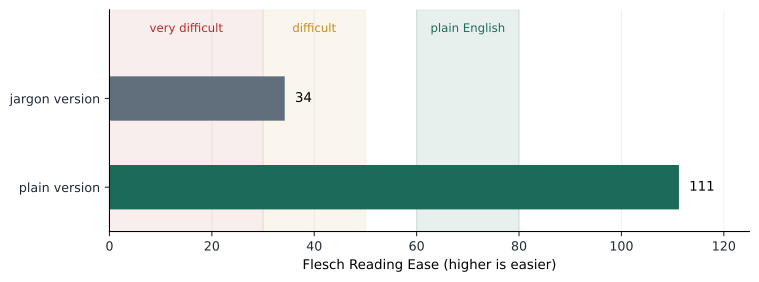
f"words/sentence {w / s:4.1f} reading ease {score:5.1f}")original words 32 sentences 1 syllables 53 words/sentence 32.0 reading ease 34.2 plain words 20 sentences 3 syllables 21 words/sentence 6.7 reading ease 111.2
The plain version uses fewer words, much shorter sentences and shorter words. Its reading ease score is above 100, off the top of the usual scale, while the original scores in the mid-thirties, the range of difficult, bureaucratic prose. The facts are the same. The difference is entirely in how much effort the reader must spend to get them. Note that the 'Ms.' in the plain version counts as a sentence ending for this simple program, which slightly flatters the score; real readability tools handle abbreviations more carefully. The comparison still holds.
Accuracy
Plain writing is pointless if it is wrong. Accuracy means that every fact in a report is correct and can be traced to a source: the officer's own observation, a witness, a document or a record. It sounds obvious, but small errors are common and their consequences can be large. A wrong date of birth can attach a criminal record to the wrong person. A misspelled name can make a witness impossible to find. A time copied wrongly from the notes can make the officer's account inconsistent with the dispatch records, and a defence lawyer will put the two side by side in front of the jury.
Accuracy also means precision. 'A large amount of cash' tells the reader little; '1,240 in 20 and 50 dollar bills' tells the reader exactly what was found. 'A short distance' should be a distance, measured or estimated, and the report should say which. 'Several minutes' should be a time. When the officer does not know something precisely, the report should say so honestly: 'about 20 m, estimated by pacing', 'between 0300 and 0330 hrs, according to the owner, who could not be more precise'. Honest uncertainty is a form of accuracy.
Copying is a special danger. Officers who attend many similar calls, impaired driving stops for example, are tempted to reuse wording from earlier reports. Courts in both countries have criticized reports that described every suspect with identical phrases, and judges have rejected evidence when it became clear that an officer's report described observations he could not have made in that case. Every report must describe the events of that incident, as that officer perceived them.
Objectivity
An objective report records facts without letting the writer's feelings, assumptions or preferred outcome shape how they are presented. Perfect objectivity is impossible, because every report involves choices about what to include and how to say it. But officers can avoid the most common ways that subjectivity creeps in.
- Loaded words. Words like 'hysterical', 'belligerent', 'sketchy', 'claimed' and 'admitted' carry judgments. 'She was hysterical' is an opinion; 'She was crying loudly and shouting, and twice I asked her to slow down so I could understand her' is a description. 'He claimed he was home' suggests the officer disbelieved him; 'He said he was home' does not.
- Conclusions presented as facts. 'He was drunk', 'she was lying' and 'the suspect fled' all state conclusions. Record the observations that support them: the odour of alcohol, the inconsistency between two statements, the man running away when officers arrived. Where an opinion is part of the officer's job, such as an opinion about impairment, set out the observations it is based on.
- Selective reporting. Including only the facts that support a charge and leaving out those that do not is both unfair and dangerous. If a witness said the man she saw was taller than the suspect, or a second witness described a different jacket, those facts belong in the report. Prosecutors must disclose them, and an officer who left them out will be asked why.
- Irrelevant personal information. Details of a person's race, religion, sexual orientation, appearance or lifestyle belong in a report only when they are relevant, for example as part of a description used to identify someone. Gratuitous detail suggests bias and has been used to discredit officers.
Including facts that favour the accused is not disloyalty to the investigation. It is part of the officer's duty to the truth and to the court, and it protects the prosecution from later surprises. The disclosure rules from R. v. Stinchcombe require the Crown to disclose relevant information whether it helps or hurts its case, and the police have a corresponding duty to give the Crown everything relevant. A report that records everything relevant, fairly, makes the officer a credible witness. One that reads like an argument invites the defence to look for what was left out.
Grammar, spelling and the small things
Readers judge the writer from the writing. A report full of spelling mistakes and broken sentences suggests carelessness, and a defence lawyer may suggest the investigation was careless too. Spell-checkers catch some errors but miss words that are spelled correctly but wrong, such as 'there' for 'their', and they do not check names. Officers should verify the spelling of every name with the person or an identity document and use the same spelling throughout.
A few grammatical problems cause real confusion. Misplaced modifiers can change meaning: 'While handcuffing the suspect, the knife fell from his pocket' says the knife was doing the handcuffing. Pronouns with unclear references are another trap: 'Lindqvist told Osei that she had locked the door' does not say who locked it. Long sentences that string several events together with 'and then' can hide the sequence. The cure for most of these problems is the same: short sentences, one fact or action each, with the person doing the action named at the start.
Technology and the writer's responsibility
Reports are increasingly written with the help of technology. Records management systems offer templates and drop-down menus, and since 2024 some agencies have trialled software that uses artificial intelligence to draft a report narrative from body-worn camera audio. The appeal is obvious: report writing takes a large share of every shift. But the officer remains responsible for every word. A draft produced by software may mishear words, mix up speakers, include things the officer did not perceive or leave out things the officer did. At least one large prosecutor's office in Washington State told police in 2024 that it would not accept narratives drafted with artificial intelligence, and other agencies and legislatures have begun requiring officers to disclose when such tools are used and to certify that they reviewed the result. Whatever tools an agency adopts, the standard does not change: the report must be the officer's accurate, honest account.
Worked problem
Rewriting for plain language and objectivity
Constable Patel, who stopped the man on Pine Street, wrote this passage in his first draft. Rewrite it: 'Upon arrival, the writer observed the accused male, who was known to police, acting in a suspicious manner in the vicinity of the premises. When approached he became belligerent and refused to cooperate, so he was detained.'
Show solution
- Replace jargon with plain words and use the first person: 'When I arrived, I saw...'.
- Replace 'acting in a suspicious manner' with observations: what was he doing, where, for how long?
- Remove 'known to police', which is irrelevant to what he was doing and suggests bias, unless his history is specifically relevant and recorded separately.
- Replace 'belligerent' and 'refused to cooperate' with what he said and did, and state the grounds for the detention.
Answer: A rewritten version might read: 'At 0228 hrs I saw Kyle Brandt walking north on Pine Street, about three blocks east of Lakeshore Hardware. He was wearing a white hooded sweatshirt and carrying a black backpack that appeared heavy. He looked back over his shoulder twice and then walked faster. I called to him and identified myself. He said, “I don’t have to talk to you,” and kept walking. Because he matched the description broadcast at 0222 hrs and was on the route the witness described, about fifteen minutes after the alarm, I detained him for investigation at 0229 hrs and told him why.' Every phrase now describes something observed, and the grounds are clear.
Common mistakes
MistakeFormal police phrases make a report sound more professional.
InsteadJargon makes reports harder to read and invites questions; plain, specific language is more professional.
MistakeA good report includes only facts that support the charge.
InsteadA fair report includes all relevant facts, including those that favour the accused, which must be disclosed anyway.
Mistake'He was uncooperative' is an observation.
InsteadIt is a conclusion; describe what he said and did.
MistakeSoftware that drafts reports means the officer no longer needs to check them.
InsteadThe officer is responsible for every word and must verify that the report reflects what he or she perceived.
Summary and key terms
- Plain language means writing so the intended reader can understand the report the first time; it is precise, not informal.
- Replace police jargon with plain words, spell out abbreviations and keep technical legal terms only where they are needed.
- Readability formulas such as Flesch Reading Ease flag long sentences and long words.
- Accuracy means every fact is correct, precise and traceable to a source; never copy wording from other reports.
- Objectivity means avoiding loaded words, conclusions presented as facts, selective reporting and irrelevant personal details.
- Short sentences with the actor named first prevent most grammatical confusion; the officer is responsible for every word, whatever tools are used.
- Plain language
- Writing that the intended reader can find, understand and use the first time.
- Jargon
- Specialized or inflated language that outsiders find hard to understand.
- Flesch Reading Ease
- A readability score based on sentence length and syllables per word; higher means easier.
- Loaded word
- A word that carries a judgment or emotion beyond its literal meaning.
- Objectivity
- Recording facts fairly, without letting the writer's feelings or preferred outcome shape them.
- Misplaced modifier
- A phrase placed so that it seems to describe the wrong word in a sentence.
Practice problems
Work each problem on paper first, then reveal the answer to check.
Give plain equivalents for 'observed', 'advised' and 'exited the vehicle'.
Show answer
Saw, told (or said) and got out of the car.
A passage has 60 words in 3 sentences and 84 syllables. What is its Flesch Reading Ease score?
Show answer
206.835 - 1.015 x 20 - 84.6 x 1.4 = 206.835 - 20.3 - 118.44 = 68.1.
Why is 'He claimed he was at home' less objective than 'He said he was at home'?
Show answer
'Claimed' suggests the officer disbelieves him, which is a judgment rather than a fact.
Fix the misplaced modifier: 'Running down the alley, the backpack fell off the suspect.'
Show answer
'As the suspect ran down the alley, his backpack fell off.'
A second witness describes a different jacket from the one the suspect wore. Should this go in the report?
Show answer
Yes. It is relevant, it must be disclosed, and leaving it out would make the report unfair and damage the officer's credibility.
Lesson quiz · 5 questions
Score 60% or more to complete this lesson.
Create a free account to save your progress, take quizzes and earn a certificate.