
LES-104 · Lesson 12 of 12 · 22 min
Capstone: a complete report package from call to court
▶ Video coming soon A video version of this lesson is on the way.
On the last evening of the course, Professor Desjardins brings back the page he showed in the first class, his report on the Harbour Street bar fight from thirty years ago, and hands a copy to each student. 'You've had twelve weeks,' he says. 'Tell me everything that's wrong with it.' In fifteen minutes the class produces a list that fills the whiteboard: no times, no names for the bartender or the other man, 'became aggressive' and 'a physical altercation ensued' instead of what anyone actually did, no source for any fact, no grounds for the arrest, no mention of the witness who said the other man swung first. Marco DiSanto adds the last item: 'It reads as if he wrote it the next week.' The professor nods. 'Three days later,' he says. 'From memory.'
This capstone lesson brings the course together. It walks through the complete package of records produced by the Lakeshore Hardware call, from the alarm at 2:14 a.m. to the trial eleven months later, showing how each lesson's skills appear in the finished product. It then sets out the capstone assignment, in which each student prepares a complete report package for an incident of their own, and the rubric used to assess it. The goal is not to memorize a format but to understand why each element is there and what goes wrong without it.
The Lakeshore Hardware package
By the time the case reaches trial, the file contains more than thirty documents and recordings. Each was produced by a different person at a different time, and each had to be consistent with the others. The table lists the main items, who produced them and which lesson's skills they depend on.
| Item | Produced by | Key skills |
|---|---|---|
| Alarm company 911 call and CAD log | Monitoring company, call-taker, dispatcher | Communications records (lesson 9) |
| Radio recordings, including the 0222 broadcast | Officers and dispatcher | Radio discipline, broadcast descriptions (lessons 6 and 9) |
| Officers' notes (three officers) | Each officer | Contemporaneous notes, sources, observation (lessons 2 and 3) |
| General occurrence report | Investigating officer | Structure, narrative, plain language, elements (lessons 4 and 5) |
| Arrest report | Investigating officer | Grounds, rights and cautions with times (lessons 4 and 8) |
| Supplementary reports (crowbar, detention, interview, follow-up) | Other officers and the detective | Same skills, linked by report number |
| Witness statements: owner and neighbour | Detective | Interviewing and statements (lessons 7 and 8) |
| Doorstep body-worn camera recording | Investigating officer's camera | Interview technique, disclosure (lessons 7 and 11) |
| Property report and exhibit list with continuity | Investigating officer and property officer | Property description, chain of custody (lessons 2 and 6) |
| Scene photographs, photo log and sketch | Investigating officer | Scene description, triangulation (lesson 6) |
| Inventory and receiving records with serial numbers | Owner, via the detective | Proving the elements (lesson 4) |
| Crown brief synopsis and disclosure index | Detective | Plain language, accuracy, disclosure (lessons 5 and 11) |
Several lessons from the course show up in the way these items fit together. The times in the officers' notes match the CAD log and radio recordings, except for one: the probationary officer's original note of the detention at 2:31, which the training officer's checker flagged in lesson 2 and which she explained in a late entry. The report's description of the suspect matches the broadcast, and the differences, the hood down and the backpack, are explained. The neighbour's statements are disclosed in both versions, with the doorstep recording that shows the leading question about the crowbar. The serial numbers on the property report match the owner's receiving binder. None of this happened by accident; each was the result of habits taught in the course.
The synopsis
The synopsis is a short summary of the whole case, written for the prosecutor, and often the first document a judge sees at a bail hearing. It must be accurate, objective and complete in its essentials, and short enough to read in a few minutes. It draws together the facts the prosecutor needs to prove each element, identifies the witnesses who can prove them and flags any weaknesses. A synopsis that overstates the case invites trouble: if the evidence at trial does not match, the prosecutor's confidence in the police, and the court's, suffers. The detective's synopsis for the Lakeshore Hardware case begins as follows.
On Saturday, March 14, 2026, at 0213 hrs, the front door of Lakeshore Hardware, 412 Harbour Street, Port Ardent, was smashed and the store entered. The owner, Ruth Lindqvist, had closed and locked the store at 1800 hrs on March 13 and gave no one permission to enter. A neighbour, Mira Osei, heard glass break and saw a man in a white hooded sweatshirt run from the store toward Pine Street. At 0229 hrs, about fifteen minutes after the alarm, Cst. A. Patel detained the accused, Kyle Brandt, 23, walking north on Pine Street about three blocks east of the store, wearing a white hooded sweatshirt and carrying a black backpack. The backpack contained three cordless drills and a reciprocating saw whose serial numbers match items missing from the store's display. A crowbar was found in the alley east of the store at 0233 hrs. The accused was arrested at 0229 hrs, advised of his rights to counsel and cautioned, and declined to give a statement. Ms. Osei saw the man only briefly, from an upstairs window, and estimated his height as taller than the accused's measured height. In her first account she said he may have had a bag; in a later statement she said he had a backpack and a crowbar, after being asked a leading question about a crowbar at the scene. The crowbar has been sent for fingerprint and tool-mark analysis.
Look at what the synopsis does. It states each element with a source: the break, the entry, the owner's lack of permission, the time and place, and the link between the accused and the property. It is written in plain language with precise times. And it states the weaknesses openly: the witness saw the man only briefly, her height estimate does not fit, her account of the crowbar changed after a leading question. A prosecutor reading it knows exactly what the case rests on (the serial numbers, the time and distance, the clothing) and what the defence will attack. That honesty is not a weakness of the synopsis; it is what makes the prosecutor trust it.
The capstone assignment
Each student prepares a complete report package for an incident based on a scenario provided by the instructor, using recordings, photographs and role-played witnesses. The package must include the officer's notes, the main report, at least one witness statement, a property or evidence list if applicable, a scene description or sketch, a synopsis and a brief reflection on what the student would do differently. Each student's scenario draws on their own interests.
- Amara Okafor, who wants to be a detective, documents an assault outside a bar in the Harbour Street district, with two witnesses who disagree about who threw the first punch and a security camera recording that partly contradicts both.
- Jesse Morningstar documents a report of a missing teenager from Nimkii Bay First Nation, working with the youth's family, an elder who serves as a support person and a neighbouring police service, and taking care to record the family's information accurately and respectfully.
- Priya Sandhu, with her fraud background, documents a telephone scam in which an older resident was persuaded to buy gift cards, with bank records, phone records and a victim who is embarrassed and reluctant to talk.
- Marco DiSanto documents a two-vehicle collision with injuries, with a scene sketch using the baseline method, measurements, statements from both drivers and a witness, and an interpreter for one of the drivers.
- Linh Tran documents a domestic disturbance call from the communications centre's side: the 911 call, the call-taker's questions, the dispatch, the radio traffic and the CAD log, together with the responding officer's notes, and analyzes whether the records are consistent.
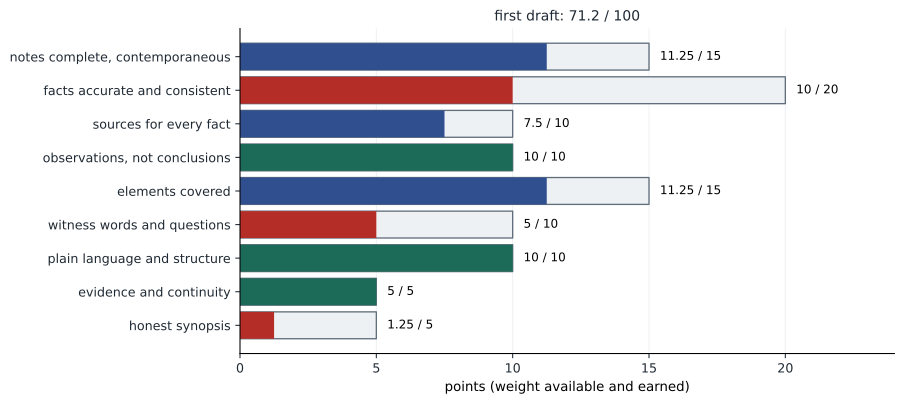
The packages are assessed against a rubric that reflects the course. Each criterion is weighted by its importance, and each is scored from 0 (missing) to 4 (excellent). Accuracy and completeness carry the most weight, because no amount of good style can rescue a report that is wrong or incomplete. The program below shows how the rubric scores a package. It uses Amara's first draft, which her instructor scored before returning it for revision.
# Capstone rubric: weighted score for a report package (scores 0-4)
rubric = {   # criterion: (weight, score for Amara's first draft)
    "notes complete and contemporaneous": (15, 3),
    "facts accurate and consistent across documents": (20, 2),
    "sources shown for every fact": (10, 3),
    "observations, not conclusions": (10, 4),
    "elements of the crime covered": (15, 3),
    "witness words and questions recorded": (10, 2),
    "plain language and structure": (10, 4),
    "evidence and continuity documented": (5, 4),
    "weaknesses stated honestly in synopsis": (5, 1),
}
assert sum(w for w, _ in rubric.values()) == 100
total = sum(w * s / 4 for w, s in rubric.values())
print(f"weighted score: {total:.1f} / 100")
weak = sorted(((w * (4 - s) / 4, c, s) for c, (w, s) in rubric.items() if s < 3), reverse=True)
print("biggest gains available:")
for lost, c, s in weak:
print(f" {c:48s} scored {s}/4, {lost:4.1f} points to gain")weighted score: 71.2 / 100 biggest gains available: facts accurate and consistent across documents scored 2/4, 10.0 points to gain witness words and questions recorded scored 2/4, 5.0 points to gain weaknesses stated honestly in synopsis scored 1/4, 3.8 points to gain
Amara's draft scored in the low seventies, a solid start. Her style was strong: she described observations rather than conclusions and wrote in plain, well-organized language. The rubric showed where the points were. The largest single gain was in accuracy and consistency, because the time she gave for the first punch in her report did not match the security video, and one witness's name was spelled two ways. The next largest were in recording the witnesses' own words and her questions, and in the synopsis, which presented the case as stronger than it was by leaving out the disagreement between the two witnesses. All three were fixable in an afternoon, and her revised package scored in the nineties.
What the course has been about
Looking back over the course, the class identifies a few principles that ran through every lesson. The first is that the record is the work: for everyone who was not there, including the prosecutor, the court and the public, the officer's notes and reports are the only evidence of what the officer saw and did. The second is honesty about sources and limits: say how you know each fact, separate what you saw from what you were told, and admit what you did not see or do not remember. The third is respect for the people in the record, whether they are victims, witnesses or the accused: record their words faithfully, describe them fairly and protect their information. The fourth is clarity: plain words, precise times and descriptions, logical structure. And the fifth is that every reader matters, from the sergeant reviewing the report in the morning to the defence lawyer reading it a year later.
Linh Tran adds a sixth from her experience in the communications centre: communication is a loop, not a line. Every message needs feedback to confirm it was understood, whether it is a plate read back on the radio, a witness's statement read back for corrections, or a draft report read by a colleague before it is submitted. Professor Desjardins says that is the best summary of the course he has heard. Then he tears his thirty-year-old report in half, drops it in the recycling bin and wishes the class luck.
Worked problem
Reviewing a report package for consistency
Before submitting his collision package, Marco checks it for consistency. His notes give the time of the collision as 1745 hrs; the report says 1750; the witness statement says 'around quarter to six'; and the CAD log shows the 911 call at 17:46:20. One driver's name appears as 'Nguyen' in the notes and 'Nguyen-Lee' in the report. How should he resolve these?
Show solution
- Identify the most reliable source for the time: the CAD time stamp of the 911 call, 17:46:20, sets a latest time for the collision.
- The notes (1745) and the witness ('around quarter to six') are consistent with that; the report's 1750 is not, because the call came before then. Check the notes to see where 1750 came from; if it was a typing error, correct the report draft before submission, citing the CAD time.
- In the report, state the time with its basis: 'The collision occurred at about 1745 hrs. The first 911 call was received at 17:46:20 (CAD).'
- For the name, check the driver's licence and his own statement. If his legal name is Nguyen-Lee, use it throughout the report and add a supplementary entry in the notes explaining the shortened form, without altering the original note.
Answer: Each inconsistency is resolved by going back to the most reliable source, stating the basis in the report and explaining any difference rather than hiding it. A defence lawyer comparing the documents will find a careful officer, not a careless one.
Common mistakes
MistakeA capstone package is mainly about using the right forms.
InsteadForms matter less than accuracy, completeness, sources and honesty; the rubric weights those most.
MistakeA synopsis should present the case as strongly as possible.
InsteadA synopsis must be accurate and state weaknesses openly; overstatement damages trust and can derail the case.
MistakeInconsistencies between documents should be fixed so they match.
InsteadGo back to the most reliable source, correct drafts openly, and explain differences in the record rather than altering original notes.
MistakeOnce the report is submitted, the officer's work on communication is done.
InsteadDisclosure, supplementary reports, preparation and testimony all depend on the original record and continue long after submission.
Summary and key terms
- A single call produces a file of notes, reports, statements, recordings, exhibits and records that must all be consistent.
- Each document depends on skills from the course: notes, observation, narrative, plain language, description, interviewing, statements, radio and testimony.
- The synopsis states each element with its source, in plain language, and openly states the weaknesses.
- The capstone rubric weights accuracy and completeness most heavily, then sources, elements, witness words, clarity and honest assessment.
- Resolve inconsistencies by returning to the most reliable source and explaining differences, never by altering original records.
- The record is the work; be honest about sources and limits, respect the people in the record, write clearly and close every communication loop.
- Report package
- The complete set of records produced for an incident, from notes to synopsis.
- Synopsis
- A short, objective summary of a case for the prosecutor, stating the facts, witnesses and weaknesses.
- Rubric
- A scoring guide listing criteria, their weights and levels of performance.
- Disclosure index
- A list of every item provided to the defence.
- Consistency check
- A review comparing times, names and facts across all documents in a file.
Practice problems
Work each problem on paper first, then reveal the answer to check.
Name five documents that might be in a report package for a break-in.
Show answer
For example: officers' notes, the main report, an arrest report, witness statements, a property report with continuity, photographs and a sketch, CAD and radio records, and a synopsis.
Why should a synopsis state the weaknesses of a case?
Show answer
So the prosecutor can make an informed decision and is not surprised at trial; honesty builds trust and protects the case.
A rubric criterion has weight 20 and a score of 2 out of 4. How many points does it contribute, and how many could be gained?
Show answer
20 x 2/4 = 10 points earned; 10 more could be gained.
The notes say 1745, the report 1750 and CAD shows the 911 call at 17:46. Which time should the report give?
Show answer
About 1745, with the CAD call time cited as the basis; 1750 is inconsistent with a call at 17:46.
State three principles that ran through the course.
Show answer
For example: the record is the work; be honest about sources and limits; respect the people in the record; write clearly; every reader matters; close the communication loop.
Lesson quiz · 5 questions
Score 60% or more to complete this lesson.
Create a free account to save your progress, take quizzes and earn a certificate.