
LES-104 · Lesson 11 of 12 · 22 min
Reports, disclosure and testifying in court
▶ Video coming soon A video version of this lesson is on the way.
Eleven months after the Lakeshore Hardware break-in, the probationary officer, now a fully qualified constable, sits on a bench outside courtroom 3 at the Ontario Court of Justice with her notebook in her lap. She has read her notes four times and her report twice. She has reviewed the CAD log and listened to her radio broadcast. She knows the defence lawyer has all of it too, because the prosecution disclosed it months ago, along with the doorstep recording of her conversation with Mira Osei, including the leading question about the crowbar. When she is called, she will take an oath or affirmation, and for the next hour everything she wrote that night will be tested, line by line, by someone whose job is to find what she got wrong.
Everything in this course leads here. Notes, reports, statements and radio recordings are written and kept so that they can be used in court, and their quality is tested most severely there. This lesson follows a case from the report room to the witness box: how the case file is assembled and disclosed, how officers prepare to testify, how notes are used while testifying and how to handle cross-examination.
From report to prosecution
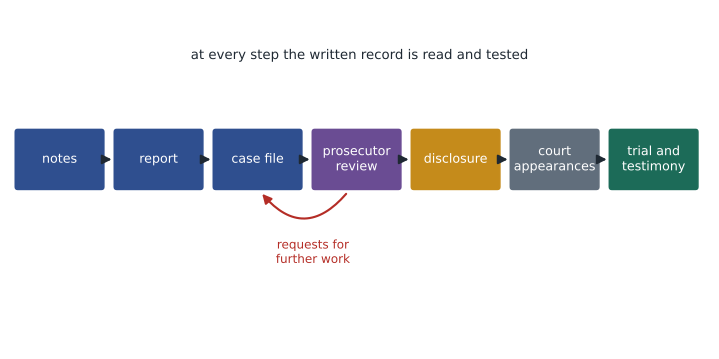
When an officer believes there are grounds for a charge, the reports, statements and evidence are assembled into a package for the prosecutor. In most of Canada, the package is called a Crown brief. Police lay most charges, and the Crown reviews them, although in British Columbia, Quebec and New Brunswick the Crown approves charges before they are laid. The brief includes a synopsis of the case, the reports, witness statements, the accused's statements, a list of exhibits and the officers' notes, together with information about any criminal record. The Crown uses it to decide whether to proceed and what to disclose.
A case file is only as strong as its weakest document. A careful prosecutor reads every report and statement looking for gaps and inconsistencies, because the defence will do the same. Prosecutors frequently return files to police with requests for further work: a missing statement, an unexplained time, an exhibit with no record of where it went. Each request delays the case. Officers who learn to write complete, consistent files from the start save themselves, the prosecutor and the courts a great deal of work.
Disclosure
The defence's right to see the evidence is one of the most important protections in criminal justice, and it makes police records central to every case. In R. v. Stinchcombe (1991), the Supreme Court of Canada held that the Crown must disclose all relevant information in its possession, whether inculpatory or exculpatory, unless it is clearly irrelevant or privileged. The police have a corresponding duty to give the Crown all relevant material from the investigation. In R. v. McNeil (2009), the court added that serious misconduct findings against officers involved in a case may have to be disclosed. And in R. v. Jordan (2016), the court set ceilings on delay, 18 months for cases in provincial court and 30 months for cases in superior court, beyond which delay is presumed unreasonable and charges may be stayed; slow or incomplete disclosure is a common cause of delay.
Disclosure has practical consequences for every officer. Every note, report, statement, recording, email and text message about a case may have to be disclosed, including drafts and rough notes in some circumstances. Officers must keep all of it and give all of it to the prosecutor, not just the parts that support the charge. An officer who withholds material, even innocently, can cause a mistrial, a stay of proceedings or a conviction overturned on appeal. An officer found to have been dishonest in a report or in testimony may become unable to testify credibly in any future case, which effectively ends a policing career.
Delay matters too, and good records help avoid it. The Lakeshore Hardware case was charged on March 14 and is set for trial eleven months later. The code below checks the case against the applicable time limit, using the rules that apply in each country. The calculations are simplified, but they show why prosecutors press police to complete files quickly.
# Jordan ceiling check (simplified): provincial court case, 18-month ceiling
from datetime import date
charged = date(2026, 3, 14)
trial_end = date(2027, 2, 12)
defence_delay_days = 28      # an adjournment requested by the defence
total = (trial_end - charged).days
net = total - defence_delay_days
ceiling = 18 * 30.44          # 18 months in days
print(f"total delay: {total} days ({total / 30.44:.1f} months)")
print(f"minus defence delay: {net} days ({net / 30.44:.1f} months)")
print(f"ceiling: {ceiling:.0f} days; margin {ceiling - net:.0f} days")
print("presumptively unreasonable" if net > ceiling else "under the ceiling")total delay: 335 days (11.0 months) minus defence delay: 307 days (10.1 months) ceiling: 548 days; margin 241 days under the ceiling
The case is well under the Jordan ceiling, with about eight months to spare once the adjournment the defence asked for is subtracted. More complex cases are not so comfortable: a file returned to police several times for missing documents, each time adding weeks or months, can use up the margin quickly. Delay attributable to the Crown or the police counts against the ceiling, and incomplete disclosure is one of the most common reasons cases are stayed. The broader point is the same in both countries: the justice system expects police files to be complete and timely, and courts can end prosecutions when they are not.
Preparing to testify
Officers are summoned to court by a subpoena, and attending is part of the job. Preparation begins long before the court date, with notes and reports that will support accurate testimony. Close to the date, the officer should review his or her own notes and reports, the statements of witnesses the officer dealt with, the CAD log and radio recordings, any body-worn camera footage and photographs, and the list of exhibits the officer handled. The goal is to refresh memory, not to memorize a script. Officers should also meet with the prosecutor when possible to understand what the testimony will cover.
Officers should never discuss their evidence with other witnesses in the case, including other officers, in a way that could shape each other's testimony. Courts treat collaboration between police witnesses with suspicion, for the same reasons discussed in lesson 3. Reviewing one's own materials is proper; comparing accounts and smoothing out differences is not. If an officer notices an error in his or her own notes or report while preparing, the officer should tell the prosecutor at once, so it can be disclosed, rather than hoping nobody notices.
Using notes in the witness box
Witnesses testify from memory, but the law allows them to use notes in certain circumstances, and police officers rely on this constantly. In Canada, an officer may ask the court's permission to refer to notes to refresh his or her memory. The judge will usually ask when the notes were made, whether they were made by the officer, whether they were made at or near the time of the events, and whether they have been changed since. Defence counsel may then examine the notes and cross-examine on them. If an officer has no memory at all of an event, notes made at the time may sometimes be admitted as a record of past recollection, but only if strict conditions are met.
The questions a court asks about notes show why the notebook rules in lesson 2 matter. Notes made at the time, by the officer, with no blank spaces, no removed pages and clearly marked corrections and late entries, will be accepted easily. Notes written days later, or copied from someone else's, or with unexplained changes, invite a challenge that may prevent the officer from using them, and may damage the officer's credibility on everything else. An officer who wrote very little at the time will have little to refresh memory with, and a year later may have little memory to refresh.
Giving evidence
Testimony begins with direct examination, also called examination-in-chief in Canada, in which the prosecutor asks open questions that let the officer tell what happened. Cross-examination follows, in which the defence asks questions, usually leading ones, designed to test the officer's account. The prosecutor may then re-examine on new matters raised in cross. The judge may also ask questions. In some cases there is a separate hearing, without the jury, on whether particular evidence should be admitted, for example whether a search or a statement violated the accused's rights.
Good testimony follows a few simple rules that apply whether the officer is testifying for the first time or the hundredth.
- Listen to the whole question. Pause before answering, which gives time to think and lets the prosecutor object if necessary.
- Answer only the question asked, truthfully and concisely. Do not volunteer information, argue or speculate.
- If you do not know or do not remember, say so. Never guess, and never fill a gap with what probably happened.
- If you do not understand a question, ask for it to be repeated or clarified.
- Speak clearly to the judge or jury, not only to the lawyer asking the questions. Use plain language, not police jargon, and explain any terms you must use.
- Stay calm and courteous, especially under hostile questioning. Never show anger, sarcasm or impatience.
- Concede fairly. If something in your notes is wrong or missing, or a defence suggestion is reasonable, say so. Admitting a small point honestly makes the rest of your evidence more credible.
Cross-examination of police officers often focuses on the same few themes: inconsistencies between the officer's notes, report and testimony, or between the officer's account and recordings; omissions, things not written down that the officer now remembers; the conditions of observation; opinions and conclusions presented as facts; leading questions put to witnesses; and the grounds for detentions, searches and arrests. Every one of these is addressed by the practices taught in this course. An officer whose notes are complete and contemporaneous, whose report separates observation from information, who recorded witnesses' words and the questions asked, and whose times match the CAD log has very little to fear from cross-examination.
| Defence line of attack | The habit that answers it |
|---|---|
| "You didn't write that down, did you?" | Contemporaneous, complete notes (lessons 2 and 4) |
| "Your notes say 2:31 but the CAD log says 2:29." | Times checked against CAD and recordings, with sources stated (lessons 4 and 9) |
| "You didn't see that yourself; someone told you." | Sources recorded for every fact (lesson 3) |
| "'Became aggressive' is your opinion. What did he actually do?" | Observations, not conclusions (lesson 5) |
| "You suggested the crowbar to her, didn't you?" | Open questions, with questions recorded (lessons 7 and 8) |
| "What made this man a suspect, other than a white hoodie?" | Grounds set out fact by fact (lessons 4 and 6) |
In the Lakeshore Hardware trial, the defence lawyer asks the officer about the leading question she put to Mira Osei on the doorstep. The officer answers: 'Yes, I asked her whether he had a crowbar. I had heard on the radio that one had been found. I should have asked an open question. Her answer was that she wasn't sure. That is recorded on my camera and in my notes.' The lawyer has nowhere to go. A poor answer, defensive or evasive, would have cast doubt on the officer's honesty and perhaps on Ms. Osei's evidence; the honest answer limits the damage to the crowbar, which the case does not depend on.
Worked problem
Answering under cross-examination
Defence counsel says: 'Officer, your notes say you arrived at 2:19, but you wrote them at 4:05, didn't you? So you can't really be sure of any of these times.' Write an answer that is honest and accurate.
Show solution
- Listen to the whole question and recognize that it contains two parts: a fact (when the notes were written) and a conclusion (that the times are unreliable).
- Concede the fact honestly: 'Yes. My notes from 0214 to 0330 were written at 0405, and I recorded that in my notebook.'
- Answer the conclusion accurately, without arguing: 'The times I recorded came from the CAD screen in my car and from my radio transmissions, which are time-stamped. I noted that in my notes. The CAD log disclosed to you shows my arrival at 2:19.'
- Stop there. Do not add speculation or criticize the question.
Answer: The answer concedes what is true, explains the source of the times as recorded at the time, and points to independent records. It is calm, short and honest, which is exactly what makes it persuasive.
Common mistakes
MistakeOnly the parts of the file that support the charge need to go to the prosecutor.
InsteadEverything relevant goes to the prosecutor, including material that helps the accused; the prosecutor must disclose it.
MistakeOfficers should agree on a common account before testifying so the evidence is consistent.
InsteadEach officer reviews his or her own materials; collaborating on testimony undermines credibility and can contaminate memory.
MistakeAdmitting a mistake in the witness box will lose the case.
InsteadConceding small points honestly makes the rest of the evidence more credible; evasion does far more damage.
MistakeIf you cannot remember a detail, give your best estimate.
InsteadSay you do not remember; refer to your notes if permitted, and never guess.
Summary and key terms
- Police assemble a Crown brief; most provinces have police lay charges, but in BC, Quebec and New Brunswick the Crown approves them first.
- Stinchcombe requires disclosure of all relevant information; McNeil can require disclosure of officer misconduct; Jordan sets 18- and 30-month delay ceilings.
- Keep and hand over everything; withheld or dishonest records can end cases and careers.
- Prepare by reviewing your own materials; never collaborate on testimony; disclose errors you find.
- Notes made at the time, by the officer, unaltered, can be used to refresh memory, and the defence may examine them.
- Listen, pause, answer only the question, admit what you do not know, use plain language, stay calm and concede fairly.
- Crown brief
- In Canada, the package of reports, statements and evidence prepared for the Crown prosecutor.
- Subpoena
- A court order requiring a person to attend and testify.
- Examination-in-chief
- The questioning of a witness by the party who called them; called direct examination in the United States.
- Cross-examination
- Questioning of a witness by the opposing party, usually with leading questions.
- Refreshing memory
- Consulting notes while testifying to help recall events, with the court's permission or under the rules of evidence.
- Stay of proceedings
- A court order halting a prosecution, for example because of unreasonable delay or abuse of process.
Practice problems
Work each problem on paper first, then reveal the answer to check.
Name three things an officer should review before testifying.
Show answer
For example: his or her notes and reports, the CAD log and radio recordings, body-worn camera footage, statements taken and the exhibit list.
Why do courts treat collaboration between police witnesses with suspicion?
Show answer
Because discussing evidence can merge or change memories and suggests the officers shaped their testimony to match.
What questions will a court ask before letting an officer refresh memory from notes?
Show answer
When the notes were made, by whom, whether at or near the time of the events, and whether they have been altered.
A defence lawyer asks a question you do not understand. What should you do?
Show answer
Ask for the question to be repeated or clarified before answering.
A provincial court case is charged on January 10, 2026 and ends on September 1, 2027, with 60 days of defence delay. Is it over the 18-month ceiling?
Show answer
Total delay is 599 days; minus 60 is 539 days, about 17.7 months, just under the 18-month ceiling (about 548 days).
Lesson quiz · 5 questions
Score 60% or more to complete this lesson.
Create a free account to save your progress, take quizzes and earn a certificate.