
LES-104 · Lesson 9 of 12 · 23 min
Radio communication and working with the communications centre
▶ Video coming soon A video version of this lesson is on the way.
Linh Tran's first shift as a part-time call-taker at the Port Ardent communications centre is a Friday night. In twelve hours she answers seventy-three calls. One is a man who has locked himself out of his car. One is a woman whispering that her husband is drunk and has a knife. Several are about noise. One is a child who has found her grandmother on the kitchen floor. Behind Linh, the dispatchers manage the radio channels, sending units, tracking where every officer is and listening for the change in an officer's voice that means something has gone wrong. 'The officers think we are the voice on the radio,' her supervisor tells her. 'We are also the ones who remember everything they said.'
The radio is an officer's lifeline. It is how calls are assigned, how information reaches officers on the street, how officers ask for help and how a supervisor knows what is happening across the city. Radio communication is also recorded, and those recordings become evidence. This lesson explains how the communications centre works, how to use the radio clearly and safely, and how radio traffic fits into the written record of an incident.
The communications centre
Emergency calls in both countries are answered at a public safety answering point, a centre that receives 911 calls and either handles them or transfers them to the right agency. In some places a single centre answers all calls and dispatches police, fire and ambulance; in others, calls are answered at one centre and transferred to separate police, fire and ambulance dispatch centres. Port Ardent's centre answers 911 calls and the police non-emergency line, and dispatches police directly. Fire and ambulance calls are transferred.
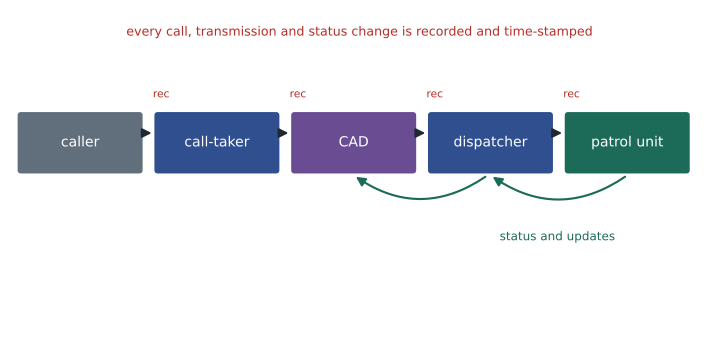
Two roles are central. The call-taker answers the call, determines what is happening and where, gathers essential information and enters it into the computer-aided dispatch (CAD) system, often while keeping the caller on the line and giving instructions, such as how to perform chest compressions or how to stay safe. The dispatcher, who sees the call appear in CAD, assigns units based on priority, availability and location, relays information to them by radio and computer, updates the call as it develops and monitors officers' safety. In smaller centres one person may do both jobs.
Call-takers follow structured questioning protocols for many types of call, which help ensure that the critical questions are asked in the right order: where is the emergency, what is happening, is anyone hurt, are weapons involved, is the suspect still there, what does the suspect look like and which way did they go. The answers are coded into CAD, which assigns a priority. Most centres use a priority scale in which the highest level covers immediate threats to life, such as a weapon in use or a serious injury, and the lowest covers reports that can be taken by phone or online.
Both countries are moving from older 911 networks to Next Generation 911, which is based on internet technology and allows text messages, more accurate caller location and, eventually, photographs and video to be sent to the centre. In Canada the transition is being directed by the Canadian Radio-television and Telecommunications Commission, and many centres already accept text messages from registered deaf, hard-of-hearing and speech-impaired callers through the Text with 9-1-1 service. These changes will give call-takers more information, but also more to manage, and they will add new kinds of records to the evidence in many cases.
Radio systems
Most police radio systems today are digital trunked systems, in which a computer assigns conversations to available channels automatically, allowing many users to share a limited number of frequencies. Officers select talk groups, such as a district patrol channel, a city-wide channel or a channel for a particular operation, rather than individual frequencies. Many agencies encrypt their radio traffic so that it cannot be heard on public scanners, a practice that protects officers' safety and people's privacy but has been criticized by journalists for reducing transparency. Provincial public safety radio networks, such as Alberta's AFRRCS and Ontario's Public Safety Radio Network, allow police, fire, ambulance and other agencies to talk to each other during major incidents.
Officers also communicate through mobile data terminals or laptops in their vehicles and through smartphones. Much routine information, such as call details, database query results and status changes, now travels this way, which reduces radio traffic and keeps sensitive personal information off the air. But the radio remains essential for anything urgent, for coordinating units at a scene and for any situation in which the officer cannot look at a screen.
Radio discipline
A radio channel is a shared resource, and when one person talks, no one else can. A single officer who talks too long, or a few officers chatting about something unimportant, can block an urgent call for help. Radio discipline is the set of habits that keeps the channel clear and messages understandable. Dispatchers and experienced officers notice immediately when a new officer lacks it.
- Think before you key the microphone. Know what you are going to say, then say it.
- Wait for a gap. Listen first so you do not talk over someone else, and pause briefly after pressing the button before speaking, because some systems clip the first syllable.
- Identify yourself and whom you are calling, using call signs: 'Dispatch, 12.' Wait for acknowledgement before giving a long message, unless it is urgent.
- Keep it brief and in a logical order: who, what, where, then details. Break long messages into parts.
- Speak clearly and at a steady pace, with the microphone a few centimetres from your mouth, and do not shout, which distorts the sound.
- Acknowledge messages so the sender knows they were received, and read back critical information such as addresses, plates and descriptions.
- Keep personal information off the air where possible, using data terminals for names, dates of birth and criminal records.
- Stay calm. A calm voice helps everyone listening think clearly; a panicked one spreads panic.
Urgent traffic takes priority over everything. Every agency has a way to clear the channel for an emergency, such as a code word, a tone, or the emergency button on the officer's radio, which alerts the dispatcher and opens the officer's microphone. An officer who needs help immediately should give the essential information first: who, where and what is needed. 'Twelve, emergency, Harbour and Pine, fighting with one, need help now' gives the dispatcher everything needed to send units. Details can come later.
Plain language and codes
For decades, many agencies used numeric codes, the best known being the ten-codes such as '10-4' for 'acknowledged', to shorten radio messages. The problem is that the codes were never standard: the same code could mean different things in neighbouring agencies, which caused dangerous confusion when agencies worked together. In Canada, practice varies: some services still use ten-codes, others have moved to plain language, and many use a mix, with a few standard codes kept for officer safety. Officers must learn their own agency's system, but the trend is toward plain English, with a small number of codes kept for situations where the meaning should not be obvious to bystanders.
Some information must be spelled out precisely, especially names and licence plates. For this, police use the international phonetic alphabet, the same one used by aviation and the military, in which each letter has a distinctive word: Alpha, Bravo, Charlie, Delta and so on. Letters that sound alike on a poor radio connection, such as B, D, E, G, P, T and V, are easily confused when spoken as letters, but not when spoken as words. Numbers are spoken digit by digit: '412' is 'four one two'. Some agencies use other word lists that predate the international one, so new officers should learn the one their agency uses.
# Spell a plate or name with the international phonetic alphabet
PHONETIC = dict(zip("ABCDEFGHIJKLMNOPQRSTUVWXYZ",
    "Alpha Bravo Charlie Delta Echo Foxtrot Golf Hotel India Juliett Kilo Lima Mike "
    "November Oscar Papa Quebec Romeo Sierra Tango Uniform Victor Whiskey X-ray "
    "Yankee Zulu".split()))
DIGITS = "zero one two three four five six seven eight nine".split()

def spell(text):
    out = []
    for ch in text.upper():
        if ch in PHONETIC:
            out.append(PHONETIC[ch])
        elif ch.isdigit():
            out.append(DIGITS[int(ch)])
        elif ch in " -":
            out.append("/")
    return " ".join(out)

for item in ["CKPT 418", "HKR 2207", "BRANDT"]:
    print(f"{item:9s} -> {spell(item)}")

# letters that are easy to confuse when spoken as letters
confusable = set("BCDEGPTVZ")
plate = "BDP 3E7"
risky = [ch for ch in plate if ch in confusable]
print(f"{plate}: {len(risky)} easily confused letters {risky}; spoken: {spell(plate)}")CKPT 418 -> Charlie Kilo Papa Tango / four one eight HKR 2207 -> Hotel Kilo Romeo / two two zero seven BRANDT -> Bravo Romeo Alpha November Delta Tango BDP 3E7: 4 easily confused letters ['B', 'D', 'P', 'E']; spoken: Bravo Delta Papa / three Echo seven
The output shows why the phonetic alphabet matters. The plate 'BDP 3E7' contains four letters that sound almost identical when spoken as letters over a noisy channel, so 'B D P' could easily be heard as 'P T B' or 'V G E'. Spoken as 'Bravo Delta Papa', there is no ambiguity. Names are spelled the same way, which avoids the errors that make a person impossible to find in a database. In Linh's centre, call-takers spell back every name and plate to the caller, and dispatchers read back every plate an officer gives, closing the communication loop described in lesson 1.
Broadcasting a description
A broadcast description must be short enough to be remembered by officers who are driving, and detailed enough to distinguish the person. Agencies usually prescribe an order, similar to the one in lesson 6: what happened, where and when, the number of suspects, then each suspect's description from general to specific, then the direction and means of travel, and finally any weapon or danger. Constable Malhotra's broadcast at 2:22 a.m. went like this: 'All units, break and enter just occurred at Lakeshore Hardware, Harbour Street. One male suspect, twenties, thin build, white hoodie with the hood up, dark pants, last seen running east toward Pine on foot, about three minutes ago. Possibly carrying a bag. Unknown weapons.'
The broadcast includes only what the witness actually reported. It does not say 'tall', because the witness was unsure and was looking down from a window, and it describes the bag as 'possibly'. It gives the time since the event, which tells officers how far the man could have travelled. It ends with weapons information, which affects how officers approach. When the description is updated, for example after a second witness is found, the officer should broadcast the update clearly, saying what has changed.
Radio traffic as evidence
Every 911 call and every radio transmission is recorded and time-stamped, and CAD logs every status change and every note the dispatcher enters. These records are routinely requested by prosecutors and the defence, played in court and examined by oversight bodies. They can be powerful evidence, because they capture events as they happened: the caller's words, the officer's breathing during a chase, the exact time a description was broadcast. They can also expose inconsistencies. If an officer's notes say a suspect was told the reason for his arrest at 2:36, but the radio shows the officer reporting at 2:36 that she was still searching for him, the defence will notice.
For this reason officers should treat everything they say on the radio as if it will be played in court, which it may be. Jokes, sarcasm, frustration and careless remarks about the people they are dealing with have been played back to juries and quoted in the media. Officers should also make sure their notes are consistent with the recorded radio traffic and CAD times, and where their notes rely on CAD times, they should say so. In the Lakeshore Hardware case, the prosecutor will receive the 911 call from the alarm company, the radio recording of Constable Malhotra's broadcast and the CAD log, and will compare all three with the officers' notes.
| Record | What it shows | How officers use it |
|---|---|---|
| 911 call recording | The caller's words, tone and background sounds, and the call-taker's questions | Confirms what was reported and when; may capture the offence itself |
| Radio recordings | Every transmission on the talk group, time-stamped | Confirms broadcasts, requests and times; checks consistency with notes |
| CAD log | Call creation, priority, unit assignments, status changes and dispatcher notes | Source of precise times for reports; shows what officers were told |
| Mobile data messages and queries | Database checks and messages between units | Shows what information officers had and when |
Worked problem
Clearing a call over the radio
At 4:25 a.m., the probationary officer is ready to clear the Lakeshore Hardware call: the suspect is in custody at the station, the scene has been photographed, the owner has secured the door with plywood, and the investigator has been notified. Write a clear, brief radio transmission.
Show solution
- Identify: 'Dispatch, 12.' Wait for 'Go ahead, 12.'
- Give the status in a logical order, briefly: 'Clearing Lakeshore Hardware. One in custody at the station, scene photographed and released to the owner, door secured. Investigations notified.'
- Give any information other units need: 'Report to follow.'
- Leave out names, dates of birth and other personal details, which go in the report and over the data terminal.
Answer: A complete transmission might be: 'Dispatch, 12, clearing Lakeshore Hardware, one in custody at the station, scene released to the owner and secured, investigations notified, report to follow.' It takes about ten seconds, keeps personal information off the air and tells the dispatcher everything needed to close the call in CAD.
Common mistakes
MistakePressing the button and speaking immediately saves time.
InsteadListen first, pause after keying, and know what you will say before you speak.
MistakeTen-codes are standard everywhere, so they are always safe to use.
InsteadCodes vary between agencies and can cause confusion; use your agency's system and plain language when working with others.
MistakePersonal details should be broadcast so all units have them.
InsteadKeep names, dates of birth and records off the air where possible; use data terminals.
MistakeRadio traffic is temporary and informal.
InsteadEvery transmission is recorded and may be played in court; speak as if a jury is listening.
Summary and key terms
- The communications centre answers 911 and non-emergency calls; call-takers gather information into CAD and dispatchers assign and support units.
- Next Generation 911 is adding text and better location to emergency calls in both countries.
- Digital trunked radio systems use talk groups; data terminals carry routine and personal information off the air.
- Radio discipline: think first, wait for a gap, identify, keep it brief and ordered, read back critical details, stay calm; urgent traffic takes priority.
- Plain language is replacing inconsistent ten-codes; the phonetic alphabet prevents confusion of letters in plates and names.
- 911 calls, radio traffic and CAD logs are recorded and disclosed; notes must be consistent with them.
- Public safety answering point
- A centre that receives 911 calls.
- Call-taker
- The person who answers emergency and non-emergency calls and gathers information.
- Dispatcher
- The person who assigns units to calls and manages radio communication.
- Talk group
- A virtual channel on a trunked radio system shared by a group of users.
- Ten-codes
- Numeric radio codes such as 10-4; their meanings vary between agencies.
- Phonetic alphabet
- A set of words (Alpha, Bravo, Charlie...) used to spell letters clearly by radio.
- Next Generation 911
- Internet-based emergency calling that supports text, better location and media.
Practice problems
Work each problem on paper first, then reveal the answer to check.
What is the difference between a call-taker and a dispatcher?
Show answer
The call-taker answers calls and gathers information into CAD; the dispatcher assigns units and manages radio communication.
Spell the plate 'GTV 58' using the phonetic alphabet.
Show answer
Golf Tango Victor five eight.
Why have many agencies moved away from ten-codes?
Show answer
Because their meanings were not standard between agencies, which caused confusion, especially when agencies worked together.
Put these broadcast elements in order: direction of travel, what happened and where, weapons, description, number of suspects.
Show answer
What happened and where, number of suspects, description, direction of travel, weapons.
Why should officers compare their notes with CAD times?
Show answer
Because CAD and radio records are disclosed, and inconsistencies with the notes will be used to challenge the officer's account.
Lesson quiz · 5 questions
Score 60% or more to complete this lesson.
Create a free account to save your progress, take quizzes and earn a certificate.