
LES-104 · Lesson 2 of 12 · 24 min
Officer notes: the duty to take notes and what to record
▶ Video coming soon A video version of this lesson is on the way.
Constable Dev Malhotra keeps her notebooks in a locked drawer at home, in date order, with a label on each spine showing the first and last date it covers. She has filled forty-one of them in nine years. Most of what is in them will never be read by anyone. A small part has been read aloud in court, quoted in a complaint investigation and examined line by line by defence lawyers. She cannot know in advance which entries those will be, so she writes all of them the same way. 'The notebook is the only witness that never forgets,' she tells the probationary officers she trains, 'as long as you gave it something to remember.'
This lesson explains what officers' notes are, why the law treats them so seriously and what a good set of notes contains. Notes are the raw material of every later document: the report, the witness list, the disclosure package and the officer's testimony. Errors and gaps in notes travel forward into all of them. A report can be rewritten; notes made at the time cannot be remade later, and that is exactly what gives them their value.
What notes are and why they matter
An officer's notes are a running, contemporaneous record of what the officer did, saw, heard and was told while on duty. Contemporaneous means made at the time of the events or as soon as practicable afterward, while memory is fresh. Notes are written first for the officer, to support his or her memory, but they become part of the official record of an investigation and, in a prosecution, part of the evidence the other side is entitled to see.
Notes matter for four reasons. First, memory is unreliable. As lesson 3 explains, people forget details quickly and fill the gaps with what they expect, and officers are no exception. A trial may take place a year or more after an arrest, by which time an officer may have attended hundreds of other calls. Second, notes allow an officer to testify accurately. Courts allow witnesses to refresh their memory from notes made at the time, and the quality of those notes largely decides how credible the officer will be. Third, notes are a tool of accountability. They show what the officer knew when decisions were made, such as the grounds for a search or an arrest, and supervisors and oversight bodies rely on them. Fourth, notes protect the officer. An officer accused of misconduct who can point to a clear, detailed, contemporaneous record is in a far stronger position than one who must rely on memory.
In Canada, the duty to take notes comes from service policy, provincial policing standards and the common law. The Supreme Court of Canada's decision in Wood v. Schaeffer (2013) arose from Ontario's Special Investigations Unit, which investigates incidents where police cause death or serious injury. The court held that officers involved in such incidents may not consult a lawyer before completing their notes, because notes must reflect the officer's own independent recollection, uninfluenced by advice about how to present it. The court described accurate, detailed and comprehensive notes as an integral part of an officer's duties.
The notebook
Most police services issue officers a notebook with numbered pages, and many have moved to electronic notes on a phone or in-car computer. Whatever the format, the same rules apply. The purpose of the rules is to make it obvious that nothing has been added, removed or changed after the fact. Professor Desjardins describes them as the rules that let a judge trust a page written by a stranger.
| Rule | Why it matters |
|---|---|
| Use a bound notebook with numbered pages, or the approved electronic system | Missing or inserted pages are immediately obvious |
| Write in ink, never pencil | Entries cannot be erased and rewritten |
| Write in chronological order, with the time of each entry | The sequence of events and decisions can be reconstructed |
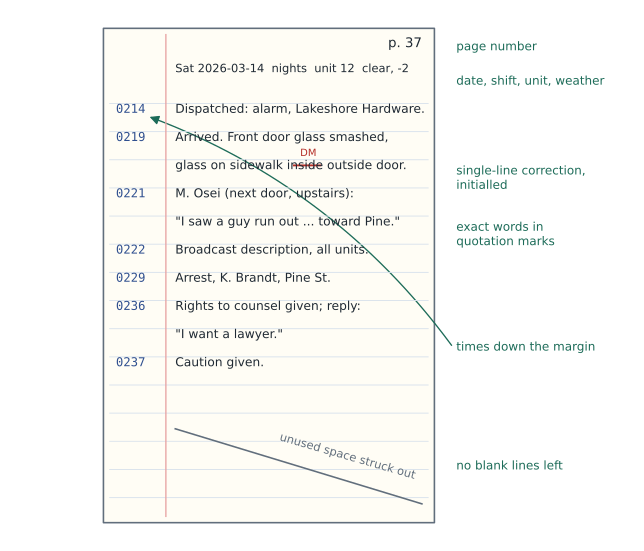
| Do not leave blank lines or spaces; draw a line through unused space | Nothing can be added later between entries |
| Correct errors with a single line through the mistake, initialled, so it stays readable | Changes are visible and explained, not hidden |
| Never tear out pages or use correction fluid | Removal of information suggests tampering |
| Record the start and end of each shift, with date, weather and assignment | The context of every entry is clear |
| Write the notes yourself, from your own observations | Notes reflect the officer's independent recollection |
Electronic notebooks follow the same principles in software. Each entry is automatically time-stamped, entries cannot be deleted, and later changes are saved as amendments with their own time stamp while the original remains visible. Electronic notes are easier to read and search, can include photographs and sketches, and can be linked directly to the report in the records management system. Their weakness is that typing on a phone while talking to a distressed witness can be awkward, and some officers jot rough notes on paper and transcribe them later. If they do, the rough notes are part of the record and must be kept.
When to write
The ideal is to write notes as events happen, and some things must be recorded on the spot: a licence plate, a suspect's exact words, the time a caution or rights advisement was given. In practice, an officer who is struggling with a suspect, giving first aid or directing traffic cannot write at the same time. The standard is therefore 'at the time or as soon as practicable afterward.' What counts as practicable depends on the circumstances, but the longer the delay, the more the notes will be questioned. Notes written at the end of a shift about events that happened ten hours earlier are much weaker than notes written in the cruiser ten minutes after the call.
When notes cannot be written immediately, the officer should record when they were written. An entry such as '0405 hrs: notes of events from 0214 to 0330 written now, in cruiser at the station lot' is honest and allows the court to judge their reliability. Officers should never backdate an entry or write it as if it had been made earlier. If something is remembered later, it should be added as a late entry with the time it was written and a note explaining when it was recalled.
A difficult question arises when an officer's actions were recorded by a body-worn camera. Some agencies let officers review the footage before writing notes or reports, arguing that accuracy improves. Others require officers to write an initial account first, from memory, and then review the footage and write a supplementary account, arguing that this preserves the officer's own perception, which is what matters in judging decisions made under pressure. Policies differ and are still changing. What all agencies agree on is that the officer must say whether the footage was reviewed before the notes were written, so that the reader knows which account is which.
What to record
The single most useful guide to what belongs in notes is a question every prosecutor and defence lawyer will eventually ask: 'Officer, how do you know that?' Notes should allow an officer to answer that question for every important fact. That means recording not only what happened, but how the officer came to know it: by seeing it, hearing it, being told by a named person, or finding it in a database.
The classic checklist is the five Ws and H: who, what, when, where, why and how. Who was involved, as suspects, victims and witnesses, with full names, dates of birth, addresses and phone numbers. What happened, in the order it happened. When each thing happened, to the minute where possible. Where it happened, with addresses, directions and distances. Why the officer acted, meaning the grounds for each decision. How the incident unfolded and how the officer responded. To the five Ws and H, police add the officer's actions: every caution, rights advisement, search, seizure, arrest, use of force and notification, each with the time it occurred.
- Dispatch and arrival: time dispatched, the information given by the dispatcher, time of arrival and the route or approach if it matters.
- Scene: weather, lighting, road conditions, the layout of the scene, and anything unusual, such as a door forced or glass broken.
- People: full identifying details for everyone involved and how identity was confirmed, such as by a driver's licence or by the person's own statement.
- Statements: what people said, as close to word for word as possible, in quotation marks, especially any admissions by a suspect and any words that matter to the elements of the offence.
- Observations: what the officer personally saw, heard and smelled, described in concrete terms rather than conclusions.
- Actions: arrests, cautions and rights advisements with exact times, searches and what was found, use of force, first aid, notifications to supervisors, investigators or family.
- Evidence: each item seized, where and when it was found, who found it and where it went, which begins the chain of custody, also called continuity.
- Sketches: a simple drawing of the scene with measurements, especially for collisions and break-ins.
Notes should record facts, not conclusions. 'The male appeared intoxicated' is a conclusion. 'The male had a strong odour of an alcoholic beverage on his breath, red, watery eyes and slurred speech, and swayed while standing' is a set of observations from which a court can draw its own conclusion. Lesson 5 develops this point in detail. The same applies to people's words. 'The victim said the suspect threatened her' tells the reader little. 'She said, “He told me he would burn the house down with me in it”' tells the reader exactly what was said.
Checking notes for completeness
Sergeant Haddad reviews the notes of every probationary officer on her platoon during their first months. She looks for gaps in the timeline, missing times for key actions and missing information about the people involved. To make the review faster, the platoon's training officer wrote a short program that checks an electronic notebook entry against a list of required elements and looks for time stamps that are missing or out of order. The code below runs the check on the probationary officer's notes from the Lakeshore Hardware call.
# Check a notebook entry: times in order, no long gaps, required actions present
entries = [
    ("02:14", "dispatched: alarm at Lakeshore Hardware"),
    ("02:19", "arrived; front glass door smashed"),
    ("02:21", "witness M. Osei, apartment next door, says male ran east"),
    ("02:22", "broadcast description to all units"),
    ("02:31", "unit 14 reports male detained on Pine Street"),
    ("02:29", "arrest by Cst. Malhotra"),
    ("02:36", "rights to counsel given"),
    ("03:30", "owner R. Lindqvist arrives, lists missing items"),
]
required = ["dispatched", "arrived", "arrest", "rights to counsel", "caution", "seized"]

def minutes(t):
    h, m = t.split(":")
    return int(h) * 60 + int(m)

problems = []
for (t1, e1), (t2, e2) in zip(entries, entries[1:]):
    gap = minutes(t2) - minutes(t1)
    if gap < 0:
        problems.append(f"time goes backward: {t1} '{e1}' then {t2} '{e2}'")
    elif gap > 30:
        problems.append(f"{gap} minutes with no entry between {t1} and {t2}")
text = " ".join(e for _, e in entries)
for item in required:
    if item not in text:
        problems.append(f"no entry recording: {item}")
for p in problems:
    print("CHECK:", p)
print(f"{len(entries)} entries, {len(problems)} items to review")CHECK: time goes backward: 02:31 'unit 14 reports male detained on Pine Street' then 02:29 'arrest by Cst. Malhotra' CHECK: 54 minutes with no entry between 02:36 and 03:30 CHECK: no entry recording: caution CHECK: no entry recording: seized 8 entries, 4 items to review
The program found four things to review. The arrest is recorded after the radio report that the suspect had been detained, but with an earlier time, so either a time is wrong or the entries were written out of order and need a note explaining the sequence. There is a fifty-four-minute gap between 2:36 and 3:30 during which the notes say nothing, although the officer was guarding the scene and waiting for the owner. And there is no record of a caution about the right to silence or of any item being seized, although the suspect was carrying a bag. None of these problems means the officer did anything wrong; they mean the notes do not yet show what she did. The sergeant sends the notes back with a request for late entries, each clearly marked with the time it was written.
A program like this can only check form, not substance. It cannot tell whether the description of the suspect was accurate or whether the grounds for arrest were sound. Those require a supervisor's judgment. But simple checks catch the most common weaknesses in notes, and many services now build them into their electronic notebook systems as prompts.
Notes and privacy
Notes contain personal information about victims, witnesses and suspects, often of a highly sensitive kind. Officers must protect their notebooks, never leave them in an unlocked vehicle, never share them with people outside the investigation and follow their agency's rules for storage and retention. Notes are usually retained for many years, because cases can be appealed, reopened or reviewed long after they end. Officers should also write about people with respect. Notes that include insulting nicknames, jokes or irrelevant comments about a person's appearance, ethnicity or lifestyle have embarrassed officers in court and in complaint hearings, and have been used to argue that the officer was biased.
Worked problem
Correcting a notebook entry
The probationary officer wrote '02:19 arrived, front door smashed, glass inside' and later realized that the glass was outside the door on the sidewalk, which suggests the door may have been broken from inside. How should she correct the entry?
Show solution
- She must not erase, blot out or rewrite the original words, and must not tear out the page.
- She draws a single line through 'inside' so it remains readable, writes 'outside, on sidewalk' above or beside it, and initials the change.
- Because she noticed the error later, she adds a late entry at the current time: '0412 hrs: correction to 0219 entry: glass was outside the door on the sidewalk, not inside. Seen on review of scene photos.'
- She tells the investigator, because the location of the glass may change the theory of how the break-in happened.
Answer: The original word stays visible, the correction is initialled and explained, and the time it was made is recorded. A court can see exactly what was first written, what was changed, when and why, which is far more credible than a page that looks perfect.
Common mistakes
MistakeIf I remember it clearly, I do not need to write it down.
InsteadMemory fades and changes quickly; a trial may be a year away and the court will ask what you wrote at the time.
MistakeMistakes should be blacked out so the page looks neat.
InsteadDraw a single line through the error so it stays readable, initial it, and explain later corrections with a time.
MistakeNotes should summarize what people said.
InsteadRecord important statements as close to word for word as possible, in quotation marks, especially admissions and threats.
MistakeBody-worn camera footage makes notes unnecessary.
InsteadFootage shows only what the camera saw; notes record what the officer perceived, knew and decided, and policies still require them.
Summary and key terms
- Notes are a contemporaneous record of what an officer did, saw, heard and was told, made at the time or as soon as practicable afterward.
- Notes support memory, allow accurate testimony, provide accountability and protect officers; they are disclosed to the defence.
- Notebook rules (numbered pages, ink, chronological order, no blank spaces, single-line initialled corrections, no removed pages) show that nothing was changed later.
- Late entries are allowed if they are clearly marked with the time they were written and never backdated.
- The five Ws and H, plus every caution, rights advisement, search, seizure, arrest and use of force with its time, form the core of good notes.
- Record observations and exact words, not conclusions, and protect the personal information notes contain.
- Contemporaneous notes
- Notes made at the time of events or as soon as practicable afterward.
- Late entry
- A note added after the fact, clearly marked with the time it was written.
- Five Ws and H
- Who, what, when, where, why and how: the basic questions notes and reports must answer.
- Chain of custody
- Also called continuity in Canada: the documented record of who held each item of evidence, when and where, from seizure to court.
- Verbatim
- In exactly the words used.
- Refreshing memory
- Consulting notes made at the time while testifying, to help recall events accurately.
Practice problems
Work each problem on paper first, then reveal the answer to check.
What does 'contemporaneous' mean when applied to police notes?
Show answer
Made at the time of the events or as soon as practicable afterward.
Why should an officer never leave blank lines in a notebook?
Show answer
So that nothing can be added later between entries, which would cast doubt on the whole record.
An officer remembers at 0600 a fact from a call at 0200. How should it be recorded?
Show answer
As a late entry at 0600, stating that it refers to the 0200 call and when it was recalled.
Rewrite as an observation: 'The suspect was nervous.'
Show answer
For example: 'His hands were shaking, he avoided eye contact, he repeatedly looked toward the alley and his voice broke when he answered.'
List four actions whose times must always be recorded.
Show answer
For example arrest, caution or rights advisement, search, seizure of evidence, use of force, and notification of a supervisor.
Lesson quiz · 5 questions
Score 60% or more to complete this lesson.
Create a free account to save your progress, take quizzes and earn a certificate.