
SLS-210 · Lesson 1 of 12 · 24 min
Why prospecting matters
▶ Video coming soon A video version of this lesson is on the way.
On Thursday, September 10, 2026, Darnell Brooks handed Maya Chen a printed list and a set of keys to nothing in particular. The list held about 640 organizations in her new territory at Ridgeline Workplace Solutions: health care clinics, law and accounting firms, insurance brokers, schools and a scattering of other offices south and east of Regina, plus the towns within about 100 kilometres of the city. "These are yours now," he said. "Most of them have never heard of us. A few of them bought a desk from us ten years ago and forgot. Nobody on this list is going to phone you. Your job for the next three months is to find out which of them should be talking to us, and to start those conversations." The keys, he explained, were a joke he played on every new account executive: a territory is like a building you have been given the keys to without being told which doors open.
This course is about opening those doors. Prospecting is the work of finding and starting conversations with potential customers who are likely to benefit from what you sell. Lead generation is the wider activity, shared with marketing, of producing names and signals of interest that salespeople can follow up. Together they fill the front of the sales process. Every later skill in this program, from discovery to negotiation to account management, depends on having the right people to talk to. The course follows Maya through the fall of 2026, in a weekly Thursday "territory session" with Darnell that runs alongside his Tuesday conversation clinic. Owen Pelletier, who leads Ridgeline's inside sales reps, and Grace Liu, the sales operations analyst, join some of the sessions.
Why prospecting is the job behind the job
New salespeople often see prospecting as the unpleasant chore that comes before the real work of selling. Experienced sellers see it the other way round. A seller with a full, well-chosen pipeline can afford to be patient, honest and selective: she can walk away from a poor-fit deal, refuse to discount out of desperation and give each buyer the attention they deserve. A seller with an empty pipeline is under pressure on every call, and buyers can feel it. Many of the bad habits that give selling a poor reputation, such as pushing too hard, overpromising and chasing anyone with a pulse, grow out of thin pipelines.
Prospecting also decides the quality of the customers a company ends up with. A seller who prospects carefully brings in customers who fit, who are easy to serve and who stay. A seller who takes whatever comes along brings in customers who churn, complain and cost more to serve than they pay. In that sense, prospecting is not only a sales activity. It shapes the whole business: service workload, margins and reputation all follow from who the sales team chose to talk to.
Finally, prospecting is where most sales careers are won or lost in the first year. Darnell's experience, shared by many sales managers, is that new account executives rarely fail because they cannot run a good meeting. They fail because they do not book enough of the right meetings, early enough, to build a pipeline before their quota catches up with them. Deals in Ridgeline's market take two to four months from first conversation to signature, so the meetings Maya books in September and October are the deals she can close in the first quarter of 2027.
Leads, prospects and opportunities
Sales teams use a handful of words for people at different stages, and they often use them loosely. In this course, the terms are used as follows. A lead is any person or organization that might become a customer, usually because their name has come in from somewhere: a list, a form on the website, a badge scan at a trade show. A lead has not yet been checked. A prospect is a lead that the seller has looked at and judged worth pursuing, because the organization fits the kind of customer the company serves well. A qualified opportunity is a prospect with an identified need, a person who can act on it and a realistic path to a decision; it is entered in the CRM with a value and a stage. Moving a name from lead to prospect is research. Moving it from prospect to opportunity takes conversation.
| Stage | What it means | What moves it forward | Who usually owns it |
|---|---|---|---|
| Lead | A name that might become a customer | Research against the ideal customer profile | Marketing, inside sales or the seller |
| Prospect | An organization that fits and is worth pursuing | Outreach that gets a conversation | Inside sales (SDR) or account executive |
| Meeting | A first conversation is booked or held | Early questions about the situation and need | Account executive |
| Qualified opportunity | A real need, a person who can act and a path to a decision | Discovery, then a proposal | Account executive |
Different companies draw these lines in different places, and some add more stages, such as the "marketing qualified lead" and "sales qualified lead" that you will meet in lesson 9. What matters is that everyone on a team uses the same definitions, so that the numbers in the CRM mean something. Maya learned this quickly. Her first week's report counted 31 "leads", which turned out to include nine existing customers, four competitors and a dentist who had retired in 2024.
Where prospects come from
Prospects reach a seller through several channels, and a healthy pipeline draws on more than one. Outbound prospecting means the seller starts the contact: researching an account, then calling, emailing or messaging someone there. Inbound leads come from buyers who contact the company first, by filling in a form, calling the main number or starting a chat. Referrals come from customers, partners or contacts who introduce the seller to someone else. Partner channels are other companies that sell alongside you; for Ridgeline, the leasing company that finances laptops and the electricians who wire meeting rooms both send leads. Expansion means finding new needs in existing customers, which is often the cheapest source of all. Lesson 4 covers referrals, lesson 8 covers events and inbound leads, and the rest of the course is largely about outbound prospecting, because that is the part a seller most controls.
| Source | Volume | Fit and win rate | Seller's control |
|---|---|---|---|
| Outbound | As high as the seller makes it | Varies with research quality | High |
| Inbound | Depends on marketing and season | Mixed; many are small or just browsing | Low; speed of response matters most |
| Referrals | Low | Highest; trust is borrowed from the referrer | Medium; depends on asking |
| Partners | Low to medium | Good when the partner understands the fit | Medium |
| Expansion | Limited by the customer base | High; the relationship already exists | High |
The numbers behind a pipeline
Prospecting is easier to plan when a seller works backward from her goal. The idea is simple: if you know roughly how many qualified opportunities you win, and how many first meetings turn into qualified opportunities, you can work out how many first meetings you need. The same arithmetic tells a seller how much pipeline coverage she needs, meaning the total value of open opportunities compared with the target still to be reached. Many B2B teams aim for a pipeline worth about three times their remaining target, because a share of every pipeline will be lost, delayed or shrunk. The right multiple depends on the team's own win rate: a team that wins one opportunity in four needs more coverage than one that wins one in two.
Worked problem
Working backward from Maya's quota
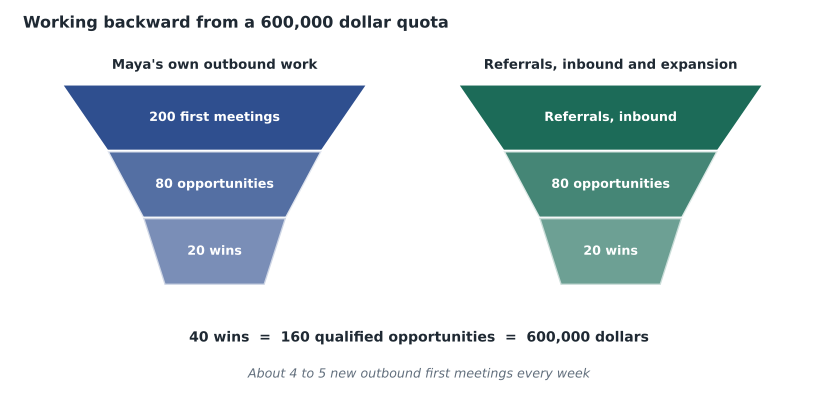
Maya's annual quota is 600,000 dollars. Darnell gives her these planning assumptions: the average first-year deal is worth 15,000 dollars; she wins 25 in every 100 qualified opportunities; and 40 in every 100 first meetings turn into qualified opportunities. About half of her opportunities will come from referrals, inbound leads and expansions. How many first meetings must her own outbound prospecting produce each week, over 48 working weeks?
Show solution
- Wins needed: 600,000 ÷ 15,000 = 40 deals a year.
- Qualified opportunities needed: 40 ÷ 0.25 = 160 a year.
- Outbound share: half of 160 = 80 opportunities from her own prospecting.
- First meetings needed for those: 80 ÷ 0.40 = 200 meetings a year.
- Per week: 200 ÷ 48 ≈ 4.2 first meetings a week.
Answer: About four or five new first meetings every week from her own outbound work. The weekly number is easier to manage than the annual quota, and it tells Maya how much prospecting time to protect.
Darnell was careful to call these numbers assumptions. A new seller does not yet know her own conversion rates, so she starts with the team's averages and replaces them with her own as the months go by. Grace Liu keeps the team averages in the CRM and updates them each quarter. The point of the exercise is not precision; it is to turn a big, frightening annual number into a small, steady weekly habit. Lesson 11 returns to this arithmetic when Maya builds her outreach cadence, and lesson 12 puts it into her plan for the first quarter of 2027.
Worked problem
Checking pipeline coverage
It is November 12, 2026. Maya's first-quarter 2027 target is 150,000 dollars. Her open pipeline for deals expected to close in that quarter is: Eastgate Physiotherapy 14,400; Keystone Grain Equipment 22,000; Prairie Valley 68,000; and seven smaller opportunities worth 61,000 in total. Darnell wants three times coverage. Is she covered, and if not, by how much is she short?
Show solution
- Total open pipeline: 14,400 + 22,000 + 68,000 + 61,000 = 165,400 dollars.
- Coverage: 165,400 ÷ 150,000 ≈ 1.10 times.
- Pipeline needed for three times coverage: 3 × 150,000 = 450,000 dollars.
- Shortfall: 450,000 − 165,400 = 284,600 dollars of additional pipeline.
Answer: She is at about 1.1 times coverage, well short of three. Unless she expects to win far more than one in three of her open deals, she needs roughly 285,000 dollars more pipeline for the quarter, which is why Darnell keeps the weekly meeting target in front of her.
What good prospecting looks like
Good prospecting is not the same as a lot of prospecting. Sending 500 identical emails is easy and usually useless; buyers recognize mass outreach instantly, and it can damage the company's reputation and break the law, as lessons 5 and 6 explain. Good prospecting has four features. It is targeted: the seller spends her time on organizations that fit the profile of customers the company serves well. It is relevant: each contact gives the buyer a reason to respond that is about their situation, not the seller's product. It is persistent but respectful: several well-spaced attempts across different channels, with an easy way to say no. And it is measured: the seller tracks what she does and what happens, so she can improve.
Darnell summarized this for Maya with a sentence he had borrowed from an old manager of his: "Earn the right to the next minute." A cold call earns the right to a second minute if the first sentence is about the buyer. A cold email earns a reply if it shows that the sender has done some homework. A first meeting earns a second if the buyer leaves with something useful, even if they never buy. Each step is small, and each one is earned rather than taken.
The emotional side of prospecting
Prospecting involves a lot of rejection. Most calls are not answered, most emails are not replied to and many people who do respond say no. For new sellers, especially those who come from roles where customers walked in the door, this can be discouraging. Maya noticed it in her second week, after a morning of calls produced two voicemails, one hang-up and a receptionist who told her the office manager "does not take sales calls". She told Darnell she felt like a nuisance.
Darnell's answer had three parts, and they are worth repeating for anyone starting out. First, rejection in prospecting is rarely personal; the person saying no usually knows nothing about you and is reacting to the interruption. Second, a no today is often a not now; Maya's territory is full of offices whose printer leases will end next year, and a polite first contact makes the later one easier. Third, the way to protect your confidence is to measure your effort, which you control, as well as your results, which you do not. A seller who makes her planned number of thoughtful contacts each day has done her job, whatever the replies. Research on salespeople has linked this kind of process focus with persistence and lower burnout, although most of the evidence comes from surveys rather than experiments.
Prospecting time and the week
Prospecting competes with every other part of a seller's job, and it usually loses, because the other tasks feel more urgent. A customer's question, a proposal deadline or a problem with a delivery always seems more pressing than calling someone who has not asked to hear from you. The common answer is time blocking: setting aside fixed periods each week for prospecting and treating them like meetings that cannot be moved. Ridgeline asks its account executives to protect two blocks of 90 minutes a week for outbound prospecting, plus time for research. Maya chose Tuesday and Thursday mornings, before the clinics she was targeting became busy.
Time blocks work best when the work inside them is prepared in advance. If Maya sits down at 8:30 with a list of 20 researched contacts, a reason to call each one and her notes from earlier attempts, she can make good use of the block. If she sits down and then starts looking for people to call, the block disappears into research and inbox checking. Lesson 3 covers research, and lesson 11 shows how to turn it into a weekly cadence.
How the course is organized
The lessons follow the order in which a seller builds a prospecting practice. Lesson 2 defines the ideal customer profile, so that Maya knows which doors to try first. Lesson 3 covers research on accounts and contacts. Lessons 4 to 8 cover the main channels: referrals and networking, cold calling, cold email, social selling and events and inbound leads. Lessons 9 and 10 cover lead scoring and qualification frameworks such as BANT and MEDDIC. Lesson 11 combines the channels into a cadence, and lesson 12 is a lab in which you build a full prospecting plan for one territory. The rules on calls, email and messages differ between Canada and the United States, and this site describes the Canadian rules. They come up in several lessons because prospecting is where sellers are most likely to break them.
Common mistakes
MistakeTreating prospecting as something to do when there is time left over.
InsteadBlock prospecting time in advance and protect it like a customer meeting.
MistakeCounting every name as a lead and every lead as pipeline.
InsteadUse clear definitions for lead, prospect and qualified opportunity, and count only qualified opportunities as pipeline.
MistakeMeasuring only results, such as meetings booked.
InsteadTrack effort, such as thoughtful contacts made, as well as results; effort is what you control day to day.
MistakeSending large volumes of identical messages.
InsteadTarget organizations that fit, and give each one a reason to respond that is about them.
MistakeWaiting for inbound leads to fill the pipeline.
InsteadCombine outbound prospecting, referrals, inbound, partners and expansion; no single source is enough.
Summary and key terms
- Prospecting finds and starts conversations with organizations likely to benefit from what you sell; lead generation is the wider activity of producing names and signals of interest.
- A full pipeline lets a seller be patient and honest; a thin one creates pressure and bad habits.
- Leads become prospects through research and prospects become qualified opportunities through conversation.
- Prospects come from outbound work, inbound leads, referrals, partners and expansion in existing accounts.
- Working backward from the quota with conversion rates turns an annual target into a weekly meeting goal.
- Pipeline coverage compares open pipeline with the remaining target; many B2B teams aim for about three times.
- Good prospecting is targeted, relevant, persistent but respectful, and measured.
- Prospecting
- Finding and starting conversations with potential customers who are likely to benefit from what you sell.
- Lead
- A name that might become a customer but has not yet been checked.
- Prospect
- A lead that has been researched and judged worth pursuing.
- Qualified opportunity
- A prospect with a real need, a person who can act and a path to a decision, recorded in the CRM with a value.
- Pipeline coverage
- The value of open opportunities divided by the target still to be reached.
- Time blocking
- Reserving fixed periods in the week for a task such as prospecting.
Practice problems
Work each problem on paper first, then reveal the answer to check.
A seller has a quota of 480,000 dollars, an average deal of 12,000 dollars and a win rate of 20 in 100 qualified opportunities. How many qualified opportunities does she need in a year?
Show answer
480,000 ÷ 12,000 = 40 wins; 40 ÷ 0.20 = 200 qualified opportunities.
Maya's pipeline for a quarter is 210,000 dollars and her target is 120,000 dollars. What is her coverage?
Show answer
210,000 ÷ 120,000 = 1.75 times.
What is the difference between a lead and a prospect?
Show answer
A lead is an unchecked name; a prospect is a lead that has been researched and judged worth pursuing.
Give two reasons a thin pipeline harms both the seller and the company.
Show answer
It pushes the seller to discount, overpromise or chase poor-fit buyers, and it brings in customers who churn or cost more to serve.
Lesson quiz · 5 questions
Score 60% or more to complete this lesson.
Create a free account to save your progress, take quizzes and earn a certificate.