
SLS-210 · Lesson 8 of 12 · 21 min
Events, trade shows and inbound leads
▶ Video coming soon A video version of this lesson is on the way.
On October 15 and 16, 2026, Ridgeline had a booth at a regional conference for office and practice managers in Regina. Maya and Owen Pelletier staffed it together, with a working RoomFlow panel on a door frame, a printer that printed nothing confidential and a bowl of good chocolate. By the end of the second day they had scanned 54 badges. At the Thursday session a week later, Darnell asked how many of the 54 were worth following up. Maya had sorted them: 19 had been real conversations about a problem, 22 were people who wanted chocolate and 13 were other suppliers. By November 6, the follow-up had produced 7 booked meetings.
Events and inbound leads have something in common: the buyer takes the first step. At an event, they walk up to the booth or the seller's table; with an inbound lead, they fill in a form, call the office or start a chat on the website. That makes these leads warmer than cold prospects, but not automatically good. Many people who stop at a booth or download a guide are curious rather than ready to buy, and the value of these leads depends almost entirely on how quickly and well the seller follows up. This lesson covers events before, during and after, and how to handle inbound leads.
Kinds of events
| Event | Typical setting | Strength for prospecting |
|---|---|---|
| Trade show or conference booth | An exhibit hall at an industry conference | Many relevant people in one place; expensive |
| Speaking or panel session | A talk at a conference or association meeting | Builds credibility; audiences approach the speaker |
| Hosted event | A breakfast, open house, demo day or customer evening run by the company | Controlled guest list; good for tier A accounts |
| Webinar or online event | A presentation or workshop online | Low cost and wide reach; attendees often passive |
| Community and association events | Chamber events, association meetings, charity events | Relationship building over time |
Each kind of event suits different goals. A conference booth works for reaching many contacts in a target industry at once. A hosted event, such as Ridgeline's spring open house where customers and prospects can try a meeting room set up with RoomFlow, works for deepening relationships with a few important accounts. A webinar can attract a wider audience but tends to produce weaker leads, because registering costs nothing and many registrants never attend. The seller should decide what the event is for before deciding how much to invest in it.
Before the event
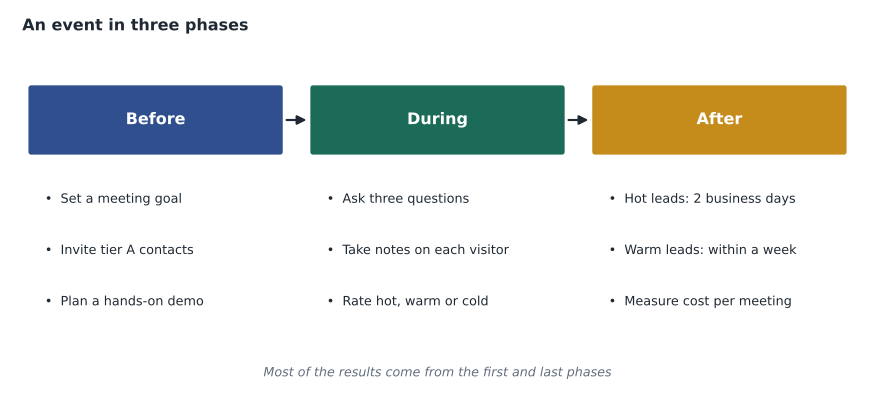
Most of the value of an event is created before it starts. Good preparation includes setting a goal in meetings booked rather than badges scanned, getting the list of registered attendees or exhibitors if the organizer shares it, inviting tier A prospects and customers in advance and preparing what the booth or table will show. Maya and Owen emailed 30 tier A contacts in the two weeks before the conference, within the consent rules described in lesson 6, inviting them to stop by and see a RoomFlow panel working. Eleven came, and five of the 19 real conversations were with people who had been invited.
The booth itself should give visitors something to do or see that relates to a real problem. Ridgeline's working room panel let office managers book a pretend meeting in ten seconds, which started more conversations than any brochure. Giveaways attract people, but a giveaway that has nothing to do with the offering, such as a prize draw for a tablet, mostly attracts people who want a tablet. Darnell calls these "chocolate leads", and he no longer counts them.
During the event
At a booth, the seller has a few minutes at most with each visitor. The aim is to find out quickly whether the visitor has a relevant problem, have a short useful conversation if they do and agree on a specific next step. Ridgeline's booth staff ask three questions in a natural way: what the visitor does, what is frustrating about their office right now and whether they would like to talk properly after the event. The answers go into notes attached to the badge scan, while the conversation is fresh.
| Field | Note |
|---|---|
| Name and role | Joyce Abara, executive director |
| Organization | Bellmont Seniors Residence, 120 residents, about 90 staff |
| Problem mentioned | Family meeting rooms always double-booked; printers in nursing stations old |
| Interest level | Hot: asked for a visit |
| Agreed next step | Maya to call Tuesday, October 20, to book a site visit |
| Consent basis | Business card and badge given at the booth; asked to be contacted |
The quality of notes decides the quality of the follow-up. A badge scan without notes is just a name. A scan with "double-booked family rooms, wants visit, call Tuesday" is a warm lead with a reason and a plan. Ridgeline's booth staff rate each visitor as hot (wants a follow-up conversation), warm (has a relevant problem but no clear interest yet) or cold (no relevant need), which makes the follow-up faster.
After the event
Follow-up should start within a day or two, while the visitor still remembers the conversation. A common target is to contact hot leads within two business days and warm leads within a week. The message should refer to the specific conversation, not a generic "thank you for visiting our booth". Cold contacts should not be flooded with sales emails: in Canada, giving a business card or having a badge scanned at a booth generally provides implied consent under CASL for messages relevant to the person's business role, as long as they did not say they did not want such messages, but this does not justify adding them to every marketing list.
Worked problem
Was the conference worth it?
The booth cost Ridgeline 2,400 dollars for the space, 900 dollars for materials and travel, and two days of time for Maya and Owen, which Grace values at 1,100 dollars in total. The follow-up produced 7 meetings. Based on Ridgeline's averages, 40 in every 100 first meetings become qualified opportunities, 25 in every 100 qualified opportunities are won and the average first-year deal is 15,000 dollars. What was the cost per meeting, and what first-year revenue should the event be expected to produce?
Show solution
- Total cost: 2,400 + 900 + 1,100 = 4,400 dollars.
- Cost per meeting: 4,400 ÷ 7 ≈ 629 dollars.
- Expected opportunities: 7 × 0.40 = 2.8.
- Expected wins: 2.8 × 0.25 = 0.7.
- Expected first-year revenue: 0.7 × 15,000 = 10,500 dollars.
Answer: Each meeting cost about 629 dollars, more than the roughly 260 dollars Ridgeline spends per outbound meeting. The event should produce about 10,500 dollars of first-year revenue, about 2.4 times its cost. Because event leads such as Bellmont tend to be warmer than average, the real result may be better, so Grace will compare actual wins at the end of the first quarter.
Measuring events in meetings and pipeline rather than badges scanned changes how teams run them. A booth that scans 300 badges and books 4 meetings is less useful than one that scans 60 and books 10. Ridgeline's marketing coordinator now reports events in cost per meeting and pipeline created, and compares them with other channels, as the example above does.
Inbound leads
An inbound lead is a person who contacts the company first: by filling in a contact form, requesting a quote, calling the main number, starting a chat on the website or downloading a guide. Inbound leads vary enormously. A clinic manager who requests a quote for 12 printers is close to a buying decision. A student who downloads a guide to "choosing an office printer" for a school project is not. Marketing teams usually generate inbound leads through the company website, search, online advertising and content, and pass them to sales according to rules that lesson 9 covers.
Speed to lead
The single most important factor in converting inbound leads is how quickly someone responds. A widely cited study published in the Harvard Business Review in 2011, by James Oldroyd, Kristina McElheran and David Elkington, tested how quickly 2,241 US companies responded to web inquiries. It found that companies that tried to contact a lead within an hour were nearly seven times as likely to have a meaningful conversation with a decision maker as those that waited longer, and that many companies took more than a day or never responded at all. The study is old and the exact multiples should not be over-read, but the pattern is consistent with later research and with most sellers' experience: interest fades quickly, and buyers often contact several suppliers at once.
Ridgeline's rule is that a quote request or "contact me" form must get a personal response, by phone if a number is given, within one business hour, and an automatic acknowledgement immediately. Owen's inside sales team covers the inbound queue during business hours on a rotation, and routes qualified leads to the right account executive by territory. Requests that arrive in the evening get a call first thing the next morning.
Worked problem
The cost of slow follow-up
In the first half of 2026, Ridgeline received 180 quote requests. Grace found that those answered within one business hour became qualified opportunities 36 times in every 100, while those answered later became opportunities 14 times in every 100. In the first half, 90 requests were answered within the hour and 90 later. If all 180 had been answered within the hour, how many more qualified opportunities might there have been?
Show solution
- Actual opportunities: 90 × 0.36 + 90 × 0.14 = 32.4 + 12.6 = 45.
- If all were fast: 180 × 0.36 = 64.8.
- Difference: 64.8 − 45 = 19.8, about 20 more opportunities.
Answer: About 20 extra qualified opportunities in six months, worth about 75,000 dollars of first-year revenue at Ridgeline's 25 in 100 win rate and 15,000-dollar average deal (20 × 0.25 × 15,000). Some of the difference may be because the most eager buyers were easier to reach quickly, so the true effect is probably smaller, but it was large enough for Ridgeline to change its routing in July.
Responding to an inbound lead
The first response to an inbound lead should be helpful and personal. It should acknowledge exactly what the person asked for, answer it if possible and suggest a next step that makes sense for them. A quote request for 12 printers deserves a call to understand the situation before a quote is sent, because a quote without context is easy to compare on price alone. A guide download deserves a short, useful follow-up and perhaps a question, not an immediate demand for a meeting.
| Inbound signal | Likely stage | Good first response |
|---|---|---|
| Quote request with details | Close to deciding | Call within an hour; ask about the situation before quoting |
| "Contact me" form with a question | Exploring options | Call or email that answers the question and offers a short conversation |
| Phone call to the main number | Often urgent | Route to a person immediately; avoid long phone menus |
| Chat on the website | Researching right now | Answer the question in the chat; offer a call if needed |
| Guide or checklist download | Early research | Send the resource and one helpful question; do not push for a meeting |
Inbound leads are also checked against the ICP. A request from a large organization outside the service area, or from a tiny office that would be better served by Ridgeline's online store, still deserves a helpful, honest answer, but not the same investment of a seller's time. Lesson 9 shows how scoring combines fit with signs of interest to decide which leads go straight to a seller.
Common mistakes
MistakeMeasuring events by badges scanned.
InsteadSet goals and measure in meetings booked and pipeline created.
MistakeUsing unrelated giveaways that attract the wrong visitors.
InsteadShow something that relates to a real problem buyers have.
MistakeSending everyone who visited the booth the same generic email.
InsteadFollow up hot and warm leads personally, referring to the actual conversation.
MistakeResponding to inbound quote requests the next day.
InsteadRespond personally within an hour where possible; interest fades fast.
MistakeSending a quote without understanding the situation.
InsteadCall first to learn the context, so the quote is about value, not just price.
Summary and key terms
- Events and inbound leads start with the buyer's first step, but their value depends on fast, relevant follow-up.
- Choose events by goal: booths for reach, hosted events for key accounts, webinars for wide but weaker interest.
- Prepare by setting meeting goals and inviting tier A contacts; at the booth, ask three questions and take notes.
- Rate visitors hot, warm or cold, and follow up hot leads within two business days and warm leads within a week.
- Measure events by cost per meeting and pipeline, and compare them with other channels.
- Speed to lead matters: inquiries answered within an hour convert far more often.
- Match the response to the inbound signal, and check every lead against the ICP.
- Inbound lead
- A person who contacts the company first, for example through a form, call or chat.
- Badge scan
- The capture of a visitor's details at a trade show booth.
- Speed to lead
- How quickly a company responds to an inbound inquiry.
- Hosted event
- An event the company organizes and controls, such as an open house or breakfast.
- Cost per meeting
- The total cost of a channel or event divided by the first meetings it produced.
Practice problems
Work each problem on paper first, then reveal the answer to check.
A webinar costs 1,800 dollars and produces 4 meetings. What is the cost per meeting?
Show answer
1,800 ÷ 4 = 450 dollars.
Why did Darnell stop counting "chocolate leads"?
Show answer
People attracted only by an unrelated giveaway rarely have a relevant need.
What should Ridgeline do with a quote request for 12 printers that arrives at 10 a.m.?
Show answer
Acknowledge it automatically and call within an hour to understand the situation before quoting.
Give two limits of the 2011 speed-to-lead study.
Show answer
It is old, and eager buyers may have been easier to reach quickly, so the multiples should not be over-read.
Lesson quiz · 5 questions
Score 60% or more to complete this lesson.
Create a free account to save your progress, take quizzes and earn a certificate.