
SLS-210 · Lesson 9 of 12 · 22 min
Lead scoring
▶ Video coming soon A video version of this lesson is on the way.
By late October, Ridgeline's inside sales team had a problem that most growing sales teams eventually face. The website, the conference, a new online guide to office moves and a referral campaign were producing more leads than Owen's three inside reps could call promptly. Some were excellent, such as a quote request from a 70-person insurance brokerage. Many were not, such as a dozen downloads of the moving guide by students and a competitor's marketing team. The reps were calling leads in the order they arrived, so the brokerage waited a day while a rep chatted with a student. On November 2, 2026, Grace Liu launched a lead-scoring model to fix this.
Lead scoring is a method of ranking leads by how likely they are to become customers, usually by adding up points for characteristics and actions. Its purpose is to help sellers spend their limited time on the leads most worth it, and to give marketing and sales a shared definition of when a lead is ready for a salesperson. This lesson explains how scoring works, how Ridgeline's model was built, the common pitfalls and how to tell whether a scoring model is working.
Fit and engagement
Most scoring models combine two kinds of information. Fit, sometimes called explicit or demographic scoring, measures how closely the lead matches the ideal customer profile: industry, size, location, role. It answers the question "Would we want this organization as a customer?" Engagement, sometimes called implicit or behavioural scoring, measures what the lead has done that suggests interest: requesting a quote, visiting the pricing page, attending a webinar, opening emails, replying. It answers the question "Are they interested now?"
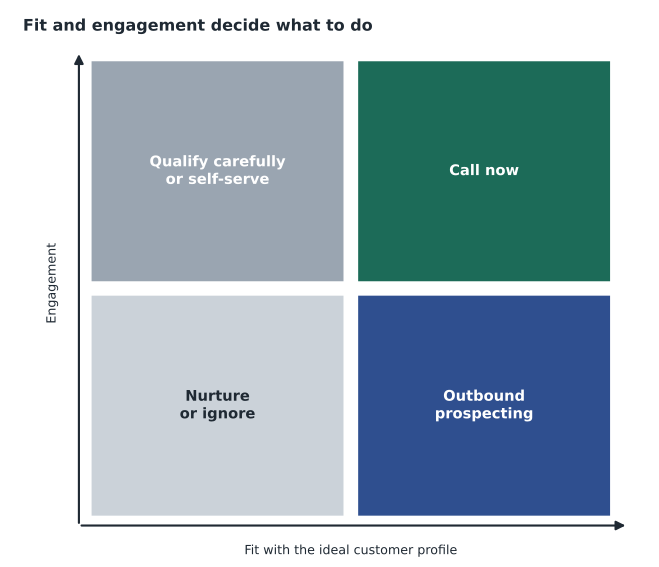
Neither kind of information is enough alone. A perfect-fit organization that has shown no interest is a prospect for outbound work, not a lead ready for a call today. A highly engaged lead that does not fit, such as a competitor reading every page of the website, is not worth a seller's time at all. The most valuable leads are high on both. This gives a simple grid that sales teams use to decide what to do.
Marketing-qualified and sales-qualified leads
Many companies use a set of terms to describe how leads pass between teams. A marketing qualified lead (MQL) is a lead that marketing judges ready for sales attention, usually because its score has crossed a threshold. A sales accepted lead (SAL) is an MQL that a seller has reviewed and agreed to work. A sales qualified lead (SQL) is a lead that a seller has spoken to and judged to have a real need and a reasonable chance of buying; at Ridgeline, an SQL becomes a qualified opportunity in the CRM. The exact names vary between companies, and some have moved away from them, but the idea of agreed hand-off points is common.
The agreement between marketing and sales about these definitions is often written down as a service-level agreement (SLA): marketing commits to delivering a certain number of MQLs that meet the agreed criteria, and sales commits to following each one up within a set time. Ridgeline's SLA says that every lead scoring 60 or more is called within one business hour, and that every lead the inside team rejects gets a reason recorded, so Grace can check whether the scoring is sending the wrong leads.
Ridgeline's scoring model
Grace built the first version of the model from the ICP in lesson 2 and from what she knew about how past customers had behaved before they bought. It has a fit score of up to 50 points and an engagement score of up to 50 points. Leads with a total of 60 or more are treated as sales-ready and go to the inside team's priority queue; leads from 35 to 59 receive a light-touch follow-up and marketing emails where consent allows; leads below 35 are not called.
| Characteristic | Points |
|---|---|
| Organization has 20 to 250 employees | 15 |
| Industry in the ICP (health care, legal, accounting, finance, education) | 15 |
| In the core service area | 10 |
| Contact's role is office, practice or operations manager, or an owner or partner | 10 |
| Action | Points |
|---|---|
| Requested a quote or a demonstration | 30 |
| Visited the pricing page | 10 |
| Attended a webinar or visited the booth with a real conversation | 10 |
| Downloaded a guide | 5 |
| Opened two or more emails | 5 |
| Signal | Points |
|---|---|
| Email domain belongs to a competitor | −50 |
| Student or job seeker (from the form) | −30 |
| Unsubscribed or asked not to be contacted | Removed from scoring entirely |
Engagement scores above 50 are capped at 50, so a single lead cannot reach sales-ready through engagement alone without any fit. Negative scores are important: without them, a competitor who reads the whole website can look like the hottest lead in the system. People who have asked not to be contacted are removed entirely, because no score should override a person's request.
Worked problem
Scoring two leads
Score these leads with Ridgeline's model. Lead A: the operations manager at a 70-person insurance brokerage in the core area requested a quote and visited the pricing page. Lead B: a student downloaded the office-move guide, opened three emails and visited the pricing page; the student's school is a large college in the core area.
Show solution
- Lead A fit: size 15 + industry (finance) 15 + area 10 + role 10 = 50.
- Lead A engagement: quote 30 + pricing 10 = 40. Total: 50 + 40 = 90, sales-ready.
- Lead B fit: the student is not at an organization buying for itself; size, industry and role do not apply, area 10 = 10.
- Lead B engagement: guide 5 + emails 5 + pricing 10 = 20. Student penalty −30.
- Lead B total: 10 + 20 − 30 = 0, not called.
Answer: Lead A, at 90, goes to the top of the queue and should be called within the hour. Lead B scores 0 and is not called; the guide was still useful to the student, and if the college later becomes a prospect, it will be approached through its procurement process, not through a student's download.
Decay
Interest fades. A webinar attended last week says more about a buyer's current interest than one attended last year. Most scoring models therefore apply decay: engagement points lose value over time. Ridgeline's model halves engagement points 30 days after the action and removes them after 90 days. Fit points do not decay, because an organization's size and industry change slowly, although they should be refreshed when the data is updated.
Worked problem
Applying decay
On September 20, Harvest Valley Credit Union's facilities manager, Gord Frey, downloaded the office-move guide (5 points) and attended a webinar on meeting rooms (10 points). On October 28, he visited the pricing page (10 points). The credit union has only 18 staff, below the 20-employee cut-off, so his fit score is industry 15 + area 10 + role 10 = 35. What is his total score on November 3?
Show solution
- Days since September 20 on November 3: 10 (rest of September) + 31 (October) + 3 = 44 days, more than 30, so those 15 points are halved to 7.5.
- Days since October 28: 6 days, so the 10 points count in full.
- Engagement: 7.5 + 10 = 17.5.
- Total: 35 + 17.5 = 52.5.
Answer: At 52.5, Gord is below the sales-ready threshold of 60, so he gets the light-touch follow-up rather than a priority call. If he requests a quote or attends another event, he will cross 60. Maya, who already knows Harvest Valley is opening a new branch, may decide to call anyway as part of her outbound work; scoring guides the inbound queue, but it does not replace a seller's judgment about her own tier A accounts.
Predictive scoring
Many CRM and marketing platforms now offer predictive lead scoring, which uses machine learning to find patterns in past leads that became customers and to score new leads automatically. These tools can find signals that a human-designed model misses, and they adjust as new data arrives. They also have limits. They need a lot of history to learn from, often thousands of past leads with known outcomes, which small companies may not have. They can be hard to explain: a seller may be told that a lead scores 87 without knowing why. And they learn from the past, so if a company has rarely sold to a segment, the model may score that segment low even if it would be a good market, the same problem lesson 2 described for ICPs built only from past customers. They can also pick up unfair or irrelevant patterns hidden in the data.
Ridgeline decided that, with about 600 inbound leads a year, its data was too thin for a reliable predictive model, and that a simple points model that everyone understood was better for now. Grace plans to test a vendor's predictive score alongside her model in 2027 and compare the two.
Checking whether scoring works
A scoring model is only useful if higher scores really predict better outcomes. The basic test is to group leads into score bands and compare how often each band becomes a qualified opportunity and a customer. If leads scoring 80 or more convert no more often than those scoring 40, the model is not working. Grace also reads the reasons the inside team gives for rejecting leads, because they reveal patterns the points miss.
Worked problem
Calibrating the model after the first month
In November, the first month of the model, Grace grouped 92 leads by score band and counted how many became qualified opportunities within 30 days: 80 to 100 points, 12 leads, 6 opportunities; 60 to 79, 20 leads, 5 opportunities; 35 to 59, 34 leads, 3 opportunities; below 35, 26 leads, 0 opportunities. What is the conversion rate for each band, and does the model rank leads in the right order?
Show solution
- 80 to 100: 6 ÷ 12 = 0.50, or 50 in every 100.
- 60 to 79: 5 ÷ 20 = 0.25, or 25 in every 100.
- 35 to 59: 3 ÷ 34 ≈ 0.088, or about 9 in every 100.
- Below 35: 0 ÷ 26 = 0.
Answer: Conversion falls steadily as the score falls, so the model ranks leads in the right order. The 60 threshold looks sensible, but the sample is small, so Grace will check again after three months. She also noticed that three of the 35 to 59 leads that converted were from clinics with fewer than 20 staff, so she may lower the size cut-off for health care.
Common pitfalls
Scoring models fail in a few predictable ways. Too many points for easy actions, such as email opens, can push uninterested people over the threshold; email opens are also unreliable, because some email apps open messages automatically to check them. No negative scoring lets competitors, students and job seekers look like hot leads. No decay lets old interest look current. Never reviewing the model means it drifts away from reality as the market and the company change. And ignoring the sellers is perhaps the worst: if the inside team does not trust the scores, it will ignore them, and the model becomes a number nobody uses. Grace's answer to the last problem was to build the model with Owen's team, show them the calibration results each month and change the model when their feedback pointed to a real pattern.
Common mistakes
MistakeScoring only on engagement.
InsteadCombine fit and engagement, so interested but unsuitable leads do not jump the queue.
MistakeGiving many points for email opens.
InsteadWeight strong signals such as quote requests heavily and weak ones such as opens lightly.
MistakeLeaving out negative scores and decay.
InsteadSubtract points for competitors and students, and let engagement fade over time.
MistakeTreating a score as a substitute for judgment.
InsteadUse scores to order the inbound queue, while sellers still use judgment on their own accounts.
MistakeNever checking the model.
InsteadCompare conversion by score band regularly and adjust the points.
Summary and key terms
- Lead scoring ranks leads by how likely they are to become customers, so sellers spend time where it is most useful.
- Models combine fit, which measures match with the ICP, and engagement, which measures signs of current interest.
- MQLs, SALs and SQLs mark agreed hand-off points between marketing and sales, often backed by a service-level agreement.
- Negative scoring removes competitors, students and others who are not buyers; people who opted out are removed entirely.
- Decay reduces the value of old engagement.
- Predictive scoring uses machine learning but needs plenty of data, can be hard to explain and learns from past patterns.
- A scoring model works if higher score bands convert more often; check this regularly and involve sellers.
- Lead scoring
- Ranking leads by adding points for characteristics and actions that predict buying.
- Fit score
- Points for how closely a lead matches the ideal customer profile.
- Engagement score
- Points for actions that suggest current interest.
- Marketing qualified lead (MQL)
- A lead that marketing judges ready for sales attention.
- Sales qualified lead (SQL)
- A lead that a seller has spoken to and judged to have a real need and a reasonable chance of buying.
- Decay
- The reduction of engagement points as time passes.
Practice problems
Work each problem on paper first, then reveal the answer to check.
Score a clinic practice manager (fit 50) who attended a webinar and downloaded a guide this week.
Show answer
Engagement 10 + 5 = 15; total 65, sales-ready.
A lead earned 20 engagement points 40 days ago and has a fit score of 35. What is the score under Ridgeline's decay rule?
Show answer
20 halved is 10; 35 + 10 = 45.
Why does Ridgeline remove people who opted out from scoring entirely?
Show answer
No score should override a person's request not to be contacted.
Leads scoring 80 or more convert 4 times in 20; leads scoring 40 to 59 convert 6 times in 30. Is the model ranking well?
Show answer
Both are 20 in 100, so the model is not separating good from weaker leads and needs review.
Lesson quiz · 5 questions
Score 60% or more to complete this lesson.
Create a free account to save your progress, take quizzes and earn a certificate.