
SLS-210 · Lesson 12 of 12 · 21 min
Lab: a prospecting plan for one territory
▶ Video coming soon A video version of this lesson is on the way.
On Thursday, November 12, 2026, the last territory session of the fall, Darnell asked Maya to bring a written prospecting plan for the first quarter of 2027. "Not a wish list," he said. "A plan I could hand to someone else and they could run your territory from it." Maya spent the week on it, drawing on everything from the previous eleven sessions. This lab walks through her plan step by step and then asks you to build one for a territory of your own. Everything in the plan is in the future: it describes what Maya intends to do from January to March 2027, and the numbers are planning estimates based on Ridgeline's data from 2026.
A prospecting plan answers six questions: what the target is and how many meetings it requires; which accounts to focus on; why each group of accounts might buy now; which channels will produce the meetings; when the work will happen each week; and how progress will be measured and the plan adjusted. Each step below takes one question in turn.
Step 1: Set the target and work backward
Maya's first-quarter target is 150,000 dollars of new first-year revenue, a quarter of her annual quota. Deals take two to four months to close, so most of the first-quarter revenue will come from opportunities already in her pipeline, and much of the pipeline she builds in the first quarter will close in the second. Her plan therefore has two targets: closing the existing pipeline and creating enough new pipeline for the second quarter.
Worked problem
Meetings needed in the first quarter
Maya wants to enter the second quarter of 2027 with three times coverage on a 150,000-dollar target, which is 450,000 dollars of open pipeline for that quarter. She expects about 60,000 dollars of it to carry over from opportunities already open. Using the planning assumptions from lesson 1 (an average first-year deal of 15,000 dollars and 40 first meetings in every 100 becoming qualified opportunities), how many first meetings does she need in the first quarter?
Show solution
- New pipeline needed: 450,000 − 60,000 = 390,000 dollars.
- Qualified opportunities needed: 390,000 ÷ 15,000 = 26.
- First meetings needed: 26 ÷ 0.40 = 65.
- Working weeks in the quarter, allowing for holidays and training: about 12.
- Per week: 65 ÷ 12 ≈ 5.4 first meetings.
Answer: Maya needs about 65 first meetings in the quarter, or 5 to 6 a week from all sources combined. This is higher than the outbound figure from lesson 1 because she is building pipeline for the following quarter as well as this one.
Step 2: Choose and tier the accounts
Maya started from her scored account list from lesson 2 and updated it with what she had learned in the fall. Some tier A accounts had become customers or open opportunities, such as Northfield Family Clinic and Eastgate Physiotherapy. Others had been qualified out for now, such as the engineering consultancy with the seven-year lease. A few tier B accounts had moved up after she found triggers. Her first-quarter list had 48 tier A accounts, 120 tier B accounts and the remaining tier C accounts, which Owen's inside team would cover with light cadences.
| Tier | Accounts | Approach | Who |
|---|---|---|---|
| A | 48 | Personal cadence, 2 new accounts a week, plus existing open opportunities | Maya |
| B | 120 | Standard cadence, 6 new accounts a week | Maya, with inside team support |
| C | About 400 | Light cadence (email where consent allows, one call) | Owen's inside team |
| Customers | 22 in her territory | Expansion and referral conversations | Maya, with Farida Haddad for key accounts |
Step 3: Find the reasons to buy now
For each segment, Maya listed the triggers most likely to create a reason to talk in early 2027. Grace's data suggested that ending leases were the strongest trigger, so Maya asked her to pull every account in the territory with a known print lease or service contract ending between April and December 2027. That produced 31 accounts, 14 of them in tier A. She also set alerts for office moves and expansions, job changes among her contacts and new public tenders, and noted seasonal patterns: accounting firms are too busy to talk about printers from February to April, so her plan contacts them in January and again in May.
| Segment | Main triggers | Timing notes |
|---|---|---|
| Health clinics | Expansions, new physicians, lease ends, records rules | Avoid the first week after holidays |
| Law and accounting firms | Mergers, office moves, lease ends | Accounting firms: January, then from May |
| Insurance and finance | New branches, new managers | Steady through the year |
| Education | Public tenders, budget years | School division budgets follow the school year; follow tender rules |
| Seniors residences | Renovations, new directors | Steady through the year |
Step 4: Plan the channel mix
No single channel can produce 65 meetings. Maya estimated what each source could realistically deliver, using her own fall results where she had them and Ridgeline's averages where she did not.
Worked problem
Building 65 meetings from several sources
Maya's planning estimates for the quarter are: tier B standard cadence, 6 new accounts a week for 12 weeks at 11 meetings per 100 accounts; tier A personal cadence, 2 new accounts a week for 12 weeks at 30 meetings per 100 accounts; meetings booked for her by Owen's inside team, 2 a week; referrals, asking 2 customers a week, with one referral for every three asks and 60 in every 100 referrals becoming meetings; the spring open house in March, 6 meetings; inbound leads routed to her territory, 4 meetings; and expansion conversations with existing customers, including Northfield's furniture decision, 3 meetings. Does the plan reach 65?
Show solution
- Tier B: 6 × 12 = 72 accounts × 0.11 ≈ 7.9 meetings.
- Tier A: 2 × 12 = 24 accounts × 0.30 = 7.2 meetings.
- Inside team: 2 × 12 = 24 meetings.
- Referrals: 2 asks × 12 weeks = 24 asks ÷ 3 = 8 referrals × 0.60 = 4.8 meetings.
- Open house 6 + inbound 4 + expansion 3 = 13 meetings.
- Total: 7.9 + 7.2 + 24 + 4.8 + 13 ≈ 56.9 meetings.
Answer: About 57 meetings, short of 65 by about 8. Maya has three options: improve the tier B meeting rate, add a second event, or ask Owen's team for one more booked meeting a week, which would add 12. She chose to ask for the extra inside-team support for January and February, when her own calendar is lightest, which brings the plan to about 69.
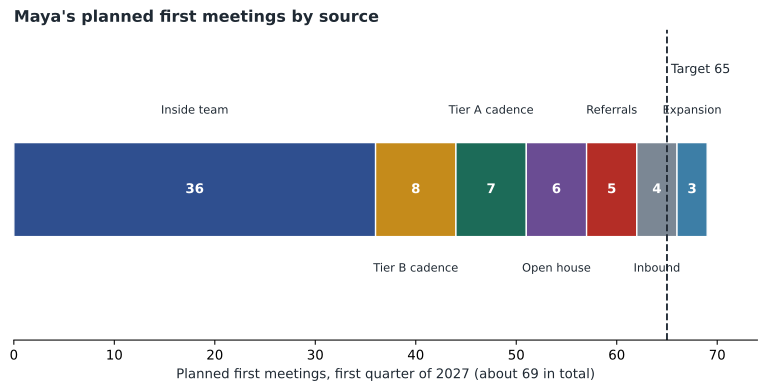
Darnell pointed out the risk in the plan: more than half of the meetings now depend on Owen's team. If the inside team is short-staffed, Maya's plan falls apart. He asked her to add a fallback: if inside-team meetings fall below 3 a week for two weeks running, she moves 30 minutes a week from email to calls on her tier B list.
Step 5: Put it in the calendar
A plan that does not appear in the calendar does not happen. Maya blocked her prospecting time for the whole quarter before the year started, using the weekly rhythm from lesson 11, and added the fixed dates: the January lease-end campaign, the accounting-firm pause from February to April, the March open house and the end-of-quarter review.
| When | Activity |
|---|---|
| Week of January 4 | Load the 31 lease-end accounts into cadences; call the 14 tier A accounts personally |
| January, every Friday | Ask two customers for referrals |
| Early February | Pause accounting firms; focus on clinics and insurance |
| Late February | Invite tier A accounts to the open house |
| March open house | Hosted demonstration of meeting rooms and managed print |
| Last week of March | Quarter review with Darnell; update tiers and plan for the second quarter |
Step 6: Check compliance
Before finalizing the plan, Maya checked it against the rules on calls and electronic messages, because a plan that relies on unlawful messages is not a plan. She used a short checklist that Grace and Ridgeline's compliance adviser had prepared.
| Check | Result |
|---|---|
| Every email step has a lawful basis for each contact | Consent or exemption recorded under CASL; contacts without one get calls and network touches only |
| Unsubscribe and opt-out requests take effect promptly | Platform removes contacts automatically, well within 10 business days |
| Calls go to published business numbers, dialed manually | Yes; no automated or prerecorded calls |
| Do-not-call requests are recorded and honoured | Recorded the same day in the CRM |
| Public tender rules followed | Prairie Valley contacted only through the procurement contact |
| Referral incentives are open and go to organizations | Service credits to customer organizations only |
| Personal data collected only as needed | Business contact details only; no personal social media details in the CRM |
Step 7: Decide how to measure and adjust
Finally, Maya chose a small set of measures to review every Friday and a larger review at the end of each month. Weekly, she checks effort and early results: new accounts loaded into cadences, calls made, personalized emails sent, referral asks and first meetings booked. Monthly, she checks conversion: first meetings to qualified opportunities, pipeline created by source and pipeline coverage for the second quarter. She also notes what she learned, such as which triggers produced conversations, so that the second-quarter plan can be better than the first.
| Measure | Weekly target | Reviewed |
|---|---|---|
| New tier A accounts started | 2 | Weekly |
| New tier B accounts started | 6 | Weekly |
| Referral asks | 2 | Weekly |
| First meetings from all sources | 5 to 6 | Weekly |
| First meetings that become qualified opportunities | 40 in 100 | Monthly |
| Second-quarter pipeline coverage | Rising toward 3 times by the end of March | Monthly |
Darnell's review
Darnell read the plan on Thursday afternoon and gave Maya three pieces of feedback, which apply to most first prospecting plans. First, the plan was strong on activity and numbers but thin on messages: for each segment, she should write the one-sentence reason for reaching out, so that the first touch in every cadence is ready before January. Second, she should test one thing deliberately in the quarter, such as whether a printed checklist mailed to tier A accounts raises the meeting rate, rather than changing many things at once. Third, she should plan her own energy. The first weeks of January after the holidays are slow for buyers and hard for sellers, so he suggested starting with the warmest work, such as referral asks and expansion conversations, before the cold calls.
Maya added a messages section and a test to the plan that evening. The plan she will run from January is not perfect, and Darnell expects it to change. But it can be handed to someone else, it adds up and it is lawful, which is what he had asked for.
Your turn: build a prospecting plan
Choose a territory you know or can research: a type of organization in a city or region and a product or service you could sell to them. It can be a real company you work for, or an imagined one like Ridgeline. Then complete the plan below. Keep it to two or three pages, and make every number traceable to an assumption you state.
| Section | What to include |
|---|---|
| 1. Target and math | Revenue target, average deal, conversion assumptions, meetings needed per week |
| 2. ICP and tiers | Your ICP in two sentences; number of accounts in each tier and how you will treat them |
| 3. Triggers | The main triggers by segment and any timing patterns |
| 4. Channel mix | Expected meetings from each source, with a total that reaches the target |
| 5. Messages | A one-sentence reason for reaching out for each segment |
| 6. Calendar | Weekly rhythm and fixed dates for the period |
| 7. Compliance | How each channel meets the call and electronic message rules in your country |
| 8. Measures and test | Weekly and monthly measures, and one deliberate test |
A good plan is honest about uncertainty. If you are new to a territory, say so and explain how you will replace estimates with your own results. If the channel mix falls short of the target, say what you will change, as Maya did, rather than inflating the estimates until the numbers work.
Common mistakes
MistakeWriting a plan that is a list of good intentions.
InsteadMake every activity specific, scheduled and measurable.
MistakeInflating estimates until the plan reaches the target.
InsteadUse honest assumptions and change the plan when it falls short.
MistakeRelying on one channel for most of the meetings without a fallback.
InsteadSpread the plan across sources and decide in advance what to do if one underdelivers.
MistakeLeaving compliance to chance.
InsteadCheck every channel against the call and electronic message rules before starting.
MistakeChanging many things at once.
InsteadTest one change deliberately each quarter, so you can tell what worked.
Summary and key terms
- A prospecting plan sets the target, accounts, triggers, channels, calendar, compliance checks and measures for a period.
- Working backward from the target and the coverage goal gives the number of first meetings needed.
- Tiering decides how much effort each group of accounts receives and who does the work.
- Triggers by segment and seasonal timing focus outreach on accounts likely to act soon.
- A realistic channel mix combines cadences, inside sales support, referrals, events, inbound and expansion.
- Plans should be scheduled in the calendar, checked for compliance and reviewed weekly and monthly.
- Good plans state their assumptions, include a fallback and test one thing at a time.
- Prospecting plan
- A written plan for producing first meetings and pipeline in a territory over a period.
- Channel mix
- The combination of sources expected to produce meetings.
- Fallback
- A planned response if part of the plan underdelivers.
- Pipeline coverage goal
- The multiple of a future target that open pipeline should reach.
- Deliberate test
- A single planned change whose effect is measured.
Practice problems
Work each problem on paper first, then reveal the answer to check.
A seller needs 30 qualified opportunities and 40 in every 100 first meetings become opportunities. How many first meetings does she need?
Show answer
30 ÷ 0.40 = 75.
Tier A accounts produce 30 meetings per 100. How many meetings will 3 new tier A accounts a week for 12 weeks produce?
Show answer
36 accounts × 0.30 = 10.8 meetings.
Why did Darnell ask Maya to add a fallback?
Show answer
More than half of her meetings depended on the inside team; if it underdelivered, the plan would fail.
Name three items on the compliance checklist.
Show answer
Any three: lawful basis for emails, prompt opt-outs, manual calls to business numbers, do-not-call records, tender rules, open referral incentives, minimal personal data.
Lesson quiz · 5 questions
Score 60% or more to complete this lesson.
Create a free account to save your progress, take quizzes and earn a certificate.