
SLS-210 · Lesson 7 of 12 · 19 min
Social selling on professional networks
▶ Video coming soon A video version of this lesson is on the way.
In early October, Maya noticed something odd. When she called Deb Wiens at Sandstone Accounting Group, Deb said, "Oh, you're the one who commented on our post about the new office." Maya had written a short, friendly comment two weeks earlier under the firm's announcement on a professional networking site, congratulating them and mentioning that moving day is always harder than people expect. She had forgotten about it. Deb had not. The call that followed was the warmest of Maya's week.
Social selling is using professional social networks to find, understand and build relationships with potential buyers. It is less a separate channel than a way of making every other channel warmer. A seller who has a credible profile, who has shared or commented on useful things and who is connected to people the buyer knows is no longer a complete stranger when she calls or emails. This lesson covers how professional networks are used in B2B prospecting, what good social selling looks like and the rules that apply. Lesson 11 shows how social touches fit into a cadence, and SLS-221 covers video prospecting and online content in more depth.
Why professional networks matter in B2B
Buyers research before they talk to sellers. Gartner's 2025 survey of B2B buyers found that 61 in every 100 preferred an overall buying experience without a sales rep, and earlier Gartner research found that buyers spend only a small part of their buying time meeting suppliers. Part of that research happens on professional networks, where buyers look up the people who contact them, see who they know and read what they post. A seller's profile is often the first thing a prospect checks after a call or email.
Professional networks also help sellers. They show who works at an organization, what their roles are, when they changed jobs and what their company is announcing. Job changes are one of the most useful triggers: a new office manager or operations leader often reviews suppliers in their first months, and a former customer contact who moves to a new organization is a warm lead. Many networks offer paid sales tools that make searching and tracking easier, such as LinkedIn Sales Navigator, but much of the value is available with an ordinary account.
Four pillars of social selling
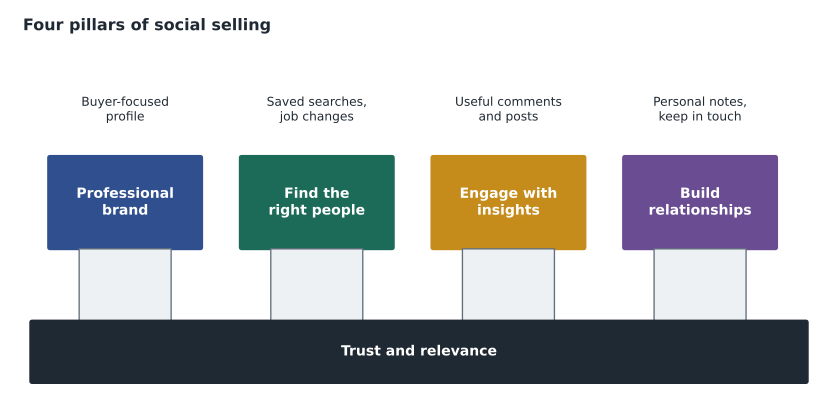
LinkedIn describes social selling in terms of four activities, which it scores in its Social Selling Index (SSI), a number from 0 to 100 made up of four parts worth up to 25 points each. The index is LinkedIn's own measure and links between it and sales results come mainly from LinkedIn's research, so it is best treated as a useful checklist rather than a goal in itself.
| Pillar | What it means | What Maya did |
|---|---|---|
| Establish a professional brand | A complete, credible, buyer-focused profile and useful activity | Rewrote her profile around the problems she helps clinics and offices solve |
| Find the right people | Use search and filters to identify the right contacts at target accounts | Saved searches for office and practice managers at tier A accounts |
| Engage with insights | Share, comment on and create content that helps buyers | Commented on prospects' announcements and shared a short office-move checklist |
| Build relationships | Connect with and stay in touch with the right people over time | Connected with new contacts after calls and meetings, with a personal note |
The profile as a landing page
Many sellers write their profile as a résumé, aimed at future employers. For social selling, it works better as a landing page aimed at buyers: a clear statement of whom the seller helps and how, a photo that looks professional and friendly, a short summary in plain language and evidence of credibility, such as customer recommendations given with permission. The headline matters most because it appears beside every comment and connection request.
| Before | After |
|---|---|
| Account Executive at Ridgeline Workplace Solutions | Helping clinics and professional offices in Regina fix printers, meeting rooms and workspaces | Ridgeline Workplace Solutions |
The summary should be honest and specific. Maya's describes her three years on the floor at Juniper & Pine Home, what she learned there about listening and the kinds of problems she helps offices with now. It does not claim that Ridgeline is "the leading provider" of anything. It ends with an invitation: "If your office is growing, moving or simply fed up with jammed printers, I'm glad to compare notes."
Finding and understanding prospects
Search tools on professional networks let a seller filter people by company, title, location and other details. Maya saved searches for office managers, practice managers and operations managers at her tier A accounts, and set alerts for job changes among her contacts. When Sandstone posted a job ad for an operations coordinator, she saw it the same day.
Profiles also help with research. A contact's posts and comments show what they care about; their career history shows how long they have been in the role; shared connections show who might make an introduction. This information should be used with care. Mentioning someone's professional announcement is relevant. Mentioning their holiday photos is creepy. The test Darnell uses is simple: would the person expect a stranger in a business role to mention this?
Engaging before selling
The core habit of social selling is engaging with prospects in ways that help or acknowledge them, before asking for anything. That can mean a thoughtful comment on a company announcement, congratulations on a new role, a useful answer to a question someone posted or sharing a short, practical resource. Engagement should be genuine. A string of generic comments such as "Great post!" on the posts of every target contact is noticed and resented.
Creating content is the most visible form of engagement. Maya posted about once a fortnight: a short checklist for office moves, a photo of a well-organized supply room with a note about what made it work, and a reflection on what she had learned about listening on the sales floor. None of these mentioned a product. Each one got modest attention, but they gave prospects a reason to recognize her name and gave her something useful to point people to.
Connection requests and messages
A connection request is an invitation to join someone's network. Sending one without a note to a stranger, followed immediately by a sales message, is one of the most disliked habits on professional networks; it is sometimes called a "pitch-slap". A better approach is to send requests with a short personal note that explains the connection, and to wait until there is a reason before sending any sales message.
| Weak | Better |
|---|---|
| (No note) | "Hi Sandra, it was good to talk on Thursday about Lakeview's printers. I'd be glad to stay connected." |
| "I'd like to add you to my professional network." | "Hi Deb, I enjoyed your post about Sandstone's move. I work with a few firms that have combined offices and would be glad to connect." |
| "Let's connect! I help businesses save money on printing." | "Hi Gord, I see Harvest Valley is opening a new branch. Congratulations, and I'd be glad to connect." |
Direct messages on a network are subject to the same writing principles as cold email: short, about the reader, with one small question. They are also subject to the law. Under CASL, a direct message sent through a social network to an account is an electronic message, so a commercial message sent that way needs consent or an exemption, just like an email, and must identify the sender and offer a way to opt out. Accepting a connection request does not by itself mean the person has consented to receive sales messages. Each platform also has user agreements that limit automated messaging, scraping and fake accounts, and breaking them can get an account suspended.
Worked problem
Planning social selling time
Darnell suggests Maya spend 20 minutes a day, four days a week, on social selling. Each session she aims to: review job-change alerts (5 minutes), make 3 thoughtful comments on prospects' posts (2 minutes each), send 3 connection requests with personal notes (2 minutes each) and spend the rest on messages to existing connections. How much time is left for messages each session, and how many personal connection requests does that plan produce in a 12-week quarter?
Show solution
- Alerts: 5 minutes. Comments: 3 × 2 = 6 minutes. Requests: 3 × 2 = 6 minutes.
- Total planned: 5 + 6 + 6 = 17 minutes, leaving 20 − 17 = 3 minutes for messages.
- Requests per quarter: 3 requests × 4 days × 12 weeks = 144 requests.
Answer: About 3 minutes a session remain for messages, and the plan produces 144 personalized connection requests a quarter. If about half are accepted, as Maya's early results suggest, she adds roughly 72 relevant connections a quarter without spending more than 80 minutes a week.
Social selling and the rest of the cadence
Social selling works best combined with other channels. A typical pattern is to view a prospect's profile and engage with a recent post, then call or email a few days later with a reference to the post, then send a connection request after the first conversation. Each touch makes the next one more familiar. Lesson 11 shows Ridgeline's standard cadence, which uses network touches on days 1 and 8. It also matters for referrals: a seller connected to many people in a territory can see shared connections who might introduce her, as lesson 4 described.
Groups and communities
Professional networks also host groups and communities: discussion forums for clinic managers, office administrators, accountants and many other roles. They can be useful places to learn what buyers worry about, because members ask each other real questions about suppliers, equipment and costs. They are poor places to sell. Most groups ban promotional posts, and members quickly notice sellers who join only to pitch. Maya joined two groups for practice and office managers in her region and used them mainly to listen. When a member asked how other clinics handled confidential printing, she answered with practical advice, mentioned where she worked only in her profile and did not follow up with a sales message. Two members later viewed her profile, and one connected with her. Darnell called this the right kind of slow.
Measuring social selling
Social selling is harder to measure than calls or emails, because its effect is often indirect: a prospect answers a call because they recognize the name, or replies to an email because they read a post. Ridgeline tracks a few simple measures: connection requests sent and accepted, conversations that started on the network, meetings where the prospect mentioned seeing the seller's activity and pipeline from accounts where the seller engaged on the network first. Grace compares these with accounts where the seller did not. Early results in 2026 suggested that prospects who had engaged with a seller's content were more likely to take a first meeting, but the sample was small and the sellers who used social selling most were also among the most experienced, so the cause is unclear.
Ethics and professionalism
Social selling raises some particular ethical questions. Sellers should not use fake profiles, buy followers or ask colleagues to fill their posts with staged praise. They should disclose relationships when posting about their own company's products or customers, which is both a platform rule and, in advertising, a legal requirement in both countries when endorsements are involved. They should respect people who do not want to connect. And they should remember that posts are public and permanent: a careless comment about a customer or competitor can be seen by everyone in the territory.
Darnell's last piece of advice to Maya on the subject was about patience. "Social selling is compound interest," he said. "One comment does nothing. A year of being useful in public means that when you call, people already know you're worth thirty seconds."
Common mistakes
MistakeSending a sales pitch immediately after a connection request is accepted.
InsteadConnect with a personal note and wait for a real reason to message.
MistakeWriting the profile as a résumé for employers.
InsteadWrite it for buyers: whom you help, how and with what evidence.
MistakeLeaving generic "Great post!" comments everywhere.
InsteadComment thoughtfully and only where you have something useful to add.
MistakeTreating network messages as outside the anti-spam rules.
InsteadUnder CASL, commercial direct messages need consent or an exemption, identification and an opt-out.
MistakeMentioning personal details found on a profile.
InsteadUse only information a person would expect a business contact to mention.
Summary and key terms
- Social selling uses professional networks to find, understand and build relationships with buyers, making other channels warmer.
- Buyers research sellers online, so a buyer-focused profile matters.
- LinkedIn's four pillars are building a professional brand, finding the right people, engaging with insights and building relationships.
- Job changes and company announcements on networks are useful triggers.
- Engage before selling, with genuine comments and useful content, and send connection requests with personal notes.
- Network messages follow the same writing principles and, depending on the country, the same legal rules as email.
- Social selling works best combined with calls and email, and should be measured as carefully as other channels.
- Social selling
- Using professional social networks to find, understand and build relationships with potential buyers.
- Social Selling Index (SSI)
- LinkedIn's 0 to 100 score of a member's social selling activity across four pillars.
- Connection request
- An invitation to join someone's professional network.
- Pitch-slap
- Informal name for a sales message sent immediately after a connection is accepted.
- Job-change trigger
- A contact starting a new role, which often prompts a review of suppliers.
Practice problems
Work each problem on paper first, then reveal the answer to check.
Rewrite this headline for buyers: "Sales Representative at Ridgeline".
Show answer
For example: "Helping clinics and offices fix printers and meeting rooms | Ridgeline Workplace Solutions".
A seller sends 4 personal connection requests a day, 5 days a week, for 10 weeks. How many requests is that?
Show answer
4 × 5 × 10 = 200 requests.
Why is a job change a useful trigger?
Show answer
New people in roles often review suppliers in their first months, and former contacts in new jobs are warm leads.
What test does Darnell use to decide whether to mention something from a profile?
Show answer
Would the person expect a stranger in a business role to mention it?
Lesson quiz · 5 questions
Score 60% or more to complete this lesson.
Create a free account to save your progress, take quizzes and earn a certificate.