
SLS-210 · Lesson 10 of 12 · 19 min
Qualifying with BANT, MEDDIC and similar frameworks
▶ Video coming soon A video version of this lesson is on the way.
On November 5, Maya had what she thought was her best first meeting yet. The office manager at a 30-person engineering consultancy talked for 40 minutes about jammed printers, a crowded boardroom and a messy supply cupboard. She loved RoomFlow's demonstration on Maya's tablet. At the end, Maya asked who else would be involved in a decision. The office manager laughed and said the firm's owner had signed a seven-year printer lease with a competitor in 2024 and "would rather sell the building than break it". Maya had spent an hour, plus travel, on a buyer who could not buy. At the Thursday session, Darnell said this was the most useful lesson of her fall: "Interest is not the same as an opportunity. Qualifying is how you tell the difference."
Qualification is the process of deciding whether a prospect is worth pursuing as a sales opportunity, by checking whether the conditions for a purchase exist: a real need, someone who can decide, the means to pay, a reason and a time frame to act, and a realistic chance that the seller's offering is the right answer. Sales teams use qualification frameworks, short checklists usually known by acronyms, to make sure the important questions are asked. This lesson describes the best-known frameworks, where they came from and when each one fits. It also covers the skill that matters as much as qualifying in: qualifying out, honestly and early.
Why qualification matters
Qualification protects three things. It protects the seller's time: every hour spent on a deal that cannot close is an hour not spent finding one that can. It protects the forecast: if the pipeline is full of opportunities that will never close, the company's revenue predictions are wrong, which affects hiring, purchasing and cash planning. And it protects the buyer: a buyer who is not ready or not a fit is better served by a seller who says so than by one who pushes. Qualification is not a single gate at the start of a sale. It continues through the whole process as the seller learns more, and an opportunity that looked qualified in October can become unqualified in December if, for example, the decision maker leaves.
BANT
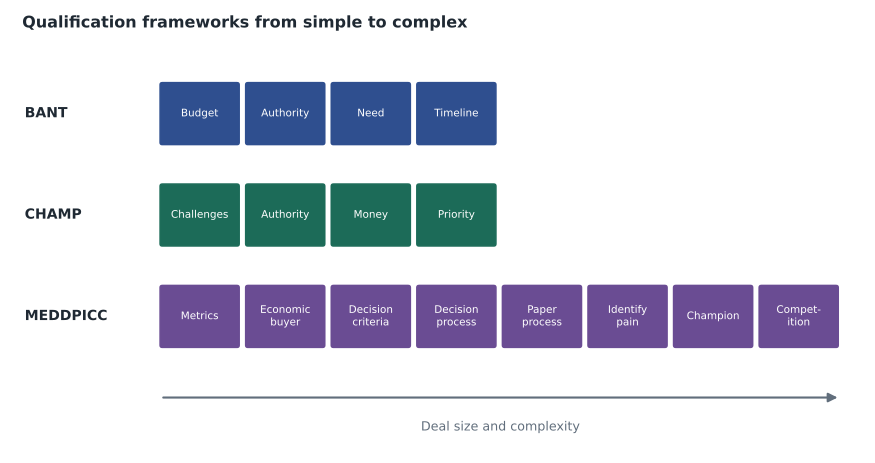
BANT stands for Budget, Authority, Need and Timeline. It is usually credited to IBM, which is said to have used it to train its sales force in the mid-twentieth century, although the exact origin is not well documented. BANT asks four questions: does the buyer have money set aside for this; is the person we are talking to able to make or strongly influence the decision; is there a real need we can meet; and is there a time frame for acting? It is easy to remember and easy to teach, which is why it is still widely used, especially in inside sales teams that qualify inbound leads quickly.
BANT also has well-known weaknesses. Budget is often not set before a buyer understands the problem and the options, especially for new kinds of purchases, so asking about budget too early can disqualify good prospects. Authority in modern organizations is usually shared by several people, not held by one. Need is the most important item but comes third in the acronym, which some trainers argue encourages sellers to ask about money before understanding the problem. And BANT says nothing about competition or how the buyer will decide. Many sellers therefore use it as a starting point and reorder it, asking about need first.
Alternatives to BANT
Several frameworks were created in response to BANT's weaknesses. ANUM (Authority, Need, Urgency, Money) moves money to the end. CHAMP (Challenges, Authority, Money, Prioritization) starts with the buyer's challenges and asks how high the purchase ranks among other priorities. HubSpot published a longer framework known as GPCTBA/C&I, which covers Goals, Plans, Challenges, Timeline, Budget, Authority, negative Consequences and positive Implications, for consultative sales where the seller helps the buyer think through a problem. All of these share a pattern: they put the buyer's situation first and treat budget and authority as things to understand rather than tests to pass.
MEDDIC and its variants
MEDDIC was developed in 1996 at Parametric Technology Corporation (PTC), a software company, by Dick Dunkel, working with Jack Napoli under the sales leader John McMahon. PTC credited it with helping the company grow very quickly, and it spread to many enterprise software and technology companies. MEDDIC is designed for complex sales with several decision makers, long cycles and large deals. Its six letters stand for Metrics, Economic buyer, Decision criteria, Decision process, Identify pain and Champion.
| Letter | Element | Question it asks | Example at Ridgeline |
|---|---|---|---|
| M | Metrics | What measurable result will the buyer gain? | Six staff hours a month saved; print costs cut by a fifth |
| E | Economic buyer | Who controls the money and gives final approval? | The managing partner, not the office manager |
| D | Decision criteria | What will they judge options on? | Cost over five years, confidentiality, service response time |
| D | Decision process | What steps, people and dates lead to a decision? | Partners' meeting on the first Monday of the month |
| P | Paper process (MEDDPICC) | How does a signed agreement actually happen? | Legal review of the service agreement; purchase order from finance |
| I | Identify pain | What problem matters enough to act on? | Jammed printers delay client files; double-booked rooms |
| C | Champion | Who inside wants this and will sell it internally? | The operations manager who presents to the partners |
| C | Competition (MEDDICC, MEDDPICC) | Who else is being considered, including doing nothing? | The current supplier's renewal offer |
Later versions added letters. MEDDICC adds a second C for Competition, and MEDDPICC adds both Paper process and Competition. The champion is one of the framework's most useful ideas. A champion is not simply a friendly contact; it is someone inside the buying organization who has influence, benefits personally from solving the problem and is willing to argue for the purchase when the seller is not in the room. Many complex deals are won or lost by the champion's efforts, and MEDDIC asks sellers to test, not assume, that their contact is one.
MEDDIC is more demanding than BANT. Answering all of its questions often takes several conversations, and much of the information comes during discovery and later stages rather than at the first contact. For this reason, Ridgeline uses BANT-style questions for qualifying inbound leads and first meetings, and MEDDPICC for larger opportunities, such as the Prairie Valley tender and multi-site deals worth more than 40,000 dollars. SLS-211 covers how the questions are explored in discovery.
Choosing a framework
No framework is right for every sale. The best choice depends on the size and complexity of the deal and the stage of the conversation. For a small, quick purchase, such as a single printer for a ten-person office, a long framework wastes everyone's time. For a large, multi-year contract with several decision makers, a short checklist misses too much. Many teams use a light framework early and a heavier one later. What matters more than the acronym is that the team agrees on what "qualified" means and records the answers consistently in the CRM, so that managers and forecasts can rely on them.
| Situation | Good fit | Why |
|---|---|---|
| Inbound lead, first call | BANT or ANUM, need first | Quick check of basic conditions |
| Consultative sale, unclear problem | CHAMP or GPCTBA/C&I | Focus on challenges and goals before money |
| Large, multi-stakeholder deal | MEDDIC or MEDDPICC | Maps economic buyer, process, champion and competition |
| Public tender | MEDDPICC, with the tender rules | The decision criteria and process are published and strict |
Qualifying at the prospecting stage
In prospecting, the seller usually has only a few minutes with a buyer, on a call or at a booth. That is not enough for a full framework, and trying to interrogate a stranger with a checklist is off-putting. The aim at this stage is lighter: to find out whether there is a plausible need, whether the timing is roughly right and whether the person is involved in decisions, and then decide whether a first meeting is worthwhile. Darnell taught Maya three questions she could weave into a cold call or a booth conversation naturally.
| Question | What it checks | Example wording |
|---|---|---|
| What is happening? | Need and trigger | "What's prompting you to look at this now?" |
| Who else cares? | Authority and process | "Who else would want a say if you changed how the printers work?" |
| What is the timing? | Timeline and contracts | "Is there anything coming up, like a lease ending or a move, that sets the timing?" |
The engineering consultancy would have failed the third question in two minutes. Had Maya asked about contracts on the first call, she would have learned about the seven-year lease and scheduled a check-in for the year before it ends instead of a meeting.
Qualifying out
Qualifying out, or disqualifying, means deciding honestly that a prospect is not an opportunity, at least for now, and telling them so politely. Many sellers find this hard, because an open opportunity feels like progress and closing it feels like failure. But a pipeline full of deals that will never close is worse than a smaller, real one: it misleads the seller, the manager and the forecast, and it uses time that should go to better prospects. Good sellers disqualify early and without drama, and keep the door open for the future.
Worked problem
The value of qualifying out
Maya has 10 hours a week for first meetings and follow-up. A well-qualified opportunity takes about 4 hours of her time and has a 25 in 100 chance of being won, with an average first-year value of 15,000 dollars. A poorly qualified one also takes about 4 hours but has only a 5 in 100 chance. If she spends a week on poorly qualified opportunities instead of qualified ones, how much expected first-year revenue does she lose?
Show solution
- Opportunities she can work in 10 hours: 10 ÷ 4 = 2.5.
- Expected value of a qualified opportunity: 0.25 × 15,000 = 3,750 dollars.
- Expected value of a poorly qualified one: 0.05 × 15,000 = 750 dollars.
- Loss per opportunity: 3,750 − 750 = 3,000 dollars; for 2.5 opportunities: 2.5 × 3,000 = 7,500 dollars.
Answer: One week spent on poorly qualified opportunities costs about 7,500 dollars in expected first-year revenue. Over a quarter of such weeks the loss would be large, which is why Darnell asks sellers to qualify out quickly and move on.
Qualifying out should be done respectfully. The seller can thank the buyer, explain honestly why now is not the right time, and agree when to check back: "It sounds like the lease runs until 2031, so changing now wouldn't make sense for you. Would it be all right if I checked in during 2030, before the renewal?" The CRM record should show the reason and the follow-up date. Buyers remember sellers who did not waste their time.
Recording qualification
Qualification only helps the team if it is recorded. Ridgeline's CRM has fields for each MEDDPICC element on larger opportunities, and three simple fields (need, people involved, timing) for every opportunity, so that Darnell can see at a glance which opportunities are real during his weekly pipeline review. An opportunity cannot move to the proposal stage until the economic buyer and the decision process are filled in. Sellers sometimes resent these fields, but they make forecasting far more accurate, and they force a seller to notice what she does not know.
Common mistakes
MistakeTreating a friendly, interested contact as a qualified opportunity.
InsteadCheck need, people, process and timing before counting it as pipeline.
MistakeOpening a first call with "What is your budget?"
InsteadAsk about the situation and need first; budget often depends on understanding the problem.
MistakeAssuming a friendly contact is a champion.
InsteadTest whether they have influence, a personal stake and willingness to advocate.
MistakeUsing one heavy framework for every sale.
InsteadMatch the framework to the deal size and complexity.
MistakeKeeping dead deals open to make the pipeline look healthy.
InsteadQualify out early and honestly, and set a future check-in date.
Summary and key terms
- Qualification decides whether a prospect is a real opportunity by checking need, decision makers, means, timing and fit.
- It protects the seller's time, the accuracy of the forecast and the buyer's interests, and continues through the whole sale.
- BANT (Budget, Authority, Need, Timeline), usually credited to IBM, is simple but weak on shared decisions and budgets set late.
- ANUM, CHAMP and GPCTBA/C&I put the buyer's situation and challenges first.
- MEDDIC, created at PTC in 1996, maps metrics, the economic buyer, decision criteria and process, pain and a champion; MEDDPICC adds the paper process and competition.
- Choose a light framework for early or simple sales and a fuller one for large, complex deals.
- Qualifying out early and respectfully is as important as qualifying in.
- Qualification
- Deciding whether a prospect is worth pursuing as an opportunity.
- BANT
- Budget, Authority, Need and Timeline: a simple qualification checklist.
- MEDDIC
- Metrics, Economic buyer, Decision criteria, Decision process, Identify pain and Champion.
- Economic buyer
- The person who controls the money and gives final approval.
- Champion
- A person inside the buying organization with influence and a stake who advocates for the purchase.
- Qualifying out
- Deciding, and telling the buyer, that a prospect is not an opportunity for now.
Practice problems
Work each problem on paper first, then reveal the answer to check.
Name the six elements of MEDDIC.
Show answer
Metrics, Economic buyer, Decision criteria, Decision process, Identify pain and Champion.
Why do many trainers suggest asking about need before budget?
Show answer
Budgets are often set only after a buyer understands the problem and options; early budget questions can disqualify good prospects.
An opportunity has a 30 in 100 chance and a value of 20,000 dollars. What is its expected value?
Show answer
0.30 × 20,000 = 6,000 dollars.
Write a polite sentence to qualify out a prospect whose contract runs three more years.
Show answer
For example: "Changing now wouldn't make sense with your contract running to 2029. May I check in during 2028?"
Lesson quiz · 5 questions
Score 60% or more to complete this lesson.
Create a free account to save your progress, take quizzes and earn a certificate.