
BAR-120 · Lesson 1 of 12 · 25 min
How the MEE is written and graded
▶ Video coming soon A video version of this lesson is on the way.
On Wednesday evening, September 16, 2026, Hollis Marchetti adds a third weekly session to the group's calendar. Tuesdays are the general study group, Saturday mornings and Monday evenings are multiple-choice drills, and Thursdays in October will be ethics. Wednesdays, she announces, are for writing. 'I graded bar essays for a UBE jurisdiction for six years,' she tells the group on the video call. 'I read hundreds of answers to the same question in a single weekend. I know what it feels like to pick up the fortieth answer and see, in the first three lines, whether the writer understood the problem. This series is about making your answer the one a tired grader is happy to read.'
Dana Whitfield and Ngozi Adeyemi are the two members who will sit the Multistate Essay Examination in February 2027: Dana as part of the Texas exam, Ngozi as part of the New York exam. Both jurisdictions still give the legacy Uniform Bar Examination until they switch to the NextGen exam. Sofia Reyes will not take the MEE, because California writes its own essay questions, but she joins anyway: California's essays are graded the same way, and her July 2026 score report showed that two weak essays cost her more than anything else. Marcus Bell, who passed Missouri's first NextGen exam in July, comes to help. Etienne 'Eddie' Boudreaux and Camila Ortiz Rivera, who face jurisdiction-drafted essays in Louisiana and Puerto Rico, join for the method weeks.
This course follows those Wednesday sessions. It teaches how bar essays are graded, a repeatable method for reading, outlining and writing an answer in 30 minutes, the business associations law that only the essay tests, and how the multiple-choice subjects you reviewed in BAR-110 and BAR-111 look when they come back as essays. Every essay question in this course is original and written for it. None is taken from the questions or analyses that the National Conference of Bar Examiners (NCBE) releases.
What the MEE is
The MEE is one of the three legacy components NCBE prepares for bar examinations, alongside the Multistate Bar Examination (MBE) and the Multistate Performance Test (MPT). It is a three-hour session of six essay questions, which works out to an average of 30 minutes per question. You may answer the questions in any order, and you decide how to divide the three hours, but each question is graded separately and the grader of one question never sees your other answers.
Each question is a short set of facts, usually a page or less, followed by one or more numbered calls: specific questions about what the law requires or how a dispute should come out. A typical question might describe a small business, a falling out among its owners and a lawsuit, then ask three things: whether a partnership was formed, whether one partner can bind the others to a contract, and what happens to the business now that one partner wants out. The calls tell you what to discuss and, just as important, what not to discuss.
What the MEE tests since July 2026
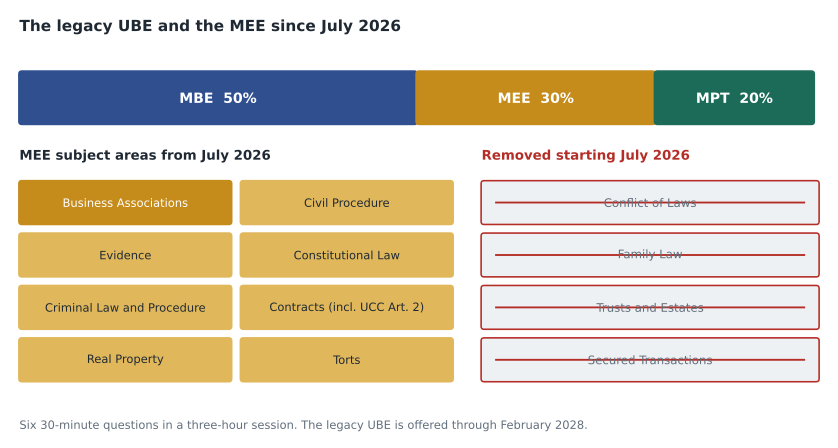
The subject list changed with the July 2026 exam. In 2023 NCBE announced that four subjects would be removed from the MEE, starting with July 2026, so that the essay's subject matter would line up with the NextGen bar exam: Conflict of Laws, Family Law, Trusts and Estates, and Secured Transactions under Article 9 of the Uniform Commercial Code. The MEE now draws its questions from eight areas:
| Area | Also on the MBE? | Where this course covers it |
|---|---|---|
| Business Associations (Agency and Partnership; Corporations and Limited Liability Companies) | No | Lessons 4 and 5 |
| Civil Procedure | Yes | Lesson 6 |
| Evidence | Yes | Lesson 6 |
| Constitutional Law | Yes | Lesson 7 |
| Criminal Law and Procedure | Yes | Lesson 7 |
| Contracts, including UCC Article 2 (Sales) | Yes | Lesson 8 |
| Real Property | Yes | Lesson 9 |
| Torts | Yes | Lesson 10 |
Two consequences follow. First, business associations is now the only area you must learn for the essay alone, which is why this course gives it two full lessons. Second, seven of the eight areas are MBE subjects, so your multiple-choice review is also essay review. The difference is depth of expression: the MBE asks you to recognize the right rule among four choices, while the essay asks you to state the rule yourself, in clear sentences, and then apply it to facts that are deliberately messy.
NCBE also notes that a single question may test more than one area, and that the areas covered vary from exam to exam. A question about a corporation's contract with a supplier can raise both a corporate authority issue and a UCC Article 2 issue. A question about a car accident can mix negligence with a hearsay objection at trial. Do not assume a question belongs to one subject because it starts that way.
What happened to the four dropped subjects? NCBE's MEE page says that Family Law and Trusts and Estates will be tested through the Multistate Performance Test from July 2026 through February 2028, which means they can appear as the subject of an MPT task, where the library supplies the law you need. Conflict of Laws and Secured Transactions are simply gone from the multistate written tests. Lesson 11 explains where all four still matter: on some jurisdictions' own essay components, on the MPT, and, for family law, on the NextGen exam from July 2028.
The MEE inside the Uniform Bar Examination
In jurisdictions that give the legacy UBE, the three NCBE components are combined with fixed weights: the MBE counts for 50 percent of the total score, the MEE for 30 percent and the MPT for 20 percent. That makes the essays worth more than either performance test and three fifths as much as the entire multiple-choice day. Put differently, each of the six MEE answers carries five percent of your total score, about the same weight as 18 or so scored MBE questions.
The legacy UBE remains available through the February 2028 administration. NCBE lists MEE administrations on February 23, 2027, July 27, 2027 and February 22, 2028, with February 2028 the last one shown. Between July 2026 and July 2028 most jurisdictions move to the NextGen Uniform Bar Exam, which does not use the MEE at all. Its written work takes the form of integrated question sets and performance tasks, covered in BAR-130. For the members of this group the timing is simple: Dana's Texas exam and Ngozi's New York exam in February 2027 are legacy exams with a full MEE session, because Texas and New York are not scheduled to give NextGen until July 2028.
Some jurisdictions that do not give the UBE also use the MEE, sometimes alongside essays they write themselves, and they set their own weights. If you are sitting in such a jurisdiction, check its bar admission website for the exact format, and use the jurisdiction course for your state in this program.
Who grades your essay
NCBE writes the questions, but it does not grade them. Each jurisdiction that uses the MEE recruits its own graders, usually practicing lawyers, and grades the answers of its own examinees. NCBE supports them with grading materials for each question, including an analysis of the issues and the law, and a grader training workshop held in Madison, Wisconsin, the weekend after the exam, which graders can attend in person or remotely. At the workshop, drafters and experienced graders walk through each question, discuss what a strong answer contains and practice on sample answers.
Marchetti describes what that meant for her. 'We received the question, the analysis and a stack of real answers. We calibrated together on sample papers until we agreed on what a 6, a 4 and a 2 looked like for that question. Then we went home and graded, sometimes hundreds of answers to one question. You are not writing for a law professor who has time to admire your style. You are writing for a careful reader with a checklist and a deadline.'
Relative grading
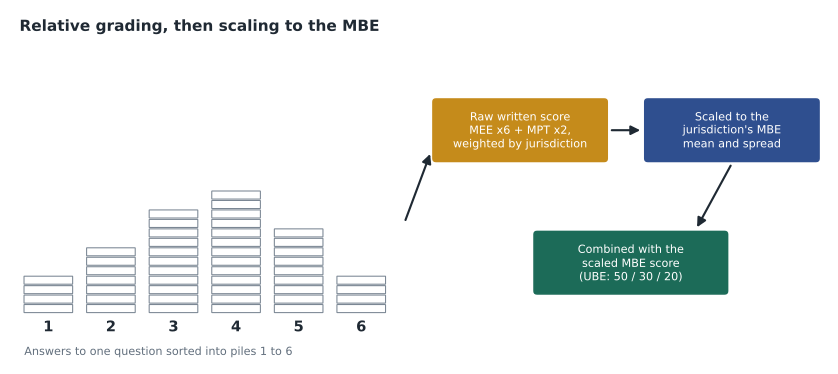
The key to understanding MEE scores is that they are relative. Graders do not ask whether your answer meets some absolute standard of perfection. They rank answers to the same question against one another and sort them into a fixed number of piles. NCBE trains graders on a scale of 1 to 6, though jurisdictions may use other scales. On a 1-to-6 scale, the best answers in the group receive a 6 even if none of them is perfect, and the weakest receive a 1. An answer that is merely better than average lands in the middle.
NCBE has explained why it recommends relative grading. Jurisdictions use different scales and procedures, questions differ in difficulty from one exam to the next, the strength of the examinee pool changes, and some graders are harsher than others. Ranking answers within each question and then scaling the results corrects for all of those differences at once. Six piles are manageable for a grader, and an even number avoids the pile-up in the middle that a five-point scale invites.
What does a pile look like? Jurisdictions publish rubrics in general terms. A typical description of a 6 is an answer showing a thorough understanding of the facts and the law, with complete, well-organized reasoning; a 4 shows satisfactory understanding and reaches reasoned conclusions; a 2 shows only a rudimentary grasp of the issues and weak application; a 0 or 1 is unresponsive or fails to engage with the problem. Look at what the descriptions reward: identifying the issues, stating the law accurately, applying it to the facts, and doing so in an organized way. They do not reward length, flourishes or legal history.
From piles to a scaled score
After grading, each examinee has six raw MEE grades and two raw MPT grades. The jurisdiction combines them using its weights; on the UBE, the MEE carries 30 points and the MPT 20 points of the written half. That combined raw written score is then scaled to the MBE. In plain terms, the written scores in the jurisdiction are converted so that they have the same mean and spread as that jurisdiction's scaled MBE scores. Because the MBE is equated across administrations, it serves as a stable anchor, so a written score means the same thing from one exam to the next even if the essay questions were harder or the graders stricter.
Scaling has a practical lesson. Your written score depends on where you rank among the examinees in your jurisdiction, and the whole group's written scores are tied to how well the same group did on the MBE. You do not need 6s. A steady run of 4s, with no 1s or 2s, puts you comfortably above the middle of the written distribution. The answers that sink candidates are the disasters: the question left half done because time ran out, the answer that discusses the wrong issue, the answer so disorganized that the grader cannot find the analysis.
Worked problem
What one blank answer costs
Ngozi asks how much a single unfinished essay matters. Suppose an examinee writes five solid answers that each receive a 4 and runs out of time on the sixth, which receives a 1. Another writes six answers that each receive a 4. Each MEE answer is one sixth of the MEE, and the MEE is 30 percent of the UBE.
Show solution
- Each MEE answer is worth one sixth of 30 percent, or 5 percent of the total UBE weight.
- The first examinee's raw MEE total is 5 times 4 plus 1, or 21. The second's is 6 times 4, or 24.
- The 3-point gap is one eighth of the second examinee's MEE total, a meaningful drop in the written score before scaling.
- On a scale where most examinees cluster around 3 and 4, losing three raw points can move an examinee from comfortably above average to below it.
Answer: Finishing every question matters more than polishing one. A rushed but complete answer that earns a 3 beats an abandoned one that earns a 1.
What graders look for
NCBE's grading analyses identify the issues each question raises and the law and reasoning a strong answer should contain. Graders are told to look for the examinee's ability to identify legal issues in the facts, separate relevant from irrelevant material, present a reasoned analysis, and show an understanding of the fundamental legal principles involved. Unless a question tells you to apply a particular jurisdiction's law or a particular uniform act, you are expected to use generally accepted principles: the majority common-law rule, the Federal Rules of Civil Procedure and Evidence, the Uniform Commercial Code, and, in business associations, the widely adopted uniform and model acts discussed in Lessons 4 and 5. Where the majority and minority rules differ and the facts make the difference matter, a strong answer notes both briefly and reaches a conclusion under the majority rule.
Marchetti puts it more bluntly. 'Graders reward three things: the right issues, the right rules, and the facts used in the analysis. If you use a fact from the problem in every paragraph, you are probably doing it right. If a paragraph has no facts in it, it is probably a law lecture, and nobody earns points for a law lecture.' The facts in an MEE question are carefully chosen. Dates, dollar amounts, who knew what, who signed what and who said what are rarely decoration. If a fact is there, it is likely there because it changes the analysis.
Conclusions matter less than you might think, but they are not irrelevant. Many questions are drafted so that a reasonable answer could go either way on a close point, and graders give credit for a well-reasoned conclusion on either side. What they will not credit is an answer that never commits, or one that reaches a conclusion the analysis does not support. A clear conclusion on each call is part of a complete answer.
How the jurisdictions use released questions
NCBE makes study materials available for the MEE. Its preparation page offers older questions with their analyses as free downloads, the questions from the July 2026 exam without analyses, and paid study aids. Practicing with released questions is the single best way to learn the style, and the analyses show what drafters consider the core issues. This course uses only original practice questions, but you should also work through official released questions under timed conditions before your exam. When you do, remember that questions released before July 2026 may test subjects that have since been dropped; skip those or treat them as background for a state component if your jurisdiction tests those subjects.
Many jurisdictions also publish selected high-scoring answers from past exams. They are useful because they show what real 5s and 6s look like when written in 30 minutes under pressure: not polished treatises, but direct, organized answers that state the rules and use the facts. Sofia, who has read the California State Bar's published sample answers from her July exam, says the same thing. 'The answers that passed were not fancy. They were complete.'
Typing, timing and logistics
Most jurisdictions administer the written portions on laptops with secure exam software, though some allow handwriting. Your jurisdiction's instructions control what you may bring, how the software works and what happens if your laptop fails. Three practical points apply almost everywhere. First, you will receive all six questions at once and can answer them in any order. Second, the clock is for the whole session, so the 30-minute average is a budget you must enforce yourself. Third, nothing you write on scratch paper is graded, so the outline you sketch should be short.
Marchetti closes the first session with a homework assignment: read one released MEE question and its analysis, any subject, and time how long it takes to read the facts carefully. 'Most people find it is four or five minutes. That tells you how much is left for outlining and writing. Next week we start with the most important minute of every answer: reading the call.'
Practice problems
Work each problem on paper first, then reveal the answer to check.
How many questions does the MEE have, and how long is the session?
Show answer
Six questions in a three-hour session, an average of 30 minutes each.
Which four subjects were removed from the MEE starting in July 2026?
Show answer
Conflict of Laws, Family Law, Trusts and Estates, and Secured Transactions.
What weight does the MEE carry on the legacy UBE?
Show answer
30 percent, with the MBE at 50 percent and the MPT at 20 percent.
Who grades MEE answers?
Show answer
Graders chosen by each jurisdiction, using NCBE grading materials and training.
What does relative grading mean?
Show answer
Answers to the same question are ranked against each other and sorted into piles, such as 1 to 6, rather than measured against a fixed standard.
Why is the written score scaled to the MBE?
Show answer
The MBE is equated across exams, so scaling written scores to it corrects for differences in question difficulty, grader strictness and examinee ability.
Common mistakes
MistakeThe MEE still tests family law and trusts and estates.
InsteadSince July 2026 those subjects appear only through the MPT, with the law supplied, until February 2028.
MistakeA score of 6 requires a perfect answer.
InsteadGrading is relative: the best answers in the group earn the top score.
MistakeSpending extra time to perfect one answer is worth it.
InsteadEach answer is graded separately; an unfinished answer costs more than a merely good one gains.
MistakeNCBE grades the essays centrally.
InsteadEach jurisdiction grades its own examinees using NCBE materials.
Summary and key terms
- The MEE is six 30-minute essay questions in a three-hour session, worth 30 percent of the legacy UBE.
- Since July 2026 it covers business associations plus seven MBE subjects; four subjects were dropped.
- Jurisdictions grade the answers relatively, typically on a 1-to-6 scale, after NCBE training.
- Combined written scores are scaled to the jurisdiction's MBE scores, so consistency beats brilliance.
- The legacy UBE, and with it the MEE, is given through February 2028.
- Multistate Essay Examination (MEE)
- NCBE's six-question essay test, worth 30 percent of the legacy Uniform Bar Examination.
- Relative grading
- Ranking answers to the same question against one another and sorting them into score piles.
- Scaling
- Converting raw written scores so they share the mean and spread of the jurisdiction's scaled MBE scores.
- Call of the question
- The specific numbered question at the end of an essay prompt that the answer must address.
- Grading analysis
- NCBE's written discussion of the issues and law in an MEE question, provided to graders.
Lesson quiz · 5 questions
Score 60% or more to complete this lesson.
Create a free account to save your progress, take quizzes and earn a certificate.