
BAR-120 · Lesson 7 of 12 · 26 min
Constitutional law and criminal procedure on the essay
▶ Video coming soon A video version of this lesson is on the way.
On Wednesday, October 28, 2026, Eddie and Camila join the Wednesday call again. Both sat in on the Saturday constitutional law weeks, and both will write constitutional questions on their own exams. Marchetti opens with what she calls the most common failure she saw as a grader in constitutional law essays. 'Candidates know the tests. Strict scrutiny, intermediate scrutiny, rational basis. Then they write a paragraph that says the law fails strict scrutiny because it is bad. Constitutional law essays are won by doing the steps in order, and by using the government's stated reason and the facts about how the law actually works.'
This lesson covers how constitutional law and criminal law and procedure appear as MEE essays and gives an order of analysis for each. The doctrine itself was reviewed in BAR-110 and BAR-111. The bar exam tests settled law, so rely on well-established doctrine and treat the newest decisions as illustrations rather than as the center of an answer, unless a question builds on them.
How constitutional law essays are built
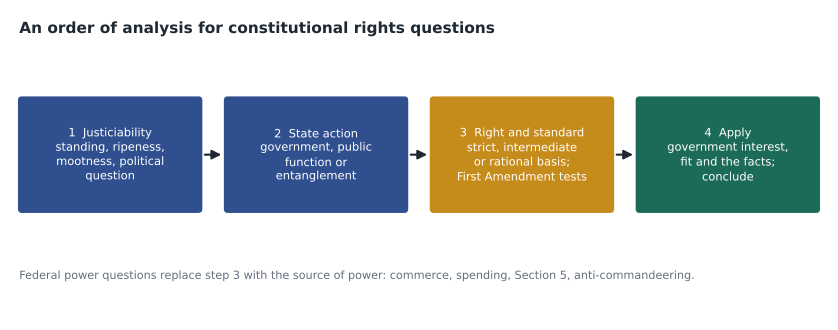
A typical constitutional law essay describes a government action, such as a statute, an ordinance, a regulation or an official's decision, and a person or business harmed by it. The calls ask whether a court can hear the challenge, whether the action is constitutional, or both. Sometimes the question involves the federal government's power to act at all, or the relationship between federal and state power. The structure that works almost every time is: justiciability, then the source of power or the right at stake, then the standard of review, then application.
Justiciability first
If the call asks whether a court can hear the case, or if the facts raise doubt, address justiciability before the merits. Standing requires that the plaintiff suffer an injury in fact that is concrete, particularized and actual or imminent; that the injury be fairly traceable to the challenged action; and that a favorable decision be likely to redress it. An organization may sue on behalf of its members if the members would have standing, the interests are germane to its purpose and individual participation is not needed. Ripeness asks whether the claim is premature; mootness asks whether a live controversy remains, with exceptions for wrongs capable of repetition yet evading review and for voluntary cessation. Political questions, such as matters committed to another branch or lacking manageable standards, are not justiciable. The Eleventh Amendment bars suits in federal court against unconsenting states for damages, but not suits against state officers for prospective injunctive relief.
Government power and federalism
When a federal law is challenged as beyond Congress's power, identify the power Congress relied on and apply its test. Under the Commerce Clause, Congress may regulate the channels and instrumentalities of interstate commerce and activities that substantially affect interstate commerce, including economic activities that in the aggregate have a substantial effect; it may not regulate non-economic activity based on attenuated effects. The taxing and spending powers are broad, but conditions on federal grants to states must be unambiguous, related to the program's purpose and not so coercive as to compel participation. Under the Tenth Amendment, Congress may not commandeer state legislatures or officials to enact or enforce federal programs, as the Court reaffirmed in Murphy v. NCAA (2018). Section 5 of the Fourteenth Amendment lets Congress enforce rights against the states only through remedies that are congruent and proportional to proven violations.
When a state law burdens interstate commerce, apply the dormant Commerce Clause: a law that discriminates against out-of-state commerce on its face, in purpose or in effect is virtually invalid unless necessary to an important, non-protectionist interest with no reasonable non-discriminatory alternative. A non-discriminatory law is usually upheld; courts may still ask whether its burden on commerce is clearly excessive in relation to local benefits, though in National Pork Producers Council v. Ross (2023) the Court declined to strike down a non-discriminatory state law based on its effects on out-of-state producers. Exceptions include the state acting as a market participant and congressional authorization. Federal law preempts state law expressly, by occupying a field, or by conflict.
Separation of powers questions ask whether one branch has taken another's power. Recent decisions have expanded presidential control over the executive branch. In Trump v. Slaughter, decided in June 2026, the Supreme Court held that the President may remove a commissioner of the Federal Trade Commission at will, overruling Humphrey's Executor v. United States (1935); the Court distinguished the Federal Reserve. In Loper Bright Enterprises v. Raimondo (2024), the Court overruled the Chevron doctrine, so courts now decide for themselves the best reading of a statute an agency administers. On the essay, state the settled framework, then use the current rule if the facts call for it.
Individual rights: state action and the standard of review
Constitutional rights, apart from the Thirteenth Amendment, limit government, not private persons. State action exists when the government acts, when a private party performs a function traditionally and exclusively reserved to the state, or when the government is significantly entangled with private conduct, for example by compelling or jointly participating in it. If the facts involve a private actor, address state action briefly before the merits.
Then choose the standard of review, which decides most equal protection and due process questions. Strict scrutiny applies to classifications based on race, national origin and, for state laws, alienage, and to laws burdening fundamental rights such as voting, interstate travel, marriage and certain family rights; the government must show the law is necessary to a compelling interest and narrowly tailored. Intermediate scrutiny applies to classifications based on sex and non-marital birth; the government must show an exceedingly persuasive justification, that the law is substantially related to an important interest. Everything else gets rational basis review: the challenger must show the law is not rationally related to any legitimate interest. In Students for Fair Admissions v. Harvard (2023), the Court applied strict scrutiny to race-conscious university admissions and held the programs unconstitutional. Under Dobbs v. Jackson Women's Health Organization (2022), abortion regulations receive rational basis review as a matter of federal law.
The First Amendment
Free speech questions turn on whether a regulation is content based. A law that applies because of the topic discussed or the idea or message expressed is content based and must satisfy strict scrutiny, as the Court held in Reed v. Town of Gilbert (2015). Content-neutral regulations of the time, place and manner of speech in a public forum are valid if narrowly tailored to a significant government interest and they leave open ample alternative channels. In a nonpublic forum, restrictions need only be reasonable and viewpoint neutral. Some categories receive less protection, including incitement to imminent lawless action, true threats, obscenity, defamation (subject to constitutional limits) and speech integral to criminal conduct. Prior restraints carry a heavy presumption against validity. In 303 Creative LLC v. Elenis (2023), the Court held that a state may not compel a website designer to create expressive work celebrating messages she disagrees with.
Religion questions involve two clauses. Under the Free Exercise Clause, a neutral law of general applicability that incidentally burdens religion is valid, but a law that targets religion or is not generally applicable, for example because it allows comparable secular exceptions, triggers strict scrutiny. Under the Establishment Clause, the Court in Kennedy v. Bremerton School District (2022) replaced the old Lemon test with an inquiry that looks to historical practices and understandings; government still may not coerce religious exercise or prefer one religion over another.
Due process, takings and the Second Amendment
Procedural due process requires notice and an opportunity to be heard before the government deprives a person of life, liberty or property, with the process due set by balancing the private interest, the risk of erroneous deprivation and the value of additional safeguards, and the government's interest. Property includes legitimate claims of entitlement, such as tenured employment. Substantive due process protects fundamental rights deeply rooted in the nation's history and tradition with strict scrutiny, and everything else with rational basis review.
The Takings Clause requires just compensation when the government takes private property for public use. A permanent physical occupation is a taking, which the Court in Cedar Point Nursery v. Hassid (2021) extended to a regulation granting union organizers access to farmland. A regulation that deprives land of all economically beneficial use is a taking; other regulations are judged by balancing their economic impact, interference with investment-backed expectations and character. Conditions on development permits must have an essential nexus to a legitimate interest and be roughly proportional to the project's impact, and in Sheetz v. County of El Dorado (2024) the Court held that this test applies to legislatively imposed fees as well as to ad hoc conditions.
Under New York State Rifle & Pistol Association v. Bruen (2022), a firearm regulation burdening conduct covered by the Second Amendment's text is valid only if it is consistent with the nation's historical tradition of firearm regulation; in United States v. Rahimi (2024) the Court upheld a federal ban on firearm possession by persons subject to domestic-violence restraining orders, explaining that a modern law need only be relevantly similar to historical analogues, not identical.
Worked problem
A constitutional law practice question
The town of Millbrook adopts an ordinance prohibiting residents from displaying signs on their lawns about political candidates or ballot measures, except in the 30 days before an election, while allowing at all times signs advertising a property for sale and signs identifying the home's address. The town says the ordinance protects the neighborhood's appearance and traffic safety. Dora, a Millbrook resident, wants to display a sign supporting a candidate four months before an election and sues. Is the ordinance constitutional?
Show solution
- Justiciability: Dora wants to post a sign now and faces enforcement, so she has a concrete, imminent injury traceable to the ordinance and redressable by an injunction. State action is clear: it is a town ordinance.
- Content: the ordinance treats signs differently depending on what they say. Political signs face limits that real estate and address signs do not, so under Reed v. Town of Gilbert it is content based.
- Strict scrutiny: Millbrook must show the ordinance is necessary to a compelling interest and narrowly tailored. Aesthetics and traffic safety are legitimate, but courts rarely treat them as compelling.
- Fit: the ordinance is underinclusive. Real estate and address signs affect appearance and traffic in the same way, yet they are allowed year-round. A residential sign is also an unusually important and inexpensive means of expression for homeowners, which makes a near-total ban for most of the year especially hard to justify.
Answer: The ordinance is a content-based restriction that fails strict scrutiny; Dora should prevail.
How criminal law and procedure essays are built
Criminal essays usually follow a defendant from the crime through investigation to trial. Calls may ask what crimes a person committed, whether defenses apply, whether evidence should be suppressed, or whether a statement was properly admitted. For substantive crimes, list each possible crime and work through its elements one at a time, with the required mental state and the facts that satisfy each element, then defenses. For accomplice liability, ask whether the defendant intentionally aided or encouraged the crime with intent that it be committed. For inchoate crimes, analyze each separately: solicitation, conspiracy (with the overt act and Pinkerton liability where it applies), and attempt (specific intent plus a substantial step or dangerous proximity).
For suppression questions, organize by piece of evidence and by constitutional right, in the order the evidence was obtained. For the Fourth Amendment: was there a search or seizure by government agents, does the defendant have standing based on a reasonable expectation of privacy or a property interest, was there a warrant supported by probable cause, and if not, does an exception apply (search incident to arrest, automobile, plain view, consent, exigent circumstances, stop and frisk, special needs)? Then remedies: the exclusionary rule and the fruit of the poisonous tree, subject to independent source, inevitable discovery, attenuation and the good-faith exception. Carpenter v. United States (2018) holds that obtaining historical cell-site location records is a search that generally requires a warrant.
For statements, analyze Miranda (custody plus interrogation, adequate warnings, valid waiver, invocation of silence or counsel and the Edwards rule against police-initiated questioning after a request for counsel), voluntariness under due process, and the Sixth Amendment right to counsel, which attaches at formal charging and is offense-specific, barring deliberate elicitation of statements about the charged offense. Remember the limits of each remedy: statements taken in violation of Miranda but voluntary may be used to impeach.
Worked problem
A criminal procedure practice question
Officers stop Wes for speeding and see a backpack on the passenger seat. Wes refuses consent to a search. An officer's trained drug-detection dog, already in the patrol car, sniffs the outside of the car during the 10 minutes it takes to write the ticket and alerts at the passenger door. Officers open the backpack and find cocaine. At the station, after Miranda warnings, Wes says, "I think I need a lawyer." A detective continues asking questions, and Wes admits the cocaine is his. What issues should the answer address?
Show solution
- The stop: speeding gives probable cause for a traffic stop.
- The dog sniff: a sniff of a car's exterior is not a search, and it is lawful if it does not prolong the stop beyond the time reasonably needed for the traffic mission. Here it took place while the ticket was being written.
- The search: a reliable dog's alert gives probable cause, and under the automobile exception officers may search any part of the car and containers that might hold the drugs, including the backpack.
- The statement: Wes was in custody and being interrogated. A request for counsel must be unambiguous; "I think I need a lawyer" is arguably ambiguous, and if so police could continue. If a court finds it a clear request, questioning had to stop, and the admission is inadmissible in the case-in-chief though usable to impeach if voluntary.
Answer: The cocaine is likely admissible. The admission depends on whether Wes's words were an unambiguous request for counsel; a strong answer argues both sides and concludes.
Camila notes that the second example illustrates a point Marchetti keeps repeating: close questions reward analysis on both sides. 'The drafters picked words that could go either way on purpose,' she says. 'The points are for seeing that.'
Practice problems
Work each problem on paper first, then reveal the answer to check.
What are the three elements of standing?
Show answer
Injury in fact, causation (fair traceability) and redressability.
What standard applies to a content-based speech restriction?
Show answer
Strict scrutiny: necessary to a compelling interest and narrowly tailored.
What did Kennedy v. Bremerton change?
Show answer
It replaced the Lemon test with an inquiry into historical practices and understandings for Establishment Clause claims.
What did Trump v. Slaughter (2026) hold?
Show answer
The President may remove an FTC commissioner at will; it overruled Humphrey's Executor.
Is a dog sniff of a car's exterior during a traffic stop a search?
Show answer
No, so long as it does not prolong the stop beyond its mission.
When does the Sixth Amendment right to counsel attach?
Show answer
At formal charging; it is offense-specific.
Common mistakes
MistakeStart a constitutional essay with the standard of review.
InsteadAddress justiciability and state action first when the facts raise them.
MistakeAny regulation of speech gets strict scrutiny.
InsteadOnly content-based regulations; content-neutral time, place and manner rules get intermediate review.
MistakeThe Lemon test still governs Establishment Clause claims.
InsteadKennedy v. Bremerton replaced it with a history-based approach.
MistakeAny mention of a lawyer stops interrogation.
InsteadThe request must be unambiguous; analyze the words used.
Summary and key terms
- Constitutional essays: justiciability, power or right, standard of review, then application with the facts.
- Federal power questions use the Commerce Clause, spending limits, anti-commandeering and Section 5 tests.
- Speech turns on content neutrality; religion uses Smith for free exercise and history for establishment.
- Criminal essays: crimes element by element, then defenses; suppression by item and by right.
- Use recent decisions as current law where relevant, but build answers on settled frameworks.
- Standing
- The requirement of injury in fact, causation and redressability for a federal court to hear a claim.
- Strict scrutiny
- Review requiring a law to be necessary to a compelling interest and narrowly tailored.
- Content-based regulation
- A speech restriction that applies because of the topic, idea or message expressed.
- Anti-commandeering doctrine
- The Tenth Amendment rule that Congress may not compel states to enact or enforce federal programs.
- Automobile exception
- The rule allowing a warrantless search of a vehicle when there is probable cause that it contains evidence.
Lesson quiz · 5 questions
Score 60% or more to complete this lesson.
Create a free account to save your progress, take quizzes and earn a certificate.