
BAR-120 · Lesson 10 of 12 · 22 min
Torts on the essay
▶ Video coming soon A video version of this lesson is on the way.
On Sunday afternoon, November 15, 2026, with the Monday drill series about to finish its last property session, the group holds its torts writing workshop. Marcus brings a story from his firm in Kansas City, where he has been working on a car-accident case. 'The partner told me the same thing you keep telling us,' he says to Marchetti. 'Duty, breach, causation, damages. In order. Every time. Even when it seems obvious.' Marchetti nods. 'Torts essays punish skipping. The element you skip because it seems obvious is the one the drafters built the question around.'
This lesson gives an order of analysis for torts essays and reviews the issues they test most: negligence and its special duty rules, causation, defenses and the apportionment of fault, vicarious liability, strict and products liability, intentional torts and the dignitary torts. The black-letter rules were reviewed in BAR-111. For the essay, remember one difference from the MBE: the MBE's instructions tell examinees to assume pure comparative fault and joint and several liability unless a question says otherwise, but an essay answer should state the majority approach and note important variations when the facts make them matter.
Negligence: the order of analysis
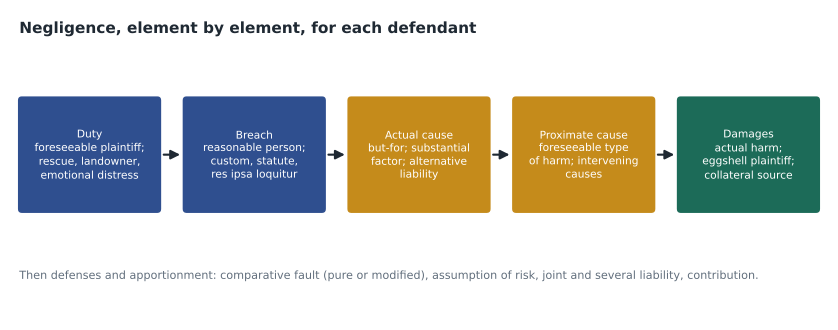
For each potential defendant, take the elements in order. Duty: did the defendant owe the plaintiff a duty of reasonable care? In general, a person whose conduct creates a risk of physical harm owes a duty of reasonable care to foreseeable plaintiffs. Breach: did the defendant fail to act as a reasonable person would under the circumstances? Causation: was the breach both an actual cause and a proximate cause of the harm? Damages: did the plaintiff suffer actual harm, such as personal injury or property damage? Then defenses and apportionment. When there are several defendants, analyze each in its own section.
Duty and the special duty rules
The general duty is easy to state, so essays test the exceptions and special situations. There is generally no duty to rescue a stranger, but a duty to act arises from a special relationship (such as carrier and passenger, innkeeper and guest, employer and employee, school and student), from creating the peril, or from voluntarily undertaking to help, after which the rescuer must act reasonably and not leave the victim worse off. Many states recognize a duty to protect third persons from a patient or person in custody when there is a special relationship and a foreseeable, identifiable victim.
Landowners' duties depend, in many states, on the entrant's status. A landowner owes trespassers only a duty not to injure them willfully or wantonly, with greater duties to discovered or anticipated trespassers and to child trespassers attracted by artificial conditions under the attractive nuisance doctrine. Licensees, such as social guests, must be warned of known dangerous conditions they are unlikely to discover. Invitees, those on the land for a business purpose or because it is open to the public, are owed reasonable care, including reasonable inspection to discover dangers. A substantial minority of states have replaced these categories with a general duty of reasonable care to entrants, often keeping the trespasser rule.
Negligent infliction of emotional distress is limited. A plaintiff in the zone of danger who suffers emotional distress from a near miss can recover in most states, often requiring physical manifestations. A bystander who is closely related to a victim, is present at the scene and contemporaneously perceives the injury may recover in states following the California approach. Pure economic loss without physical injury or property damage is generally not recoverable in negligence, outside special relationships.
Breach
The standard is the conduct of a reasonable person under the circumstances. Professionals are held to the skill and knowledge of members of their profession in good standing, and children to that of a child of like age, intelligence and experience, unless engaged in an adult activity. Breach can be shown by balancing the probability and gravity of harm against the burden of precautions, by industry custom (relevant but not conclusive), by violating a statute that was designed to protect the class of persons that includes the plaintiff from the type of harm that occurred (negligence per se, subject to excuses), or by res ipsa loquitur, where the accident ordinarily does not happen without negligence and the instrumentality was in the defendant's control.
Causation
Actual cause is usually the but-for test: the harm would not have occurred without the breach. When two independent causes each would have been sufficient, courts use the substantial factor test. When two negligent defendants each might have caused the harm and the plaintiff cannot tell which, the burden shifts to the defendants to show they did not, under alternative liability. Proximate cause limits liability to harms within the scope of the risk that made the conduct negligent: the type of harm must be foreseeable, though its extent need not be. Foreseeable intervening causes, such as ordinary medical negligence, rescuers and foreseeable negligence by others, do not cut off liability; unforeseeable, extraordinary acts such as intentional crimes may, unless the defendant's negligence consisted of creating the opportunity for them.
Damages, defenses and apportionment
Negligence requires actual damages; nominal damages are not available. A plaintiff recovers for all foreseeable consequences, and the defendant takes the plaintiff as it finds her, including unusual vulnerabilities. Under the collateral source rule, the defendant cannot reduce damages by benefits the plaintiff receives from other sources, such as insurance, although many states have modified the rule by statute. Punitive damages require more than negligence, such as malice or reckless indifference, and are subject to due process limits.
Only a few jurisdictions still apply contributory negligence as a complete bar. Most states use comparative fault, which reduces the plaintiff's recovery in proportion to her share of fault. Under pure comparative fault, a plaintiff recovers even if more at fault than the defendant. Under modified comparative fault, the version most states follow, she recovers only if her fault is less than the defendant's, or not greater than it, depending on the state. Express assumption of risk, such as a valid release, can bar recovery, subject to public policy limits; implied assumption of risk is usually absorbed into comparative fault, except where the defendant owed no duty because the risk was inherent in an activity such as a sport.
When two or more defendants cause an indivisible injury, traditional joint and several liability lets the plaintiff recover the full amount from any of them, with contribution among them according to fault. Many states have abolished or limited joint and several liability, making each defendant liable only for its share, at least for non-economic damages or for defendants below a fault threshold. Indemnity shifts the whole loss in some relationships, such as from an employer held vicariously liable to the negligent employee, or from a retailer to the manufacturer of a defective product.
Vicarious liability
Agency law from Lesson 4 returns here. An employer is vicariously liable for torts committed by employees within the scope of employment; a principal generally is not liable for an independent contractor's torts, except for non-delegable duties and inherently dangerous activities, and may be directly liable for negligent hiring, retention or supervision. Owners of vehicles are generally not vicariously liable for the negligence of drivers they lend cars to, unless a state statute imposes liability or the owner was negligent in entrusting the car. A strong torts answer often analyzes both the employee's negligence and the employer's liability.
Strict liability and products liability
Strict liability applies to owners of wild animals for harms from their dangerous propensities; to owners of domestic animals with known dangerous propensities; and to abnormally dangerous activities, which create a foreseeable and highly significant risk of physical harm even when reasonable care is exercised and are not of common usage. Blasting is the classic example. Liability extends only to harms from the risk that made the activity abnormally dangerous.
Products liability claims can be brought in strict liability, negligence or warranty. In strict liability, a commercial seller of a defective product is liable for physical harm the defect causes to a foreseeable user or bystander, if the product reached the plaintiff without substantial change. There are three kinds of defects. A manufacturing defect is a departure from the intended design. A design defect exists when the foreseeable risks could have been reduced or avoided by a reasonable alternative design, under the risk-utility approach of the Restatement (Third), although some states still use the consumer expectations test. A warning defect exists when foreseeable risks could have been reduced by reasonable instructions or warnings. All commercial sellers in the chain of distribution, including retailers, are subject to strict liability, though many states let an innocent retailer seek indemnity from the manufacturer or limit retailer liability by statute. Defenses include product misuse that was not reasonably foreseeable, substantial alteration, and comparative fault, which reduces recovery in most states. Warranty claims under the UCC, for breach of an express warranty or the implied warranty of merchantability, can supplement tort claims.
Intentional torts and other torts
Intentional tort essays require the specific elements of each tort: battery (intentional harmful or offensive contact), assault (intent to cause apprehension of an imminent battery and such apprehension), false imprisonment (intentional confinement within fixed boundaries of which the plaintiff is aware or by which she is harmed), intentional infliction of emotional distress (extreme and outrageous conduct intentionally or recklessly causing severe distress), and trespass to land and chattels and conversion. Intent includes purpose and knowledge to a substantial certainty, and transferred intent applies among the traditional trespass-based torts. Then privileges: consent, self-defense, defense of others and property, necessity, and the shopkeeper's privilege to detain a suspected shoplifter reasonably.
Defamation requires a defamatory statement of fact about the plaintiff, published to a third person, with the required fault and, in some cases, damages. When the plaintiff is a public official or public figure, the First Amendment requires proof of actual malice, meaning knowledge of falsity or reckless disregard for the truth, under New York Times Co. v. Sullivan. Private plaintiffs must show at least negligence on matters of public concern and cannot recover presumed or punitive damages without actual malice under Gertz v. Robert Welch, Inc. Truth is a defense, and some occasions are privileged. The privacy torts, nuisance and the business torts appear less often but follow the same pattern: state the elements, apply each with facts.
Worked problem
A torts practice question
Rita, a delivery driver employed by Swift Couriers, was driving her assigned route when she stopped at her sister's house, two blocks off the route, to drop off a birthday present. Pulling away, she glanced at her phone and rear-ended a car driven by Sam, who was stopped at a light. Sam's seat belt, made by Holdfast Corp., tore at a seam where the stitching had been done improperly, and Sam struck the windshield. Sam had been driving five miles per hour over the speed limit before stopping. The state follows modified comparative fault and the Restatement (Third) for products. What claims does Sam have against Rita, Swift and Holdfast?
Show solution
- Rita: she owed other drivers a duty of reasonable care; looking at a phone while driving breached it, and her conduct was the but-for and proximate cause of the collision. Damages: Sam's injuries.
- Swift: Rita was an employee. A two-block stop to drop off a gift is a minor detour, not a frolic, and she had resumed her route, so the accident was within the scope of employment; Swift is vicariously liable.
- Holdfast: the torn seam departed from the intended design, a manufacturing defect, for which a commercial seller is strictly liable. Causation: the failure made his injuries worse, so Holdfast is liable at least for the enhanced injury.
- Defenses: Sam's earlier speeding did not cause a rear-end collision while he was stopped, so it should not reduce his recovery.
Answer: Sam can recover from Rita and, vicariously, from Swift for the collision, and from Holdfast in strict liability for the injuries its defective seat belt caused or worsened.
Dana spots what made the question work. 'The sister's house is there for the frolic and detour issue, and the speeding is there to see if you notice it had nothing to do with the crash.' Marchetti smiles. 'Two facts, two issues. That is how these questions are built.'
Practice problems
Work each problem on paper first, then reveal the answer to check.
List the elements of negligence in order.
Show answer
Duty, breach, actual cause, proximate cause and damages.
When does a duty to rescue arise?
Show answer
From a special relationship, creating the peril, or voluntarily undertaking to help.
What is negligence per se?
Show answer
Breach shown by violating a statute designed to protect the plaintiff's class from the type of harm that occurred.
Under modified comparative fault, when is a plaintiff barred?
Show answer
When her fault equals or exceeds the defendant's, depending on the state's version.
What test does the Restatement (Third) use for design defects?
Show answer
The risk-utility test with a reasonable alternative design.
What must a public figure prove in a defamation claim?
Show answer
Actual malice: knowledge of falsity or reckless disregard for the truth.
Common mistakes
MistakeSkipping duty because it seems obvious.
InsteadState duty in a sentence; special duty rules are often the main issue.
MistakeApplying pure comparative fault on every essay.
InsteadState the majority modified approach unless the question specifies the rule.
MistakeAn employee on any personal errand is outside the scope of employment.
InsteadA minor detour stays within it; only a frolic falls outside.
MistakeOnly the manufacturer is strictly liable for a defective product.
InsteadEvery commercial seller in the chain is subject to strict liability.
Organizing a multi-defendant torts answer
When a question names several possible defendants, give each its own heading and run the full analysis for each, even if parts repeat. A grader looking for the analysis of the employer's liability should find it under the employer's name, not scattered through the driver's section. Put the direct tortfeasor first, then those liable vicariously, then the product seller or other independent defendants. Close with a short paragraph on apportionment: how comparative fault reduces the plaintiff's recovery, whether the defendants are jointly and severally liable, and which of them can seek contribution or indemnity from the others.
Summary and key terms
- Analyze negligence element by element for each defendant, then defenses and apportionment.
- Special duty rules (rescue, landowners, emotional distress) are frequent main issues.
- Causation needs both actual and proximate cause; intervening causes matter only if unforeseeable.
- Vicarious liability links back to agency; strict liability covers animals, abnormally dangerous activities and defective products.
- For intentional and dignitary torts, state each element and apply it with facts, then privileges.
- Negligence per se
- Using a statutory violation to establish breach when the statute protects the plaintiff's class against the harm suffered.
- Proximate cause
- The limit on liability to harms within the scope of the risk that made the conduct negligent.
- Modified comparative fault
- Apportionment that reduces recovery by the plaintiff's fault and bars it at a set threshold.
- Manufacturing defect
- A product that departs from its intended design.
- Actual malice
- Knowledge that a statement is false or reckless disregard of whether it is false.
Lesson quiz · 5 questions
Score 60% or more to complete this lesson.
Create a free account to save your progress, take quizzes and earn a certificate.