
BAR-120 · Lesson 4 of 12 · 25 min
Agency and partnership
▶ Video coming soon A video version of this lesson is on the way.
Business associations is the one MEE subject that never appears on the MBE, so on Wednesday, October 7, 2026, Marchetti devotes a full session to its first half: agency and partnership. 'Two of the six questions on a typical MEE are not guaranteed to be anything,' she says, 'but business associations appears so often that you should expect it. And agency is everywhere. It shows up inside partnership questions, corporation questions and LLC questions, because every business acts through people.' Dana, who took Business Associations in her second year, admits she remembers corporations better than agency. Ngozi, who practiced commercial law in Lagos, knows the concepts but not the American vocabulary.
This lesson covers the agency and partnership law the MEE tests: creating an agency, the kinds of authority, liability in contract and in tort, an agent's duties, partnership formation, partners' rights and duties, liability to creditors, dissociation and dissolution, and the limited liability forms of partnership. Unless a question says otherwise, use the Restatement (Third) of Agency for agency and the Revised Uniform Partnership Act (RUPA) for general partnerships, which the large majority of states have adopted; limited partnerships follow the Uniform Limited Partnership Act of 2001 in most states. Where the older Uniform Partnership Act of 1914 differs in a way that matters, note it briefly.
Creating an agency
Agency is the fiduciary relationship that arises when one person, the principal, manifests assent that another, the agent, shall act on the principal's behalf and subject to the principal's control, and the agent manifests assent or otherwise consents. No writing, no consideration and no intent to create an 'agency' by name is required; the relationship is judged by the parties' conduct. Control is the heart of it. A person who acts for another but is not subject to that person's control, such as an independent lawyer or a contractor who decides how to do a job, may still be an agent for some purposes, but the degree of control matters greatly for tort liability.
Authority: when the agent binds the principal in contract
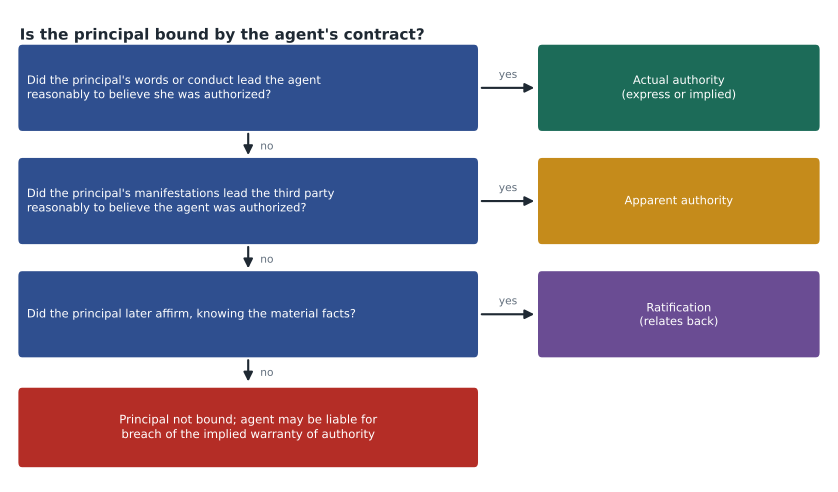
A principal is bound by a contract the agent makes if the agent had actual authority or apparent authority, or if the principal ratified the contract. Essay questions almost always turn on which, if any, of these applies.
Actual authority exists when the agent reasonably believes, from the principal's manifestations to the agent, that the principal wishes the agent to act. It may be express, as when the principal tells the agent to buy inventory up to a limit, or implied, covering acts reasonably necessary to accomplish what was expressly authorized or that the agent reasonably believes the principal wants based on past practice and the nature of the job. A store manager told to run the store has implied authority to hire a clerk and order ordinary supplies.
Apparent authority exists when a third party reasonably believes the agent has authority to act on the principal's behalf and that belief is traceable to the principal's manifestations to the third party. The manifestation can come from words, from placing the agent in a position that customarily carries authority, such as a title like 'purchasing manager', or from a course of dealing. The key is that the manifestation comes from the principal, not from the agent alone: an agent cannot create her own apparent authority simply by claiming it. Apparent authority often survives after actual authority ends, which is why a principal who fires an agent should notify the third parties who dealt with her.
Ratification occurs when a principal, with knowledge of the material facts, affirms an act done by someone who purported to act on the principal's behalf, either expressly or by conduct such as accepting the benefits. Ratification relates back to the time of the act. It must be of the whole transaction, not the favorable parts, and it is ineffective if the third party has already withdrawn or if circumstances have materially changed.
The agent's own liability on the contract
Whether the agent is personally liable depends on what the third party knew about the principal. If the principal was disclosed, meaning the third party knew both that the agent acted for a principal and who the principal was, the agent is not a party to the contract and is not liable on it, unless she agreed to be. If the principal was unidentified, meaning the third party knew there was a principal but not who, the agent is a party to the contract and is liable along with the principal. If the principal was undisclosed, meaning the third party believed the agent acted for herself, the agent is liable, and the principal, once discovered, is also bound if the agent acted with actual authority. An agent who purports to act with authority she lacks is liable to the third party for breach of the implied warranty of authority.
Vicarious liability in tort
A principal is liable for the torts of an employee committed within the scope of employment under respondeat superior. Two questions organize the analysis. First, was the actor an employee? The test is the principal's right to control the manner and means of the work, with factors such as who supplies tools, how the person is paid, the length of the relationship, the skill involved and whether the work is part of the principal's regular business. A principal generally is not vicariously liable for the torts of an independent contractor, although it may be directly liable for its own negligence in selecting or supervising the contractor, and liable for a contractor's breach of a non-delegable duty or for inherently dangerous activities.
Second, was the tort within the scope of employment? Under the Restatement (Third), an employee acts within the scope of employment when performing work assigned by the employer or engaging in a course of conduct subject to the employer's control; conduct is outside the scope when it occurs within an independent course of conduct not intended by the employee to serve any purpose of the employer. The classic vocabulary distinguishes a minor detour, which stays within the scope, from a frolic, a substantial departure for personal purposes, which does not. Intentional torts are within the scope when they serve the employer's purpose or are a foreseeable part of the job, such as a bouncer's use of force; a purely personal attack usually is not.
The agent's duties
An agent is a fiduciary. The duty of loyalty requires the agent to act solely for the principal's benefit in matters connected with the agency: not to acquire a material benefit from third parties in connection with the agency, not to act as or for an adverse party, not to compete with the principal and not to use the principal's property or confidential information for her own purposes, unless the principal consents after full disclosure. The agent also owes duties of care, competence and diligence, a duty to act within actual authority and to comply with lawful instructions, and a duty to provide information the principal would want. Remedies for breach of loyalty include disgorgement of profits and rescission of the tainted transaction. The principal, in turn, owes the agent compensation as agreed and indemnification for expenses and losses incurred within actual authority.
Forming a general partnership
Under RUPA, the association of two or more persons to carry on as co-owners a business for profit forms a partnership, whether or not the persons intend to form a partnership. No filing, writing or formal agreement is needed. The most important evidence is profit sharing: a person who receives a share of the profits of a business is presumed to be a partner, unless the profits were received in payment of a debt, as wages or compensation to an employee or independent contractor, as rent, as an annuity or retirement benefit, as interest on a loan, or for the sale of the goodwill of a business. Sharing gross returns, or co-owning property, does not by itself establish a partnership. Other evidence of co-ownership includes shared control, shared losses, joint contributions of capital or labor and how the parties held themselves out.
A person who is not a partner can still be liable as one under partnership by estoppel, which RUPA calls liability of a purported partner. If a person represents himself, or consents to being represented, as a partner, he is liable to a third party who extends credit in reliance on the representation. Likewise, the actual partners who consent to the representation can be bound by the purported partner's acts.
Partnership property and partners' rights
A RUPA partnership is an entity distinct from its partners, so property acquired by the partnership belongs to it, not to the partners individually. Property is partnership property if acquired in the partnership's name or by a partner in that capacity with an instrument naming the partnership. Property bought with partnership funds is presumed to be partnership property even if titled in a partner's name; property bought by a partner in her own name without partnership funds is presumed to be separate property, even if the partnership uses it.
Unless the partnership agreement says otherwise, each partner is entitled to an equal share of profits and bears losses in the same proportion as profits. Each partner has equal rights in management. Ordinary matters are decided by a majority of partners; acts outside the ordinary course of business and amendments to the partnership agreement require the consent of all partners. A partner is not entitled to a salary for services, other than for winding up. Partners have rights to information and access to books and records.
A partner's only transferable interest is the right to receive distributions. A transferee does not become a partner and has no right to participate in management or to see records beyond limited information. A partner's personal creditor can obtain a charging order against the partner's transferable interest, which entitles the creditor to the partner's distributions but not to partnership property or a say in management.
Partners' fiduciary duties
RUPA confines a partner's fiduciary duties to loyalty and care. The duty of loyalty requires a partner to account for any property, profit or benefit derived from the partnership business or from use of partnership property, including appropriation of a partnership opportunity; to refrain from dealing with the partnership as or for an adverse party; and to refrain from competing with the partnership before dissolution. The duty of care is limited: a partner must refrain from grossly negligent or reckless conduct, intentional misconduct or a knowing violation of law. Partners must also discharge their duties consistently with the contractual obligation of good faith and fair dealing. The partnership agreement may limit these duties within statutory bounds but may not eliminate the duty of loyalty or unreasonably reduce the duty of care.
Liability to partnership creditors
The partnership is liable for a partner's actionable conduct in the ordinary course of business or with authority, and the partnership is bound by contracts within a partner's actual or apparent authority. All partners are liable jointly and severally for all obligations of the partnership, unless otherwise agreed by the claimant or provided by law. A judgment creditor generally must first obtain a judgment against the partnership and try to collect from partnership assets before levying on a partner's personal assets. A person admitted as a partner is not personally liable for partnership obligations incurred before admission, though her contribution is at risk.
Dissociation, dissolution and winding up
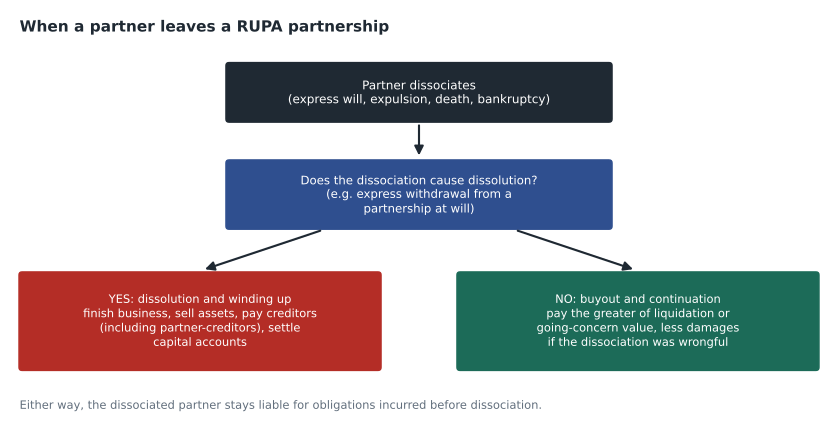
A partner dissociates from a partnership on events such as the partnership's receiving notice of the partner's express will to withdraw, expulsion, death, or bankruptcy. Every partner has the power to dissociate at any time, but a dissociation is wrongful if it breaches an express term of the partnership agreement or, in a partnership for a definite term or particular undertaking, occurs before the term ends. A wrongfully dissociating partner is liable for damages caused by the dissociation.
Dissociation does not always end the partnership. In a partnership at will, the partnership is dissolved, and its business must be wound up, when it has notice of a partner's express will to withdraw. Dissolution also occurs in other situations, including in a partnership for a term when the term expires, when all partners agree, or on a judicial decree. If dissociation does not cause dissolution, the partnership must buy out the dissociated partner's interest for the amount that would have been distributable to her if, on the date of dissociation, the assets had been sold at the greater of their liquidation value or the value of the entire business as a going concern without her, less any damages for wrongful dissociation.
In winding up, the partnership completes its business, sells its assets and pays its creditors, including partners who are creditors. Remaining surpluses are distributed to partners according to their capital accounts. If the accounts show a negative balance for a partner, that partner must contribute the amount. A dissociated partner remains liable for partnership obligations incurred before dissociation and, for two years, may be liable for some obligations incurred after dissociation to third parties who reasonably believed she was still a partner, unless the third party had notice of the dissociation; a filed statement of dissociation gives that notice 90 days after filing.
Limited liability partnerships and limited partnerships
A limited liability partnership (LLP) is a general partnership that has filed a statement of qualification with the state. In an LLP, a partner is not personally liable, directly or indirectly, for a partnership obligation solely by reason of being a partner, whether the obligation arises in contract, tort or otherwise. Partners remain liable for their own torts and for those of persons they directly supervise in many states. The shield applies only to obligations incurred while the partnership is an LLP.
A limited partnership (LP) is formed by filing a certificate of limited partnership and has at least one general partner and at least one limited partner. General partners manage the business and are personally liable for its obligations, unless the LP has elected to be a limited liability limited partnership (LLLP). Limited partners are not personally liable for the LP's obligations. Under the older uniform acts, a limited partner who participated in control could lose that protection; under the Uniform Limited Partnership Act of 2001, a limited partner is not liable for the LP's obligations even if he participates in management and control.
Worked problem
An agency issue inside a partnership question
Bright Path Landscaping is a general partnership of Kim and Omar. Their written agreement requires both partners to approve any purchase over 5,000 dollars. Omar, without telling Kim, orders a 12,000-dollar mower from a dealer that has sold the partnership smaller equipment for years, signing the order "Bright Path Landscaping, by Omar, partner." The dealer did not know of the approval requirement, and no statement of partnership authority was filed. Is the partnership bound?
Show solution
- Omar lacked actual authority, because the agreement required Kim's approval for purchases over 5,000 dollars.
- Under RUPA, a partner's act for apparently carrying on the business in the ordinary course binds the partnership unless the partner lacked authority and the third party knew or had received notification of that.
- Buying a mower is apparently in the ordinary course of a landscaping business, and the dealer's prior dealings with the partnership confirm it.
- The dealer did not know of the limitation and received no notification, and no filed statement of partnership authority limited Omar's power.
Answer: The partnership is bound. As between the partners, Omar breached the agreement and may be liable to the partnership for any loss.
Practice problems
Work each problem on paper first, then reveal the answer to check.
What is required to form a general partnership under RUPA?
Show answer
An association of two or more persons to carry on as co-owners a business for profit; intent to form a partnership and filings are not required.
What does sharing profits create?
Show answer
A presumption of partnership, unless the profits were received as debt repayment, wages, rent, annuity, interest or for the sale of goodwill.
Who is liable on a contract made for a disclosed principal with authority?
Show answer
The principal only; the agent is not a party unless she agreed to be.
What makes apparent authority?
Show answer
A third party's reasonable belief in the agent's authority that is traceable to the principal's manifestations.
In a partnership at will, what happens when a partner gives notice of withdrawal?
Show answer
She dissociates and the partnership dissolves, triggering winding up.
Is a limited partner liable for participating in management under ULPA 2001?
Show answer
No. ULPA 2001 protects limited partners even if they participate in management.
Common mistakes
MistakeAn agent can create apparent authority by telling the third party she has it.
InsteadApparent authority must be traceable to the principal's manifestations.
MistakeProperty titled in a partner's name is always her separate property.
InsteadProperty bought with partnership funds is presumed to be partnership property.
MistakeA transferee of a partnership interest becomes a partner.
InsteadA transferee receives only distributions, not management rights.
MistakeEvery dissociation dissolves the partnership.
InsteadOnly some, such as express withdrawal from a partnership at will; otherwise the partnership buys out the departing partner.
Summary and key terms
- Agency requires the principal's assent to the agent acting on its behalf and subject to its control, and the agent's consent.
- Principals are bound by actual authority, apparent authority or ratification; agent liability depends on disclosure.
- Respondeat superior covers employees acting within the scope of employment, not independent contractors.
- A RUPA partnership forms by co-ownership of a business for profit; profit sharing creates a presumption.
- Partners owe loyalty and limited care, are jointly and severally liable, and dissociation may cause dissolution or a buyout.
- Actual authority
- Authority an agent reasonably believes she has from the principal's manifestations to her, express or implied.
- Apparent authority
- Power to bind arising from a third party's reasonable belief traceable to the principal's manifestations.
- Respondeat superior
- An employer's vicarious liability for an employee's torts within the scope of employment.
- Dissociation
- A partner's ceasing to be associated with the carrying on of the partnership business.
- Charging order
- A court order giving a partner's or member's judgment creditor the right to that person's distributions.
Lesson quiz · 5 questions
Score 60% or more to complete this lesson.
Create a free account to save your progress, take quizzes and earn a certificate.