
BAR-120 · Lesson 12 of 12 · 23 min
Capstone: timed essays with model answers
▶ Video coming soon A video version of this lesson is on the way.
After the Saturday morning MBE drill on November 21, 2026, Marchetti emails the group two original essay questions with instructions: set a timer for one hour, write both answers without notes, and send them back by midnight. She grades them on Sunday, November 22, the way she graded real bar essays, relative to one another on a 1-to-6 scale, and emails each member a score and three lines of comments. This lesson reproduces the two questions, a model answer for each, the rubric she used and the debrief. Try the questions yourself under time before reading the models: 30 minutes each, about 8 to 10 minutes reading and outlining and the rest writing.
Essay 1: business associations
Facts: Three friends, Ana, Ben and Cal, formed Greenline Cycles LLC in their state, which has adopted the Revised Uniform Limited Liability Company Act. They filed a certificate of organization and signed a short operating agreement that says each member contributes 30,000 dollars, profits are shared equally, and 'major decisions, including any lease or purchase over 20,000 dollars, require the consent of all members.' The agreement does not say whether the LLC is member-managed or manager-managed. Greenline operates a bicycle shop. Its website lists Ana, Ben and Cal as 'owners'.
In March, Ben, without telling the others, signed a five-year lease for a second shop at a monthly rent of 3,000 dollars, signing as 'Ben, member, Greenline Cycles LLC.' The landlord had visited the first shop and seen Ben managing it. In April, Cal learned that a nearby competitor, Spoke House, was for sale. Instead of telling Ana and Ben, Cal bought Spoke House through a corporation he owns and began operating it. In August, Greenline's sales fell and it stopped paying rent on the second shop. Greenline has never held a formal meeting or kept minutes; the members decide things informally over coffee. Greenline has 8,000 dollars in its bank account.
Calls: (1) Is Greenline bound by the lease Ben signed? Explain. (2) Did Cal breach any duty to Greenline, and what remedies are available? Explain. (3) Can the landlord recover the unpaid rent from Ana, Ben or Cal personally? Explain.
Model answer to Essay 1
1. Is Greenline bound by the lease? Greenline is probably bound, through Ben's apparent authority, even though he lacked actual authority. Because the operating agreement does not expressly provide that Greenline is manager-managed, it is member-managed under RULLCA. Under RULLCA, a member is not an agent of the LLC solely by reason of being a member, so whether Ben bound Greenline depends on agency law and any filed statement of authority; none is mentioned. Ben lacked actual authority: the operating agreement requires all members' consent for any lease over 20,000 dollars, and a five-year lease at 3,000 dollars a month totals 180,000 dollars. Ana and Cal did not consent. Apparent authority exists when a third party reasonably believes the agent has authority, based on the principal's manifestations. Greenline held Ben out as an owner on its website and placed him in charge of the shop, where the landlord saw him managing it. A landlord could reasonably believe an owner-manager may lease additional space, and nothing suggests the landlord knew of the consent requirement. On the other hand, a five-year lease for a second location is not an ordinary, day-to-day act, which makes reliance somewhat less reasonable. On balance, Greenline's manifestations support apparent authority, and Greenline is likely bound. Greenline could also be bound if Ana and Cal ratified the lease, for example by moving inventory into the second shop with knowledge of the lease; the facts do not say. As between the members, Ben breached the operating agreement and may be liable to Greenline for resulting losses.
2. Did Cal breach a duty? Cal breached his duty of loyalty by taking a company opportunity and competing with Greenline. In a member-managed LLC, each member owes the company and the other members the duty of loyalty, which includes accounting for any benefit derived from the company's activities or from appropriating a company opportunity, and refraining from competing with the company before dissolution. Buying a nearby competing bicycle shop is an opportunity in Greenline's line of business, and Cal did not disclose it or give Greenline a chance to pursue it. Operating Spoke House in competition with Greenline also violates the duty not to compete. Using his own corporation does not avoid the duty, because Cal controls it. Cal might argue that Greenline lacked funds to buy Spoke House, but that is a reason to disclose the opportunity, not to take it secretly, and the members never had the chance to decide. Remedies include an accounting and disgorgement of Cal's profits from Spoke House, a constructive trust over Spoke House for Greenline's benefit, damages for lost sales, and an injunction against further competition. Ana and Ben could pursue the claim on Greenline's behalf in a derivative action, after demanding that Greenline sue or showing that demand would be futile, since Cal is a member whose interests are adverse. Cal's conduct could also support his expulsion by court order or dissolution if it makes it not reasonably practicable to carry on the business with him.
3. Are the members personally liable? No, absent grounds to pierce the veil. Under RULLCA, a debt of the LLC is solely the debt of the company, and a member is not personally liable for it solely by reason of being or acting as a member. The landlord may argue that Greenline's veil should be pierced because it never held meetings or kept minutes. But RULLCA provides that the failure to observe formalities relating to the exercise of the company's powers or management is not a ground for imposing liability on members. Piercing requires abuse of the entity form, such as commingling of funds, using the LLC to defraud creditors or gross undercapitalization, causing an injustice. The members each contributed 30,000 dollars and the facts show no commingling or fraud; the LLC's current low balance results from falling sales, not abuse. The landlord therefore can recover only from Greenline's assets. Ben is not personally liable on the lease, because he signed it in Greenline's name as a member and Greenline is bound; if a court found that Greenline was not bound, Ben could be liable to the landlord for breach of the implied warranty of authority.
Essay 2: contracts and sales
Facts: Orchard Ridge Farm grows apples. In January, it signed a contract with Copper Kettle Cidery to sell 'all 40,000 pounds of Northern Spy apples to be grown in Orchard Ridge's north orchard this season,' to be delivered in four installments of 10,000 pounds each on September 1, September 15, October 1 and October 15, at 0.80 dollars per pound, payment due on each delivery. The first installment was delivered and paid for. The second installment, delivered September 15, included about 1,500 pounds of bruised apples. Copper Kettle's manager called Orchard Ridge that afternoon to complain, and Orchard Ridge's owner said, 'We will replace the bruised apples with sound ones by September 20.' Copper Kettle replied that it was rejecting the entire installment and refused to pay. In late September, an unusual hard frost destroyed half of the remaining apples in the north orchard; frost that severe had not occurred in the region in decades. Orchard Ridge promptly notified Copper Kettle that it could deliver only 10,000 of the remaining 20,000 pounds, and offered 5,000 pounds on each remaining date. Copper Kettle bought 20,000 pounds of comparable apples elsewhere at 1.00 dollar per pound and sued.
Calls: (1) Was Copper Kettle entitled to reject the second installment? Explain. (2) Is Orchard Ridge excused from delivering the full remaining quantity? Explain. (3) What damages, if any, may Copper Kettle recover? Explain.
Model answer to Essay 2
Governing law. Apples are movable goods, so Article 2 of the UCC governs. Both parties appear to be merchants dealing in apples.
1. Rejection of the second installment. Copper Kettle was not entitled to reject the second installment. The contract requires delivery in separate lots to be separately accepted, so it is an installment contract. Under UCC section 2-612, the perfect tender rule does not apply to installments. A buyer may reject an installment only if the nonconformity substantially impairs the value of that installment and cannot be cured; if the nonconformity does not substantially impair the value of the whole contract and the seller gives adequate assurance of its cure, the buyer must accept the installment. About 1,500 of 10,000 pounds were bruised, roughly 15 out of every 100 pounds. A cidery may be able to use some bruised apples, but even assuming the defect substantially impaired the installment's value, it could be cured: Orchard Ridge promptly promised to replace the bruised apples with sound ones within five days. That is adequate assurance of cure, and the defect in one portion of one installment did not substantially impair the value of the whole 40,000-pound contract. Copper Kettle therefore had to accept the installment, subject to cure, and its refusal to pay for it was a breach. Orchard Ridge may recover the price of the conforming apples, offset by any damages for the bruised ones.
2. Excuse for the remaining quantity. Orchard Ridge is excused in part. Under UCC section 2-615, a seller's failure to deliver is not a breach if performance as agreed has been made impracticable by a contingency whose non-occurrence was a basic assumption of the contract. Failure of a particular source of supply that the parties specified can qualify. Here the contract was for apples 'to be grown in Orchard Ridge's north orchard,' so both parties assumed the crop would come from that orchard, and an unusually severe frost, unprecedented in decades, was not a foreseeable risk the seller assumed. When the contingency affects only part of the seller's capacity, the seller must allocate production fairly among its customers and must notify the buyer seasonably of the delay or shortfall and of the estimated quota. Orchard Ridge notified Copper Kettle promptly and offered all of the surviving 10,000 pounds, equally across the two remaining dates. Under section 2-616, Copper Kettle could either terminate the unexecuted portion of the contract or accept the allocation, by written notice within a reasonable time not exceeding 30 days. Orchard Ridge is excused from delivering the 10,000 pounds the frost destroyed.
3. Damages. Copper Kettle may not recover damages for the 10,000 pounds whose delivery was excused, and it has no claim for the second installment, which it wrongfully rejected. As to the remaining 10,000 pounds Orchard Ridge offered, Copper Kettle could accept them at the contract price or terminate the unexecuted portion under section 2-616. By buying all 20,000 pounds elsewhere instead, it most likely chose not to take the allocation. If its conduct is treated as a termination under section 2-616, Orchard Ridge is discharged and Copper Kettle recovers nothing for those apples. If Copper Kettle argues instead that Orchard Ridge breached by offering only part, cover damages would be the cover price minus the contract price: 1.00 minus 0.80 dollars, or 0.20 dollars per pound. But the excuse covers the shortfall, and the offered 10,000 pounds were tendered in accordance with a permitted allocation, so no breach occurred and no cover damages are due. Copper Kettle's own wrongful rejection of the second installment leaves it liable to Orchard Ridge for the price of that installment, 8,000 dollars, less any reduction for the bruised apples if they were not replaced.
The rubric
Marchetti graded with a rubric like the ones NCBE gives graders: a list of the issues and the key points for each call, used to rank the answers, not to add up points mechanically. Use it to grade your own answers.
| Call | Points a strong answer includes |
|---|---|
| Essay 1, call 1 | Member-managed by default; member not an agent solely by membership; no actual authority (consent clause, 180,000-dollar lease); apparent authority from website and role; counterpoint that a new five-year lease is unusual; possible ratification; Ben liable to Greenline for breach |
| Essay 1, call 2 | Duty of loyalty in member-managed LLC; company opportunity; no disclosure; non-competition; use of own corporation irrelevant; inability-to-pay argument rejected; disgorgement, constructive trust, damages, injunction; derivative action |
| Essay 1, call 3 | Shield for members; no piercing for lack of formalities under RULLCA; piercing requires abuse and injustice; facts show adequate initial capital and no commingling; Ben not liable because Greenline is bound (warranty of authority if not) |
| Essay 2, call 1 | Article 2 governs; installment contract; section 2-612 standard; substantial impairment of installment and curability; adequate assurance of cure; no impairment of whole contract; wrongful rejection |
| Essay 2, call 2 | Section 2-615 impracticability; specified source; unforeseeable frost; partial failure; fair allocation and seasonable notice; section 2-616 buyer options |
| Essay 2, call 3 | No damages for excused quantity; buyer's choice to terminate or accept allocation; cover formula stated and rejected; buyer liable for price of second installment |
A 6 identifies nearly all of the points for each call, states the rules accurately and uses the facts throughout. A 4 identifies the main issue in each call with sound reasoning but misses some secondary points or uses the facts thinly. A 2 misses a main issue, misstates a key rule or leaves a call unanswered.
The debrief
Marchetti's Sunday email gives each member a score for each essay and three comments. Dana earns a 5 on the LLC question and a 4 on the apples question. Her comments: strong use of RULLCA on formalities; she missed ratification; on the apples question she applied the perfect tender rule for two sentences before catching herself and switching to section 2-612. Ngozi earns a 4 and a 5. She stated every rule precisely but used too few facts in the apparent authority analysis, and her section 2-615 analysis was the best in the group, including the allocation and the buyer's options. Sofia, writing for practice although California does not use the MEE, earns a 4 and a 4; her structure was much improved from July, with clear headings and conclusions, but she ran out of time on the third call of the apples question and wrote it in bullet points.
Marcus, writing cold as a volunteer, earns two 5s, and jokes that NextGen ruined him for writing without a library. Eddie and Camila, who read both questions as practice in method, send in outlines only; Marchetti says both outlines identified every main issue.
Plans for the final stretch
The group's plans for the weeks after Thanksgiving, all still ahead, follow from the debrief. Dana will write two timed MEE answers a week through January, alternating business associations with her weaker MBE subjects, and keep a list of rules she misstates. Ngozi will practice writing the application first in her outlines, listing three facts per element before she writes any rule. Sofia will practice the last call of each question first in timed drills, so that running out of time never again means bullet points on a main issue. Marchetti will continue the Wednesday sessions in December, adding performance test practice from BAR-121.
A final checklist for exam day
Before the MEE session begins, rehearse the routine one last time. Read the calls first. Read the facts once, actively, marking each fact with its issue. List issues by call in the order a court would decide them, and rank them. Outline in a few words per issue. Write by call with headings: conclusion, rule, application with facts, conclusion. Move on at 30 minutes, whatever happens.
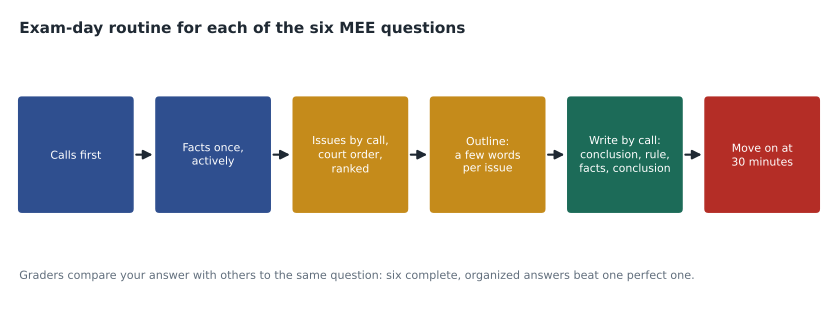
And remember the scoring: graders compare your answer with others to the same question. You do not need perfection. You need six complete, organized answers that state the law and use the facts.
Practice problems
Work each problem on paper first, then reveal the answer to check.
In Essay 1, why was Greenline member-managed?
Show answer
Under RULLCA, an LLC is member-managed unless the operating agreement expressly provides otherwise.
Why did Ben lack actual authority?
Show answer
The operating agreement required all members' consent for leases over 20,000 dollars, and the lease totaled 180,000 dollars.
Why did the lack of meetings not justify piercing Greenline's veil?
Show answer
RULLCA provides that failure to observe formalities is not a ground for member liability.
In Essay 2, why could Copper Kettle not reject the second installment?
Show answer
In an installment contract, a curable defect that does not impair the whole contract must be accepted when the seller gives adequate assurance of cure.
What made the frost an excuse under section 2-615?
Show answer
The contract specified apples from a particular orchard, and an unforeseeable frost destroyed part of that source.
What options did Copper Kettle have after receiving the allocation notice?
Show answer
Terminate the unexecuted portion or accept the allocated quantity, by written notice within a reasonable time.
Common mistakes
MistakeApplying the perfect tender rule to installment contracts.
InsteadSection 2-612 governs rejection of installments.
MistakeTreating informal management as grounds to pierce an LLC.
InsteadRULLCA rejects lack of formalities as a ground for liability.
MistakeIgnoring the specified source in an impracticability question.
InsteadA named source of supply is what makes crop failure an excuse.
MistakeWriting the last call in bullet points to save time.
InsteadBudget time by call so the main issue on the last call gets full sentences.
Summary and key terms
- Write each capstone essay in 30 minutes: read the calls, read the facts, outline, then write by call.
- Essay 1 tested apparent authority, the duty of loyalty and the LLC liability shield under RULLCA.
- Essay 2 tested installment contracts, impracticability with a specified source, allocation and damages.
- Grade yourself with the rubric; aim for complete coverage of main issues with facts on every call.
- Use the debrief to target the weakest step of your routine before exam day.
- Installment contract
- A contract requiring or authorizing delivery of goods in separate lots to be separately accepted.
- Adequate assurance of cure
- A seller's credible commitment to fix a nonconformity, which can oblige an installment buyer to accept.
- Impracticability
- An excuse for nonperformance when an unforeseen contingency makes performance as agreed impracticable.
- Allocation
- A seller's fair division of reduced supply among customers after a partial excuse under section 2-615.
- Rubric
- The list of issues and points graders use to rank answers to an essay question.
Lesson quiz · 5 questions
Score 60% or more to complete this lesson.
Create a free account to save your progress, take quizzes and earn a certificate.