
BAR-120 · Lesson 5 of 12 · 26 min
Corporations and LLCs
▶ Video coming soon A video version of this lesson is on the way.
On Wednesday, October 14, 2026, the second business associations session begins with a show of hands. 'Who has worked for a corporation?' Everyone. 'Who has read a set of articles of incorporation?' Only Ngozi and Marcus. 'Who could explain the business judgment rule to a client in two sentences?' Dana tries, and gets most of it. 'Good,' Marchetti says. 'Corporations questions on the MEE are rarely about exotic doctrine. They are about the same dozen issues: formation, promoters, piercing, shares, meetings, voting, duties, conflicts and derivative suits. LLC questions are about forming the company, who can bind it, who owes duties, whether members are shielded and what happens when someone leaves.'
Unless a question says otherwise, use the Model Business Corporation Act (MBCA), which most states follow in whole or in part, for corporations, and the Revised Uniform Limited Liability Company Act (RULLCA) for LLCs. Delaware law, which governs many large public companies, differs on some points; mention Delaware only if a question invokes it. This lesson covers the issues that recur, in the order a court or a careful lawyer would take them.
Formation
A corporation comes into existence when articles of incorporation are filed with the secretary of state, unless a delayed effective date is specified. Under the MBCA, the articles must state the corporation's name, the number of shares it is authorized to issue, the street address of its initial registered office and the name of its registered agent, and the name and address of each incorporator. They may include optional provisions, such as limiting directors' liability for money damages, granting preemptive rights or providing for cumulative voting. The bylaws, adopted by the incorporators or the initial board, govern internal affairs and may contain any provision not inconsistent with law or the articles.
When incorporation is defective or never happens, the question is who is liable for debts incurred in the corporation's name. Under the MBCA, all persons purporting to act as or on behalf of a corporation, knowing that there was no incorporation, are jointly and severally liable for liabilities created while so acting. Many states also recognize, in some form, the common-law doctrines of de facto corporation (a good-faith, colorable attempt to incorporate and actual use of corporate powers) and corporation by estoppel (a party who dealt with the business as a corporation may be estopped from denying its existence). On an essay, apply the MBCA rule first, then note the common-law doctrines if the facts suggest good faith.
Promoters and pre-incorporation contracts
A promoter is a person who arranges the formation of a corporation and often signs contracts for it before it exists. A promoter is personally liable on a pre-incorporation contract unless the contract clearly provides otherwise or there is a novation, an agreement among all three parties substituting the corporation for the promoter. The corporation is not bound by a pre-incorporation contract until it adopts it, expressly or impliedly, for example by knowingly accepting its benefits. Adoption alone does not release the promoter; only a novation does. Promoters owe fiduciary duties to the corporation and to each other, including a duty not to make secret profits on sales to the corporation.
Piercing the corporate veil
Shareholders are generally not personally liable for the corporation's obligations. Courts may disregard the corporate entity, or pierce the veil, when the corporation is used to perpetrate fraud or injustice, and its separateness was not respected. Factors include commingling of funds, disregard of corporate formalities, using corporate assets as personal assets, undercapitalization at the time of formation in light of foreseeable risks, and using the corporation to evade an existing obligation or commit fraud. Courts pierce more readily in tort cases, where the plaintiff did not choose to deal with the corporation, than in contract cases. Piercing reaches only shareholders who participated in the abuse, and it is almost always applied to closely held corporations, not public companies.
Financing: shares and distributions
The articles authorize a number of shares; shares sold are issued, and those not reacquired are outstanding. Under the MBCA, the board may issue shares for any tangible or intangible property or benefit to the corporation, including cash, promissory notes, services performed, contracts for future services and other securities. Before issuing shares, the board must determine that the consideration received or to be received is adequate, and that determination is conclusive as to whether the shares are validly issued, fully paid and nonassessable. Par value is optional under the MBCA. Shareholders have no preemptive right to buy newly issued shares unless the articles provide for it.
A distribution is a transfer of money or property to shareholders with respect to their shares, such as a dividend or a repurchase. Under the MBCA, a distribution is prohibited if, after giving it effect, the corporation would not be able to pay its debts as they become due in the usual course of business (the equity insolvency test), or its total assets would be less than its total liabilities plus amounts needed to satisfy preferential rights on dissolution (the balance sheet test). Directors who vote for an unlawful distribution without complying with their duties are personally liable to the corporation for the excess, with a right of contribution from other directors and from shareholders who knowingly accepted it.
Management: directors, officers and meetings
All corporate powers are exercised by or under the authority of the board of directors, and the business is managed under its direction. Directors act as a body. They may act at a meeting at which a quorum, by default a majority of the fixed number of directors, is present, by the vote of a majority of directors present; or without a meeting by unanimous written consent. Regular meetings may be held without notice unless the articles or bylaws require it; special meetings require two days' notice of the date, time and place, unless waived, and a director waives notice by attending without objecting. Action taken without proper meeting, quorum or consent is generally invalid unless later ratified.
Officers are appointed by the board and have the authority described in the bylaws or given by the board, along with the implied and apparent authority that agency law supplies. A president typically has apparent authority to bind the corporation in ordinary business transactions, but not in extraordinary ones such as selling major assets. Agency principles from Lesson 4 apply directly.
Shareholders: meetings, voting and inspection
Shareholders elect and remove directors, approve fundamental changes and may amend the bylaws. Corporations must hold an annual shareholders' meeting; special meetings may be called by the board or, under the MBCA, by holders of at least ten percent of the votes entitled to be cast on an issue. Shareholders must receive notice of meetings no fewer than 10 nor more than 60 days before the meeting, and notice of a special meeting must describe its purpose. Shareholders may also act without a meeting by unanimous written consent, or by less than unanimous consent if the articles so provide.
Unless the articles provide otherwise, a quorum is a majority of the votes entitled to be cast, and action on a matter other than electing directors is approved if the votes cast in favor exceed the votes cast against. Directors are elected by a plurality of the votes cast. Cumulative voting, which lets minority shareholders concentrate their votes on one candidate, applies only if the articles provide for it. Shareholders may vote by proxy, which is revocable unless it states that it is irrevocable and is coupled with an interest. Shareholders may also enter voting agreements and voting trusts.
A shareholder has a right to inspect certain records, such as the articles, bylaws, minutes of shareholder meetings and recent financial statements, on written notice at least five business days in advance. For other records, such as board minutes and accounting records, the demand must be made in good faith and for a proper purpose, describe the purpose and the records with reasonable particularity, and the records must be directly connected with the purpose.
Fundamental changes
Mergers, share exchanges, sales of all or substantially all assets outside the ordinary course, amendments to the articles and voluntary dissolution are fundamental changes. They generally require board adoption followed by shareholder approval. Shareholders who do not vote in favor of certain transactions, including most mergers, share exchanges, dispositions of substantially all assets and amendments that materially affect their shares, have appraisal rights, meaning the right to be paid the fair value of their shares in cash, if they follow the statutory procedure. The MBCA withholds appraisal rights for shares traded on a national securities exchange in many situations, the so-called market exception.
Directors' and officers' duties
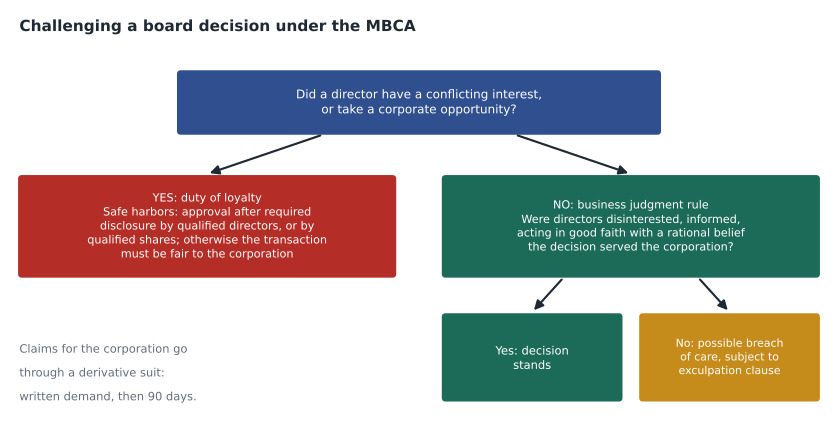
Directors must act in good faith and in a manner they reasonably believe to be in the best interests of the corporation, and when becoming informed and making decisions, with the care that a person in a like position would reasonably believe appropriate. In practice, courts protect business decisions through the business judgment rule: a court will not second-guess a decision made by disinterested directors who acted in good faith, on an informed basis and with a rational belief that the decision was in the corporation's best interests. A plaintiff challenging a decision must overcome that presumption, for example by showing the directors were uninformed, interested or acting in bad faith. Directors may rely on reports from officers, employees, experts and committees they reasonably believe reliable. The articles may eliminate directors' liability for money damages for breaches of the duty of care, but not for receiving an improper financial benefit, intentionally harming the corporation or its shareholders, voting for an unlawful distribution or intentionally violating criminal law.
The duty of loyalty addresses conflicts. Under the MBCA's safe harbors, a director's conflicting interest transaction cannot be enjoined, set aside or give rise to damages because of the director's interest if it was approved, after required disclosure, by a majority of qualified (disinterested) directors, or by a majority of votes cast by holders of qualified shares, or if the transaction, judged as of when it was entered, was fair to the corporation. A director may not usurp a corporate opportunity, meaning a business opportunity in the corporation's line of business or one the director learned of in a corporate capacity; the safe course is to offer it to the corporation first and take it only after the corporation, through disinterested directors or shareholders, declines. Officers owe parallel duties. In March 2025 Delaware amended its corporation statute to create statutory safe harbors for transactions involving interested directors and controlling stockholders and to narrow stockholders' books-and-records rights; those are Delaware rules, relevant on the MEE only if a question invokes Delaware law.
Shareholder litigation: direct and derivative suits
A shareholder sues directly to redress an injury to herself as a shareholder, such as denial of voting or inspection rights. A shareholder sues derivatively to enforce the corporation's own claim, typically against directors or officers for breach of duty; any recovery goes to the corporation. Under the MBCA, a derivative plaintiff must have been a shareholder when the wrong occurred (or received shares by operation of law from one who was), must fairly and adequately represent the corporation's interests, and must make a written demand on the corporation to take action. The plaintiff must then wait 90 days unless the demand is rejected earlier or irreparable injury would result. This universal demand rule differs from Delaware's, which excuses demand when it would be futile. The court must dismiss a derivative suit if independent directors or a court-appointed panel, after a reasonable inquiry, determine in good faith that maintaining the suit is not in the corporation's best interests.
Close corporations
Shareholders of a closely held corporation may vary the usual rules by unanimous shareholder agreement, eliminating the board, restricting the board's discretion, setting distributions or governing employment, as long as the agreement complies with the statute. Courts may order dissolution of a corporation when those in control have acted illegally, oppressively or fraudulently, when shareholders are deadlocked, or when assets are being wasted. Under the MBCA, the corporation or the other shareholders may elect to buy the petitioner's shares at fair value instead. Some courts also hold that shareholders in close corporations owe each other heightened fiduciary duties.
Limited liability companies
An LLC is formed by filing a certificate of organization. The operating agreement, which may be oral, written or implied, governs the relations among members and the company; where it is silent, the statute supplies default rules. An LLC is member-managed unless the operating agreement expressly provides that it is manager-managed.
Under RULLCA, a member is not an agent of the LLC solely by reason of being a member, so whether a member or manager binds the LLC is a question of agency law, along with any filed statement of authority. In a member-managed LLC, ordinary matters are decided by a majority of members and acts outside the ordinary course require all members' consent. In a manager-managed LLC, managers decide ordinary matters and members' consent is required for extraordinary acts such as amending the operating agreement.
In a member-managed LLC, members owe each other and the company duties of loyalty and care like those of partners: loyalty to account for benefits, avoid adverse dealings and not compete, and care to avoid gross negligence, recklessness, willful misconduct and knowing violations of law. In a manager-managed LLC, the managers owe those duties, and members generally do not owe fiduciary duties solely by reason of being members. All must act consistently with the contractual obligation of good faith and fair dealing.
A member or manager is not personally liable for the LLC's obligations solely by reason of being or acting as a member or manager. Courts can pierce an LLC's veil using the same equitable principles as for corporations, but RULLCA provides that failure to observe formalities relating to the exercise of the LLC's powers or management is not a ground for imposing personal liability, since LLCs are designed to be informal. A member's transferable interest carries only the right to distributions, and a charging order is the exclusive remedy of a member's judgment creditor against that interest.
A member may dissociate at any time by express will. Under RULLCA, dissociation does not dissolve the LLC and does not entitle the dissociated member to a buyout; she becomes, in effect, a transferee of her own interest. An LLC is dissolved by an event stated in the operating agreement, the consent of all members, the passage of 90 consecutive days with no members, or a court order, for example when it is not reasonably practicable to carry on the business or when managers or controlling members have acted oppressively. Distributions are subject to solvency tests like those for corporations.
| Form | Formed by | Owners' liability | Default management |
|---|---|---|---|
| General partnership | Co-owning a business for profit; no filing | Jointly and severally liable (after exhaustion) | Equal rights; majority for ordinary matters |
| LLP | Filing a statement of qualification | Not liable solely as partners | Same as a general partnership |
| Limited partnership | Filing a certificate | General partners liable; limited partners not | General partners manage |
| Corporation | Filing articles of incorporation | Shareholders not liable, absent piercing | Board of directors; officers |
| LLC | Filing a certificate of organization | Members and managers not liable as such | Member-managed unless the agreement says otherwise |
Worked problem
A director's conflict
Lena is a director of Harbor Fixtures, Inc., a manufacturer. She owns the warehouse that Harbor leases at a rent about 20 percent above market. The lease was approved at a board meeting at which Lena disclosed her ownership but not the market rent data she had, and the two other directors, both close friends of Lena who regularly vacation with her, voted for it. A shareholder wants to challenge the lease. What issues should the answer address?
Show solution
- Identify the conflicting interest transaction: Lena has a financial interest in the lease.
- Apply the safe harbors: approval counts only if made after required disclosure, which includes facts a director knows that a reasonable person would consider material, such as market rent data. Lena withheld it.
- Ask whether the approving directors were qualified: close personal ties that would reasonably be expected to affect their judgment may disqualify them.
- Without a valid safe harbor, the lease stands only if fair to the corporation; a rent 20 percent above market suggests it was not.
- Procedure: the claim belongs to the corporation, so the shareholder sues derivatively and must make a written demand and wait 90 days unless an exception applies.
Answer: The safe harbors likely fail, the lease is likely unfair, and the shareholder's path is a derivative suit after demand.
Practice problems
Work each problem on paper first, then reveal the answer to check.
Is a promoter released from a pre-incorporation contract when the corporation adopts it?
Show answer
No. Only a novation releases the promoter.
What two tests limit distributions under the MBCA?
Show answer
The equity insolvency test and the balance sheet test.
What is the default quorum for a board of directors?
Show answer
A majority of the fixed number of directors.
What does the business judgment rule protect?
Show answer
Decisions made in good faith by disinterested directors on an informed basis with a rational belief they serve the corporation.
What must a shareholder do before filing a derivative suit under the MBCA?
Show answer
Make a written demand and wait 90 days unless it is rejected earlier or irreparable injury would result.
Is an LLC member an agent of the LLC solely because she is a member under RULLCA?
Show answer
No; authority comes from agency law and any statement of authority.
Common mistakes
MistakeShareholders automatically have preemptive rights.
InsteadUnder the MBCA, only if the articles provide for them.
MistakeDirectors can act by majority written consent without a meeting.
InsteadBoard action without a meeting requires unanimous written consent.
MistakeFailure to hold formal meetings is grounds to pierce an LLC's veil.
InsteadRULLCA says failure to observe formalities is not a ground for personal liability.
MistakeA dissociating LLC member is entitled to be bought out.
InsteadUnder RULLCA, she becomes a transferee with no buyout right.
Summary and key terms
- Incorporation requires filing articles; those who act knowing there was no incorporation are liable.
- Promoters stay liable on pre-incorporation contracts absent a novation; veil piercing needs abuse and injustice.
- Boards act by majority at a meeting with a quorum or by unanimous written consent; shareholders elect directors by plurality.
- Care is protected by the business judgment rule; conflicts need a safe harbor or fairness; derivative suits require demand.
- LLC members are shielded, owe duties depending on management structure, and have no buyout right on dissociation.
- Promoter
- A person who arranges a corporation's formation and may contract on its behalf before it exists.
- Piercing the corporate veil
- Disregarding the entity to hold shareholders or members personally liable for its obligations.
- Business judgment rule
- The presumption that disinterested, informed directors acting in good faith made a proper business decision.
- Derivative suit
- A shareholder's lawsuit to enforce a claim belonging to the corporation.
- Appraisal rights
- The right of dissenting shareholders to be paid the fair value of their shares in certain fundamental changes.
Lesson quiz · 5 questions
Score 60% or more to complete this lesson.
Create a free account to save your progress, take quizzes and earn a certificate.