
BAR-120 · Lesson 11 of 12 · 22 min
Subjects that left the MEE in July 2026
▶ Video coming soon A video version of this lesson is on the way.
On Wednesday, November 18, 2026, Ngozi arrives with a stack of flashcards she made in the summer for trusts and estates, family law, conflict of laws and secured transactions. 'I used an older outline,' she admits. 'Then I read NCBE's preparation page and realized none of these will be on my MEE.' Marchetti tells her the cards were not wasted. 'They are not on the essay anymore. But two of them can still show up in February as the subject of a performance test, some jurisdictions test them on their own components, and one of them is coming back on the NextGen exam. Tonight we sort out exactly where each one lives now.'
This lesson explains what changed in July 2026, where the four removed subjects are still tested, and what you need to know about each. If your exam is a legacy UBE in February 2027 or later, you will not see these subjects as MEE essays. You may see family law or trusts and estates on the MPT, where the law is supplied, and you may need them for a jurisdiction-specific component. The short refreshers below are aimed at those uses, and at reading an MPT library quickly.
What changed and why
In July 2023, NCBE announced that four subjects would be removed from the MEE starting with the July 2026 bar exam: Conflict of Laws, Family Law, Trusts and Estates, and Secured Transactions. NCBE explained that it was aligning the MEE's subject matter with the subjects that the NextGen bar exam would test, so that law students could choose their courses knowing what both versions of the exam would cover. Older MEE questions and analyses, which NCBE still makes available for practice, include all four subjects, so be careful when you choose practice questions.
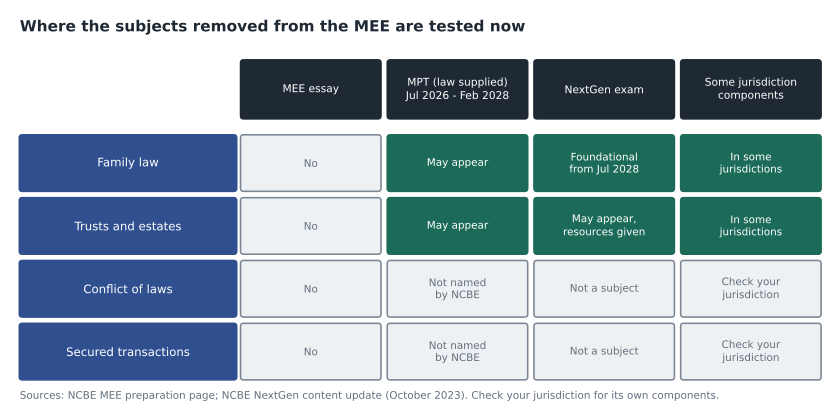
Where the subjects still appear
On the MPT. According to NCBE's MEE preparation page, Family Law and Trusts and Estates will be tested through the Multistate Performance Test from July 2026 through February 2028. On the MPT, the file and library supply the governing law, so you will not need to recall doctrine, but familiarity with the vocabulary and structure of the subject helps you read the library faster and spot what the task requires. BAR-121 covers the MPT itself.
On the NextGen exam. In October 2023, NCBE announced that family law would be added to the NextGen exam's foundational concepts and principles beginning with the July 2028 administration, and that doctrinal family law knowledge would not be tested before then. Trusts and estates was not added to the foundational list, but NCBE said NextGen questions may cover it, with legal resources supplied so that examinees do not need to rely on recalled doctrine. BAR-130 covers the NextGen exam.
On jurisdiction components. Several jurisdictions test their own law in addition to, or instead of, the national components, and some of those tests cover subjects the MEE dropped. For example, NCBE's chart of NextGen jurisdiction components lists North Carolina's component exam on decedents' estates and trusts, and Texas's law component covering subjects that include trusts, wills and family law. Jurisdictions that write their own essays, such as California and Louisiana, set their own subject lists, and California's list has traditionally included community property, wills and trusts. Check your jurisdiction's bar admission website and the jurisdiction course for your state in this program.
And in practice. None of these subjects matters less to clients. Family law and estate planning are among the most common areas of practice for new lawyers in small firms, and secured transactions is at the heart of commercial lending. Several jurisdictions also require new admittees to complete courses on local law. Treat the refreshers below as a foundation, not as the last time you will study these subjects.
Eddie points out that his Louisiana exam covers successions and matrimonial regimes under the Civil Code. 'The vocabulary is different,' he says, 'forced heirship, community property, usufruct, but knowing the common law version helps me see where Louisiana departs from it.'
Family law refresher
Marriage requires capacity (age, mental capacity, not already married, not too closely related) and the formalities of a license and solemnization. In Obergefell v. Hodges (2015), the Supreme Court held that the Fourteenth Amendment requires states to license and recognize marriages between two people of the same sex. A minority of states still recognize common-law marriage formed within their borders; other states generally recognize a common-law marriage validly formed where the couple lived. Premarital agreements are generally enforceable if entered voluntarily, with fair disclosure or a waiver of disclosure, and if not unconscionable when signed under the approach of the Uniform Premarital Agreement Act; provisions about child support cannot adversely affect the child.
Every state allows no-fault divorce, typically on a showing of irreconcilable differences or a period of separation. Property division follows one of two systems. Most states use equitable distribution, dividing marital property, generally that acquired during the marriage other than by gift or inheritance, in a fair but not necessarily equal way. A minority of states, including California, Texas and Louisiana, are community property states, treating property acquired during marriage as owned equally by both spouses. Spousal support depends on need, ability to pay, the length of the marriage and other factors, and is often rehabilitative and time-limited.
Child custody is decided by the best interests of the child, considering factors such as each parent's caregiving history, the child's needs and wishes, stability and any domestic violence. Child support is set using state guidelines that create a rebuttable presumption, and the right to support belongs to the child, so parents cannot bargain it away. Interstate cases use uniform acts adopted by nearly every state: under the Uniform Child Custody Jurisdiction and Enforcement Act (UCCJEA), the child's home state, where the child lived with a parent for six consecutive months before the case began, has priority to make the initial custody decision, and that state keeps exclusive, continuing jurisdiction to modify it while a parent or the child remains there. Under the Uniform Interstate Family Support Act (UIFSA), the state that issued a child support order generally keeps continuing, exclusive jurisdiction to modify it while the obligor, the obligee or the child resides there.
Trusts and estates refresher
When a person dies without a valid will, intestacy statutes distribute the estate, typically to a surviving spouse and descendants first, then to parents and more remote relatives. A valid attested will requires a writing, the testator's signature, and the signatures of two witnesses, with testamentary capacity and intent; many states also accept holographic wills, handwritten and signed by the testator, and the Uniform Probate Code allows a court to excuse harmless errors in execution with clear and convincing evidence of intent. A will is revoked by a later will or codicil, by a physical act such as burning or tearing done with intent to revoke, and in many states, as to a former spouse, by divorce. When a beneficiary dies before the testator, the gift lapses unless an anti-lapse statute saves it for the beneficiary's descendants, usually when the beneficiary was a close relative. Specific gifts of property no longer in the estate adeem, and when assets are insufficient, gifts abate in a set order. Surviving spouses in separate property states may claim an elective share in place of the will's provisions, and pretermitted children born after a will may take a share.
An express private trust requires a settlor with intent to create a trust, trust property, ascertainable beneficiaries and, for land in many states, a writing. Under the Uniform Trust Code, a trust is revocable unless its terms say it is irrevocable, reversing the traditional default. A spendthrift clause bars voluntary and involuntary transfers of a beneficiary's interest, with exceptions for certain creditors such as children owed support. Charitable trusts need a charitable purpose but not ascertainable beneficiaries, and when a purpose becomes impossible or impracticable, a court may apply cy pres to substitute a similar purpose. Trustees owe a duty of loyalty, which forbids self-dealing absent authorization, and a duty of prudence, which under the Uniform Prudent Investor Act requires investing as a prudent investor would, considering the portfolio as a whole and diversifying unless special circumstances make it imprudent.
Conflict of laws refresher
Conflict of laws asks which state's law applies, which court may hear a case and whether other courts must respect a judgment. For choice of law, states use several approaches. The traditional vested rights approach of the First Restatement applies fixed rules, such as the law of the place of injury for torts and the place of contracting for contract formation. The Second Restatement, followed by a plurality of states, applies the law of the state with the most significant relationship to the issue, considering the contacts and policy factors listed in its section 6. Governmental interest analysis compares the policies of the states involved and the interests each has in applying its law. Courts characterize an issue as substantive or procedural first, applying their own procedural rules. A federal court in a diversity case applies the choice-of-law rules of the state where it sits, under Klaxon Co. v. Stentor Electric Manufacturing Co. (1941). And the Full Faith and Credit Clause requires states to give a valid judgment from a sister state the same effect it has where rendered, if the rendering court had jurisdiction.
Secured transactions refresher
Article 9 of the UCC governs security interests in personal property. A security interest attaches, and becomes enforceable against the debtor, when the secured party gives value, the debtor has rights in the collateral, and either the debtor has authenticated a security agreement describing the collateral or the secured party has possession or control under the agreement. Perfection makes the interest effective against third parties, usually by filing a financing statement in the proper office, by possession, by control for deposit accounts and certain investment property, or automatically, as with a purchase-money security interest in consumer goods. Priority among competing secured parties generally goes to the first to file or perfect, but a purchase-money security interest can take priority over an earlier interest if perfected on time and, for inventory, if notice is given to earlier secured parties. A buyer in the ordinary course of business takes free of a security interest created by its seller, even if perfected. On default, a secured party may repossess without a breach of the peace and must dispose of the collateral in a commercially reasonable manner, with notice; the debtor is liable for any deficiency and entitled to any surplus.
Worked problem
Reading an MPT library on family law
Imagine an MPT task in February 2027 asking you to write a memo on whether a state court may modify a custody order entered in another state. The library contains the state's version of the UCCJEA and two cases. What do you already know that will speed you up?
Show solution
- You know the UCCJEA's structure: home-state priority for initial decisions and exclusive, continuing jurisdiction in the decree state.
- You therefore read the library looking for the provisions on modification and on when the decree state loses exclusive jurisdiction, for example when neither parent nor the child still lives there.
- You treat the library's statute and cases as the law, even if they differ from what you remember, because the MPT instructs examinees to use the materials provided.
- You spend your saved time on applying the cases to the file's facts, which is where performance test points are earned.
Answer: Background knowledge helps you navigate an MPT library, but the library, not memory, supplies the rule.
Ngozi decides to keep her family law and trusts flashcards for one purpose only: to read MPT libraries faster. 'I will not memorize the anti-lapse statute again,' she says. 'But I will know what it is when I see it.'
Practice questions from before July 2026
NCBE's released questions and analyses span many years, and many include the removed subjects. When building a practice set, use questions in the eight current subject areas for MEE practice. Older questions on family law and trusts and estates can still serve as background for MPT preparation, and they are directly relevant if your jurisdiction tests those subjects on its own component. Conflict of laws and secured transactions questions are useful only if your jurisdiction specifically tests them, or for your own practice later.
Practice problems
Work each problem on paper first, then reveal the answer to check.
Which four subjects left the MEE in July 2026?
Show answer
Conflict of Laws, Family Law, Trusts and Estates, and Secured Transactions.
How may family law and trusts and estates be tested between July 2026 and February 2028?
Show answer
Through the MPT, with the law supplied in the library.
When does family law become a NextGen foundational subject?
Show answer
With the July 2028 administration.
Which state has priority to make an initial custody decision under the UCCJEA?
Show answer
The child's home state, where the child lived with a parent for six consecutive months before the case began.
What is the default revocability of a trust under the Uniform Trust Code?
Show answer
Revocable, unless the terms make it irrevocable.
What three things are needed for a security interest to attach?
Show answer
Value given, the debtor's rights in the collateral, and an authenticated security agreement or possession or control.
Common mistakes
MistakePracticing with any released MEE question is equally useful.
InsteadQuestions in the four removed subjects do not reflect the current MEE.
MistakeFamily law is gone from bar exams entirely.
InsteadIt may appear on the MPT through February 2028 and joins NextGen in July 2028.
MistakeOn the MPT, apply the rule you memorized if it differs from the library.
InsteadThe library supplies the law for the task.
MistakeEvery jurisdiction has dropped these subjects.
InsteadSome jurisdiction components still test them; check your state.
Summary and key terms
- NCBE removed conflict of laws, family law, trusts and estates and secured transactions from the MEE from July 2026.
- Family law and trusts and estates may appear on the MPT through February 2028, with the law supplied.
- Family law becomes a NextGen foundational subject in July 2028; trusts and estates may appear with resources supplied.
- Some jurisdictions still test these subjects on their own components.
- Background knowledge helps you read libraries and serves you in practice.
- UCCJEA
- The Uniform Child Custody Jurisdiction and Enforcement Act, giving priority to the child's home state.
- Anti-lapse statute
- A statute that saves a gift to a predeceased beneficiary for the beneficiary's descendants.
- Cy pres
- The doctrine allowing a court to redirect a failed charitable trust to a similar purpose.
- Most significant relationship
- The Second Restatement's test for choosing the law of the state most connected to an issue.
- Attachment
- The moment a security interest becomes enforceable against the debtor.
Lesson quiz · 5 questions
Score 60% or more to complete this lesson.
Create a free account to save your progress, take quizzes and earn a certificate.