
BAR-120 · Lesson 9 of 12 · 23 min
Real property on the essay
▶ Video coming soon A video version of this lesson is on the way.
Because the Wednesday of November 11 was taken by Hollis's call with Ngozi about the MPRE, the real property writing session moves to Sunday afternoon, November 8, 2026. Ngozi, who found recording acts the hardest part of the Monday property drills, has a request. 'On the multiple-choice questions I can sometimes guess. On an essay I have to explain who wins and why, step by step. I need an order.' Marchetti has one ready. 'Real property essays are mostly about four things: who owns what interest, what happens when land changes hands, what landlords and tenants owe each other, and mortgages. Each has its own order, and every one of them starts with the same move: draw the timeline.'
This lesson shows how real property is tested on MEE essays and reviews the rules that essays use most: co-ownership, conveyancing and recording, landlord and tenant, servitudes, adverse possession and mortgages. The rules were reviewed in BAR-111; the emphasis here is on organizing an answer around events and dates.
Draw the timeline first
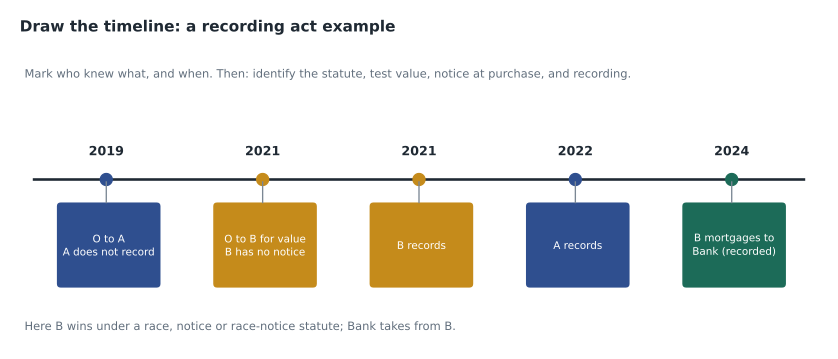
Property questions are built from a sequence of transactions: a conveyance, a mortgage, a death, a lease, a recording, a default. Before outlining, list every event in date order with the parties and what each received. Who knew what, and when, belongs on the timeline too, because notice drives the recording acts and many other rules. Nearly every property call becomes manageable once the timeline is on your scratch paper.
Estates, future interests and co-ownership
Essays sometimes begin by asking what interests a grant created. Identify the present estate (fee simple absolute, fee simple determinable, fee simple subject to a condition subsequent, fee simple subject to an executory limitation, life estate) and each future interest (reversion, possibility of reverter, right of entry, remainder, executory interest), then classify remainders as vested or contingent and apply the Rule Against Perpetuities only to interests it covers. More often, though, essays focus on co-ownership.
In a joint tenancy, co-owners hold equal undivided interests with a right of survivorship: when one dies, the survivors take her share, and a will cannot change that. Creating a joint tenancy traditionally required the four unities of time, title, interest and possession, and modern statutes require clear language of survivorship. A joint tenant who conveys her interest severs the joint tenancy as to that share, and the grantee becomes a tenant in common with the others. Whether a mortgage by one joint tenant severs depends on the jurisdiction: in title theory states it does, while in the majority lien theory states it does not, and if the mortgagor dies first, the survivor takes free of the mortgage. Tenants in common hold undivided interests, which may be unequal, with no survivorship; each share passes by will or intestacy. A tenancy by the entirety, available in some states to married couples, cannot be severed unilaterally or reached by one spouse's creditors alone.
Co-owners' rights to possession, rents and expenses come up often. Each co-tenant may possess the whole; a co-tenant in sole possession generally does not owe rent to the others unless she ousted them or agreed to pay. Rents collected from third parties must be shared. A co-tenant who pays more than her share of mortgage interest and taxes may seek contribution; improvements are usually credited only in partition, to the extent they increased value. Any co-tenant may seek partition, in kind if practicable and otherwise by sale.
Conveyancing: contracts, deeds and title
Land sale questions follow the transaction. The contract must satisfy the Statute of Frauds, though part performance may take an oral contract outside it. Every land sale contract carries an implied promise that the seller will deliver marketable title at closing, meaning title free from reasonable doubt, such as defects in the chain of title, encumbrances the buyer did not agree to, and significant zoning violations; the buyer's remedy for unmarketable title is to rescind, sue for damages or seek specific performance with an abatement. Under equitable conversion, in the majority of states, the buyer bears the risk of loss between contract and closing if the property is destroyed without fault, but receives the benefit of the seller's insurance proceeds. Some states shift the risk to the seller by statute. Sellers must disclose known latent material defects in many states, and a general 'as is' clause does not excuse fraud or active concealment.
After closing, the contract merges into the deed, and the buyer's rights rest on the deed's covenants of title. A general warranty deed contains the present covenants of seisin, right to convey and against encumbrances, which are breached, if at all, at delivery, and the future covenants of quiet enjoyment, warranty and further assurances, which are breached when the grantee is evicted or disturbed by someone with paramount title. A special warranty deed warrants only against defects arising during the grantor's ownership; a quitclaim deed contains no covenants. A deed must be delivered with intent to pass title presently; recording creates a presumption of delivery.
The recording acts
At common law, the first in time prevails. Recording acts protect certain later purchasers who record or lack notice. Under a race statute, the first to record wins, regardless of notice. Under a notice statute, a subsequent bona fide purchaser for value without notice prevails over an earlier unrecorded interest, whether or not she records. Under a race-notice statute, a subsequent purchaser for value without notice prevails only if she also records first. A purchaser may have actual notice, constructive notice (from properly recorded documents in the chain of title) or inquiry notice (from facts, such as someone in possession, that would lead a reasonable buyer to investigate). Donees and heirs are not purchasers for value and take subject to prior interests. Under the shelter rule, a person who takes from a protected purchaser has that purchaser's rights, even if she has notice. A wild deed, one recorded outside the chain of title, does not give constructive notice.
| Statute type | Later buyer wins if she | Typical statutory language |
|---|---|---|
| Race | records first | "no conveyance is valid against a purchaser who first records" |
| Notice | paid value and had no notice when she bought | "no conveyance is valid against a subsequent purchaser for value without notice unless recorded" |
| Race-notice | paid value, had no notice, and recorded first | "... without notice, who first records" |
Ngozi now has a method: draw the timeline, identify the statute by its words, decide whether the later party is a purchaser for value, check notice at the time of purchase, then check recording if the statute requires it. 'In Nigeria we look at the register and the register is the answer,' she says. 'Here the register is only part of the answer.'
Landlord and tenant
Landlord-tenant essays usually involve a tenancy type, a habitability or eviction problem, a transfer, or the end of a lease. Identify the tenancy: a term of years ends automatically; a periodic tenancy continues until notice equal to the period (traditionally six months for a year-to-year tenancy); a tenancy at will ends on either party's notice; a tenancy at sufferance arises when a tenant holds over. When a tenant holds over, the landlord may evict or, in many states, elect to bind the tenant to a new periodic tenancy.
The tenant must pay rent and avoid waste, and is liable for her own conduct and for damage beyond ordinary wear and tear. Most states imply a warranty of habitability in residential leases, requiring premises fit for human habitation; remedies typically include withholding rent after notice, repairing and deducting, or terminating the lease. The covenant of quiet enjoyment, implied in every lease, is breached by actual eviction or by constructive eviction: the landlord's substantial interference with the tenant's use, notice and a reasonable time to fix it, and the tenant's vacating within a reasonable time. A landlord who retaliates against a tenant for reporting code violations may be barred from evicting or raising rent.
Transfers produce the classic privity problem. If a tenant assigns, transferring the entire remaining term, the assignee is in privity of estate with the landlord and is liable for rent while in possession; the original tenant remains liable in privity of contract unless the landlord releases her. An assignee who expressly assumes the lease is also in privity of contract. If the tenant subleases, transferring less than the entire term, the subtenant is not in privity with the landlord and is not directly liable for rent, unless she assumed the lease. Many leases require the landlord's consent to transfer, and many states require that consent not be unreasonably withheld. When a tenant abandons, the majority rule requires the landlord to make reasonable efforts to relet and mitigate damages.
Servitudes and adverse possession
Easements are created expressly in a writing, by implication from prior use when land is divided (prior apparent and continuous use, reasonable necessity), by necessity when a division leaves land without access, and by prescription (open, notorious, continuous and adverse use for the statutory period). Easements appurtenant run with the land to successors; they end by merger, release, abandonment shown by physical acts with intent, estoppel, prescription or the end of necessity. Real covenants run at law for damages if the original parties intended them to run, they touch and concern the land, the burdened successor had notice, and there is the required privity; equitable servitudes are enforced by injunction against a successor with notice if intended to run and touching and concerning the land, without privity. Common schemes in subdivisions can create implied reciprocal servitudes.
Adverse possession transfers title to a possessor whose possession is actual, open and notorious, exclusive, hostile (without the owner's permission) and continuous for the statutory period. Successive possessors in privity may tack their periods together. The period does not run against an owner who was under a disability when the possession began, though statutes usually limit that extension.
Mortgages
Mortgage essays reward careful attention to order of events. A mortgage secures a debt with an interest in land; the note is the debt and the mortgage is the security. A mortgage follows the note when the note is transferred. When mortgaged land is sold, a buyer who assumes the mortgage becomes personally liable on the debt, while a buyer who takes subject to it is not personally liable, although the land remains security. The original mortgagor stays liable in either case unless released, as by a novation.
Priority is generally first in time, as modified by the recording acts and two important exceptions. A purchase-money mortgage, one given to finance the purchase of the land, takes priority over other mortgages and liens arising through the buyer, regardless of when they are recorded, though the recording acts can affect a later purchaser for value. Subordination agreements can reorder priority. On default, the lender may foreclose, usually by judicial sale. Foreclosure extinguishes the mortgage being foreclosed and all junior interests that were made parties, but it does not affect senior interests; the buyer at the sale takes subject to them. Sale proceeds pay the expenses of sale, then the foreclosing mortgage, then junior interests in order, with any surplus to the mortgagor. If the sale brings less than the debt, the lender may seek a deficiency judgment against those personally liable, subject to anti-deficiency statutes in some states. Before the sale, the mortgagor has an equitable right to redeem by paying the full debt; some states add a statutory right to redeem after the sale.
Worked problem
A mortgage priority problem
In 2020, Jo bought a duplex, financing it with a purchase-money mortgage from First Bank, which was recorded. In 2022, Jo borrowed from Lake Credit Union, giving a second mortgage that was recorded. In 2024, Jo sold the duplex to Max, who took subject to both mortgages without assuming them. Max stopped paying, and in 2026 Lake Credit Union foreclosed, joining Max and Jo but not First Bank. At the sale, Pia bought the duplex for 60,000 dollars, while 70,000 dollars remained due to Lake. What are the rights of the parties?
Show solution
- Order: First Bank is senior as the first recorded, purchase-money mortgage; Lake is junior.
- Foreclosure of the junior mortgage extinguishes Lake's mortgage and Max's interest, but not First Bank's senior mortgage, which was not affected by the junior foreclosure; Pia takes subject to it.
- Proceeds: the 60,000 dollars, after sale expenses, goes to Lake, leaving at least 10,000 dollars unpaid.
- Deficiency: Max took subject to the mortgages and did not assume, so he is not personally liable. Jo remains personally liable on her note to Lake, absent a release or an anti-deficiency statute.
Answer: Pia owns the duplex subject to First Bank's mortgage; Lake may seek a deficiency only from Jo.
Dana asks why First Bank does not have to be joined. 'Senior interests are not affected by a junior foreclosure,' Marchetti explains. 'Joining them is unnecessary for the junior lender, and the buyer at the sale knows she is buying subject to them. That is why sale prices at junior foreclosures are usually low.'
Writing a property answer
Use the timeline to order the analysis, and state the governing rule with its elements before applying it. When the call asks who owns the land, answer it in terms of interests: 'Pia owns the fee simple subject to First Bank's mortgage.' When the question gives a statute, quote the language that decides the type of recording act. And when a rule varies among states, such as whether a joint tenant's mortgage severs, state the majority rule, note the minority rule if it matters, and conclude.
Practice problems
Work each problem on paper first, then reveal the answer to check.
What should you draw before outlining a property essay?
Show answer
A timeline of every transaction, party and notice fact, in date order.
Does a joint tenant's mortgage sever the joint tenancy in a lien theory state?
Show answer
No; in the majority lien theory states it does not.
Under a race-notice statute, what must a later purchaser show to prevail?
Show answer
That she paid value, had no notice when she bought, and recorded first.
Who bears the risk of loss between contract and closing under equitable conversion?
Show answer
The buyer, in the majority of states, with credit for the seller's insurance proceeds.
Is a subtenant liable to the landlord for rent?
Show answer
Not directly, unless she assumed the lease; she is not in privity of estate or contract with the landlord.
What does a foreclosure of a junior mortgage do to a senior mortgage?
Show answer
Nothing; the senior mortgage survives and the buyer takes subject to it.
Common mistakes
MistakeA will can override a joint tenant's right of survivorship.
InsteadSurvivorship operates at death before the will can pass the share.
MistakeA donee can be a bona fide purchaser.
InsteadDonees do not pay value and take subject to prior interests.
MistakeA buyer who takes subject to a mortgage is personally liable.
InsteadOnly a buyer who assumes the mortgage is personally liable.
MistakeForeclosure wipes out all mortgages on the property.
InsteadOnly the foreclosed mortgage and joined junior interests.
Summary and key terms
- Start property essays with a timeline that includes notice facts.
- Distinguish joint tenancy, tenancy in common and tenancy by the entirety, and know severance rules.
- Conveyancing: marketable title, equitable conversion, merger into the deed and deed covenants.
- Identify the recording act by its words, then test value, notice and recording.
- Mortgages: priority, purchase-money exceptions, assumption versus subject-to, and the effects of foreclosure.
- Right of survivorship
- A joint tenant's right to take a deceased co-tenant's share automatically.
- Equitable conversion
- The doctrine that treats the buyer as owner between contract and closing, placing the risk of loss on the buyer.
- Bona fide purchaser
- A person who buys for value without notice of a prior interest.
- Purchase-money mortgage
- A mortgage given to finance the purchase of the land, with special priority.
- Deficiency judgment
- A judgment for the unpaid balance of a debt after a foreclosure sale brings less than the amount owed.
Lesson quiz · 5 questions
Score 60% or more to complete this lesson.
Create a free account to save your progress, take quizzes and earn a certificate.