
BAR-210 · Lesson 1 of 12 · 14 min
Becoming a lawyer in Florida
▶ Video coming soon A video version of this lesson is on the way.
Yesenia Carmody grew up in Fort Myers, finished law school at a Florida law school in May 2026 and now works as a law clerk at a small Tampa firm that handles insurance defense, condominium disputes and residential real estate closings. She will sit the Florida General Bar Examination in Tampa on February 23 and 24, 2027. She is a first-time taker, and she is organized: she registered with the Florida Board of Bar Examiners as a first-year law student, she passed the MPRE in her third year, and she filed her bar application before the timely deadline in November 2026.
Even so, she arrives at her first session with Hollis Marchetti with a page of questions. Why does Florida not accept a Uniform Bar Examination score? Why does the Board want her credit report from three years ago? What exactly is Part A, and why do her friends from other states keep saying they only had to study the national subjects? Marchetti, who has coached bar candidates for fifteen years, smiles at the list. 'Good,' she says. 'Florida rewards people who ask those questions early. It is one of the few states that still writes most of its own exam, and it runs one of the most thorough background investigations in the country. Let us start with the whole map.'
This course follows their sessions from November 2026 through the exam. This first lesson explains who controls admission in Florida, which bodies do the work, what every applicant must show, and the order in which the steps usually happen. Later lessons take each step in detail and then turn to the Florida law that Part A tests and that a new Florida lawyer uses every week.
Who controls admission
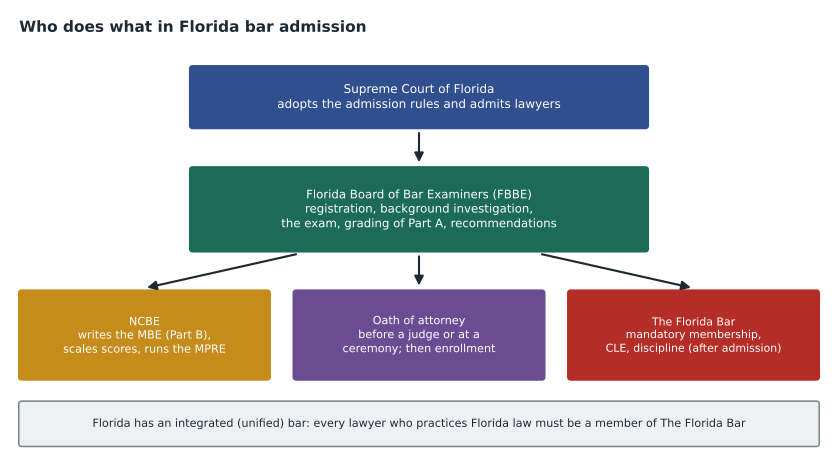
In Florida, the power to admit lawyers belongs to the Supreme Court of Florida. Article V of the Florida Constitution gives the Court exclusive jurisdiction to regulate the admission of persons to the practice of law and the discipline of persons admitted. The Court exercises that power through two sets of rules: the Rules of the Supreme Court Relating to Admissions to the Bar, which govern applicants, and the Rules Regulating The Florida Bar, which govern lawyers after admission.
The Court delegates the day-to-day work of admission to the Florida Board of Bar Examiners, usually called the FBBE or simply the Board. The Board is an administrative agency of the Court. Its members are lawyers and public members appointed by the Court, and it has a professional staff in the Tippin-Moore Building in Tallahassee. The Board registers law students, investigates the character and fitness of every applicant, gives and grades the exam, and recommends to the Court which applicants should be admitted. In November 2026 the Board announced that Laura E. Pincus had become its chair and Rosalyn Destinie Baker Sutton its vice chair, effective November 1.
The other players
The National Conference of Bar Examiners, or NCBE, prepares the Multistate Bar Examination, which Florida gives as Part B of its exam. NCBE also scales Florida's written scores to the MBE and runs the Multistate Professional Responsibility Examination, the MPRE, which Florida requires. NCBE does not decide who is admitted in Florida, and it does not conduct Florida's character and fitness investigation for exam applicants. The Board does that itself.
After admission, The Florida Bar takes over. Unlike many states, Florida has an integrated, or unified, bar. Every lawyer who practices Florida law must be a member in good standing of The Florida Bar, which is an official arm of the Supreme Court. The Bar collects annual fees, runs the continuing legal education program, administers the client security fund, investigates complaints and prosecutes discipline cases before referees appointed by the Court. Voluntary bar associations also exist, including local bars in every circuit, but membership in The Florida Bar itself is not optional.
Marchetti makes sure Yesenia knows which body to call. 'The Board answers questions about your application, your investigation and the exam. The Florida Bar answers questions about life after admission: membership, fees, CLE, ethics opinions. NCBE answers questions about the MPRE and about how your MBE score is reported. If you call the wrong one, you lose a day.'
Only one way in for most applicants
Many states offer three routes to admission: passing that state's exam, transferring a Uniform Bar Examination score earned elsewhere, or admission on motion for experienced lawyers. Florida offers only the first route for almost everyone. NCBE's published jurisdiction information for Florida, current in November 2026, lists no admission on motion and no acceptance of legacy UBE scores. Florida will begin accepting NextGen scores only from the July 2028 exam, when it starts giving NextGen itself. Until then, a lawyer admitted in New York for twenty years who wants to practice in Florida must apply to the Board, pass the background investigation and pass the Florida exam.
That rule shapes the whole study experience. Florida applicants cannot study only national law, because Part A tests Florida law in depth. And lawyers moving to Florida cannot skip the exam, so the Board's applicant pool includes experienced attorneys alongside recent graduates. Lesson 11 returns to the narrow exceptions and to the limited ways a transferred MBE score can count.
| Route | Available in Florida? | Notes (November 2026) |
|---|---|---|
| Admission by examination | Yes | Part A and Part B, with a combined passing score of 136 |
| Legacy UBE score transfer | No | Florida has never been a UBE jurisdiction |
| NextGen score transfer | Not yet | From the July 2028 exam, with a passing score still to be set |
| Admission on motion | No | Florida rules do not provide for it |
| Transferred MBE score | In limited cases | Counted toward Part B under the Board's rules |
What every applicant must show
Every applicant must prove four things. The first is legal education. For decades that meant a Juris Doctor from a law school accredited by the American Bar Association. In January 2026, in a rules case numbered SC2025-2064, the Supreme Court of Florida amended its rules so that, beginning October 1, 2026, a law school may also qualify through another accrediting agency recognized by the United States Department of Education and approved by the Court. The ABA remains an approved accreditor, so graduates of ABA-accredited schools like Yesenia are unaffected. When the Court ruled, the ABA was the only law school accreditor recognized by the Department, and the Court had not yet approved any other.
The second requirement is a passing score on the MPRE. Florida requires a scaled score of 80, and the Board's published instructions say the score must be achieved within 25 months of passing the other parts of the exam. The third is good moral character and fitness, established through the Board's investigation. The fourth is a passing score on the General Bar Examination, Parts A and B. When all four are complete, the Board certifies the applicant to the Court, and the applicant takes the oath of attorney and becomes a member of The Florida Bar.
Notice what Florida adds and what it does not. It adds a long, Florida-written day of testing, and a background investigation that many applicants begin during their first year of law school. It does not add a separate online course on state law, the way Arizona and New York do, because Part A itself does that job.
The usual order of steps
Most successful Florida applicants follow a pattern. During the first year of law school, they register with the Board as law students, which starts the background investigation early and costs less than filing later. During the second or third year, they take the MPRE. Early in the third year, they convert their student registration into a bar application for a specific exam and file it before the timely deadline. They graduate, take the exam in Tampa, receive their results, and then wait for the Board to complete any open items in the investigation. Once the Board clears them and certifies them to the Court, they take the oath, often at a ceremony organized with their law school or a local court, and enroll in The Florida Bar.
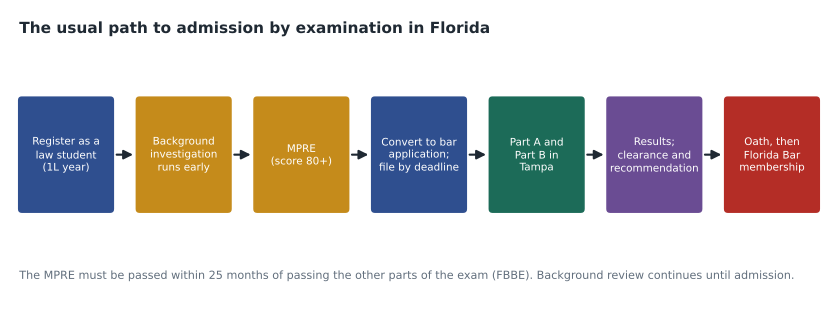
Yesenia has finished most of the early steps. She registered in January of her first year, and the Board's investigation turned up nothing that needed explanation beyond a minor traffic ticket she had already disclosed. Her MPRE score of 91 is comfortably above 80 and well within the 25-month window. Her application for February 2027 was postmarked on November 9, 2026, a week before the timely deadline of November 16. What remains is the exam, the continuing duty to keep her application current, and the oath.
Why Florida admissions take time
Marchetti warns every Florida candidate about the same thing: passing the exam is not the same as being admitted. The Board will not recommend an applicant until both the exam and the background investigation are complete. Applicants who file late, or who did not register as students, sometimes pass the exam and then wait months while the Board gathers records, interviews references or schedules an investigative hearing. 'The exam result comes on a date the Board announces,' she says. 'The clearance comes when your file is finished. You control the second one more than you think.'
The same is true of honesty. Florida's application asks detailed questions about criminal history, civil litigation, finances, employment, academic discipline and certain conduct. An applicant who leaves something out creates a larger problem than the original fact. Lesson 3 covers the investigation in detail, including how the Board treats candor, debt and mental health questions.
Where candidates go wrong
Marchetti keeps a list of the most common Florida mistakes. The first is assuming a UBE score from another state will transfer; it will not. The second is studying only the MBE subjects, which leaves a candidate unprepared for an entire day of Florida-specific testing. The third is missing the timely filing deadline, which costs a late fee of 325 dollars and, after the second deadline, 625 dollars, and leaves less time for the investigation. The fourth is forgetting the 25-month MPRE window: a candidate who passed the MPRE early and then postponed the exam can find the score has expired by the time the other parts are passed. The fifth is treating the application as a form to finish rather than a record to keep current. Florida requires applicants to update their answers whenever something changes until they are admitted.
A sixth mistake is specific to people coming from other states. Experienced lawyers sometimes underestimate Part A because they already practice law. Florida's multiple-choice questions on civil procedure, criminal procedure and the Rules of General Practice and Judicial Administration reward precise knowledge of Florida's own rules, and a lawyer who has practiced under a different state's rules for years can carry the wrong deadlines and terms into the exam.
How this course is organized
The next four lessons cover the admission process: registration, eligibility, deadlines and fees (lesson 2), character and fitness and the MPRE (lesson 3), the exam format, scoring and the 136 passing score (lesson 4), and the move to NextGen with a Florida law component in July 2028 (lesson 5). Lesson 6 explains how Part A tests Florida law. Lessons 7 to 10 cover the Florida law that matters most on Part A and in early practice: courts and civil procedure, torts after the 2023 civil remedies law, family law, homestead and estates, and evidence, criminal procedure and the Rules Regulating The Florida Bar. Lesson 11 covers lawyers admitted elsewhere and life after admission, and lesson 12 is a capstone with original practice questions, an essay and an exam-week plan.
Every fact in this course was checked, where possible, against the Florida Board of Bar Examiners' published notices, the Supreme Court of Florida's opinions, NCBE's published jurisdiction information, The Florida Bar's rules and news, and the Florida Statutes as they stood in November 2026. Where an official page could not be reached, the course says so or describes the rule in general terms. Rules and fees change, so a candidate should always confirm details with the Board before relying on them.
Marchetti's first assignment
At the end of the session, Marchetti gives Yesenia three tasks. The first is to log into her Board account and print the current status of her application, including any items marked as pending. The second is to download the Board's study guide and the most recent Part A essay questions the Board has released, and to read one essay question without trying to answer it. The third is to build a calendar from now to February 24, 2027, with two days a week reserved for Part A subjects. 'Most people plan their study around the MBE because the commercial courses do,' Marchetti says. 'In Florida, Part A is half your score. Plan like it.'
Common mistakes
MistakeThe Florida Bar decides who is admitted.
InsteadThe Supreme Court of Florida admits lawyers on the recommendation of the Florida Board of Bar Examiners; The Florida Bar governs lawyers after admission.
MistakeA UBE score from another state can be transferred to Florida.
InsteadFlorida does not accept legacy UBE scores and will accept NextGen scores only from July 2028.
MistakeExperienced lawyers can be admitted on motion.
InsteadFlorida rules do not provide for admission on motion; out-of-state lawyers take the Florida exam.
MistakePassing the exam completes admission.
InsteadThe Board must also complete the background investigation before certifying the applicant to the Court.
Summary and key terms
- The Supreme Court of Florida controls admission under Article V of the Florida Constitution and its admission rules.
- The Florida Board of Bar Examiners registers students, investigates applicants, gives and grades the exam and recommends admission.
- NCBE supplies the MBE (Part B), scales written scores and runs the MPRE; Florida runs its own background investigation.
- Every applicant needs qualifying legal education, an MPRE score of 80 within 25 months, character and fitness clearance, and a passing exam score.
- Florida has no admission on motion and does not accept legacy UBE scores; membership in The Florida Bar is mandatory after admission.
- FBBE
- The Florida Board of Bar Examiners, the Supreme Court's agency for bar admission.
- Integrated bar
- A bar association that every practicing lawyer must join; The Florida Bar is one.
- Part A
- The Florida-written day of the exam: essays and multiple-choice questions.
- Part B
- The Multistate Bar Examination, given on the second day.
- Student registration
- Registering with the Board during law school so the background investigation starts early.
Lesson quiz · 5 questions
Score 60% or more to complete this lesson.
Create a free account to save your progress, take quizzes and earn a certificate.