
BAR-210 · Lesson 8 of 12 · 15 min
Florida torts and the 2023 civil remedies law
▶ Video coming soon A video version of this lesson is on the way.
Yesenia's firm defends insurers and businesses in personal injury cases, and almost every file she opens begins with the same question: when did the accident happen? 'Before or after March 24, 2023?' she says. 'The answer changes the limitations period and the comparative fault rule. The partners call it B.T.R. and A.T.R., before and after tort reform.' Marchetti writes the date on the whiteboard. 'Then that is where we start,' she says. This lesson covers the Florida negligence framework, the 2023 civil remedies law known as HB 837, comparative fault and joint liability, damages, and several Florida doctrines that appear on Part A and in practice.
The 2023 civil remedies law
In March 2023, the Florida Legislature passed House Bill 837, a broad set of changes to civil litigation. The Governor approved it, and it took effect on March 24, 2023, as Chapter 2023-15, Laws of Florida. The Florida Senate's bill summary describes its main features, and every Florida torts lawyer now works with them.
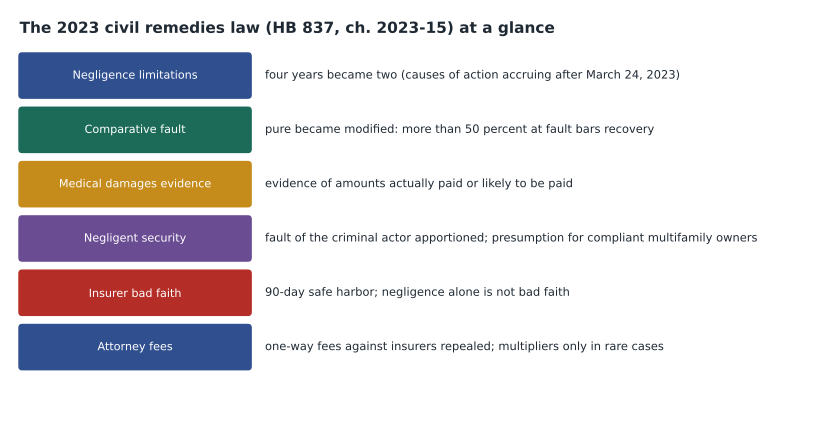
The first change concerns time. Florida's limitations period for general negligence actions fell from four years to two. The shorter period applies only to causes of action accruing after March 24, 2023, so a car accident on March 1, 2023 still carries a four-year period, while one on April 1, 2023 carries two years. The Senate summary notes a protection for servicemembers whose active duty materially affects their ability to appear. Other limitations periods, such as those for medical malpractice and wrongful death, have their own rules and were not shortened by this change.
The second change concerns fault. Florida moved from pure comparative negligence, under which a plaintiff could recover a reduced amount even if 99 percent at fault, to modified comparative negligence. Under section 768.81 as amended, a plaintiff found to be more than 50 percent at fault for his or her own harm may not recover any damages. A plaintiff exactly 50 percent at fault can still recover half of the damages. The change does not apply to actions for personal injury or wrongful death arising out of medical negligence, which remain under pure comparative fault.
The third group of changes concerns damages evidence and insurance. The law allows evidence of the amounts actually paid, or that better approximate the costs a claimant will incur, for medical treatment in personal injury and wrongful death actions, modifying Florida's collateral source practice. It changed insurer bad faith law, giving insurers a 90-day safe harbor to tender the lesser of the policy limits or the amount demanded after receiving a claim with sufficient supporting evidence, providing that negligence alone does not establish bad faith, and letting the trier of fact consider the good faith of the insured and claimants. It repealed Florida's one-way attorney fee statutes that awarded fees to insureds who prevailed against their insurers, leaving a limited fee remedy in a declaratory judgment action after a total denial of coverage. It limited contingency fee multipliers to rare and exceptional circumstances, and it extended the offer of judgment statute to civil actions involving insurance contracts.
The fourth change concerns negligent security. In a suit against the owner or operator of property by a lawful visitor injured by a third party's criminal act, the trier of fact must consider the fault of all persons who contributed to the injury, including the criminal. The owner or principal operator of a multifamily residential property that substantially implements specified security measures is presumed not negligent for criminal acts by third parties who are not its employees or agents.
Comparative fault and several liability
Section 768.81 governs how fault is allocated. The trier of fact assigns a percentage of fault to each party and, where properly pleaded and proved, to nonparties who contributed to the harm. Since 2006, Florida has largely abolished joint and several liability for negligence: each defendant is liable for damages only in proportion to its own percentage of fault, so a plaintiff bears the risk that a defendant cannot pay. A defendant who wants a nonparty included in the allocation must plead the nonparty's fault and prove it at trial; Florida case law has long required that, in Fabre v. Marin and later decisions, and practitioners still call the nonparties Fabre defendants.
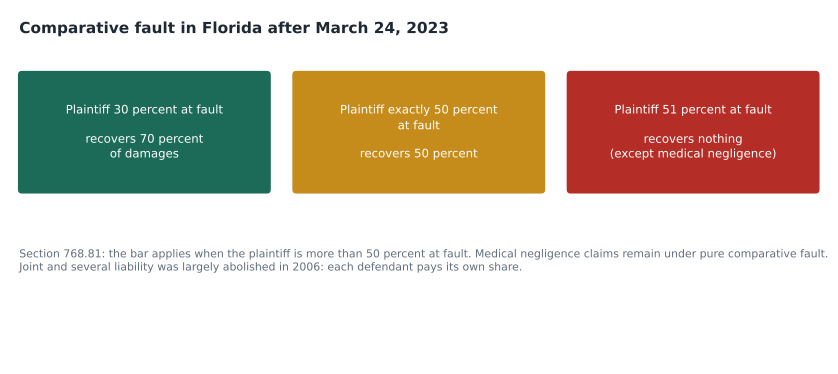
| Plaintiff's fault | Damages 200,000 dollars: recovery (accident after March 24, 2023) | Recovery before the 2023 law |
|---|---|---|
| 20 percent | 160,000 dollars | 160,000 dollars |
| 50 percent | 100,000 dollars | 100,000 dollars |
| 51 percent | Nothing (unless medical negligence) | 98,000 dollars |
| 70 percent | Nothing (unless medical negligence) | 60,000 dollars |
The elements of negligence
Florida negligence follows the familiar elements: a duty of care owed to the plaintiff, breach of that duty, causation in fact and proximate causation, and damages. Florida courts describe duty in terms of a foreseeable zone of risk: a defendant whose conduct creates a foreseeable zone of risk owes a duty to lessen the risk or protect others from it, as the Supreme Court of Florida explained in McCain v. Florida Power Corp. Proximate cause asks whether the harm was a reasonably foreseeable result of the conduct. On Part A, a negligence analysis should walk through each element with the facts, and then apply the 2023 rules on fault and limitations where the date calls for them.
Premises liability
Florida has special rules for the most common premises case: a slip and fall in a business. Under section 768.0755 of the Florida Statutes, a person who slips and falls on a transitory foreign substance in a business establishment must prove that the business had actual or constructive knowledge of the dangerous condition and should have taken action to remedy it. Constructive knowledge may be shown by circumstantial evidence that the condition existed long enough that the business should have known of it, or that the condition occurred with regularity and was therefore foreseeable. Florida also distinguishes among invitees, licensees and trespassers in defining the duties owed by landowners.
The dangerous instrumentality doctrine
One Florida doctrine surprises lawyers from other states: the dangerous instrumentality doctrine. Since Southern Cotton Oil Co. v. Anderson in 1920, Florida has held that the owner of a motor vehicle who voluntarily entrusts it to another is vicariously liable for injuries caused by the driver's negligent operation. The doctrine has been extended to other instrumentalities in some cases. The Legislature has limited the liability of owners who lend vehicles to natural persons, and of rental and leasing companies, through caps and exceptions in the motor vehicle statutes, so the amount of vicarious liability depends on who owned the vehicle and how it was entrusted. Florida also requires personal injury protection insurance for motor vehicles under its no-fault law, which affects how minor injury claims are handled.
Damages
Florida allows compensatory damages for economic losses such as medical expenses and lost earnings, and for noneconomic losses such as pain and suffering. Florida has no general cap on noneconomic damages in negligence cases. The Legislature adopted caps on noneconomic damages in medical negligence cases in 2003, but the Supreme Court of Florida held the caps unconstitutional as applied to wrongful death actions in Estate of McCall v. United States in 2014 and as applied to personal injury actions in North Broward Hospital District v. Kalitan in 2017.
Punitive damages require a special procedure. Under section 768.72, a claimant may not plead punitive damages without first making a reasonable showing, by evidence in the record or a proffer, that provides a reasonable basis for recovery, and the court must grant leave to amend. Punitive damages require proof of intentional misconduct or gross negligence by clear and convincing evidence, and section 768.73 generally limits them to the greater of three times compensatory damages or 500,000 dollars, with higher limits for certain motives and conduct.
Claims against the government
Florida has waived sovereign immunity in tort for the state and its agencies and subdivisions under section 768.28, subject to conditions. A claimant must give written notice of the claim to the agency and, in most cases, to the Department of Financial Services within the period the statute requires before suing, and the statute caps the amount a claimant may collect from the government without a special act of the Legislature, called a claim bill. The Legislature has debated raising those caps in recent sessions, so the current figures should be checked in the statute itself. Individual government employees are generally immune from personal liability unless they acted in bad faith, with malicious purpose or with wanton and willful disregard of human rights or safety.
Worked problem
Applying the 2023 law on Part A
On June 15, 2024, Rosa slipped on spilled detergent in a grocery store in Tampa. The jury finds her damages are 300,000 dollars, finds the store 40 percent at fault and Rosa 60 percent at fault for not watching where she walked. She sued on May 1, 2026. What result?
Show solution
- The cause of action accrued after March 24, 2023, so the two-year negligence limitations period applies.
- Rosa sued within two years of June 15, 2024, so the claim is timely.
- Under section 768.0755 she must prove the store had actual or constructive knowledge of the spill; the jury found the store at fault, so assume she did.
- Rosa is more than 50 percent at fault, and this is not medical negligence, so under amended section 768.81 she recovers nothing.
Answer: Rosa's claim is timely but barred by modified comparative fault. Before the 2023 law she would have recovered 120,000 dollars.
Common mistakes
MistakeThe two-year negligence period applies to every claim filed after March 24, 2023.
InsteadIt applies to causes of action accruing after that date.
MistakeModified comparative fault applies to medical negligence claims.
InsteadMedical negligence claims remain under pure comparative fault.
MistakeA plaintiff 50 percent at fault recovers nothing.
InsteadThe bar applies only when the plaintiff is more than 50 percent at fault.
MistakeFlorida caps noneconomic damages in medical malpractice cases.
InsteadThe Supreme Court of Florida struck down those caps in McCall (2014) and Kalitan (2017).
Dating every tort fact pattern
Because the 2023 civil remedies law changed so much, the first question on any Florida tort problem is when the cause of action accrued, or when the action was filed, depending on the provision. Marchetti asks Yesenia to write the date of each event at the top of her outline whenever she reads a tort fact pattern. A slip and fall in 2022 may still fall under the pure comparative fault rule and the old four-year limitation period, while a slip and fall in 2024 falls under modified comparative fault and the two-year period. The Board can test both, and an essay about an older accident may expect the older rules.
Yesenia builds a small table for her flashcards: each major change in the 2023 law, the date or event that controls whether it applies, and the effect. Comparative fault applies to actions filed after the law took effect. The shorter limitation period applies to negligence causes of action accruing after March 24, 2023. Other provisions have their own application rules. Where she is unsure, she notes the general principle and the uncertainty rather than guessing.
Insurance and bad faith
The 2023 law also changed the law of insurer bad faith in ways that matter to Florida practice and to Part A. It created a safe harbor for an insurer that tenders the lesser of the policy limits or the amount demanded within 90 days after receiving notice of a claim with sufficient evidence to support the amount, and it clarified that negligence alone is not enough to establish bad faith. It repealed one-way attorney fee provisions that had allowed insureds to recover fees from insurers in many coverage disputes. Yesenia sees the effect at her firm, where insurance defense lawyers now evaluate claims differently.
Negligent security
The 2023 law added a statute on negligent security claims, which are common in Florida. It requires the jury to apportion fault between the property owner and the criminal actor who caused the harm, and it creates a presumption against liability for owners of multifamily residential property who implement specified security measures. Yesenia's firm represents several condominium associations, and the partner has asked her to summarize the measures for a client newsletter. 'You will know this better than most first-year lawyers,' Marchetti says.
Writing a tort essay
A Florida tort essay rewards an orderly structure: duty, breach, causation and damages for each defendant, then defenses, then apportionment of fault, then any special rules such as the dangerous instrumentality doctrine, sovereign immunity or caps. Yesenia practices with a simple template and fills each heading with Florida rules. Her answers improve when she stops writing about every possible theory and focuses on the theories the facts actually support.
Summary and key terms
- HB 837 (ch. 2023-15) took effect March 24, 2023.
- General negligence claims accruing after that date must be brought within two years, not four.
- A plaintiff more than 50 percent at fault recovers nothing, except in medical negligence cases.
- Joint and several liability is largely abolished; each defendant pays its own share, including allocation to Fabre nonparties.
- Florida doctrines to know: section 768.0755 slip and fall, the dangerous instrumentality doctrine, the punitive damages proffer, and sovereign immunity under section 768.28.
- HB 837
- The 2023 Florida civil remedies law, chapter 2023-15.
- Modified comparative fault
- A rule barring recovery by a plaintiff above a fault threshold.
- Fabre defendant
- A nonparty to whom fault is allocated under section 768.81.
- Dangerous instrumentality doctrine
- Florida rule making a vehicle owner vicariously liable for a permitted driver's negligence.
- Claim bill
- A special legislative act paying a claim above the sovereign immunity caps.
Lesson quiz · 5 questions
Score 60% or more to complete this lesson.
Create a free account to save your progress, take quizzes and earn a certificate.