
BAR-210 · Lesson 11 of 12 · 15 min
No reciprocity: lawyers from other states, Florida Bar membership and practice after admission
▶ Video coming soon A video version of this lesson is on the way.
At their eleventh session, Yesenia brings a question from work. A lawyer licensed in Georgia for twelve years has joined her firm's Tampa office and wants to know how quickly he can be admitted in Florida. 'He assumed there was a motion process like in Georgia,' she says. 'I told him I would check.' Marchetti smiles. 'You can save him the search. Florida has no admission on motion and no reciprocity. Every new Florida lawyer, including a lawyer with decades of experience elsewhere, passes the Florida exam.' This lesson explains what that means for lawyers coming from other states, the narrow routes that allow limited practice without full admission, and what happens after a candidate passes: membership in The Florida Bar, the oath, and the education requirements that begin on day one.
No admission on motion, no UBE
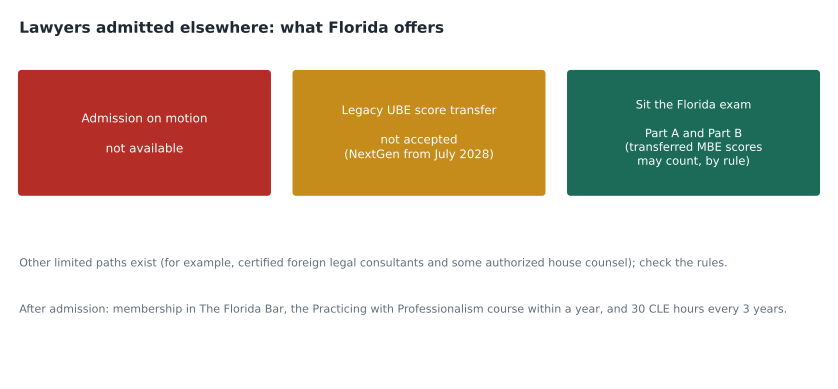
Most states allow experienced lawyers from other states to be admitted on motion, without an exam, if they meet practice and character requirements. Florida does not. NCBE's jurisdiction profile for Florida lists no admission on motion, and Florida has never adopted the Uniform Bar Examination, so it does not accept transferred UBE scores. A lawyer admitted elsewhere who wants to practice Florida law generally must apply to the Florida Board of Bar Examiners, complete the background investigation, and pass the Florida exam.
The reasons are partly historical and partly economic. Florida's large population of retirees, its tourism economy and its attraction for lawyers who want to move south have long produced pressure from out-of-state lawyers, and the Supreme Court of Florida has preferred to keep its own exam as the single gateway. Whether the policy is wise is debated, but for a candidate it is simply the rule.
What the exam looks like for experienced lawyers
Experienced lawyers still take an exam, but Florida offers some flexibility. Lawyers admitted in another jurisdiction pay a higher application fee than first-time candidates who are not lawyers: NCBE lists a fee of 1,000 dollars for a first-time non-attorney applicant and between 1,600 and 3,000 dollars for attorney applicants, depending on how long they have been admitted. Florida also accepts transferred MBE scores under its rules, so a candidate who earned a sufficiently high MBE score in another jurisdiction within the period the rules allow may be able to transfer that score and sit only Part A. The conditions are technical and change, so candidates should read the Board's current rules on MBE score transfer and, if in doubt, write to the Board before relying on a transfer.
Some experienced lawyers may also qualify for exceptions on Part B under the Board's rules. Marchetti tells Yesenia to give the Georgia lawyer one piece of advice: read the rules carefully, apply early, and plan for Part A as a serious exam. 'Experienced lawyers fail Part A because they assume twelve years of practice is enough,' she says. 'It is Florida procedure, Florida family law, Florida trusts and Florida ethics, tested precisely.'
Limited routes without full admission
Florida allows lawyers who are not members of The Florida Bar to practice in a few limited ways. Each route is narrow, and none is a substitute for admission for a lawyer who plans to build a Florida practice.
The first is appearance pro hac vice. Under Rule 2.510 of the Florida Rules of General Practice and Judicial Administration, a lawyer in good standing in another United States jurisdiction may ask a Florida court for permission to appear in a particular case, with a member of The Florida Bar associated as local counsel. The motion must disclose other recent pro hac vice appearances in Florida, and a lawyer who appears too often may be found to be engaged in a general practice in Florida, which the rule does not allow. The Florida Bar collects a fee for each appearance.
The second is authorized house counsel. Chapter 17 of the Rules Regulating The Florida Bar allows a lawyer admitted elsewhere who works exclusively for a business organization in Florida to register as authorized house counsel. A registered house counsel may advise the employer and its affiliates but may not appear in Florida courts or represent anyone else, and must meet continuing education requirements.
The third is certification as a foreign legal consultant under Chapter 16 of the Rules Regulating The Florida Bar. A lawyer admitted in a foreign country who meets the rule's requirements may advise on the law of that country in Florida, without practicing Florida or United States law.
The rules also address temporary practice by lawyers from other jurisdictions, such as work related to a matter pending elsewhere, under rule 4-5.5 of the Rules Regulating The Florida Bar, which follows the structure of Model Rule 5.5 with Florida variations. Unlicensed practice beyond these routes can be the unauthorized practice of law, which the Supreme Court of Florida treats seriously and which Chapter 10 of the Bar rules governs.
| Route | Who can use it | What it allows |
|---|---|---|
| Full admission | Anyone who meets education and character rules and passes the exam | General practice of Florida law |
| Pro hac vice (Rule 2.510) | Lawyers in good standing elsewhere, with Florida local counsel | Appearance in one case; not a general practice |
| Authorized house counsel (Chapter 17) | Lawyers admitted elsewhere working for one employer | Advising the employer only; no court appearances |
| Foreign legal consultant (Chapter 16) | Lawyers admitted in a foreign country | Advice on the law of that country |
| Temporary practice (rule 4-5.5) | Lawyers admitted elsewhere, in limited situations | Specific temporary work as the rule allows |
Foreign-educated applicants
Florida generally requires a JD from a law school accredited by the American Bar Association, and from October 1, 2026, a school accredited by another accrediting agency recognized by the U.S. Department of Education and approved by the Court, although no such agency had been approved when the change took effect. NCBE's profile notes that an LLM alone does not qualify an applicant. Foreign-educated lawyers should read the Board's rules on education requirements and any exceptions for lawyers with a set period of practice in another United States jurisdiction, and should contact the Board early.
After the exam: results and admission
Florida releases results for each exam on dates the Board announces. NCBE lists grading time of six to eight weeks. Passing the exam is not the end. An applicant is recommended for admission only when the background investigation is complete and the Board has made a favorable character and fitness finding, and the applicant must take the oath of admission before an authorized officer, often at a ceremony in Tallahassee or a local circuit court. A candidate who passes before character and fitness is complete waits, sometimes for months, so Yesenia's early registration as a 1L is a real advantage.
Membership in The Florida Bar
The Florida Bar is a mandatory, or integrated, bar. Every lawyer admitted to practice in Florida must be a member, pay annual fees and comply with the Rules Regulating The Florida Bar. The Bar is an official arm of the Supreme Court of Florida. It administers lawyer discipline under the Court's supervision, runs the continuing legal education program, regulates lawyer advertising and trust accounts, and offers sections, committees and practice resources. New members receive a Bar number, which appears on every pleading they sign.
Education requirements from day one
New Florida lawyers have two sets of education requirements. The first is the Basic Skills Course Requirement. Under the Bar's rules, every new member must complete Practicing with Professionalism, an eight-hour course, within the first year after admission, and must complete 21 additional hours of basic skills credit within the first three years. Lawyers who have practiced elsewhere for a set period and are old enough may be exempt from parts of the requirement under the rules.
The second is continuing legal education. Every member must complete 30 hours of approved CLE in each three-year reporting cycle. Of those hours, at least five must be in ethics, professionalism, substance abuse, mental health or related subjects, including a Florida-specific professionalism course, and at least three must be in technology. Each member's reporting cycle is assigned at admission, and the Bar tracks compliance; a member who falls behind may be declared delinquent.
| Requirement | What it requires | When |
|---|---|---|
| Practicing with Professionalism | 8-hour course | Within 1 year of admission |
| Basic Skills Course Requirement | 21 additional hours | Within 3 years of admission |
| CLE | 30 hours, including 5 ethics and related and 3 technology | Every 3-year cycle |
| Annual fees | Membership fees and any required trust account certification | Every year |
Board certification and practice areas
The Florida Bar's board certification program allows experienced lawyers to become certified in specialties such as civil trial, marital and family law, real estate and wills, trusts and estates. Certification requires years of practice, substantial involvement in the specialty, peer review and a written exam. A new lawyer cannot be certified, but Marchetti mentions it because Florida's advertising rules restrict who may call themselves a specialist or expert, and Part A questions on advertising sometimes turn on that restriction.
Worked problem
Advising the Georgia lawyer
Yesenia's colleague, admitted in Georgia for twelve years, wants to practice in the firm's Tampa office. He asks whether he can be admitted on motion and, if not, what he can do in the meantime.
Show solution
- Florida has no admission on motion and does not accept UBE scores, so he must apply to the Board and pass the exam.
- He may be able to transfer an MBE score if the Board's rules allow; he should read them and ask the Board.
- Meanwhile he may work on Georgia matters and may appear in a Florida case only pro hac vice under Rule 2.510, with Florida counsel.
- He must not hold himself out as a Florida lawyer or engage in a general Florida practice, which would be unlicensed practice.
Answer: He should file an application early, plan for Part A, and keep his Florida work within the pro hac vice and temporary practice rules.
Common mistakes
MistakeExperienced lawyers can be admitted on motion in Florida.
InsteadFlorida has no admission on motion.
MistakeA UBE score from another state can be transferred to Florida.
InsteadFlorida does not accept UBE scores; it may accept transferred MBE scores under its rules.
MistakePro hac vice allows an out-of-state lawyer to practice in Florida generally.
InsteadIt allows appearance in a particular case, and repeated appearances can be barred.
MistakeCLE begins after the first three years.
InsteadNew members have basic skills requirements from the first year, then the 30-hour cycle.
Why the rules matter to new lawyers
Yesenia will be admitted, she hopes, in the spring of 2027, and Marchetti wants her to know what to do in her first weeks as a Florida lawyer. She should log in to The Florida Bar's member portal, confirm her contact information and her designated email address for service, check her CLE reporting cycle, and register for Practicing with Professionalism. She should read the trust accounting rules again if she will handle client funds, and she should keep a simple record of her CLE hours from the start. 'New lawyers get into trouble on small things,' Marchetti says. 'An email address that is not checked, a missed course, a trust account they do not understand.'
Advice for colleagues from other states
The Georgia lawyer at Yesenia's firm is not unusual. Florida's economy and population growth attract many lawyers licensed elsewhere, and many assume that their experience will carry them through Part A. Marchetti's advice to them mirrors her advice to Yesenia: start with the Board's rules and fee schedule, file early so that the background investigation does not delay admission, take Part A seriously, and use their practice experience to understand the problems rather than to replace the study of Florida rules. A lawyer who has practiced for years often writes well organized essays, but still needs to learn the Florida answers.
The unauthorized practice of law
Florida takes the unauthorized practice of law seriously, and the line matters for new graduates as well as for out-of-state lawyers. Before admission, Yesenia works as a law clerk under the supervision of Florida lawyers. She may research, draft and assist, but she may not give legal advice on her own, sign pleadings, or hold herself out as a lawyer. Her email signature says law clerk, and her business card says the same. After she passes, she must still wait until she has taken the oath before she can practice. Marchetti reminds her that the unauthorized practice rules protect clients, and that a clerk who respects them builds a reputation that lasts beyond the exam.
Membership has obligations
Membership in The Florida Bar brings obligations that continue throughout a career. Members pay annual fees, keep their contact details current, comply with trust accounting and CLE requirements, and answer to the Bar in discipline matters. Many also join voluntary sections and committees, which provide education, networking and a voice in the development of Florida law. Yesenia plans to join the young lawyers section, which serves newer members.
Summary and key terms
- Florida has no admission on motion and does not accept UBE scores; experienced lawyers take the exam, sometimes with a transferred MBE score.
- Limited routes include pro hac vice under Rule 2.510, authorized house counsel and foreign legal consultants.
- Admission requires passing the exam, a favorable character and fitness finding and the oath.
- The Florida Bar is a mandatory bar and an arm of the Supreme Court of Florida.
- New lawyers complete Practicing with Professionalism in year one and 21 basic skills hours within three years, then 30 CLE hours every three years.
- Admission on motion
- Admission without an exam based on practice elsewhere; not available in Florida.
- Pro hac vice
- Permission to appear in a single case without full admission.
- Authorized house counsel
- A lawyer admitted elsewhere registered to advise one Florida employer.
- Integrated bar
- A bar association that every lawyer in the state must join.
- Basic Skills Course Requirement
- Florida's education requirement for new members in their first three years.
Lesson quiz · 5 questions
Score 60% or more to complete this lesson.
Create a free account to save your progress, take quizzes and earn a certificate.