
BAR-210 · Lesson 9 of 12 · 15 min
Florida family law, homestead, wills and estates
▶ Video coming soon A video version of this lesson is on the way.
Yesenia's firm handles residential closings, and every few weeks a closing stalls on the same word: homestead. A seller's spouse refuses to sign a deed, a title insurer will not insure a sale by an estate, or a lender wants both spouses on a mortgage when only one is on title. 'I learned more about the Florida Constitution from title commitments than from law school,' she says at their ninth session. Marchetti agrees that this is the right lens. 'Homestead runs through family law, property and estates in Florida,' she says. 'Part A essays love it because one fact pattern can test all three.' This lesson covers dissolution of marriage and the 2023 alimony reform, time-sharing, the homestead provisions of the Florida Constitution, the rights of a surviving spouse, will execution and intestacy, and the basics of Florida probate and trusts.
Dissolution of marriage
Florida is a no-fault state. Under Chapter 61 of the Florida Statutes, a court may dissolve a marriage on a finding that it is irretrievably broken or that one party has been adjudged mentally incapacitated for a set period. At least one party must have been a Florida resident for six months before filing the petition. Where there are minor children, or where one spouse denies that the marriage is irretrievably broken, the court has discretion to order counseling or delay; otherwise, the inquiry into breakdown is usually brief.
Property division follows the equitable distribution statute, section 61.075. The court first classifies assets and liabilities as marital or nonmarital, then values the marital assets and divides them. The statute directs the court to begin with the premise that the distribution should be equal, unless there is a justification for an unequal distribution based on listed factors, such as each spouse's contribution to the marriage, the duration of the marriage, and the intentional dissipation of assets. Nonmarital assets, generally those acquired before the marriage or by gift or inheritance and kept separate, stay with their owner, although the enhancement in value of a nonmarital asset from marital funds or effort can be marital.
The 2023 alimony reform
In 2023, Florida overhauled its alimony law. Senate Bill 1416, approved by the Governor in 2023, applies to final judgments entered on or after July 1, 2023. Its central change was the elimination of permanent, lifetime alimony. The forms of alimony that remain are bridge-the-gap alimony, rehabilitative alimony, now limited to five years, and durational alimony. Durational alimony is not available for marriages lasting less than three years, and its length is limited by reference to the length of the marriage, with longer marriages allowing longer awards. The amount of durational alimony may not exceed the lesser of the recipient's reasonable need or 35 percent of the difference between the parties' net incomes, according to the Florida Senate's bill summary.
The law also codified a reasonable retirement standard, allowing a paying spouse who plans to retire to seek modification no sooner than six months before retirement, with the court considering listed factors. It requires a court to reduce or terminate alimony if it finds a supportive relationship, with burden-shifting rules, and it changed parts of the law on modifying parenting plans, including making a relocation within 50 miles of the child's primary residence a substantial change in circumstances and removing the requirement that a change be unanticipated.
Children: parental responsibility and time-sharing
Florida law speaks of shared parental responsibility and time-sharing rather than custody. The court approves a parenting plan setting out each parent's time with the child and how decisions are made, applying the best interests of the child. In 2023, the Legislature amended section 61.13 to create a rebuttable presumption that equal time-sharing is in the best interests of a minor child, which a parent may rebut by a preponderance of the evidence. Child support follows the guidelines in section 61.30, based on the parents' combined net income and the number of overnights each parent has. Relocation of a child more than a set distance requires agreement or court approval under section 61.13001.
Homestead under the Florida Constitution
Article X, section 4 of the Florida Constitution gives Florida homestead three distinct protections, and Part A essays often test all three. The first is protection from forced sale by creditors. Property owned by a natural person and used as a residence by the owner or the owner's family, within size limits of one-half acre inside a municipality or 160 acres outside one, is exempt from forced sale and liens, with exceptions for taxes, purchase money, and obligations for improvement and repair. Florida's exemption has no dollar cap, which is why it is famous among debtors.
The second protection restricts alienation during life. A married owner may not sell or mortgage the homestead without the joinder of the other spouse, even if the other spouse is not on title. This is why lenders and title insurers insist on both spouses' signatures. The third protection restricts devise. If the owner is survived by a spouse or a minor child, the homestead may not be devised, except that, if there is no minor child, the owner may devise it to the spouse. A devise that violates the restriction fails, and the homestead passes under section 732.401.
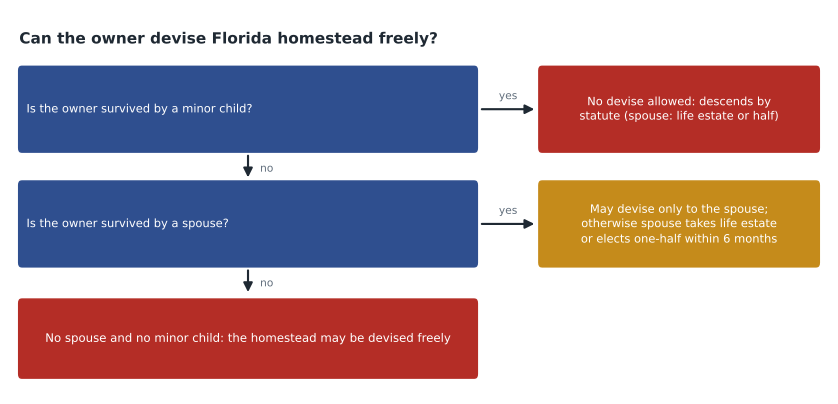
Section 732.401 sets the default. If a decedent is survived by a spouse and descendants and the homestead was not, or could not be, devised as the constitution allows, the surviving spouse takes a life estate in the homestead, with a vested remainder to the descendants in being at the decedent's death. Instead of the life estate, the surviving spouse may elect to take an undivided one-half interest in the homestead, with the other half passing to the descendants per stirpes. The election must be made within six months after the decedent's death, and during the spouse's lifetime, with limited provision for extension by a guardian or attorney in fact.
| Survivors | Can the owner devise the homestead? | If not devised (or devise invalid) |
|---|---|---|
| Spouse and minor child | No | Spouse: life estate or elect one-half; remainder or other half to descendants |
| Spouse, no minor child (adult children only) | Only to the spouse | Spouse: life estate or elect one-half; descendants take the rest |
| Minor child, no spouse | No | Passes to descendants by intestacy |
| No spouse, no minor child | Yes, freely | Passes under the will or intestacy |
Spouses can waive homestead rights. Under section 732.702, a spouse may waive rights in the other's estate, including homestead rights, by a written contract, agreement or waiver signed before two subscribing witnesses. A waiver signed before marriage needs no disclosure; one signed after marriage requires fair disclosure. Waivers are common in premarital agreements for second marriages.
Other rights of a surviving spouse
Beyond homestead, a surviving spouse has several statutory protections. The elective share entitles the spouse to 30 percent of the elective estate, a broad measure that includes not only probate assets but also certain nonprobate transfers such as revocable trusts and jointly held property, under sections 732.201 through 732.2155. The election must be made within the statutory deadline. A surviving spouse may also claim exempt property, such as household furniture and vehicles within limits, and a family allowance during administration. A spouse who married the decedent after the will was signed, and is not provided for or mentioned, may take a pretermitted spouse share, generally an intestate share, unless an exception applies, under section 732.301.
Wills
A Florida will must be in writing, signed at the end by the testator (or by someone else in the testator's presence and at the testator's direction), and signed by two attesting witnesses in the presence of the testator and of each other, under section 732.502. Florida does not recognize holographic wills, wills entirely in the testator's handwriting, unless they meet the same formalities, and it does not recognize oral wills. A will may be made self-proving under section 732.503 by an affidavit before an officer, which avoids the need for witness testimony at probate. Since January 1, 2020, Florida has permitted electronic wills and remote witnessing through an online notary, subject to safeguards, including limits on remote witnessing for vulnerable adults.
Several Florida rules change a will's effect. A divorce revokes provisions in favor of the former spouse, as if the former spouse died first, under section 732.507. Florida's anti-lapse statute saves a devise to a predeceasing grandparent or descendant of a grandparent of the testator by substituting the devisee's descendants, unless the will provides otherwise. A child born or adopted after the will is signed who is not provided for may take a pretermitted child's share.
Intestacy and probate
If a decedent dies without a valid will, Florida's intestacy statute, section 732.102, controls. A surviving spouse takes the entire intestate estate if there are no descendants, or if all of the decedent's descendants are also descendants of the surviving spouse and the spouse has no other descendants. Otherwise, the spouse takes one-half and the descendants take the rest. Homestead, as explained above, follows its own rules.
Florida offers formal administration, with a personal representative appointed by the court, and summary administration, a shorter procedure available when the value of the estate subject to administration is no more than 75,000 dollars or the decedent has been dead for more than two years. Florida generally restricts who may serve as personal representative: a nonresident may serve only if related to the decedent in specified ways. Trusts are governed by the Florida Trust Code, Chapter 736, based on the Uniform Trust Code, with Florida variations.
Worked problem
A homestead essay in miniature
Daniel owned his Orlando home in his own name and lived there with his second wife, Grace. He had two adult children from his first marriage and no minor children. His will, signed before he married Grace, left the home to his children. Grace signed no prenuptial agreement. Daniel died in September 2026. What does Grace take in the home?
Show solution
- The home is homestead: a residence owned by a natural person.
- Daniel was survived by a spouse and no minor child, so he could devise the homestead only to Grace. The devise to his children is invalid.
- Under section 732.401, Grace takes a life estate with a vested remainder to Daniel's descendants, or she may elect an undivided one-half interest within six months of death.
- Grace may also be a pretermitted spouse, because she married Daniel after the will, and may claim other rights such as exempt property; the homestead itself is governed by section 732.401.
Answer: Grace takes a life estate in the home, or may elect a one-half interest by March 2027; the children take the remainder or the other half.
Common mistakes
MistakeA married owner can mortgage the homestead alone if only he is on title.
InsteadThe constitution requires the other spouse's joinder.
MistakeAn owner survived by a spouse can always devise the homestead to the children.
InsteadWith a surviving spouse, the owner may devise it only to the spouse (if no minor child).
MistakeFlorida still awards permanent alimony.
InsteadSB 1416 eliminated permanent alimony for judgments entered on or after July 1, 2023.
MistakeA handwritten, unwitnessed will is valid in Florida.
InsteadFlorida does not recognize holographic wills that lack the formalities of section 732.502.
Homestead at the closing table
Yesenia's closings give her a practical view of homestead. When a married seller holds title alone, the title insurer requires the nonowner spouse to sign the deed. When an estate sells a home, the title insurer asks whether the decedent was survived by a spouse or minor child, whether the home was homestead, and whether a court has determined its status. If the answers are unclear, the closing waits for an order determining homestead from the probate court. Marchetti asks Yesenia to write a one-page memo explaining to a new paralegal why these requirements exist, citing Article X, section 4 and section 732.401. 'If you can explain it to a paralegal, you can explain it to a grader,' she says.
Mixing the subjects
Part A essays combine family law and estates often, because the same family appears in both. A question may start with a divorce in progress and ask what happens if a spouse dies before the final judgment, which brings in homestead, the elective share, and the effect of a pending dissolution on the will. It may involve a second marriage, a premarital agreement and a waiver under section 732.702. Yesenia's outline now has a page called family and estates together, listing the questions she should ask whenever a married couple appears in a fact pattern: is there homestead, is there a minor child, is there a waiver, when was the will signed, and is a dissolution pending.
Summary and key terms
- Dissolution is no-fault, with six months' residence; equitable distribution starts from an equal division.
- Since July 1, 2023, Florida has no permanent alimony; durational alimony is capped and time-limited.
- A 2023 amendment created a rebuttable presumption of equal time-sharing.
- Homestead is protected from forced sale, cannot be conveyed without the spouse's joinder, and cannot be devised if the owner is survived by a spouse or minor child (except to the spouse when there is no minor child).
- Section 732.401 gives the spouse a life estate or an elected one-half interest (within six months); the elective share is 30 percent; wills need two witnesses.
- Homestead
- Florida residence property protected by Article X, section 4 of the constitution.
- Joinder
- The other spouse's signature required to convey or mortgage homestead.
- Elective share
- A surviving spouse's right to 30 percent of the elective estate.
- Equitable distribution
- Florida's method of dividing marital property, starting from equality.
- Durational alimony
- Alimony for a set period, limited by the length of the marriage.
Lesson quiz · 5 questions
Score 60% or more to complete this lesson.
Create a free account to save your progress, take quizzes and earn a certificate.