
BAR-210 · Lesson 7 of 12 · 15 min
Florida courts and civil procedure after the 2025 amendments
▶ Video coming soon A video version of this lesson is on the way.
At work, Yesenia has just watched a partner at her firm scramble to serve initial disclosures in a condominium case. 'He said the rules changed in 2025 and half the bar still has not caught up,' she tells Marchetti at their seventh session. 'Then he said, "Don't tell anyone I said that."' Marchetti laughs. 'He is right, and it is exactly why the Board will test it.' This lesson covers the structure of the Florida courts, the basic shape of a civil case under the Florida Rules of Civil Procedure, the major amendments that took effect on January 1, 2025, summary judgment, proposals for settlement and appeals.
The Florida courts
Florida's state courts have four levels. At the top is the Supreme Court of Florida, with seven justices. It hears cases within its constitutional jurisdiction, including death penalty appeals, certain questions certified by the district courts, and conflicts among the district courts, and it regulates the admission and discipline of lawyers. Below it are the District Courts of Appeal, the intermediate appellate courts. Florida had five districts for decades; the Legislature created a Sixth District Court of Appeal, which began operating on January 1, 2023. Most appeals end in a district court of appeal.
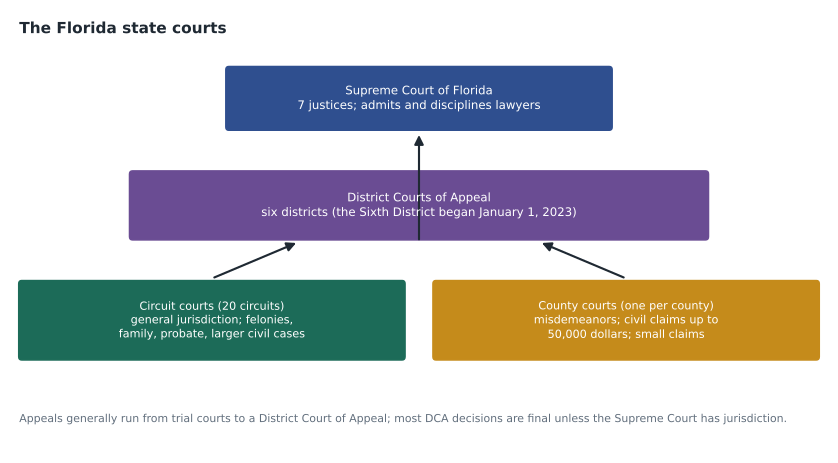
The trial courts are the circuit courts and the county courts. Florida is divided into 20 judicial circuits, and the circuit courts are the courts of general jurisdiction: they hear felonies, family law, probate, juvenile matters and civil cases above the county court limit. Each county has a county court, which hears misdemeanors, traffic matters, small claims and civil cases within its monetary limit. Since January 1, 2023, county courts have jurisdiction over civil actions in which the amount in controversy does not exceed 50,000 dollars. Small claims procedure applies to the smallest cases under separate rules.
The rules that govern a civil case
Civil cases in Florida's trial courts are governed by the Florida Rules of Civil Procedure, together with the Florida Rules of General Practice and Judicial Administration, which cover matters common to all courts such as computing time, electronic filing and service, confidentiality of court records and the conduct of attorneys in court. Appeals are governed by the Florida Rules of Appellate Procedure. All of these are adopted by the Supreme Court of Florida, which amends them regularly on the recommendation of Florida Bar committees.
Florida's procedure resembles federal procedure in many ways, and Florida has moved closer to the federal model in recent years. But Florida pleading has long been described as fact pleading: a complaint must state the ultimate facts showing entitlement to relief, not merely conclusions. A defendant generally must serve an answer or a motion within 20 days after service of process. A plaintiff must serve the initial process on each defendant within 120 days after filing the complaint, or face dismissal or an order to serve, unless the court extends the time for good cause or excusable neglect.
The January 1, 2025 amendments
On December 5, 2024, the Supreme Court of Florida issued orders adopting the most significant changes to Florida civil procedure in decades. The amendments took effect on January 1, 2025, and apply to pending cases, with one exception: the initial disclosure requirement does not apply to actions commenced before that date. The changes were designed to make Florida cases move faster and to bring Florida discovery closer to the federal model.
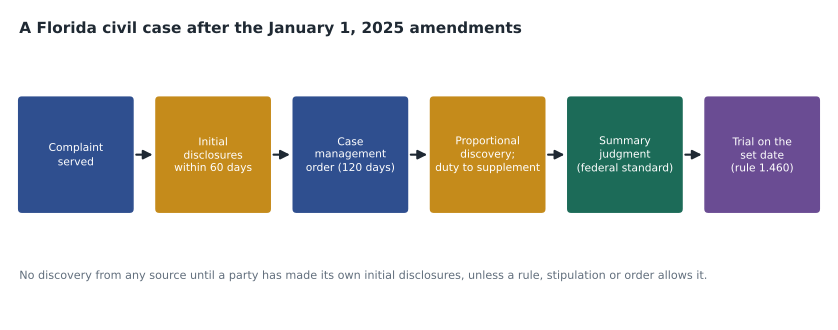
The first major change is case management. Under amended rule 1.200, the court must issue a case management order within 120 days after the action begins, setting deadlines that now include deadlines for summary judgment motions, objections to pleadings and pretrial motions. The deadlines are to be strictly enforced unless the court changes them. Requests to extend those deadlines are governed by rules 1.200 and 1.201 rather than the general extension rule, and trial continuances are governed by rule 1.460, which makes them harder to obtain.
The second change is initial disclosures. Amended rule 1.280(a) requires each party to provide certain information without waiting for a discovery request: the names of individuals likely to have discoverable information, copies or descriptions of documents it may use, a computation of damages, and insurance agreements, among other items. The disclosures are due within 60 days after service of the complaint or joinder. A party may not seek discovery from any source until it has made its own initial disclosures, unless a rule, a stipulation or a court order allows it.
The third change is proportionality. Rule 1.280 now uses the federal proportionality standard from Federal Rule of Civil Procedure 26(b)(1), and the Court's commentary directs Florida courts to apply it consistently with federal case law. Objections to interrogatories and document requests must be stated with specificity, grounds not timely stated are waived absent good cause, and a party objecting to a document request must say whether it is withholding anything. Parties now also have a duty to supplement their discovery responses and disclosures, and a party that fails to disclose information or a witness generally cannot use it at trial unless the failure was substantially justified or harmless.
The fourth change is conferral. Amended rule 1.202 requires the movant to confer with the opposing party before filing many motions and to include a certificate of conferral, while expanding the list of motions exempt from conferral, including summary judgment motions and motions for judgment on the pleadings, and excusing conferral with an unrepresented party.
| Rule | What changed on January 1, 2025 | Practical effect |
|---|---|---|
| 1.200 | Case management order within 120 days; strict deadlines | Cases follow a schedule from the start |
| 1.280(a) | Initial disclosures within 60 days | No discovery until a party discloses |
| 1.280 | Federal proportionality standard; duty to supplement | Narrower, better-focused discovery |
| 1.202 | Conferral and certificate of conferral | Fewer unnecessary motions |
| 1.460 | Stricter standard for trial continuances | Trial dates are harder to move |
Summary judgment
Florida summary judgment changed earlier, and dramatically. In 2021, the Supreme Court of Florida amended rule 1.510 to adopt the federal summary judgment standard, effective May 1, 2021. Before then, Florida courts applied a stricter test under which summary judgment was improper if the record reflected even the slightest doubt that an issue might exist. Under the federal standard, as articulated in Celotex Corp. v. Catrett, Anderson v. Liberty Lobby and Matsushita Electric v. Zenith Radio, the question is whether there is a genuine dispute as to any material fact and whether the movant is entitled to judgment as a matter of law, viewed in the light of the substantive evidentiary burden at trial.
The rule also sets timing. Under rule 1.510 as amended, the response to a summary judgment motion is due no later than 40 days after service of the motion, and the hearing must be set at least 10 days after the response deadline unless the parties stipulate or the court orders otherwise. Since 2025, summary judgment motions must also be filed consistently with the deadlines in the case management order. Candidates should know both the standard and the timing, because Part A questions test both.
Proposals for settlement
Florida has a distinctive fee-shifting mechanism that every litigator uses: the proposal for settlement under section 768.79 of the Florida Statutes and rule 1.442. If a defendant serves an offer of judgment that the plaintiff rejects, and the judgment obtained by the plaintiff is at least 25 percent less than the offer, the defendant is entitled to recover reasonable costs and attorney fees incurred after the offer. If a plaintiff serves a demand that the defendant rejects, and the plaintiff recovers a judgment at least 25 percent greater than the demand, the plaintiff is entitled to fees and costs from the date of the demand. Rule 1.442 imposes strict requirements on the form and timing of proposals, and Florida courts construe those requirements strictly; a proposal that is ambiguous or fails to apportion an offer among multiple parties may be unenforceable.
Proposals for settlement appear constantly in Florida practice and on Part A. The 2023 civil remedies law, covered in lesson 8, extended the offer of judgment statute to civil actions involving insurance contracts, making proposals even more important in insurance litigation, which is the core of Yesenia's job.
Appeals
An appeal from a final order of a Florida trial court is begun by filing a notice of appeal within 30 days of rendition of the order, under the Florida Rules of Appellate Procedure. The 30-day deadline is jurisdictional: a late notice cannot be cured. Florida also allows appeals from certain nonfinal orders listed in the appellate rules, such as orders on injunctions and orders determining jurisdiction of the person, and review of other orders by petition for certiorari in limited circumstances. Most cases end in the district court of appeal. The Supreme Court of Florida's discretionary jurisdiction is narrow and depends on the grounds listed in Article V of the Florida Constitution, such as express and direct conflict among the district courts.
Worked problem
Applying the 2025 rules
A plaintiff filed a negligence action in Hillsborough County circuit court on February 3, 2025, and served the defendant on February 10. On March 20, before serving any disclosures, the plaintiff served interrogatories. The defendant objects. Who is right?
Show solution
- The action was commenced after January 1, 2025, so the initial disclosure requirement of rule 1.280(a) applies.
- Initial disclosures are due within 60 days after service of the complaint, so by about April 11, 2025.
- A party may not seek discovery from any source until it has made its own initial disclosures, unless a rule, stipulation or order allows it.
- The plaintiff served interrogatories before making its own disclosures.
Answer: The defendant's objection is well founded. The plaintiff must serve its initial disclosures first.
Common mistakes
MistakeFlorida summary judgment still requires the absence of the slightest doubt.
InsteadSince May 1, 2021, rule 1.510 follows the federal standard.
MistakeInitial disclosures apply to every pending case.
InsteadThey do not apply to actions commenced before January 1, 2025.
MistakeA proposal for settlement shifts fees whenever the offeror does better than offered.
InsteadThe judgment must differ from the offer by at least 25 percent, and the proposal must meet rule 1.442.
MistakeCounty courts hear civil cases up to 15,000 dollars.
InsteadSince January 1, 2023, the county court limit is 50,000 dollars.
Following a case through the system
To make the rules concrete, Marchetti asks Yesenia to trace a case from her firm through the Florida courts, using the firm's file with the client's name removed. The case is a condominium dispute over water damage between a unit owner and the association. The amount in controversy exceeds the county court limit, so it was filed in circuit court in Hillsborough County, within the Thirteenth Judicial Circuit. Because it was filed after January 1, 2025, the court issued a case management order setting deadlines, and the parties exchanged initial disclosures under the amended rules. Yesenia's assignment is to find each deadline in the file and match it to the rule that created it.
She finds the answer deadline, the disclosure deadline, the dates in the case management order, and a motion for an extension that the firm filed with the conferral certificate the rules now require. 'That last one surprised me,' she says. 'The partner said the rule on conferral changed how the firm handles every motion.' Marchetti nods. 'That is exactly the kind of detail Session II tests.'
Practice deadlines
Marchetti asks Yesenia to make flashcards for Florida civil procedure deadlines and requirements: the time to answer a complaint, the time for service of process, the time to serve a response to a summary judgment motion and the minimum time before the hearing, the deadline for initial disclosures, the time within which the court must issue a case management order, the time to file a notice of appeal, and the requirements for a proposal for settlement. Each card names the rule on the back. Yesenia reviews them for ten minutes each morning before work.
Where Florida procedure departs from federal procedure
Because the MBE tests the Federal Rules of Civil Procedure, Yesenia must keep the two systems separate. Florida uses fact pleading, requiring a complaint to state the ultimate facts showing entitlement to relief, rather than the federal plausibility standard developed in federal case law. Florida's summary judgment rule now follows the federal standard, but its timing rules are its own. Florida's proposal for settlement mechanism has no exact federal equivalent, and its consequences for fees can be significant. Florida's initial disclosure obligations, introduced in 2025, are similar in spirit to federal Rule 26 but are set out in Florida's own rule with its own timing.
Marchetti suggests a simple discipline: every time Yesenia learns a Florida procedure rule, she writes the federal rule next to it, even if they are the same. On exam day, she will know which rule she is applying.
Summary and key terms
- Florida has a Supreme Court, six District Courts of Appeal, 20 circuit courts and a county court in each county.
- County courts hear civil cases up to 50,000 dollars.
- The 2025 amendments added case management orders within 120 days, initial disclosures within 60 days, federal proportionality, conferral and stricter continuances.
- Rule 1.510 has followed the federal summary judgment standard since May 1, 2021, with a 40-day response period.
- Proposals for settlement shift fees when the judgment differs from the offer by at least 25 percent; notices of appeal are due within 30 days.
- Rule 1.200
- The Florida rule on case management orders.
- Initial disclosures
- Information each party must provide without a request, within 60 days.
- Proportionality
- Limiting discovery to what is proportional to the needs of the case.
- Proposal for settlement
- A fee-shifting offer under section 768.79 and rule 1.442.
- Rendition
- The filing of a signed, written order with the clerk, which starts the appeal clock.
Lesson quiz · 5 questions
Score 60% or more to complete this lesson.
Create a free account to save your progress, take quizzes and earn a certificate.