
BAR-210 · Lesson 10 of 12 · 15 min
Florida evidence, criminal procedure and the Rules Regulating The Florida Bar
▶ Video coming soon A video version of this lesson is on the way.
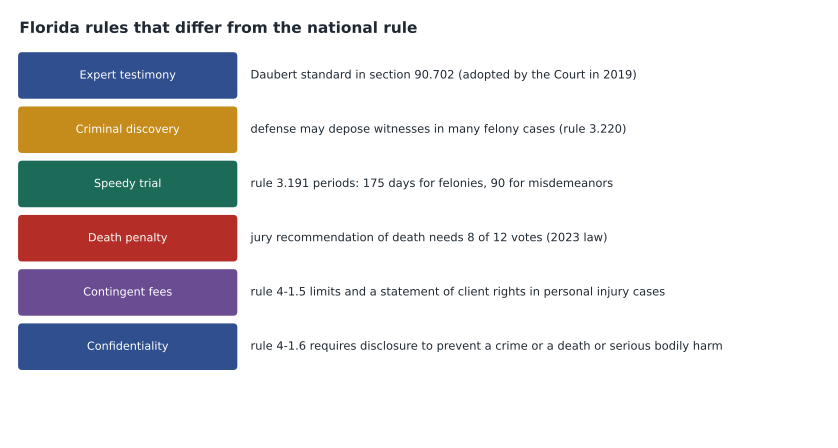
Yesenia scored best on evidence in her diagnostic and worst on Florida criminal procedure. 'I learned the Federal Rules of Evidence for the MBE and assumed Florida was the same,' she admits at their tenth session. 'Then I hit a question about prior inconsistent statements from a deposition and got it wrong.' Marchetti pulls up her differences chart. 'Florida's Evidence Code looks federal from a distance and is Florida up close. The same goes for criminal procedure, and especially for the rules on lawyer conduct.' This lesson covers the Florida Evidence Code, key features of Florida criminal procedure, and the parts of the Rules Regulating The Florida Bar that Part A tests most often.
The Florida Evidence Code
Florida's rules of evidence are codified in Chapter 90 of the Florida Statutes, the Florida Evidence Code, adopted by the Legislature and approved by the Supreme Court of Florida as procedural rules where they touch procedure. The Code follows the structure of the Federal Rules of Evidence closely, and many sections are nearly identical. Section 90.401 defines relevance, section 90.403 permits exclusion when probative value is substantially outweighed by the danger of unfair prejudice, confusion or misleading the jury, and the hearsay rules in sections 90.801 through 90.806 track the federal rules in broad outline. The differences are where Part A questions live.
Expert testimony: Daubert in Florida
For decades Florida applied the Frye test, which admitted expert opinion based on scientific principles only if they were generally accepted in the relevant scientific community. In 2013, the Legislature amended section 90.702 to adopt the Daubert standard used in federal court. The Supreme Court of Florida initially declined to adopt the amendment as a procedural rule, but in 2019, in In re Amendments to the Florida Evidence Code, it reversed course and adopted the Daubert amendment. Florida courts now ask whether expert testimony is based on sufficient facts or data, is the product of reliable principles and methods, and reflects a reliable application of those principles and methods to the facts, as section 90.702 provides.
Prior statements and impeachment
Florida's treatment of prior inconsistent statements is a classic trap. Under section 90.801(2)(a), a witness's prior inconsistent statement is not hearsay, and may be used as substantive evidence, if the witness testifies, is subject to cross-examination, and the statement was given under oath subject to the penalty of perjury at a trial, hearing or other proceeding, or in a deposition. The explicit inclusion of depositions matters in Florida, where depositions are common in both civil and criminal cases. A prior inconsistent statement that does not meet those conditions may still be used to impeach the witness, but not as proof of what it asserts.
Florida also has its own rule on impeachment by conviction. Under section 90.610, a party may attack a witness's credibility with evidence that the witness was convicted of a crime punishable by death or imprisonment in excess of one year, or of a crime involving dishonesty or a false statement, regardless of punishment. Florida practice traditionally limits the inquiry: the examiner asks whether the witness has been convicted of a felony or a crime of dishonesty and how many times, and goes into the nature of the convictions only if the witness denies them or answers inaccurately.
| Issue | Federal Rules of Evidence | Florida Evidence Code |
|---|---|---|
| Expert testimony | Rule 702 (Daubert) | Section 90.702 (Daubert, adopted by the Court in 2019) |
| Prior inconsistent statement as substantive evidence | Under oath at a trial, hearing, proceeding or deposition | Under oath at a trial, hearing, proceeding or deposition (section 90.801(2)(a)) |
| Impeachment by conviction | Rule 609 balancing tests | Section 90.610; inquiry usually limited to whether and how many |
| Child victim hearsay | No specific rule | Section 90.803(23) exception with reliability findings |
| Sexual offense cases | Rules 413 and 414 | Section 90.404(2)(b) and (c) similar-act evidence |
Florida also has specific hearsay exceptions without exact federal equivalents. Section 90.803(23) admits certain out-of-court statements by a child victim describing abuse or a sexual offense, if the court finds after a hearing that the time, content and circumstances of the statement provide sufficient safeguards of reliability, and the child testifies or is unavailable with corroboration. Section 90.404(2) admits evidence of other acts of child molestation or sexual offenses in prosecutions for those crimes, under conditions. Florida's privileges include a lawyer-client privilege, a psychotherapist-patient privilege, a privilege for accountants and a qualified privilege for journalists, each defined in the Code.
Criminal procedure
Florida criminal procedure is governed by the Florida Rules of Criminal Procedure and by constitutional law, both federal and state. Part A tests both, and Florida's rules contain features that lawyers from other states rarely see.
The first is speedy trial. Under rule 3.191, a person charged with a crime must be brought to trial within 175 days of arrest for a felony and 90 days for a misdemeanor, if no demand is filed, unless an exception applies. A defendant may also file a demand for speedy trial, which triggers shorter deadlines. When the period runs, the defendant may file a notice of expiration, and the court must hold a hearing and order trial within a short recapture window; only if the state fails to bring the defendant to trial within that window is the defendant discharged. The details of the periods and the recapture procedure are tested often.
The second is discovery. Florida criminal discovery under rule 3.220 is broad and reciprocal. A defendant who elects to participate in discovery receives the state's witness list, statements, reports and physical evidence, and in return must provide reciprocal discovery. Unusually, Florida permits depositions of witnesses in criminal cases, with limits that vary with the category of witness and the charge. A Florida criminal defense lawyer routinely deposes the arresting officer, something almost unheard of in federal court.
The third concerns capital cases. In 2023, the Legislature amended Florida's capital sentencing statute so that a jury may recommend a sentence of death if at least eight of twelve jurors agree, replacing the unanimity requirement Florida had adopted after Hurst v. State. Florida remains one of the few states that does not require a unanimous jury recommendation for death. Part A candidates should know the current statute and the history behind it.
Florida's self-defense statutes, often called stand your ground laws, also appear on Part A. Under sections 776.012 and 776.032, a person who is not engaged in criminal activity and is in a place where he or she has a right to be has no duty to retreat before using force, including deadly force, in the circumstances the statutes describe, and is immune from criminal prosecution and civil action for the justified use of force. Since 2017, once a defendant raises a prima facie claim of self-defense immunity at a pretrial hearing, the state must overcome it by clear and convincing evidence.
The Rules Regulating The Florida Bar
Part A tests Chapters 4 and 5 of the Rules Regulating The Florida Bar. Chapter 4 contains the Rules of Professional Conduct, based on the ABA Model Rules but with significant Florida differences. Chapter 5 contains the rules on trust accounts. Because the MPRE tests the Model Rules, Florida candidates must learn where Florida departs from them.
Confidentiality is a leading example. Model Rule 1.6(b) permits a lawyer to reveal confidential information in listed situations, such as to prevent reasonably certain death or substantial bodily harm. Florida's rule 4-1.6 is stricter in one direction: it requires a lawyer to reveal confidential information to the extent the lawyer reasonably believes necessary to prevent a client from committing a crime, or to prevent a death or substantial bodily harm to another. It then permits disclosure in other listed situations, such as to establish a claim or defense in a controversy between the lawyer and client. A Part A question asking whether a Florida lawyer may or must disclose a client's plan to commit a crime turns on this difference.
Fees are another. Rule 4-1.5 governs fees and, in subdivision (f), contingent fees. A contingent fee agreement must be in writing and signed by the client and the lawyer. In personal injury and similar cases, Florida requires the client to receive and sign a Statement of Client's Rights before the agreement is signed, and the rule sets presumptive maximum percentages that vary with the stage of the case and the amount recovered. A fee that exceeds the schedule is presumed clearly excessive unless approved by the court in the manner the rule describes.
Florida's advertising rules in Subchapter 4-7 are among the most detailed in the country. They regulate the content of lawyer advertising, prohibit misleading statements and certain testimonials and claims, and require many advertisements to be filed with The Florida Bar for review. Florida also prohibits sharing fees with, or forming partnerships with, nonlawyers, consistent with the traditional Model Rule 5.4.
Chapter 5 governs trust accounts. A lawyer must keep client and third-party funds in a trust account separate from the lawyer's own funds, maintain the records Chapter 5 requires, perform monthly reconciliations and keep an annual listing, and participate in Florida's Interest on Trust Accounts program for nominal or short-term funds. Trust account violations are among the most common grounds for serious discipline in Florida, and Part A questions on trust accounting are common.
Worked problem
Disclose or not?
A Florida client tells her lawyer, in confidence, that she plans to file a false insurance claim next week to recover money for a car she reported stolen but actually sold. What must the lawyer do under the Florida rules?
Show solution
- Filing a false insurance claim is a crime.
- Under rule 4-1.6, a Florida lawyer must reveal confidential information to the extent the lawyer reasonably believes necessary to prevent a client from committing a crime.
- The lawyer should first try to dissuade the client and must not assist the fraud (rule 4-1.2 and related rules).
- If the client persists, the lawyer must disclose what is reasonably necessary to prevent the crime, and may need to withdraw.
Answer: Unlike the Model Rule, which would only permit disclosure in some such situations, the Florida rule requires disclosure to prevent a client's crime.
Common mistakes
MistakeFlorida still uses the Frye test for experts.
InsteadFlorida adopted the Daubert standard in section 90.702, effective by the Court's 2019 decision.
MistakeDefendants cannot take depositions in Florida criminal cases.
InsteadRule 3.220 allows depositions of many witnesses.
MistakeFlorida requires a unanimous jury recommendation for death.
InsteadSince 2023, eight of twelve jurors may recommend death.
MistakeFlorida's confidentiality rule is the same as Model Rule 1.6.
InsteadRule 4-1.6 requires disclosure to prevent a client's crime or death or substantial bodily harm.
Keeping evidence rules straight
Yesenia's mistake on prior inconsistent statements came from mixing the two systems. Marchetti asks her to add every evidence difference to her chart, with the section of the Florida Evidence Code next to the federal rule. She also asks her to practice evidence questions in a set order: first, is the evidence relevant; second, is it excluded by a specific rule such as character evidence or privilege; third, if it is an out-of-court statement offered for its truth, is it hearsay, and if so, is there an exception; and fourth, should it be excluded under section 90.403. Following the same order every time reduces careless errors.
Criminal procedure deadlines
Florida criminal procedure, like civil procedure, rewards memorizing deadlines. Yesenia makes flashcards for the speedy trial periods, the effect of a demand for speedy trial, the notice of expiration and the recapture period, and the basic structure of discovery under rule 3.220. She reviews constitutional criminal procedure separately, because it is tested both on the MBE and on Part A, and the federal constitutional rules apply in Florida as everywhere else. Where the Florida Constitution provides different protections, she notes them, including the state's conformity clause on searches and seizures, which ties Florida's protection to the Fourth Amendment as interpreted by the United States Supreme Court.
Ethics: two sets of rules
Yesenia passed the MPRE on the Model Rules, and now she must learn the Florida rules for Part A. Marchetti suggests the same chart technique. Confidentiality goes first, because Florida's mandatory disclosure rule differs sharply from the Model Rule. Contingent fees come next, because Florida's schedule and the Statement of Client's Rights have no Model Rule equivalent. Advertising follows, because Florida's rules are detailed and frequently amended. Trust accounting under Chapter 5 completes the list. 'If you know these four areas cold,' Marchetti says, 'you will recognize most of the Florida ethics questions on Part A.'
Yesenia also reads a few recent discipline summaries published in The Florida Bar News, to see how the rules apply in practice. Most involve trust account problems, neglect of client matters, or dishonesty. The pattern reinforces the lesson: the rules that lead to discipline are the ones Part A tests most.
Summary and key terms
- The Florida Evidence Code (Chapter 90) tracks the federal rules with important differences, including section 90.610 on convictions and section 90.803(23) on child hearsay.
- Florida adopted the Daubert standard for experts in 2019.
- Rule 3.191 sets speedy trial periods of 175 days for felonies and 90 for misdemeanors; rule 3.220 allows criminal depositions.
- Since 2023, a jury may recommend death with eight of twelve votes.
- Rule 4-1.6 requires disclosure to prevent a client's crime; rule 4-1.5 regulates contingent fees; Chapter 5 governs trust accounts.
- Florida Evidence Code
- Chapter 90 of the Florida Statutes.
- Speedy trial rule
- Rule 3.191, setting time limits for bringing a defendant to trial.
- Recapture window
- The short period after a notice of expiration in which the state may still try the defendant.
- Statement of Client's Rights
- A document Florida requires clients to sign before certain contingent fee agreements.
- IOTA
- Interest on Trust Accounts, Florida's program for nominal or short-term client funds.
Lesson quiz · 5 questions
Score 60% or more to complete this lesson.
Create a free account to save your progress, take quizzes and earn a certificate.