
BAR-210 · Lesson 12 of 12 · 13 min
Capstone: Florida practice questions and an exam-day plan
▶ Video coming soon A video version of this lesson is on the way.
Yesenia's twelfth session with Marchetti is the last before she switches to full-time study. Her application is filed, her character and fitness file is open, and she knows the exam dates: Tuesday and Wednesday, February 23 and 24, 2027, in Tampa. 'Today we do two things,' Marchetti says. 'We work through practice questions that pull the whole course together, and we write the plan for exam week, down to the hour.' This lesson contains original practice questions written for this course in the style of Part A, a full essay problem with a model answer, and a study and exam-week plan you can adapt. None of the questions is a released Board question.
Ten practice questions
Work each question before reading the answer. Time yourself at about 108 seconds per question, the Session II pace.
Question 1. A plaintiff is injured in a slip and fall at a grocery store in Orlando in May 2024. She sues in July 2026. The store moves to dismiss on limitations grounds. What is the likely result? Answer: The motion should be granted if no tolling applies. For negligence causes of action accruing after March 24, 2023, the limitation period is two years, so the claim expired in May 2026. A candidate who applies the old four-year period gets this wrong.
Question 2. In the same case, assume the suit was timely and the jury finds the plaintiff 55 percent at fault and the store 45 percent at fault. What may she recover? Answer: Nothing. Under Florida's modified comparative fault rule, a plaintiff more than 50 percent at fault may not recover in a negligence action, except a medical negligence action.
Question 3. A Florida lawyer's client says he plans to lie under oath at a deposition next week about the date he signed a contract. What must the lawyer do? Answer: Remonstrate with the client and refuse to assist. Perjury is a crime, and Florida's rule 4-1.6 requires a lawyer to reveal confidential information to the extent reasonably necessary to prevent a client from committing a crime. The candor duties in rule 4-3.3 may also apply if false testimony is offered.
Question 4. A married man owns his Miami residence in his own name. He wants to mortgage it to fund his business. His wife refuses to sign. Can he give a valid mortgage? Answer: No. Under Article X, section 4 of the Florida Constitution, a married owner may not alienate or encumber homestead without the joinder of the spouse.
Question 5. A defendant charged with a felony is arrested on January 5 and files no demand for speedy trial. On which day does the speedy trial period under rule 3.191 expire, counting from arrest? Answer: The rule allows 175 days for a felony, so the period expires 175 days after arrest, subject to exceptions and to the recapture procedure after a notice of expiration. Discharge is not automatic.
Question 6. A party moves for summary judgment in a Florida circuit court case filed in 2025. When is the response due? Answer: Under rule 1.510 as amended effective January 1, 2025, the nonmovant must serve a response, with supporting evidence, no later than 40 days after service of the motion, and the hearing must be set at least 10 days after the response deadline.
Question 7. An expert in a Florida civil case relies on a novel methodology that has not been tested. Which standard does the court apply? Answer: The Daubert standard under section 90.702, which the Supreme Court of Florida adopted in 2019. The court considers whether the testimony rests on sufficient facts or data and reliable principles and methods reliably applied.
Question 8. A husband and wife divorce in 2026 after a 22-year marriage. The wife asks for permanent alimony. What is the likely result? Answer: Permanent alimony is no longer available for judgments entered on or after July 1, 2023. The court may consider bridge-the-gap, rehabilitative or durational alimony, subject to the statutory limits.
Question 9. A lawyer licensed in North Carolina for 15 years moves to Jacksonville and asks to be admitted without exam. What is the answer? Answer: Florida has no admission on motion. She must apply to the Board, pass character and fitness and pass the exam, though she may be able to transfer an MBE score if the rules allow.
Question 10. A testator signs a will in front of one witness and a notary. Is the will valid in Florida? Answer: No. Section 732.502 requires two attesting witnesses who sign in the presence of the testator and of each other. A notary may serve as one of the two witnesses, but one witness plus a notary acting only as notary is not enough.
| Question | Topic | Lesson |
|---|---|---|
| 1 and 2 | Torts after the 2023 civil remedies law | Lesson 8 |
| 3 | Confidentiality under rule 4-1.6 | Lesson 10 |
| 4 | Homestead joinder | Lesson 9 |
| 5 | Speedy trial | Lesson 10 |
| 6 | Summary judgment after the 2025 amendments | Lesson 7 |
| 7 | Expert testimony | Lesson 10 |
| 8 | Alimony reform | Lesson 9 |
| 9 | Admission of lawyers from other states | Lesson 11 |
| 10 | Will execution | Lesson 9 |
A Part A essay problem
Use the 60-minute timing plan from Lesson 6. Read the call first, then the facts twice.
The facts. Rafael and Celia married in 2008 and live in Sarasota with their daughter, Inés, who is 15. Rafael bought their home in 2005 in his own name. In 2016, Rafael signed a will leaving the home to his brother, Tomás, and the rest of his estate to Celia. In March 2025, Rafael was driving to work when a truck owned by a delivery company ran a red light and struck his car. Rafael suffered serious injuries and died in October 2025. The police report says Rafael was speeding. Celia has hired a lawyer, Wen, who also represented the delivery company in an unrelated contract dispute that ended in 2024. Celia asks three questions: who owns the house now, can she sue the delivery company and what might reduce her recovery, and can Wen represent her.
The call. Advise Celia on each question.
A model answer
Who owns the house. The home is Florida homestead under Article X, section 4 of the Florida Constitution: it is a residence owned by a natural person and used by him and his family. Because Rafael was survived by a spouse and a minor child, Inés, he could not devise the homestead to anyone, so the devise to Tomás is invalid. The home passes under section 732.401. Celia takes a life estate, with a vested remainder to Rafael's descendants in being at his death, here Inés. Instead, Celia may elect to take an undivided one-half interest, with the other half passing to Inés, by making the election within six months after Rafael's death, which here means by April 2026. Whether she made a timely election should be confirmed. The rest of the estate passes to Celia under the will. Tomás takes nothing in the home.
Can she sue, and what reduces recovery. A personal representative of Rafael's estate may bring a wrongful death action under Florida's Wrongful Death Act for the benefit of survivors, including Celia and Inés. The accident occurred after March 24, 2023, so the 2023 civil remedies law applies. The limitation period for wrongful death is two years from the date of death, so the action should be filed before October 2027. Comparative fault will be central: if the jury finds Rafael more than 50 percent at fault because he was speeding, the survivors may recover nothing; if his share is 50 percent or less, damages are reduced by his percentage. The company's driver ran a red light, which supports a finding of substantial fault. Evidence of medical expenses is subject to the limits of section 768.0427. The company may be vicariously liable for its driver, and Florida's dangerous instrumentality doctrine may make the vehicle's owner liable. Because joint and several liability has been abolished, each defendant pays only its share of fault.
Can Wen represent her. Wen previously represented the delivery company, a former client. Under rule 4-1.9 of the Rules Regulating The Florida Bar, a lawyer who has formerly represented a client may not represent another person in the same or a substantially related matter in which that person's interests are materially adverse to the former client, unless the former client gives informed consent, and may not use the former client's confidential information to its disadvantage. The earlier contract dispute appears unrelated to a traffic accident, so the representation is likely permitted, but Wen should confirm that the matters are not substantially related and that she holds no confidential information relevant to the case. If the fee is contingent, Wen must use a written agreement and give Celia the Statement of Client's Rights under rule 4-1.5.
A strong answer would also note that Celia may have other rights in the estate, such as exempt property and a family allowance, and that the will is not revoked by the invalid devise; only the homestead devise fails.
Self-grading checklist
Marchetti grades Yesenia's practice essay against a checklist and asks her to do the same with every essay from now on. For this problem, the checklist has ten items: homestead identified; devise restriction applied because of the spouse and minor child; section 732.401 life estate and remainder; six-month election; wrongful death action by the personal representative; two-year limitation from death; modified comparative fault with the 50 percent bar; abolition of joint and several liability; rule 4-1.9 former client analysis; and rule 4-1.5 contingent fee requirements. Yesenia hits eight of ten on her first attempt, missing the limitation period and the contingent fee point.
The study plan
Yesenia plans to study full time from late December, after her last week at the firm, until the exam. Before then she studies in the evenings and on weekends. Her plan has three phases.
| Phase | Dates | Focus |
|---|---|---|
| Foundation | Now to mid-December 2026 | Bar course lectures, Florida outlines, differences chart, 10 MBE and 10 Florida questions daily |
| Intensive | Late December 2026 to early February 2027 | Full-time study; 2 timed essays and 100 MBE questions per week day; full practice sessions on Saturdays |
| Final | Early February to February 22, 2027 | Review weak subjects, timed full sessions, rest, logistics |
In the intensive phase she will take two simulated exams: one full Part A day and one full MBE day, each with the real schedule. She will grade herself, update her differences chart and spend the next two days on the subjects where she lost the most points.
Exam week
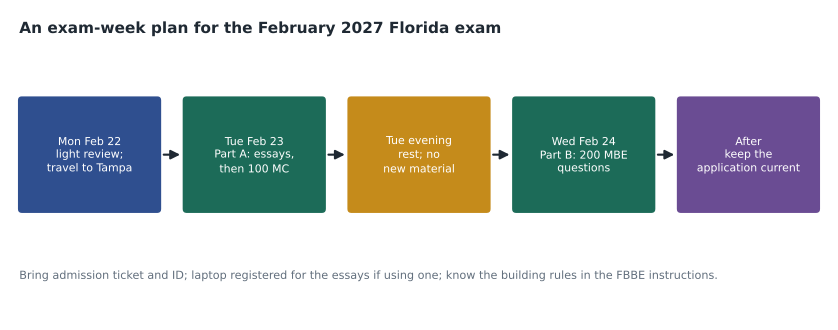
Marchetti's exam-week rules are simple. Do not learn new material in the last two days. Confirm logistics in writing: the admission ticket, the laptop software and its test run, the hotel booking, the parking or transport plan, and what is allowed in the exam room under the Board's rules. Eat what you normally eat. Sleep at your normal time. On Tuesday evening, do not discuss the essays with other candidates, and do not reread Florida outlines; review only your short MBE list and go to bed. On Wednesday, take each MBE session one question at a time.
For Yesenia, logistics include a hotel near the exam site, because the drive from her apartment could take an hour in morning traffic. She books it now, in November, and asks her cousin Teo to call her on Monday evening only to wish her luck.
When results arrive
Florida results usually arrive six to eight weeks after the exam. A candidate who passes completes any remaining character and fitness steps, receives the Board's recommendation and takes the oath. A candidate who passes only one part under the individual method may be able to carry that part forward under the Board's rules, or may retake the whole exam; the rules on retained scores are technical and should be checked on the Board's website. A candidate who does not pass should review the score information the Board provides, rebuild a plan around the weakest subjects and register for the next exam. Florida does not limit the number of attempts, according to NCBE's profile.
Looking back over the course
This course has followed Yesenia from her 1L registration to the eve of the exam. It began with the bodies that govern admission: the Supreme Court of Florida, the Florida Board of Bar Examiners and The Florida Bar. It covered registration and deadlines, character and fitness and the MPRE, the structure and scoring of the exam, the move to NextGen with a Florida component in July 2028, and the Florida law Part A tests: civil procedure after the 2025 amendments, torts after the 2023 civil remedies law, family law, homestead, wills and estates, evidence, criminal procedure and the Rules Regulating The Florida Bar. It ended with the routes for lawyers from other states and the requirements that follow admission. Every lesson shares one theme: Florida is different in specific, testable ways, and candidates who learn the differences precisely pass.
Common mistakes
MistakeLearning new material the night before the exam helps.
InsteadUse the last two days for light review, rest and logistics.
MistakeOne practice essay is enough.
InsteadWrite timed essays every week, rising to three per week in the final month, and grade them against a checklist.
MistakeAn essay answer on homestead can ignore minor children.
InsteadA minor child changes whether the owner can devise the homestead.
MistakeA candidate who fails one part must always retake both.
InsteadThe individual method and the rules on retained scores may help; read the Board's rules.
Summary and key terms
- Practice questions should mix subjects and test exact Florida rules, at Session II pace.
- Use the 60-minute essay plan and grade every essay against an issue checklist.
- Plan three study phases: foundation, intensive and final.
- Exam week: no new material, logistics confirmed, normal sleep, one session at a time.
- Results arrive in six to eight weeks; Florida has no limit on attempts.
- Issue checklist
- A list of the points a model answer should cover, used for self-grading.
- Simulated exam
- A full practice session under real exam timing.
- Wrongful Death Act
- Florida's statute allowing recovery for survivors of a person killed by wrongful act.
- Former client conflict
- A conflict under rule 4-1.9 arising from a prior representation.
- Retained score
- A passing part score carried forward under the Board's rules.
Lesson quiz · 5 questions
Score 60% or more to complete this lesson.
Create a free account to save your progress, take quizzes and earn a certificate.