
BAR-210 · Lesson 3 of 12 · 15 min
Character and fitness and the MPRE
▶ Video coming soon A video version of this lesson is on the way.
Florida has a reputation among bar applicants for one thing above all: the background investigation. Yesenia's friends who applied in other states finished a questionnaire in an afternoon. Hers, as a first-year law student, took three weekends and a stack of documents. At their third session, Marchetti explains why. 'The Florida Board has to tell the Supreme Court that every person it recommends can be trusted with clients' money, secrets and cases,' she says. 'It takes that job literally. Your task is not to look perfect. It is to be complete, candid and consistent.' This lesson covers the character and fitness standard, how the Board investigates, the issues that most often cause delay, and Florida's MPRE requirement.
The standard
Florida's admission rules require every applicant to establish good moral character and fitness to practice law. The burden is on the applicant, not the Board. The rules describe the purpose in plain terms: to protect the public and the administration of justice by admitting only applicants who can be relied on to meet a lawyer's obligations to clients, courts and the profession. The Board looks for conduct that would show a lack of honesty, trustworthiness, diligence or reliability, and it considers the conduct in context, including how long ago it happened, the applicant's age at the time, how serious it was, and evidence of rehabilitation.
Marchetti stresses one point repeatedly. In Florida, as in most states, the most serious problems in character and fitness cases come not from the original conduct but from the way the applicant handled it on the application. An old shoplifting charge that was dismissed is rarely a barrier to admission. An application that leaves the charge out, and a later explanation that the applicant forgot or misunderstood the question, can be. Candor during the process is itself evidence of character.
What the Board investigates
The Board's application asks for a detailed history. Applicants list every residence and every job for a set period, every school attended, any academic discipline, any arrest or charge (even if sealed or expunged, unless the rules say otherwise), any civil lawsuit as a party, any bankruptcy, any judgment or debt in default, traffic citations above a minor threshold, professional license discipline and military discharge. The application also asks a narrow set of questions about conduct and, in some forms, about current conditions that impair the ability to practice. The Board collects fingerprints for a criminal history check, sends inquiries to employers, schools and references, and obtains a credit report.
Because many students register in their first year, the Board often has a mostly complete picture before the applicant files for an exam. When the registration is converted to an application, the Board updates the investigation for the intervening years. Gaps between the registration and the application are a common source of questions: a new job that ended badly, a move that left unpaid utility bills, or a traffic case that was never resolved.
When the Board has questions
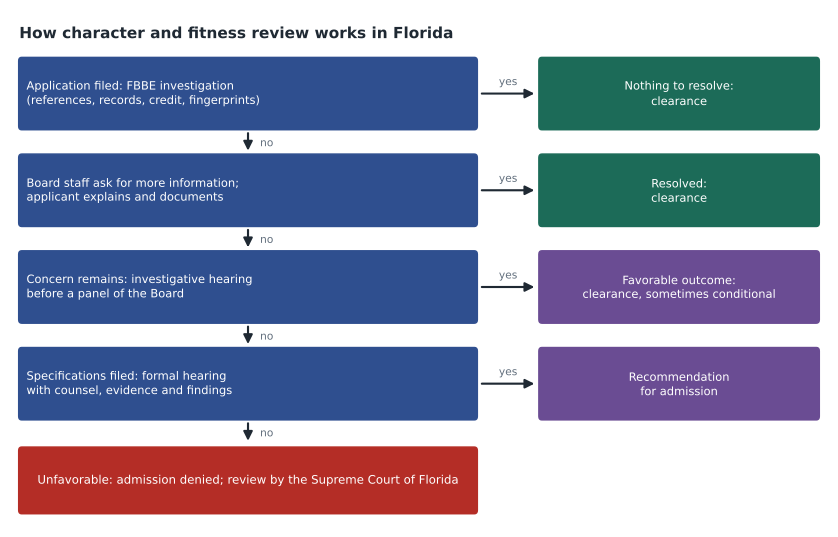
Most applicants never hear from the Board beyond routine requests. When something needs explanation, the Board's staff write to the applicant asking for records and a written statement. A prompt, documented answer usually ends the matter. If a concern remains, Florida's rules provide for an investigative hearing, an informal proceeding before a panel of Board members at which the applicant answers questions, often with a lawyer. After an investigative hearing, the Board may clear the applicant, clear the applicant subject to conditions, or file formal charges, called specifications. Specifications lead to a formal hearing with evidence, witnesses and findings. An applicant who receives an unfavorable decision may seek review in the Supreme Court of Florida, which has the final word on admission.
The Board can also recommend conditional admission in appropriate cases, for example for an applicant in recovery from substance use who is participating in a monitoring program. Conditional admission lets an applicant become a lawyer while complying with specified conditions for a period, rather than waiting for a longer track record.
The issues that most often cause delay
Marchetti groups the common Florida issues into five categories, because each calls for a different kind of preparation. The first is criminal history. Arrests and charges must be disclosed as the questions require, along with the outcome. The applicant should obtain certified court records and write a short, factual account of what happened, accepting responsibility where appropriate. The second is financial responsibility. The Board looks at defaulted student loans, collections, judgments, unpaid taxes and unpaid child support. The concern is not debt itself, which nearly every law graduate has, but neglect: ignoring creditors, letting judgments go unpaid without explanation, or hiding obligations. An applicant who has contacted creditors and set up payment plans is in a far better position than one who has not.
The third category is academic and employment conduct: plagiarism findings, honor code cases, terminations for cause and dishonesty at work. The fourth is candor in prior applications, such as inconsistencies between the bar application and a law school application. Law schools and the Board compare answers, and a law school application that omitted an arrest later disclosed to the Board can lead to an amended law school record and a harder conversation. The fifth is mental health and substance use. Florida, like many states, has narrowed its questions in this area over the past decade to focus on current conduct and current impairment rather than diagnosis or treatment history. An applicant who has sought counseling or treatment should read each question carefully and answer exactly what it asks.
| Issue | What the Board wants to see | What to prepare |
|---|---|---|
| Criminal history | Full disclosure, the outcome, and responsibility | Certified dispositions and a short factual statement |
| Debts and judgments | Diligence, not the absence of debt | Proof of payment plans, contact with creditors, explanations |
| Academic or job discipline | Honesty and change since | The school or employer record and the applicant's account |
| Inconsistent applications | Consistency and correction | Amended prior applications where needed |
| Current impairment | Ability to practice now | Answers that track the precise question; treatment records only if asked |
Candor: the duty that runs to admission day
Florida's application is not a snapshot. Applicants must update their answers whenever something changes, until they are admitted. That includes a new arrest or citation, a new lawsuit, a change in employment and a new judgment. The Board's view is straightforward: an applicant who will soon owe a duty of candor to courts must show the same candor to the Board. Marchetti asks Yesenia to set a monthly reminder to review her answers until the day she takes the oath.
Yesenia raises the small claims case from her old apartment. She was not a party, only a witness, but she disclosed it anyway when she converted her registration. Marchetti approves. 'If a question could be read to cover it, disclose it and explain,' she says. 'Nobody has ever been denied admission for telling the Board too much.'
The MPRE requirement
Florida requires a scaled score of 80 on the Multistate Professional Responsibility Examination. The MPRE is written and administered by NCBE, given at Pearson VUE test centers several times a year, and consists of 60 multiple-choice questions over two hours, of which 50 are scored. Scores are reported on a scale from 50 to 150. NCBE's Comprehensive Guide charts show passing scores across jurisdictions ranging from 75 to 86, so Florida's 80 sits in the middle. A candidate who scored 80 or more for any other jurisdiction meets Florida's score requirement, as long as the score falls within Florida's time window.
That window is specific. The Board's published instructions say the MPRE score must be achieved within 25 months of passing the other parts of the bar exam. Florida thus measures the window from the date the applicant passes Part A and Part B, not from graduation. Most candidates take the MPRE during their second or third year of law school, which leaves plenty of time. Candidates who delay the bar exam should check the window before assuming an old score still counts.
The MPRE tests the ABA Model Rules of Professional Conduct and related law, not the Rules Regulating The Florida Bar. Part A, however, tests Chapters 4 and 5 of Florida's own rules, so a Florida candidate must learn both. Lesson 10 covers the most important differences between the Model Rules and Florida's rules.
Registering for the MPRE
MPRE registration runs through an NCBE account, not through the Board. NCBE does not allow late registration, so a candidate who misses the deadline must wait for the next administration. The Board's notice for the February 2027 exam reminded candidates that registration for the March 2027 MPRE closed on January 21, 2027. Candidates who need testing accommodations on the MPRE must request them from NCBE separately from any accommodations on the bar exam.
After the MPRE, NCBE reports scores to the jurisdictions the candidate designates. A candidate should designate Florida, confirm in the Board's portal that the score was received, and keep a copy of the score report. If a score was sent to another state first, the candidate can request an additional score report for Florida through NCBE.
Worked problem
An honest mistake, corrected
Kendra registered as a first-year student and answered that she had never been a party to a lawsuit. In her third year, while converting her registration, she remembers that a credit card company sued her when she was 19 and obtained a default judgment, which she paid two years later. What should she do?
Show solution
- Disclose the lawsuit and judgment now, in the converted application, and amend her registration answer.
- Obtain the court docket showing the judgment and proof that it was satisfied.
- Write a short statement explaining that she overlooked the case when she registered, and how she resolved the debt.
- Check whether her law school application asked a similar question and, if so, amend it with the school.
Answer: Correcting the omission herself, with documents, is strong evidence of candor. Waiting for the Board to find it would be far worse.
Common mistakes
MistakeSealed or dismissed charges never need to be disclosed.
InsteadDisclose as the Board's questions require; read each question's exceptions carefully.
MistakeStudent debt is a character problem.
InsteadDebt is not; neglect of obligations is. Show diligence and payment plans.
MistakeAn MPRE score from law school always counts.
InsteadIt must be within 25 months of passing the other parts of the Florida exam.
MistakeThe MPRE tests Florida's rules.
InsteadThe MPRE tests the ABA Model Rules; Part A tests the Rules Regulating The Florida Bar.
Writing the disclosures
Marchetti spends part of the session on how Yesenia should write her disclosures, not just whether to make them. The Board reads thousands of applications, and a clear, complete, factual answer saves everyone time. For the small claims case with her former landlord, Yesenia writes the court, the case number, the dates, her role as a witness, and a two-sentence description of what the case was about and how it ended. She attaches a copy of the docket. She does not argue that the case was trivial or explain why the landlord was wrong. 'Facts, documents, and a short explanation if one is needed,' Marchetti says. 'Let the investigator decide what matters.'
The same approach applies to anything a candidate is unsure about. If a question could be read to include an event, the safer course is to disclose it with a short explanation of why the candidate was unsure, rather than to decide privately that it falls outside the question. An applicant who discloses too much loses nothing. An applicant who leaves out something the Board later finds may face questions about candor that are far more serious than the original event.
Keeping the application current
Yesenia's application is not a document she files once. Florida requires applicants to keep their applications current, and an amendment is due whenever an answer changes. A new job, a new address, a traffic citation, a new lawsuit, or a change in a financial obligation can all require an update within the time the Board's rules set. Marchetti suggests a simple habit: every time something significant happens in her life before admission, Yesenia asks herself whether any answer on the application has changed, and if the answer is maybe, she checks the question and files an amendment.
Preparing for the MPRE score report
Yesenia passed the MPRE with a 91, comfortably above Florida's required 80, but Marchetti checks the timing anyway. Florida requires the score to be earned within the period the Board's rules allow relative to the applicant's Part A and Part B results, and NCBE must report it to the Board. Yesenia confirms in the portal that her score report has arrived and notes the date of her test. Candidates who took the MPRE early in law school, or who are coming back to the Florida exam after a gap, should check that their score will still count.
Summary and key terms
- Applicants must prove good moral character and fitness; candor in the process is itself evidence of character.
- The Board investigates residences, jobs, schools, criminal history, litigation, finances and certain current conduct, with fingerprints and a credit report.
- Concerns can lead to an investigative hearing, specifications and a formal hearing, with review in the Supreme Court of Florida; conditional admission is possible.
- Applicants must update their answers whenever information changes, until admission.
- Florida requires an MPRE score of 80, achieved within 25 months of passing the other parts of the exam.
- Investigative hearing
- An informal hearing before a panel of the Board about a character concern.
- Specifications
- Formal charges filed by the Board after an investigative hearing.
- Conditional admission
- Admission subject to conditions, such as monitoring, for a set period.
- MPRE
- The Multistate Professional Responsibility Examination, written by NCBE.
- Duty to update
- The applicant's continuing obligation to amend answers until admission.
Lesson quiz · 5 questions
Score 60% or more to complete this lesson.
Create a free account to save your progress, take quizzes and earn a certificate.