
BAR-220 · Lesson 10 of 12 · 19 min
Maine family law, probate and the Maine Rules of Professional Conduct
▶ Video coming soon A video version of this lesson is on the way.
Three of Josie's November files fit in one week. On Monday she drafts a financial statement for a client in a divorce after a twelve-year marriage. On Wednesday she prepares an application for informal probate of a retired teacher's will in the Penobscot County Probate Court. On Friday a client tells her, almost in passing, that he intends to sell a boat that is part of his late mother's estate before the court appoints anyone, and asks her to keep that between them. Josie brings all three to Marchetti's Tuesday group the following week. 'Family law, probate and ethics,' Marchetti says. 'The three things every small Maine firm does every week.'
This lesson introduces Maine family law under Title 19-A, the Maine Probate Code in Title 18-C and the Maine Rules of Professional Conduct, with emphasis on where Maine differs from the general rules tested on the exam. Family law and trusts and estates were removed from the MEE beginning in July 2026 and can appear on the legacy exam only on the MPT, with the law supplied, so this lesson is for practice rather than for February.
Family law under Title 19-A
Maine's family law is collected in Title 19-A of the Maine Revised Statutes. Divorce cases are filed in the District Court and proceed under the family matters chapter of the civil rules, with case management conferences, financial statements, mediation in many contested cases and parenting education where children are involved. Maine allows divorce on several grounds, including irreconcilable marital differences, which is the ground most cases rely on.
Maine uses the phrase parental rights and responsibilities rather than custody. The court may order that those rights and responsibilities be shared, allocated between the parents in specific areas or given solely to one parent, and it decides according to the best interest of the child, considering factors listed in the statute. A parent's residence and the child's contact schedule are set in a parenting plan. Child support is calculated under Maine's child support guidelines, which use both parents' incomes and a statutory table.
Spousal support under section 951-A
Maine's spousal support statute, 19-A M.R.S. section 951-A, names five types of support. General support provides ongoing support where one spouse cannot meet reasonable needs after the divorce. Transitional support helps a spouse through a short-term need, such as returning to the work force or completing education. Reimbursement support compensates a spouse for economic misconduct or for contributions to the other spouse's education or career. Nominal support is a small award that preserves the court's power to award support later. Interim support applies while the divorce is pending.
The statute adds two presumptions about general support tied to the length of the marriage. If the parties were married for less than ten years, there is a rebuttable presumption that general support should not be awarded. If they were married for at least ten years but not more than twenty years, there is a rebuttable presumption that general support should not exceed half the length of the marriage. Both presumptions can be overcome, but they shape negotiations in nearly every Maine divorce.
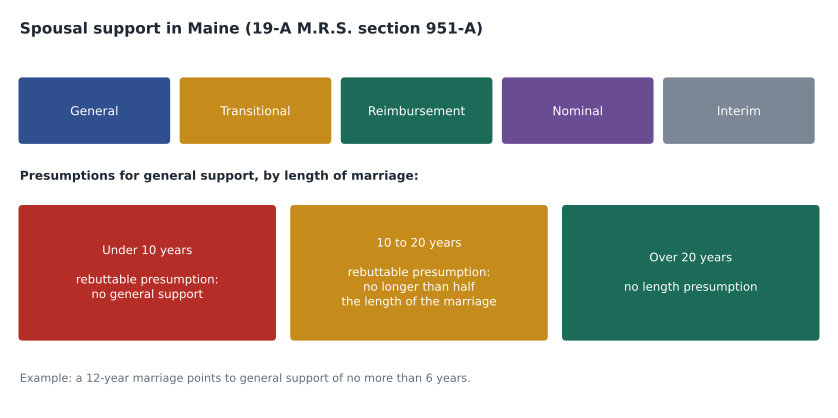
For Josie's client married twelve years, the presumption is that any general support should not last longer than six years. The other spouse could still seek transitional or reimbursement support, and either party could try to rebut the presumption with evidence.
The Maine Probate Code
Maine's Probate Code, Title 18-C, took effect on September 1, 2019, replacing the older Title 18-A. It is based on the Uniform Probate Code and covers intestate succession, wills, probate and administration of estates, guardianships and conservatorships, and related matters. Probate cases are heard in the county probate courts under the Maine Rules of Probate Procedure.
Maine offers both informal and formal probate. In informal probate, the register of probate can admit a will and appoint a personal representative on an application without a hearing, provided the will appears valid and no one objects. Formal probate is a court proceeding with notice, used when the will is contested, when the will is lost or questionable or when a party wants a binding court order. Small estates may qualify for simplified procedures. The personal representative, once appointed, gathers assets, pays debts and expenses and distributes the remainder under the will or the intestacy rules.
Title 18-C also modernized Maine's guardianship law. A guardianship of an adult is a last resort, and the court must consider less restrictive alternatives such as powers of attorney and supported decision-making. A guardian's authority should be limited to what the person actually needs. Minor guardianships, such as the grandmother's case from Lesson 9, have their own procedures and may raise the Indian Child Welfare Act.
| Topic | Maine source | Key point for a new lawyer |
|---|---|---|
| Divorce procedure | Title 19-A and the family matters chapter of the civil rules | Filed in the District Court with case management and financial statements |
| Parental rights | 19-A M.R.S. chapter on parental rights and responsibilities | Shared, allocated or sole rights decided by the best interest of the child |
| Spousal support | 19-A M.R.S. section 951-A | Five types; presumptions for marriages under ten years and ten to twenty years |
| Probate | Title 18-C, effective September 1, 2019 | Informal and formal probate in the county probate courts |
| Adult guardianship | Title 18-C | Last resort after less restrictive alternatives |
The Maine Rules of Professional Conduct
Maine's Rules of Professional Conduct are based on the ABA Model Rules, with some important Maine variations. The Board of Overseers of the Bar enforces them. Complaints are reviewed by Bar Counsel, contested matters may be heard by panels of the Grievance Commission and serious sanctions are imposed by the Supreme Judicial Court. Every new lawyer should read the Maine rules themselves, not just the Model Rules studied for the MPRE.
The most significant difference for daily practice is confidentiality. ABA Model Rule 1.6 protects all information relating to the representation of a client. Maine Rule 1.6 uses an older formula: it protects a client's confidences and secrets. The Maine rule's definitions are broad, covering information protected by the privilege and other information gained in the professional relationship that the client has asked to be kept confidential or whose disclosure would be embarrassing or likely to be detrimental to the client, but the starting point is different.
All of the exceptions in Maine Rule 1.6(b) are permissive. A lawyer may reveal confidential information to prevent reasonably certain death or substantial bodily harm; to prevent a crime or fraud that is reasonably certain to cause substantial injury to another's financial interests or property, where the client has used the lawyer's services; to prevent, mitigate or rectify such injury; to obtain legal advice about compliance with the rules; to establish a claim or defense in a dispute between the lawyer and the client or in response to allegations about the lawyer's conduct; to detect and resolve conflicts arising from a lawyer's change of employment or from the sale of a law practice, an exception added in 2015; and to comply with other law or a court order. Maine Rule 1.6(c) adds a requirement the Model Rule does not have: before disclosing under the bodily harm and crime or fraud exceptions, the lawyer must, where practicable, first counsel the client to take steps that would make disclosure unnecessary.
Worked problem
The boat in the estate
Josie's client says he will sell a boat from his late mother's estate before any personal representative is appointed and asks Josie to keep it to herself. What should Josie consider under Maine rules?
Show solution
- Identify the duty. Under Maine Rule 1.6, what the client told her is a confidence or secret, and she must protect it unless an exception applies.
- Advise the client. She should explain that he has no authority to sell estate property before appointment and that the sale could harm other heirs and expose him to liability.
- Check the exceptions. Disclosure for crime or fraud is permissive and applies only where the client has used or is using the lawyer's services. Maine Rule 1.6(c) requires counseling the client first where practicable.
- Protect herself. She must not assist the sale, and if the client insists she should consult Haskell about withdrawal and the firm's duties.
Answer: Josie should counsel the client against the sale, refuse to assist it and consult her supervisor. Any disclosure would be permissive, and Maine requires counseling the client first where practicable.
At the next session, Josie reports that the client changed his mind after she explained his position. 'You did exactly the right thing,' Marchetti says. 'And notice that you got there from the Maine rule. On the MPRE you would start from the Model Rule, which protects more information but reaches the same advice on these facts.'
Common mistakes
MistakeMaine Rule 1.6 is identical to the ABA Model Rule.
InsteadMaine protects confidences and secrets and requires counseling the client before certain disclosures where practicable.
MistakeMaine has mandatory disclosure exceptions to confidentiality.
InsteadAll of the Maine Rule 1.6(b) exceptions are permissive.
MistakeGeneral support is presumed in every long marriage.
InsteadSection 951-A presumes no general support for marriages under ten years and limits duration for marriages of ten to twenty years.
MistakeMaine still uses Title 18-A for probate.
InsteadTitle 18-C replaced it on September 1, 2019.
MistakeAn adult guardianship should be broad to protect the person.
InsteadTitle 18-C treats guardianship as a last resort, limited to actual needs.
Practice problems
Work each problem on paper first, then reveal the answer to check.
Name the five types of spousal support in Maine.
Show answer
General, transitional, reimbursement, nominal and interim.
What presumption applies to general support after a fifteen-year marriage?
Show answer
A rebuttable presumption that general support should not exceed half the length of the marriage, here seven and a half years.
When did the Maine Probate Code in Title 18-C take effect?
Show answer
September 1, 2019.
Property division in a Maine divorce
Maine divides property in a divorce under an equitable distribution approach. The court first sets apart each spouse's nonmarital property, which generally includes property acquired before the marriage and property received by gift or inheritance, and then divides the marital property in proportions the court considers just. Equitable does not always mean equal. The court considers factors such as each spouse's contribution to acquiring the property, the value of the property set apart to each spouse and the economic circumstances of each spouse when the division takes effect.
Tracing is often the hardest part. A house bought before the marriage but paid down with marital earnings, or an inheritance deposited in a joint account, can be partly marital and partly nonmarital. Lawyers spend much of their preparation in contested divorces gathering the records needed to trace each asset. Josie's twelve-year-marriage client owns a camp on a lake that her parents gave her before the marriage, and much of Josie's work on the file is documenting what the couple spent on it during the marriage.
Probate in practice
For the retired teacher's estate, Josie's work follows a common pattern. She confirms that the original will is available and appears properly signed and witnessed. She prepares the application for informal probate and appointment of the named personal representative, together with the required notices to heirs and devisees. After appointment, the personal representative publishes notice to creditors, gathers assets, pays valid claims and expenses and, after the creditor period ends, distributes the estate under the will. If anyone objects, or if the will is unclear, the matter may move to formal proceedings before the probate judge.
Small Maine estates often involve real estate, such as a house or a camp, and sometimes property in more than one county. Lawyers learn the practices of each county's register of probate, because the probate courts are county courts and local practices vary within the statewide rules.
Discipline and the Board of Overseers
The Board of Overseers of the Bar enforces the Maine Rules of Professional Conduct. Complaints about lawyers are reviewed by Bar Counsel, who may dismiss a complaint, resolve minor matters informally or bring formal charges. Contested matters can be heard by panels of the Grievance Commission. Panels can dismiss, issue a reprimand or, in serious cases, recommend that the matter go to the Supreme Judicial Court for suspension or disbarment. A lawyer who is the subject of a complaint should respond promptly and candidly and should consider consulting counsel.
The most common sources of complaints in small practices are familiar: failure to communicate with clients, missed deadlines, fee disputes and trust account errors. Most of them can be prevented with simple habits. Returning calls within a day or two, sending copies of important filings, putting fee agreements in writing and reconciling the trust account every month address the large majority of risks.
Comparing Maine Rule 1.6 with the Model Rule on the MPRE
Because the MPRE tests the Model Rules, a Maine applicant must keep two versions of the confidentiality rule in mind. On the MPRE, the duty covers all information relating to the representation, whatever its source, and the exceptions are those in Model Rule 1.6(b), which are also permissive. In Maine practice, the duty covers confidences and secrets as Maine defines them, and Maine Rule 1.6(c) adds the duty to counsel the client first where practicable before certain disclosures. On most MPRE-style facts the two rules reach the same result, but an answer choice that relies on a Maine-only feature will be wrong on the MPRE.
Summary and key terms
- Title 19-A governs Maine family law; Maine uses parental rights and responsibilities instead of custody.
- Section 951-A names five support types and sets presumptions for marriages under ten years and ten to twenty years.
- Title 18-C, effective September 1, 2019, governs probate, with informal and formal probate in the county probate courts.
- Maine Rule 1.6 protects confidences and secrets; all its exceptions are permissive.
- Maine Rule 1.6(c) requires counseling the client before certain disclosures where practicable.
- Parental rights and responsibilities
- Maine's term for the decision-making and care rights allocated between parents.
- General support
- Ongoing spousal support under section 951-A, subject to length-of-marriage presumptions.
- Informal probate
- Admission of a will and appointment of a personal representative by the register of probate without a hearing.
- Confidences and secrets
- The information Maine Rule 1.6 protects, in place of the Model Rule's information relating to the representation.
Lesson quiz · 5 questions
Score 60% or more to complete this lesson.
Create a free account to save your progress, take quizzes and earn a certificate.