
BAR-220 · Lesson 3 of 12 · 19 min
Character and fitness and the MPRE
▶ Video coming soon A video version of this lesson is on the way.
Before she filed, Josie spent two evenings with her application and a stack of old papers. She found a speeding ticket from a drive back from Orono in 2020, a note from her college about a late library fine that had been sent to collections for three months, and the dates of a part-time job at a Lewiston restaurant that she had remembered as a summer longer than it really was. 'None of it seems important,' she tells Marchetti. 'Do I really need to list the library fine?' Marchetti answers with a question. 'Does the form ask about debts sent to collection?' It does. 'Then you list it, explain it in two sentences and attach the letter showing it was paid. The point is not the fine. The point is that you answered every question fully.'
This lesson covers the two requirements that test an applicant's fitness to practice rather than knowledge of the law: the character and fitness review under Rule 9 of the Maine Bar Admission Rules and the Multistate Professional Responsibility Examination under Rule 11. It also covers conditional admission under Rule 9A.
The standard and the burden
Rule 9 requires every applicant to show good moral character and fitness to practice law. The burden is on the applicant. That allocation matters: the Board does not have to prove that an applicant is unfit; the applicant must persuade the Board that the applicant is fit. Questions left unanswered or answered vaguely count against the applicant because they leave the record incomplete.
Character and fitness reviews in Maine, as elsewhere, look for conduct that bears on honesty, trustworthiness, diligence and respect for the law. Common topics include criminal charges and convictions, traffic offenses beyond minor ones, academic discipline, employment terminations, civil lawsuits, unpaid debts and defaults, prior bar applications and discipline in other professions. Mental health conditions as such are not grounds for denial; the focus is on conduct. An applicant who has had problems in the past can show rehabilitation through time, candor, restitution and a steady record since.
The most serious character problem is often not the underlying conduct but a failure to disclose it. Bar examiners across the country treat a lack of candor in the application itself as strong evidence of unfitness, because the application is the applicant's first sworn statement to the court that will admit the applicant. A minor offense disclosed fully is usually resolved quickly. The same offense found by an investigator after the applicant omitted it raises a question that can take months to answer.
How the review works
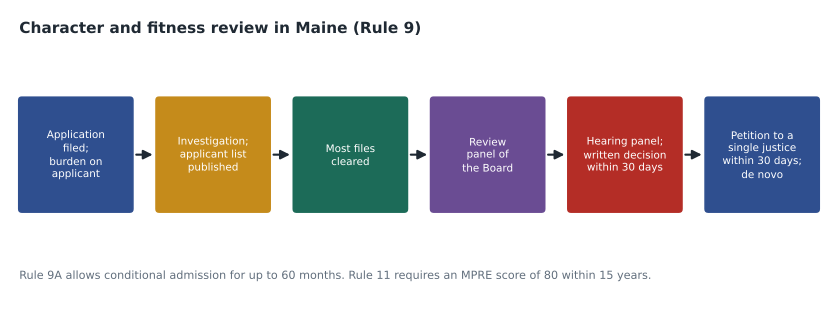
The review begins when the applicant files. The Board may use NCBE's character investigation services, which verify the applicant's history and contact references, employers and schools. As described in Lesson 2, the Board publishes lists of applicants after each filing window closes, inviting information from anyone who knows of a reason an applicant should not be admitted.
Most applications raise no concern and are cleared without a meeting. When an application raises a question, Rule 9 provides for review by a panel of the Board. The panel may ask the applicant for more information or invite the applicant to meet. If the panel has continuing concerns, the matter can go to a hearing before a panel of the Board, where the applicant may present evidence, call witnesses and be represented by counsel. The hearing panel issues a written decision, which Rule 9 requires within thirty days of the hearing.
An applicant denied certification may seek review in the Supreme Judicial Court. Under Rule 9, the applicant files a petition within thirty days, and a single justice of the court hears the matter de novo, which means the justice decides the question fresh rather than deferring to the Board's view. That is a significant protection for the applicant, and it reflects the fact that admission is ultimately the court's decision.
Rule 8 adds a related limit: an applicant who is currently disbarred or suspended from practice in another jurisdiction is not eligible for a certificate of qualification. A lawyer facing discipline elsewhere needs to resolve that matter before applying in Maine.
Conditional admission
Rule 9A allows the court to admit an applicant on conditions when the applicant has shown rehabilitation from a problem such as substance use or financial difficulty but the Board believes ongoing monitoring is appropriate. The conditions can last up to sixty months and may include treatment, reporting, a practice monitor or financial oversight. A conditionally admitted lawyer is a full member of the bar who must comply with the conditions; breach can lead to further proceedings. Conditional admission gives applicants with a documented recovery a path to practice while protecting clients during the early years.
| Issue on the application | Better approach | Risky approach |
|---|---|---|
| Old traffic ticket, paid | List it with the date and outcome | Leave it off because it seems minor |
| Debt sent to collection, later paid | List it, explain briefly, attach proof of payment | Answer no because the debt is now paid |
| College disciplinary matter | Describe it, give the outcome and what changed | Describe it vaguely or omit the outcome |
| Unsure of exact employment dates | Check records and give the best accurate dates | Guess and move on |
Worked problem
A late correction
Ruth, an invented applicant, filed in the October to December window and realized in January that she had left out a small claims case a former landlord brought against her in 2021, which she settled. What should she do?
Show solution
- Identify the duty. The application is a continuing statement, and the burden of showing fitness is on Ruth under Rule 9.
- Act promptly. She should write to the Board now, before the issue is found in the investigation.
- Explain fully. She should give the case name, court, dates and how it ended, and attach the settlement papers.
- Expect follow-up. A panel may ask questions, but a prompt correction is far better than a discovered omission.
Answer: Ruth should send a written correction with documents right away. A prompt, complete correction usually resolves a minor matter; a later discovery could delay or endanger certification.
The MPRE requirement
Rule 11 requires every applicant, whether admitted by examination, transferred score or motion, to pass the Multistate Professional Responsibility Examination with a scaled score of at least 80. The score must have been earned within fifteen years before the applicant's admission. The fifteen-year window is generous compared with many states and means that most lawyers seeking admission on motion can use an MPRE score from law school.
The MPRE is a separate exam from the bar exam, written and scored by NCBE. It has 60 multiple-choice questions, of which 50 are scored and 10 are unscored pretest questions, and it is given on computer at testing centers several times a year. It tests the law governing lawyers, based mainly on the ABA Model Rules of Professional Conduct and the ABA Model Code of Judicial Conduct, along with generally accepted principles from court decisions and the Restatement of the Law Governing Lawyers. It does not test Maine's own version of the rules.
That point matters because Maine's Rules of Professional Conduct differ from the Model Rules in some places. Lesson 10 describes one important difference: Maine's confidentiality rule protects a client's confidences and secrets rather than all information relating to the representation. An applicant preparing for the MPRE should study the Model Rules as written and save the Maine variations for practice.
Scores scale from 50 to 150. NCBE reports scores to the jurisdictions the examinee chooses, and Maine applicants should make sure their score is sent to the Maine Board. An applicant who has already taken the MPRE should check that the score is at least 80 and was earned within the fifteen-year window.
When to take the MPRE
Josie took the MPRE in March of her third year of law school, after her professional responsibility course, and scored 94. Many applicants find that timing ideal because the material is fresh. Those who have not yet taken it can sit it before or after the bar exam; Maine requires the score for admission, not for permission to sit the bar exam. Taking it within a few weeks of the bar exam, however, splits study time at the worst moment. Marchetti's advice is to take it either well before the bar exam or in the first available window after it.
Josie's file
Josie's application lists the 2020 speeding ticket, which she paid; the library fine, with the college's letter confirming payment; and the corrected employment dates, checked against old pay stubs. She attaches a short explanation for each. Her references include Haskell, a law school professor and the supervising attorney from her summer legal aid project. Marchetti reads the file and returns it with one comment: 'This is what candor looks like. Nobody will need to ask you twice.'
Common mistakes
MistakeThe Board must prove an applicant is unfit.
InsteadUnder Rule 9 the applicant bears the burden of showing good character and fitness.
MistakeA paid debt no longer needs to be listed.
InsteadIf the form asks about debts sent to collection, the debt must be listed even if it was later paid.
MistakeA denied applicant has no further review.
InsteadThe applicant may petition a single justice of the Supreme Judicial Court within thirty days, and the justice hears the matter de novo.
MistakeThe MPRE tests Maine's professional conduct rules.
InsteadThe MPRE tests the ABA Model Rules and general law governing lawyers, not Maine's variations.
MistakeAn MPRE score expires after a few years in Maine.
InsteadMaine accepts a score of 80 or higher earned within fifteen years.
Practice problems
Work each problem on paper first, then reveal the answer to check.
What MPRE score does Maine require, and how old may it be?
Show answer
A scaled score of at least 80, earned within fifteen years.
How long may conditions last under Rule 9A?
Show answer
Up to sixty months.
What standard of review applies when a single justice hears a denied applicant's petition?
Show answer
De novo review.
What a review panel looks for
When a file raises a question, the panel's interest is practical. It wants to know what happened, when it happened, how the applicant responded and what the applicant's conduct has been since. A single incident years ago, followed by a clean record, reads very differently from a pattern of similar conduct continuing into law school. Panels also look at how the applicant described the matter on the application. A full, plain account that accepts responsibility tends to resolve concerns. An account that minimizes the conduct, blames others or leaves out important facts tends to create new ones.
Financial matters are a common example. Student debt by itself is not a concern; nearly every applicant has it. What draws attention is unpaid obligations that the applicant has ignored, defaults without any effort to resolve them or debts sent to collection without explanation. An applicant with financial problems should show a plan: payment arrangements, correspondence with creditors and a realistic budget. The question for the panel is whether the applicant will handle clients' money responsibly, and the applicant's handling of personal obligations is evidence of that.
Preparing for a meeting or hearing
An applicant invited to meet with a panel should treat the meeting seriously but not with alarm. Most meetings are conversations meant to fill gaps in the record. The applicant should reread the application, gather the documents that relate to the issue, think through a short and honest explanation and be ready to answer follow-up questions. Many applicants find it helpful to consult a lawyer who has experience with bar admission matters, especially if a hearing is possible.
At a hearing, the applicant may present evidence, call witnesses and be represented by counsel, and the panel must issue a written decision within thirty days. Witnesses who can speak to the applicant's conduct over time, such as an employer, a professor or a counselor, are usually more persuasive than character letters written in general terms. Documents that show rehabilitation, such as treatment records, payment histories or completion of court-ordered programs, carry weight because they show what the applicant has done, not just what the applicant says.
Keeping the application current
The application is not a snapshot. If something changes after filing, such as a new traffic citation, a change of address, a new job or a civil suit, the applicant should tell the Board promptly. An applicant who passes the exam but has an undisclosed change in circumstances can find admission delayed while the Board reviews the new information. Josie sets a reminder on her calendar for the first day of each month through admission: check whether anything in her life has changed that the application asks about.
The MPRE in brief
For applicants who have not yet taken it, the MPRE rewards focused preparation. The exam is two hours long and covers the regulation of the legal profession, the client-lawyer relationship, client confidentiality, conflicts of interest, competence and malpractice, litigation and other forms of advocacy, communications about legal services, the lawyer's duties to the public and the legal system, and judicial conduct. Conflicts of interest and confidentiality are among the most heavily tested areas.
Two habits help. The first is to read the Model Rules themselves, not only an outline, because the questions often turn on precise wording such as whether a duty applies when a lawyer knows, reasonably believes or reasonably should know a fact. The second is to separate what the rules require from what they permit. Many MPRE questions ask whether a lawyer must, may or must not do something, and a lawyer who mixes up a permissive rule with a mandatory one will choose the wrong answer.
Summary and key terms
- Rule 9 requires good moral character and fitness, and the applicant bears the burden.
- Applicant lists are published after each filing window; most files clear without a meeting.
- Concerns go to a review panel, then a hearing panel with a written decision within thirty days.
- A denied applicant may petition a single justice of the Supreme Judicial Court within thirty days for de novo review.
- Rule 9A allows conditional admission for up to sixty months; Rule 11 requires an MPRE score of 80 within fifteen years.
- Character and fitness
- The review of an applicant's honesty, trustworthiness and conduct before admission.
- De novo
- Review in which the reviewing judge decides the question fresh without deferring to the earlier decision.
- Conditional admission
- Admission subject to monitoring conditions, available in Maine for up to sixty months.
- MPRE
- The Multistate Professional Responsibility Examination, NCBE's exam on the law governing lawyers.
Lesson quiz · 5 questions
Score 60% or more to complete this lesson.
Create a free account to save your progress, take quizzes and earn a certificate.