
BAR-220 · Lesson 9 of 12 · 19 min
The Wabanaki Nations and Maine law
▶ Video coming soon A video version of this lesson is on the way.
Haskell's firm sits about a dozen miles from Indian Island, the home of the Penobscot Nation, and the firm's work brushes against tribal matters more often than Josie expected. In October, a client asks whether a small claims judgment against a debtor who lives on tribal land can be enforced in the usual way. A week later, a grandmother asks for help with a guardianship of her grandchild, whose father is a citizen of the Passamaquoddy Tribe. Haskell answers both questions the same way at first. 'Slow down,' he says. 'In Maine, the relationship between the state and the Wabanaki Nations rests on a 1980 settlement that works differently from the rules in most other states. Before we file anything, we find out which court has jurisdiction and which law applies.'
This lesson introduces the legal relationship between the State of Maine and the Wabanaki Nations. It is not tested on the bar exam, which covers federal Indian law only incidentally, if at all, but it is a part of Maine law that a new lawyer should understand from the start. The lesson describes the framework in general terms; a lawyer handling a matter involving a tribal member, tribal land or a tribal government should read the governing statutes and consult the tribal court or tribal counsel.
The Wabanaki Nations
Four federally recognized tribal nations are in Maine: the Houlton Band of Maliseet Indians, the Mi'kmaq Nation, the Passamaquoddy Tribe and the Penobscot Nation. Together they are known as the Wabanaki, often translated as the people of the dawnland. The Passamaquoddy have two communities, at Sipayik (Pleasant Point) and at Motahkomikuk (Indian Township). The Penobscot Nation's main community is on Indian Island in the Penobscot River near Old Town. The Houlton Band and the Mi'kmaq Nation are based in Aroostook County.
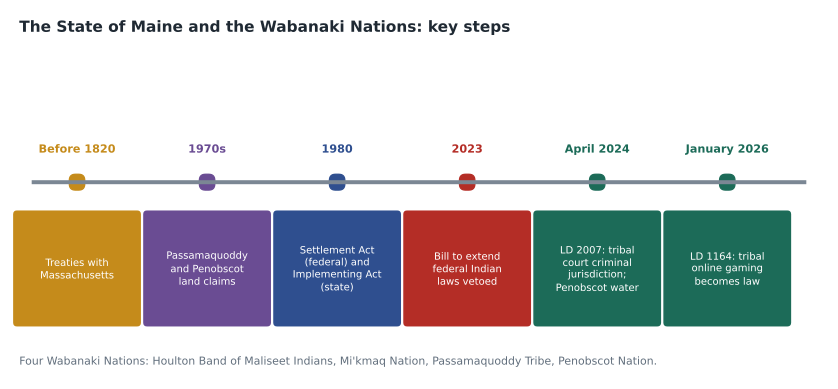
The Wabanaki Nations have lived in what is now Maine for thousands of years, long before the state existed. Their relationship with Maine has been shaped by treaties with Massachusetts, of which Maine was part until 1820, and by later Maine laws. A new lawyer working in Maine benefits from learning that history, because it explains why the current legal framework took the form it did.
The 1980 settlement
In the 1970s, the Passamaquoddy Tribe and the Penobscot Nation brought land claims asserting that large areas of Maine had been taken from them in violation of a federal law that required federal approval for transfers of Indian land. The claims covered a large part of the state. They were resolved in 1980 by a settlement enacted in two parts: a federal statute, the Maine Indian Claims Settlement Act, and a state statute, the Act to Implement the Maine Indian Claims Settlement, often called the Maine Implementing Act, which appears in Title 30 of the Maine Revised Statutes. The settlement extinguished the land claims and provided federal funds that the tribes used to acquire land. The Houlton Band was included in the settlement, and the Mi'kmaq Nation later received federal recognition and its own settlement legislation.
The settlement set up a framework that differs from the one that applies to most tribes in the United States. In general terms, it provides that the Passamaquoddy Tribe and the Penobscot Nation have the rights and duties of municipalities under Maine law in many respects, while keeping authority over defined internal tribal matters. It also provides that federal laws enacted after 1980 for the benefit of Indian tribes do not apply in Maine unless Congress specifically makes them applicable. As a result, some federal Indian laws that apply to tribes elsewhere do not apply to the Wabanaki Nations in Maine in the same way.
Jurisdiction in practice
Because of the settlement, questions of jurisdiction in Maine often turn on statutes rather than on the general federal rules taught in federal Indian law courses. The Passamaquoddy Tribe and the Penobscot Nation operate tribal courts that hear certain criminal, civil, family and juvenile matters involving tribal members within their territories, as provided by the Implementing Act. Other matters remain within the jurisdiction of the Maine courts. A lawyer cannot assume that a case involving a tribal member on tribal land belongs in tribal court, or that it belongs in a Maine court; the answer depends on the type of matter, the parties and the specific statutory grant.
Family cases deserve special care. The federal Indian Child Welfare Act, enacted in 1978 before the settlement, governs certain child custody proceedings involving Indian children, including foster care placements, terminations of parental rights and some guardianships. Maine courts apply it in proceedings involving Wabanaki children, and tribes have rights to notice and to intervene. The grandmother's guardianship case at Haskell's firm may raise those requirements, so Josie's first task is to determine whether the child is a member or eligible for membership and to identify the tribe's contact for notice.
Recent legislation
The framework has been the subject of continuing debate in Maine. In 2023, the Governor vetoed a bill that would have extended more federal Indian laws to the Wabanaki Nations, and that bill did not become law. In April 2024, the Governor signed LD 2007, which expanded the criminal jurisdiction of tribal courts and allowed the Penobscot Nation to regulate drinking water on its lands. In January 2026, LD 1164, An Act to Create Economic Opportunity for the Wabanaki Nations, became law without the Governor's signature. It authorizes the tribes to offer online gaming in Maine under the oversight of the state's Gambling Control Unit.
These changes show that the law in this area is active, and a lawyer should check the current statutes rather than relying on older summaries. Maine's Legislature, the tribal governments and the courts continue to shape the relationship.
| Topic | General federal approach | Maine framework (general terms) |
|---|---|---|
| Source of rules | Federal Indian law and treaties | The 1980 settlement acts plus later Maine and federal statutes |
| Status of tribes under state law | Generally outside state regulatory authority on reservations | Passamaquoddy and Penobscot treated like municipalities in many respects, with defined internal tribal matters |
| Later federal Indian laws | Generally apply to tribes | Do not apply in Maine unless Congress specifically provides |
| Tribal courts | Jurisdiction under federal law and tribal law | Jurisdiction over defined matters under the Implementing Act, expanded by LD 2007 in 2024 |
| Child custody | Indian Child Welfare Act | Indian Child Welfare Act applies in Maine proceedings involving Indian children |
Working respectfully and carefully
Haskell gives Josie three practical rules for matters that touch the Wabanaki Nations. The first is to identify early whether a client, an opposing party, a child or a property is connected to a tribe, because that fact can change the court, the notice requirements and the governing law. The second is to read the governing statute instead of relying on general federal rules from a law school course; the Maine framework is specific. The third is to treat the tribal nations as governments. Tribal courts, tribal clerks and tribal counsel deserve the same professional courtesy as any other court or government office, and a phone call to the tribal court clerk often answers a jurisdiction question faster than an hour of research.
For the client with the small claims judgment, Josie's research shows that enforcement involving a debtor living on tribal land raises jurisdictional questions the firm should resolve before taking any step. Haskell decides to call the tribal court clerk before advising the client. For the grandmother, Josie drafts a list of facts to gather about the child's tribal membership and a short memo on the notice requirements that may apply.
Worked problem
Spotting the issue
An invented client asks Josie to file a petition for guardianship of her nine-year-old grandson in a Maine probate court. The boy lives with her in Bangor. His father is a citizen of the Penobscot Nation. What should Josie do before filing?
Show solution
- Identify the tribal connection. The father's citizenship suggests the child may be a member or eligible for membership.
- Consider the Indian Child Welfare Act. If the child is an Indian child and the proceeding is covered, the Act's notice and placement requirements may apply.
- Check jurisdiction. Determine whether the matter falls within a Maine court or within the tribal court's jurisdiction under the Implementing Act.
- Contact the tribe. Identify the tribe's designated contact for notice and, where appropriate, reach out early.
Answer: Josie should confirm the child's tribal status, check whether the Indian Child Welfare Act applies, determine the proper court and arrange notice to the tribe before filing.
At the end of the session, Marchetti adds a note for Josie's exam preparation. 'None of this is on the exam,' she says. 'But you are going to practice in Penobscot County. Learn it now, and learn it from the statutes.'
Common mistakes
MistakeGeneral federal Indian law rules apply to the Wabanaki Nations exactly as they do elsewhere.
InsteadThe 1980 settlement created a distinct framework, and later federal Indian laws do not apply in Maine unless Congress specifically provides.
MistakeEvery case involving a tribal member on tribal land belongs in tribal court.
InsteadJurisdiction depends on the type of matter and the statutory grant; many matters remain in Maine courts.
MistakeThe Indian Child Welfare Act does not apply in Maine.
InsteadThe Act predates the settlement and applies in covered proceedings involving Indian children.
MistakeThe framework has not changed since 1980.
InsteadMaine enacted LD 2007 in 2024 and LD 1164 became law in January 2026, among other changes.
Practice problems
Work each problem on paper first, then reveal the answer to check.
Name the four Wabanaki Nations in Maine.
Show answer
The Houlton Band of Maliseet Indians, the Mi'kmaq Nation, the Passamaquoddy Tribe and the Penobscot Nation.
What two statutes made up the 1980 settlement?
Show answer
The federal Maine Indian Claims Settlement Act and the state Maine Implementing Act.
What did LD 2007 do in 2024?
Show answer
It expanded tribal court criminal jurisdiction and allowed the Penobscot Nation to regulate its drinking water.
Why the framework is debated
The 1980 settlement was negotiated at a particular moment, and people in Maine have long disagreed about how well it has worked. Supporters of change argue that the settlement's limits on later federal Indian laws have left the Wabanaki Nations without benefits and protections that tribes elsewhere enjoy, in areas such as health care funding, environmental regulation and economic development. Others have raised concerns about the effect of changes on state regulatory authority, on municipalities near tribal lands and on businesses. A task force and several legislative sessions have studied proposals, and some have become law while others have not.
For a new lawyer, the point is not to take a side but to recognize that the law is in motion. A summary written five years ago may be wrong today. The best sources are the current statutes, recent court decisions and the tribal governments' own published codes and court rules.
Tribal courts and tribal law
The Passamaquoddy Tribe and the Penobscot Nation have tribal courts with their own judges, clerks and procedures. Those courts apply tribal law, which includes tribal codes adopted by the tribal governments, along with applicable state and federal law. A lawyer appearing in a tribal court should learn its admission requirements and rules of procedure, which may differ from those of the Maine courts. Some tribal courts admit lawyers who are members of the Maine bar on application, and some have their own bar or practice rules.
The 2024 legislation, LD 2007, expanded the criminal jurisdiction of tribal courts. The details of which offenses and which defendants are covered are set out in the statute, and a lawyer handling a criminal matter involving a tribal member or tribal land should read it directly. The change shows how jurisdiction under the Maine framework is allocated by statute, offense by offense and party by party, rather than by a single general rule.
Land, natural resources and regulation
Many disputes involving the Wabanaki Nations concern land and natural resources: hunting and fishing rights, water quality, the status of particular parcels and the reach of state environmental regulation. The Implementing Act defines the territories of the Passamaquoddy Tribe and the Penobscot Nation and addresses which laws apply there. Questions about whether a parcel is within a tribe's territory, or whether a particular state regulation applies there, can be complex, and the answers may depend on how and when the land was acquired.
The Penobscot Nation's authority to regulate drinking water under LD 2007 is an example of how specific these questions can be. The statute addresses a particular resource and a particular nation, rather than changing the framework as a whole. A lawyer advising on a matter involving land or resources should start with the governing statute and any related agreements, then check for recent changes.
Professional responsibility in this area
The Maine Rules of Professional Conduct require competence, which includes the legal knowledge, skill, thoroughness and preparation reasonably necessary for the representation. A lawyer who takes on a matter involving tribal jurisdiction without understanding the framework risks giving wrong advice on something as basic as which court to file in. The rules allow a lawyer to become competent through study or to associate with a lawyer who has the necessary experience. Haskell's practice of calling the tribal court clerk and, where needed, consulting a lawyer with experience in tribal matters is an example of meeting that duty.
Respect is part of competence too. Tribal nations are governments with their own institutions, histories and priorities. A lawyer who treats a tribal court or tribal government with the same professional courtesy owed to any court or government will be more effective and will serve clients better.
Summary and key terms
- Four federally recognized Wabanaki Nations are in Maine.
- The 1980 settlement, enacted as federal and state statutes, resolved land claims and set a distinct legal framework.
- Later federal Indian laws do not apply in Maine unless Congress specifically provides.
- Tribal courts have jurisdiction over defined matters; the Indian Child Welfare Act applies in covered child custody cases.
- LD 2007 (2024) and LD 1164 (2026) show that the framework continues to change.
- Wabanaki
- The collective name for the Maliseet, Mi'kmaq, Passamaquoddy and Penobscot peoples, often translated as the people of the dawnland.
- Maine Indian Claims Settlement Act
- The 1980 federal statute that resolved the Passamaquoddy and Penobscot land claims.
- Maine Implementing Act
- The 1980 Maine statute in Title 30 that implements the settlement within state law.
- Indian Child Welfare Act
- The 1978 federal law governing certain child custody proceedings involving Indian children.
Lesson quiz · 5 questions
Score 60% or more to complete this lesson.
Create a free account to save your progress, take quizzes and earn a certificate.