
BAR-220 · Lesson 11 of 12 · 18 min
Score transfer, admission on motion and practice after admission in Maine
▶ Video coming soon A video version of this lesson is on the way.
Haskell's firm is thinking about growth. In November he tells Josie that he has two possible hires for 2027: an invented New Hampshire lawyer, Priya, who has practiced in Concord for eight years and wants to move to Bangor, and an invented recent graduate, Owen, who passed the Massachusetts bar exam in July 2026 with a UBE score of 276. 'One of them comes in on motion and one transfers a score,' Haskell says. 'Find out what each needs, how long it takes and whether either can start before you do.' Josie laughs and opens her source file.
This lesson explains the two main routes for lawyers who do not sit the Maine exam: admission by transferred Uniform Bar Examination score under Rule 11B and admission on motion under Rule 11A. It also covers temporary practice under Rule 11C and the duties every Maine lawyer takes on after admission: registration with the Board of Overseers, continuing legal education and trust accounting.
Admission by transferred score
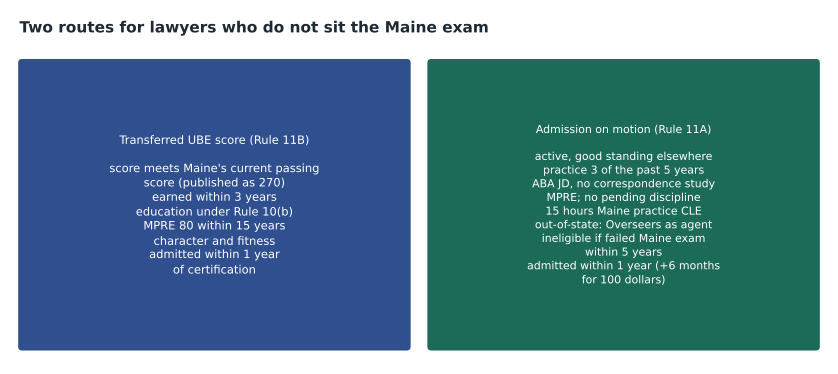
Rule 11B allows an applicant who earned a UBE score in another jurisdiction to transfer it to Maine. NCBE's summary for Maine confirms that Maine accepts transferred scores. The rule's main conditions are that the score must meet Maine's current passing score, which the Board has published as 270 for the legacy UBE, and that the score must have been earned within three years before the date of admission. The applicant must also meet Maine's education requirement under Rule 10(b), pass the MPRE with a score of 80 within fifteen years and satisfy character and fitness review under Rule 9. Once the Board certifies the applicant, the applicant must be admitted within one year.
The applicant asks NCBE to send an official score transcript to the Maine Board. The fee is set by Rule 6, as described in Lesson 2. A transfer applicant does not need to have been admitted in the jurisdiction where the score was earned; a score earned in another UBE jurisdiction by someone who never took the oath there can still be transferred, as long as it meets Maine's conditions.
Owen's score of 276 is above 270 and was earned in July 2026, so it is well within the three-year window, which would close in July 2029. He has a juris doctor from an ABA-accredited law school and an MPRE score of 91. He can apply under Rule 11B now, and his admission depends mainly on how quickly the character review is completed.
Admission on motion
Rule 11A allows experienced lawyers admitted elsewhere to join the Maine bar without an exam. The applicant must be an active member in good standing of the bar of another jurisdiction and must have been primarily engaged in the active practice of law for at least three of the five years before applying. The applicant must hold a juris doctor from an ABA-accredited law school; the rule does not accept degrees earned through correspondence study. The applicant must pass the MPRE, have no discipline pending and show good character and fitness.
Two further requirements are specific to Maine. First, the applicant must complete fifteen hours of continuing legal education on Maine practice and procedure within the year before certification. Second, an applicant who lives outside Maine must designate the Board of Overseers of the Bar as agent for service of process. The rule also excludes some applicants: anyone who has failed the Maine bar exam within the past five years is ineligible for admission on motion.
Once certified, the motion applicant must be admitted within one year. The Board may grant one extension of six months for a fee of 100 dollars. Motion applicants, as Lesson 2 noted, may file at any time rather than in the exam windows, and they pay 1,000 dollars plus NCBE's character report fee.
Priya has practiced full time in New Hampshire for eight years, is in good standing and has no discipline. Her juris doctor is from an ABA-accredited school and her MPRE score of 98 dates from 2017, within the fifteen-year window. She has never sat the Maine exam. She qualifies under Rule 11A, but she must complete fifteen hours of Maine practice and procedure CLE and, because she lives in New Hampshire until her move, designate the Board of Overseers as her agent for service.
| Requirement | Transferred score (Rule 11B) | Admission on motion (Rule 11A) |
|---|---|---|
| Exam score | UBE score meeting Maine's current passing score | Not required |
| Time limit | Score earned within three years | Practice three of the past five years |
| Education | Rule 10(b) standard | ABA juris doctor, no correspondence study |
| MPRE | 80 within fifteen years | 80 within fifteen years |
| Maine CLE before admission | Not required by the rule | 15 hours of Maine practice and procedure within one year before certification |
| Exclusions | Score below Maine's current passing score | Failed Maine exam within five years; pending discipline |
| After certification | Admitted within one year | Admitted within one year; one six-month extension for 100 dollars |
Temporary practice under Rule 11C
Rule 11C allows a lawyer admitted elsewhere to practice in Maine for a limited time while employed by a public defense provider or a nonprofit legal services organization serving low-income clients. The authorization lasts up to two years, giving the lawyer time to qualify by exam, transfer or motion while serving clients who need help. Maine, like many rural states, has a shortage of lawyers in some counties and in public defense, and the rule is one way the court has responded.
Registration and the Board of Overseers
After admission, every Maine lawyer must register with the Board of Overseers of the Bar and renew registration each year, paying the annual fee and reporting required information, including trust account details. A lawyer who fails to register can be administratively suspended. Registration is also how the Overseers know where to send notices, so a lawyer must keep contact information current.
Continuing legal education under Maine Bar Rule 5
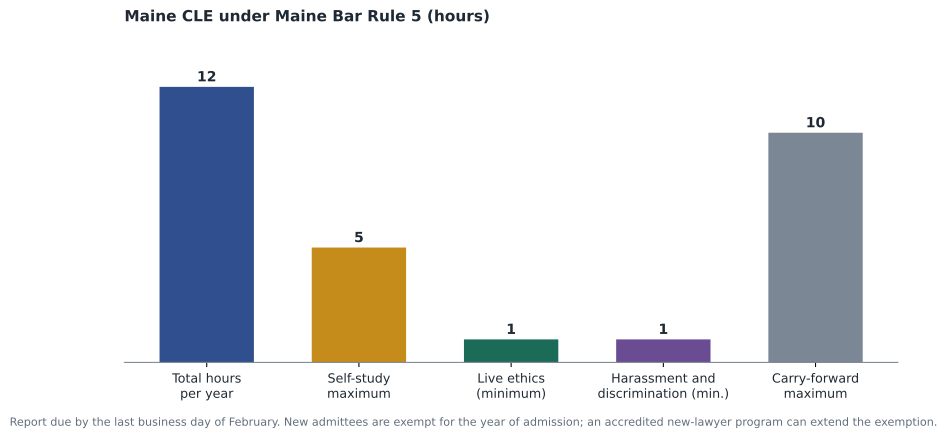
Maine Bar Rule 5 requires twelve credit hours of continuing legal education each year. At most five of those hours may be earned through self-study. Each year's hours must include at least one hour of ethics and professionalism earned live and at least one hour on harassment and discrimination earned in person. A lawyer who earns more than twelve hours may carry up to ten excess hours forward. The reporting period follows the calendar year, and the annual report is due by the last business day of February.
New admittees get a break. A lawyer is exempt from the CLE requirement for the year of admission. A new lawyer who completes an accredited program for new attorneys, such as the Maine State Bar Association's Bridging the Gap program, may also be exempt for the following year, according to the rule's reporter's notes. That exemption gives a new lawyer time to settle into practice, but it is not a reason to skip education; most new Maine lawyers attend several programs in their first years.
Trust accounts
Maine lawyers who hold client money must keep it in a trust account separate from their own funds and follow the Maine rules on recordkeeping. Most client trust accounts in Maine are interest on lawyers' trust accounts, whose interest goes to fund civil legal services. A new lawyer should learn the firm's trust accounting procedures in the first week, because errors in trust accounts are among the most common sources of discipline.
Worked problem
Comparing the two hires
Haskell wants to know whether Priya or Owen can be admitted first. What are the main steps and risks for each?
Show solution
- Owen, transfer. Score of 276 meets 270 and is within three years. He needs an NCBE score transcript, character and fitness review and MPRE confirmation. No Maine CLE is required before admission.
- Priya, motion. She meets the practice and education requirements. She must complete fifteen hours of Maine practice and procedure CLE and designate the Board of Overseers as agent for service while living out of state.
- Timing. Both may file at any time. Character review is the main variable for each.
- Risk. Owen's path is simpler but depends on the three-year score window; Priya's depends on finishing the Maine CLE.
Answer: Either could be admitted in early 2027 if the character reviews go smoothly. Owen has fewer steps; Priya must finish the Maine CLE first.
Common mistakes
MistakeAny passing UBE score can be transferred to Maine.
InsteadThe score must meet Maine's current passing score and be earned within three years.
MistakeAdmission on motion requires five years of practice.
InsteadRule 11A requires active practice for three of the past five years.
MistakeA lawyer who failed the Maine exam can immediately seek admission on motion.
InsteadAn applicant who failed the Maine exam within five years is ineligible for admission on motion.
MistakeMaine requires fifteen CLE hours a year.
InsteadMaine Bar Rule 5 requires twelve hours a year; the fifteen-hour Maine practice course is for motion applicants.
MistakeAll CLE hours can be self-study.
InsteadAt most five of the twelve annual hours may be self-study.
Practice problems
Work each problem on paper first, then reveal the answer to check.
How old may a transferred UBE score be in Maine?
Show answer
It must have been earned within three years before admission.
How many CLE hours must a Maine lawyer earn each year, and how many may be self-study?
Show answer
Twelve hours, at most five of them self-study.
How long may a lawyer practice in Maine under Rule 11C?
Show answer
Up to two years while employed by a public defense or legal services provider.
Choosing between transfer and the exam
A recent examinee from another UBE jurisdiction sometimes faces a choice: transfer the existing score or sit the Maine exam. Transfer is usually faster and cheaper if the score meets Maine's current passing score and the three-year window is still open. An examinee whose score falls short of 270, or whose score is about to age out, may need to sit the Maine exam instead. Because a failure on the Maine exam affects later eligibility for admission on motion, an examinee who expects to qualify on motion in a few years should think carefully before sitting the Maine exam as a backup.
Timing matters for transfers. The score must have been earned within three years before admission, not before filing. An applicant whose score is close to the three-year mark should file early, respond promptly to the Board's questions and complete the character review quickly, because a delay could push admission past the window.
What counts as the practice of law for a motion applicant
Rule 11A requires that the applicant have been primarily engaged in the active practice of law for three of the past five years. The rule and the Board's instructions explain what qualifies. Private practice, work as a government lawyer, in-house counsel work and judicial service commonly count, but the applicant must show that the work was legal work performed while admitted. An applicant whose work mixes legal and nonlegal duties, or who practiced part time, should describe the work in detail and ask the Board early whether it qualifies.
The fifteen hours of Maine practice and procedure CLE give motion applicants a structured introduction to Maine law, covering topics such as Maine civil procedure, Maine courts and Maine professional conduct rules. Programs offered for this purpose cover many of the subjects introduced in Lessons 7 to 10 of this course.
The first year after admission
Admission is the beginning of a new set of duties. In the first weeks, a new Maine lawyer registers with the Board of Overseers, sets up or learns the firm's trust account procedures, registers for electronic filing and obtains malpractice coverage through the firm or individually. In the first months, the lawyer learns local court practices, builds a calendar system for deadlines and starts attending CLE programs, even during the exempt period.
New lawyers also benefit from mentoring. Maine's small bar makes it easy to find experienced lawyers willing to help, and the Maine State Bar Association and county bar associations offer programs for new lawyers. Bridging the Gap, which can extend the CLE exemption, is designed for exactly this purpose.
Keeping CLE records
Maine lawyers report their CLE hours each year, and the Board of Overseers may ask for proof. A lawyer should keep certificates of attendance, note whether each program was live, in person or self-study and track the ethics and harassment and discrimination hours separately. A simple spreadsheet updated after each program avoids a scramble in February. Carry-forward hours, up to ten, should be tracked too, so that the lawyer knows how many hours remain for the next year.
Haskell's decision
After reading Josie's memo, Haskell decides to move forward with both hires. Owen will file under Rule 11B in December, and Priya will start the fifteen hours of Maine practice and procedure CLE in January and file under Rule 11A once she finishes. Josie updates her source file with both timelines. 'If all three of us are admitted by summer,' Haskell says, 'we will need a bigger office.'
Summary and key terms
- Rule 11B transfers require a score meeting Maine's current passing score, earned within three years, plus education, MPRE and character requirements.
- Rule 11A motion admission requires practice three of the past five years, an ABA juris doctor, the MPRE and fifteen hours of Maine practice and procedure CLE.
- A failed Maine exam within five years bars admission on motion; certified motion applicants must be admitted within one year, with one six-month extension.
- Rule 11C allows up to two years of temporary practice for public defense and legal services lawyers.
- Maine Bar Rule 5 requires twelve CLE hours a year, with ethics and harassment and discrimination hours, reported by the last business day of February.
- Transferred score
- A UBE score earned in another jurisdiction and used for admission in Maine under Rule 11B.
- Admission on motion
- Admission without an exam for experienced lawyers under Rule 11A.
- Agent for service
- A person designated to receive legal papers; out-of-state motion applicants designate the Board of Overseers.
- Bridging the Gap
- An accredited program for new Maine lawyers that can extend the new-admittee CLE exemption.
Lesson quiz · 5 questions
Score 60% or more to complete this lesson.
Create a free account to save your progress, take quizzes and earn a certificate.