
BAR-220 · Lesson 8 of 12 · 19 min
Maine tort law: comparative negligence, limitation periods and the Maine Tort Claims Act
▶ Video coming soon A video version of this lesson is on the way.
The plow truck file lands on Josie's desk in mid-October. On an icy morning in late September, an invented town's public works truck, backing out of a side street with its plow raised, struck the parked car of Haskell's client, Denise Gagnon, while she sat inside it waiting for her daughter's school bus. Mrs. Gagnon had a sore neck for weeks and the car needed body work. Haskell hands Josie the folder with two instructions. 'First, find out exactly how long we have to give the town written notice. Second, tell me whether anything Mrs. Gagnon did could reduce what she recovers. And do not tell me the federal rule or the general rule. Tell me Maine.'
This lesson introduces three areas of Maine tort law a new lawyer meets early: Maine's comparative negligence statute, the general limitation period for civil actions and the Maine Tort Claims Act, which governs claims against the state and local governments. None of it is tested on the bar exam, but all of it appears in a small Maine firm's caseload.
Comparative negligence under section 156
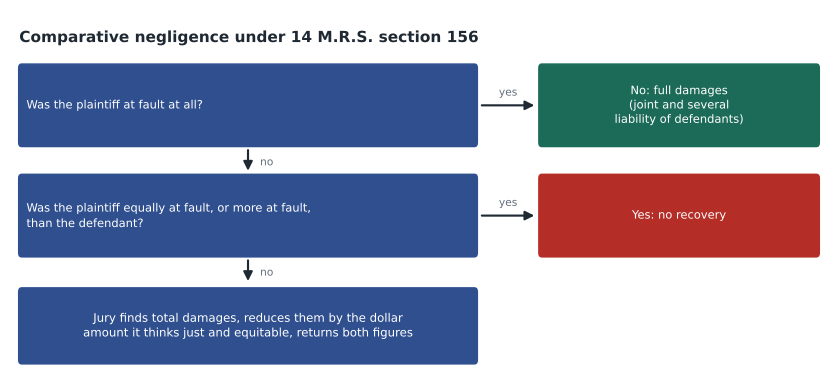
Maine's comparative negligence statute, 14 M.R.S. section 156, replaced the old rule of contributory negligence. Its rule is simple to state. When a person suffers damage partly through the person's own fault and partly through the fault of another, the claim is not defeated by the claimant's fault. Instead, the damages are reduced to the extent the jury thinks just and equitable, having regard to the claimant's share in the responsibility for the damage. There is one important limit: if the claimant is found equally at fault or more at fault than the defendant, the claimant cannot recover.
Maine's statute differs from many comparative negligence rules in how the reduction is expressed. The jury first finds the claimant's total damages as if the claimant were not at fault. It then reduces those damages by the amount it finds just and equitable, and it returns both figures. The reduction is a dollar amount based on the jury's judgment of responsibility, not a percentage multiplied through mechanically. A Maine jury might find total damages of 40,000 dollars and reduce them to 30,000 dollars because the plaintiff was partly at fault, without stating any percentage.
Where there are several defendants, Maine retains joint and several liability. Each defendant found liable can be required to pay the whole of the plaintiff's reduced damages, with rights of contribution among defendants. The court may use special interrogatories to ask the jury to determine each defendant's share of fault, and the statute has provisions for cases in which one defendant settled and was released before trial.
Limitation periods
Maine's general limitation period is long. Under 14 M.R.S. section 752, civil actions must be commenced within six years after the cause of action accrues, unless another statute sets a different period. That general six-year rule covers many personal injury and property damage claims that other states limit to two or three years. Lawyers who come to Maine from other states often notice this difference first.
Several important claims have shorter periods under other statutes. Defamation claims have a shorter period. Medical malpractice claims follow the Maine Health Security Act, which has its own limitation period and requires claims to go through a prelitigation screening panel before suit. Claims against governmental entities and employees under the Maine Tort Claims Act have their own deadlines, discussed below. A new lawyer should never assume that the six-year rule applies without checking the statute that governs the specific claim.
The Maine Tort Claims Act
The Maine Tort Claims Act, in Title 14 beginning at section 8101, governs tort claims against the state, its agencies and political subdivisions such as towns, counties and school districts, and against their employees. Its starting point is immunity: governmental entities are immune from suit on tort claims except where the Act creates an exception. The exceptions include claims arising from the negligent ownership, maintenance or use of motor vehicles and certain other equipment, the negligent construction or maintenance of public buildings, the discharge of pollutants and negligence in certain road construction, street cleaning and repair work. Governmental employees have their own immunities for discretionary functions and certain other acts.
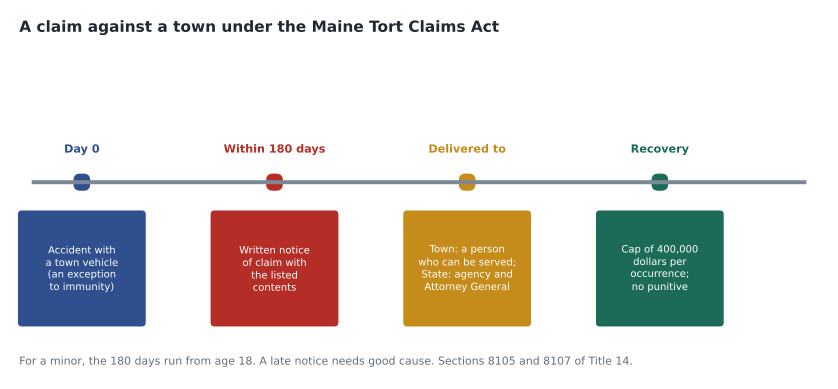
Mrs. Gagnon's claim fits a familiar exception: the negligent operation of a town vehicle. But fitting an exception is only the first step. The Act also limits damages and imposes a strict notice requirement.
The damages cap
Under 14 M.R.S. section 8105, the liability of a governmental entity for claims within the Act is limited to 400,000 dollars for any and all claims arising out of a single occurrence. The cap includes costs and prejudgment interest. Punitive damages are not available against a governmental entity. The statute allows a claimant who believes the cap is inadequate in an exceptional case to petition the Legislature for authority to collect more, which the Legislature rarely grants. Where the entity has insurance coverage above the cap, other provisions of the Act can affect the limit, so a careful lawyer reads the entity's coverage as well as the statute.
Written notice of claim
Section 8107 requires a claimant to file a written notice of claim within 180 days after the cause of action accrues. The notice must be in writing and must contain the information the statute lists: the claimant's name and address, the name and address of the claimant's attorney if any, a concise statement of the basis of the claim including the date, time, place and circumstances of the act or omission, the name of any governmental employee involved if known, the nature and extent of the injury and the amount of damages claimed. For a claim against the state, the notice goes to the state agency involved and to the Attorney General. For a claim against a political subdivision such as a town, it goes to a person upon whom a summons and complaint could be served under the civil rules.
The statute allows a late notice when the claimant shows good cause why it could not reasonably have been filed within 180 days, but courts read that exception narrowly. For a minor, the 180 days run from the minor's eighteenth birthday. Haskell's instruction to Josie was well placed: a firm that misses the notice deadline may lose a valid claim entirely.
| Issue | Maine rule | Source |
|---|---|---|
| Plaintiff equally at fault | No recovery | 14 M.R.S. section 156 |
| Plaintiff less at fault | Damages reduced as the jury thinks just and equitable, in dollars | 14 M.R.S. section 156 |
| General limitation period | Six years after accrual | 14 M.R.S. section 752 |
| Claim against a town | Written notice of claim within 180 days | 14 M.R.S. section 8107 |
| Governmental damages | Capped at 400,000 dollars per occurrence, no punitive damages | 14 M.R.S. section 8105 |
Worked problem
The plow truck claim
The town truck backed into Mrs. Gagnon's parked car on an invented date of September 24, 2026. She was sitting in the car, which was legally parked, with her seat belt on. What should Josie report to Haskell?
Show solution
- Exception. Negligent operation of a town vehicle falls within an exception to immunity under the Tort Claims Act.
- Written notice. The notice, with the contents listed in section 8107 must reach a person who could be served for the town within 180 days, so well before late March 2027. The firm should send it now.
- Fault. A legally parked, belted occupant is unlikely to be found at fault; if she were found equally at fault she would recover nothing under section 156, and otherwise any reduction would be a dollar amount.
- Damages. Any recovery against the town is capped at 400,000 dollars per occurrence, far above this claim's likely value, and punitive damages are unavailable.
Answer: The claim fits a Tort Claims Act exception. The firm should send a complete written notice of claim promptly, well within the 180 days; comparative fault is unlikely to reduce recovery, and the cap is not a practical concern.
Josie drafts the notice that afternoon. Haskell reads it, adds the adjuster's claim number from the town's insurer, and signs it. 'We send this by a method we can prove,' he says. 'And we calendar the limitation period for suit on the same day.'
Common mistakes
MistakeMaine uses pure comparative fault.
InsteadA Maine plaintiff found equally at fault or more at fault than the defendant recovers nothing.
MistakeMaine juries reduce damages by a percentage.
InsteadThe jury reduces total damages by the dollar amount it thinks just and equitable and returns both figures.
MistakeMaine personal injury claims must be brought within two years.
InsteadThe general limitation period under section 752 is six years, though specific statutes set shorter periods for some claims.
MistakeA claim against a town needs no advance written notice.
InsteadSection 8107 requires written notice of claim within 180 days.
MistakePunitive damages are available against a Maine town.
InsteadSection 8105 bars punitive damages against governmental entities.
Practice problems
Work each problem on paper first, then reveal the answer to check.
What is the damages cap under the Maine Tort Claims Act?
Show answer
400,000 dollars per occurrence, including costs and prejudgment interest.
When does the 180-day notice period run for a minor?
Show answer
From the minor's eighteenth birthday.
What happens under section 156 if the jury finds the plaintiff and defendant equally at fault?
Show answer
The plaintiff recovers nothing.
A worked comparative negligence example
Consider an invented case. A cyclist rides at dusk without a rear light and is struck by a driver who looked down at a phone. The jury finds that the cyclist's total damages are 120,000 dollars. It then considers the parties' shares of responsibility. If it finds the cyclist equally at fault with the driver, or more at fault, the cyclist recovers nothing under section 156. If it finds the cyclist less at fault, it reduces the 120,000 dollars by whatever amount it thinks just and equitable, perhaps to 90,000 dollars, and returns both figures on the verdict form.
The structure has practical effects. Because the jury does not have to state a percentage, lawyers argue about responsibility in terms of conduct and fairness rather than numbers. Because a finding of equal fault bars recovery entirely, a plaintiff's lawyer must take seriously any evidence that the plaintiff contributed to the harm, and a defense lawyer may focus on raising the plaintiff's share to at least an equal level.
Multiple defendants and settlements
When several defendants share responsibility, joint and several liability means the plaintiff can collect the whole reduced judgment from any liable defendant. That defendant can then seek contribution from the others. Special interrogatories can ask the jury to allocate fault among the defendants, which helps the court apportion contribution. When one defendant settles before trial and is released, section 156 and related provisions govern how the release affects the claims against the remaining defendants. A lawyer negotiating a settlement with one of several defendants should read those provisions carefully, because the wording of the release can affect what the plaintiff can recover from the others.
Why limitation periods deserve care
The general six-year period in section 752 is generous, but it is a default. Claims governed by other statutes can have much shorter periods, and some claims require a notice step before suit. Medical malpractice claims go through the Maine Health Security Act's prelitigation procedures. Claims against governmental entities require the Tort Claims Act notice within 180 days and have their own limitation period for filing suit. Wrongful death claims have their own statute. A new lawyer who assumes six years for every claim will eventually miss a deadline.
Accrual also matters. A limitation period runs from the time the cause of action accrues, which is usually the date of injury but can be different for certain claims, such as those involving a hidden injury or a professional's error discovered later. Maine's statutes and case law address accrual for specific claims, and the question can decide whether a claim is timely.
Working with a town's insurer
Many Maine towns are insured through risk pools or commercial insurers, and a Tort Claims Act claim often begins with an adjuster rather than a town official. The adjuster may ask for medical records, repair estimates and a recorded statement. The lawyer should cooperate where it helps the claim but should not treat contact with an adjuster as a substitute for the statutory notice. The notice must be sent in the form and to the person the statute requires, within 180 days, whatever informal discussions are under way.
The insurer's coverage can also matter for the cap. The Act's cap of 400,000 dollars per occurrence applies to the governmental entity's liability, and the Act includes provisions on how insurance coverage interacts with immunity and the cap. In a serious injury case, the lawyer should obtain the coverage details early.
Josie's report to Haskell
Josie's memo to Haskell on the Gagnon file runs one page. It states the exception that applies, the 180-day notice deadline and where the notice must go, the comparative negligence analysis, the cap and the bar on punitive damages, and the next steps: send the notice, gather medical records and the repair estimate and calendar the limitation period for suit. Haskell reads it and returns it with a single note: 'This is what a client file should look like.'
Summary and key terms
- Under 14 M.R.S. section 156, a plaintiff equally or more at fault recovers nothing; otherwise the jury reduces damages as it thinks just and equitable.
- Maine juries find total damages, reduce them in dollars and return both figures; defendants are jointly and severally liable.
- The general limitation period under section 752 is six years, but specific statutes set other periods.
- The Maine Tort Claims Act starts from immunity and creates exceptions, including negligent operation of vehicles.
- Governmental claims require written notice within 180 days and are capped at 400,000 dollars per occurrence.
- Comparative negligence
- A rule that reduces rather than bars a negligent plaintiff's recovery, within limits.
- Joint and several liability
- Liability under which each liable defendant may be required to pay the whole judgment.
- Tort claim notice
- The written notice a claimant must give a governmental entity within 180 days under the Maine Tort Claims Act.
- Governmental immunity
- Protection of governmental entities from tort suits except where a statute creates an exception.
Lesson quiz · 5 questions
Score 60% or more to complete this lesson.
Create a free account to save your progress, take quizzes and earn a certificate.