
BAR-220 · Lesson 12 of 12 · 26 min
Capstone: Maine practice questions and an exam-day plan
▶ Video coming soon A video version of this lesson is on the way.
On the evening of Friday, November 20, 2026, Josie sits at her kitchen table in Bangor with a timer, a printed set of ten practice questions Marchetti wrote for her and one timed essay. Five questions test the Maine admission rules and Maine practice from this course; five are general-law questions of the kind the MBE asks. She finishes in forty minutes, then writes the essay in thirty. She gets nine of the ten questions right, all five Maine questions among them, and misses one evidence question about a present sense impression. Her essay, on the liability of a limited liability company member, earns a strong grade from Marchetti, with one comment: she spotted the issue but did not state the default rule before applying it. 'Rule first,' Marchetti writes. 'Then facts. Then conclusion. Every time.'
This capstone pulls the course together in two parts. The first part offers original practice questions that test the distinction at the heart of this course: the Maine rules that govern admission and practice and the general rules tested on the exam. The second part builds a written plan for the weeks before the exam and the two exam days. The questions are invented for this course and are not released bar exam questions.
Part one: practice questions
Each question below is followed by a short answer and an explanation. Work each one before reading the answer, and note whether the question calls for a Maine rule or a general rule. That habit is the single most useful thing a working clerk can carry into February.
Practice problems
Work each problem on paper first, then reveal the answer to check.
Question 1. An applicant who graduated in May 2026 files a February 2027 application on December 22, 2026. Will the Board accept it for that exam?
Show answer
No. Rule 5 sets the February window from October 15 to December 20, with no late filing period. The applicant should file in the March 15 to May 20, 2027 window for the July exam.
Question 2. A lawyer admitted in Vermont for seven years, practicing full time, failed the Maine exam four years ago. Can she seek admission on motion under Rule 11A?
Show answer
No. An applicant who failed the Maine exam within the past five years is ineligible for admission on motion. She could sit the exam again or, if she holds a qualifying UBE score earned within three years, consider a transfer.
Question 3. An examinee in Maine has a scaled MBE score of 133 and a scaled written score of 136. What is the combined score, and does it meet the published passing score?
Show answer
The combined score is 269, one point below the published passing score of 270, so it does not pass.
Question 4. A Maine jury finds a plaintiff 50 percent at fault and the defendant 50 percent at fault in a car crash case. What does the plaintiff recover under 14 M.R.S. section 156?
Show answer
Nothing. A plaintiff found equally at fault cannot recover under Maine's statute.
Question 5. A client injured by a county snowplow on January 10, 2027 comes to a firm on August 1, 2027. What is the first concern under the Maine Tort Claims Act?
Show answer
Written notice of claim was due within 180 days after the claim accrued, so by early July 2027. The firm must consider whether good cause allows a late notice, which courts read narrowly.
Question 6. In federal court, a defendant served with a summons and complaint and not waiving service must generally answer within how many days?
Show answer
21 days under the Federal Rules of Civil Procedure. The Maine rule's twenty days is the wrong answer on the MBE.
Question 7. A witness testifies that a bystander, watching a car run a red light, said at that moment, There goes a car through the red light. Under the Federal Rules of Evidence, what is the best basis for admitting the statement?
Show answer
Present sense impression: a statement describing an event made while or immediately after the declarant perceived it.
Question 8. A seller and buyer sign a written contract for the sale of a house that says nothing about the closing date. What will a court generally imply?
Show answer
A reasonable time for performance, under general contract principles.
Question 9. Under the general rule of business associations, are members of a limited liability company personally liable for its debts merely because they are members?
Show answer
No. Members are generally not personally liable for the company's obligations solely by reason of membership, though they may be liable for their own conduct or if a court disregards the entity.
Question 10. A lawyer's client says he plans to sell property he has no authority to sell and asks the lawyer to keep quiet. Under the ABA Model Rules tested on the MPRE, may the lawyer assist the sale?
Show answer
No. A lawyer may not counsel or assist a client in conduct the lawyer knows is fraudulent or criminal. Whether the lawyer may disclose depends on the exceptions in Model Rule 1.6, which are permissive.
Josie's answers line up with the pattern in her results. Questions 1 to 5 call for Maine rules; questions 6 to 10 call for general or federal rules. She answered every Maine question correctly and missed only question 7, which she had answered as an excited utterance. 'The bystander was calm,' Marchetti points out. 'Excited utterance needs a startling event and a statement made under the stress of excitement. Present sense impression only needs the timing.'
Part two: the weeks before the exam
A good plan for the final three months does three things: it keeps the general law fresh, it builds speed under timed conditions and it protects health and sleep. Marchetti and Josie build hers in writing.
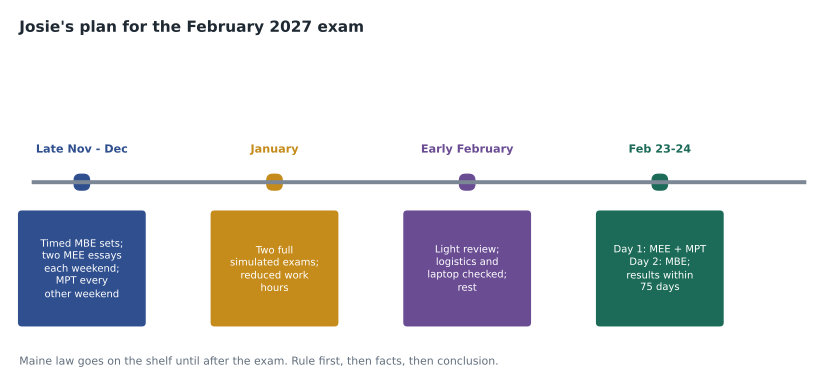
From late November to the end of December, Josie plans to work through timed MBE sets of thirty-three questions several mornings a week, write two MEE essays each weekend and complete one MPT every other weekend. She will review every missed MBE question and write the rule she missed in a short notebook. In January she plans two full simulated exams, each over two days, about two weeks apart. Haskell has agreed to reduce her hours beginning in January and to give her the full week of the exam off.
The plan also keeps a short Maine page, but for after the exam. During the final weeks she will not study Maine tort law, Maine family law or Maine procedure at all. 'You have earned that knowledge,' Marchetti says. 'Put it on a shelf until March.'
Part three: the exam days
The two exam days follow the schedule from Lesson 4: the MEE and MPT on Tuesday, February 23, and the MBE on Wednesday, February 24. A written plan for each day removes small decisions so that energy goes to the questions.
| When | What to do | Why |
|---|---|---|
| Two weeks before | Confirm the location, reporting time and permitted items from the Board's instructions; confirm laptop software is registered | Avoid surprises and the risk of handwriting |
| The day before | Light review only, pack the permitted items, check the route, eat normally and sleep | Fatigue costs more points than one more hour of review |
| Tuesday morning | Six MEE essays in three hours, about thirty minutes each; outline briefly, rule first, then facts and conclusion | Graders reward organized answers that state the rule |
| Tuesday afternoon | Two MPTs in three hours, about ninety minutes each; read the task memo first, then the library, then the file | The task tells you what to look for |
| Wednesday | Two MBE sessions of 100 questions; about 1.8 minutes per question; mark and move on | Pacing protects the last questions |
| After the exam | Rest; do not compare answers; return to work | Results come within seventy-five days |
Common errors to avoid
Marchetti closes the course with a short list of errors she has seen in Maine applicants. The first is mixing Maine law into general law answers, which this course has addressed throughout. The second is losing track of the filing windows, especially for applicants coming from states with a single early deadline. The third is incomplete character and fitness disclosures. The fourth is assuming that Maine's passing score, NextGen date or transfer rules match those of a neighboring state. The fifth is spending the last week studying new material rather than resting.
Worked problem
A last-week decision
Five days before the exam, Josie learns that a friend in another state is studying a new outline on conflict of laws. Should she add that subject to her review?
Show solution
- Check the content. NCBE removed conflict of laws from the MEE beginning in July 2026.
- Check the plan. Her plan calls for light review of tested subjects and rest in the final week.
- Weigh the cost. New material in the last week adds stress and takes time from tested subjects.
- Decide. She should keep to her plan.
Answer: No. Conflict of laws is no longer an MEE subject, and the last week is for light review and rest.
The finish line
At their final session of November, Marchetti hands Josie a card with three lines in her handwriting: rule first; general law on the exam, Maine law at the office; sleep. Josie tapes it inside the front cover of her notebook. Her filing is in, her MPRE score is reported and her plan for the final months is written down. What remains is the work.
'February 23,' Marchetti says. 'You will be ready.'
Common mistakes
MistakeThe final week is the best time to learn new subjects.
InsteadThe final week is for light review and rest; new material adds stress and takes time from tested subjects.
MistakeMaine rules on filing, scoring and transfer match those of nearby states.
InsteadMaine has its own windows, published passing score, NextGen date and transfer conditions.
MistakeAn MPT should be read from the first page of the file to the last.
InsteadRead the task memo first so you know what to look for in the file and library.
MistakeAn excited utterance and a present sense impression are the same.
InsteadAn excited utterance needs a startling event and stress; a present sense impression needs only contemporaneous description.
Reviewing missed questions
Josie's single miss on the capstone is a useful example of how to review. She does not simply note the right answer. She writes out the elements of both exceptions she confused, the present sense impression and the excited utterance, and then writes one sentence explaining which fact in the question pointed to the right one: the bystander was calm and spoke while watching. She adds a line to her MBE notebook and plans to work ten more evidence questions on hearsay exceptions that week.
That method works for any missed question. Identify the rule that was tested, identify the fact that triggered it, identify why the wrong answer was tempting and write a short note that will help the next time. Over a few months, the notebook becomes a personal outline of the rules most likely to trip up the examinee.
Writing a better essay in thirty minutes
Marchetti's comment on Josie's essay, rule first, applies to every MEE answer. A strong structure for each issue is a heading that names the issue, a sentence or two stating the rule, a short paragraph applying the rule to the specific facts and a one-sentence conclusion. On the limited liability company question, Josie identified that a member was not personally liable merely by being a member but did not state the default rule before applying it. Stating it explicitly would have taken one sentence and earned the credit she missed.
Timing matters as much as structure. Thirty minutes per essay leaves about five minutes to read the question and outline, about twenty minutes to write and a few minutes to check that every part of the call has been answered. An examinee who finishes an essay early should move on rather than polish, saving the time for a harder question later in the session.
Managing the days around the exam
The days immediately before and after the exam deserve planning too. The week before, Josie will review her notebook of missed rules, work a small number of timed questions to stay sharp and rest. The night before each day, she will lay out her admission ticket, identification and permitted items. Between the two days, she will avoid comparing answers with other examinees, which tends to increase anxiety without changing anything.
After the exam, she plans to take two days off before returning to the firm. Results will come within seventy-five days, and the character review should be finished by then. In the meantime, she can return to the Maine law she set aside: the plow truck claim, the probate file and the guardianship case. That work will not wait, and it is the reason she sat the exam in the first place.
What this course has covered
The twelve lessons have followed the path to a Maine law license: the bodies that control admission, the education and filing rules, character and fitness and the MPRE, the legacy UBE and Maine's published passing score, the coming change to NextGen, the difference between exam law and Maine law, and an introduction to the Maine courts, tort law, the Wabanaki Nations, family law, probate, professional conduct, transfers, admission on motion and practice after admission. The common thread is careful attention to the rule that actually applies, whether it is a filing window, a passing score or the law a question calls for.
Summary and key terms
- Practice questions should be labeled as calling for Maine rules or for general and federal rules.
- A final-months plan builds timed practice, full simulations and rest, with Maine law set aside until after the exam.
- Day one is six MEE essays and two MPTs; day two is the 200-question MBE.
- Confirm location, reporting time, permitted items and laptop registration from the Board's instructions.
- Rule first, then facts, then conclusion.
- Present sense impression
- A hearsay exception for a statement describing an event made while or immediately after the declarant perceived it.
- Excited utterance
- A hearsay exception for a statement about a startling event made under the stress of the excitement it caused.
- Simulated exam
- A full-length practice exam taken under timed conditions over the same schedule as the real exam.
- Task memo
- The instructions at the start of an MPT that describe the assignment.
Lesson quiz · 5 questions
Score 60% or more to complete this lesson.
Create a free account to save your progress, take quizzes and earn a certificate.