
BAR-220 · Lesson 7 of 12 · 18 min
Maine courts and civil procedure
▶ Video coming soon A video version of this lesson is on the way.
In early November, Haskell takes Josie to the Penobscot Judicial Center in Bangor for a morning of hearings. In one courtroom a District Court judge hears a protection from abuse petition and then a contested child support motion. Down the hall, the Superior Court clerk is setting a civil jury trial in a car crash case. In the afternoon they drive to the Penobscot County Probate Court, where an elected judge who also keeps a private law practice approves a small estate settlement. 'Three courts in one day,' Haskell says on the drive back, 'and only one of them could have given us a jury. Learn which court does what, and half of Maine procedure falls into place.'
This lesson introduces the Maine court system and the main features of Maine civil procedure that a new lawyer meets early. None of it is tested on the bar exam, which follows the federal rules, but all of it appears in a first-year Maine practice.
The Supreme Judicial Court
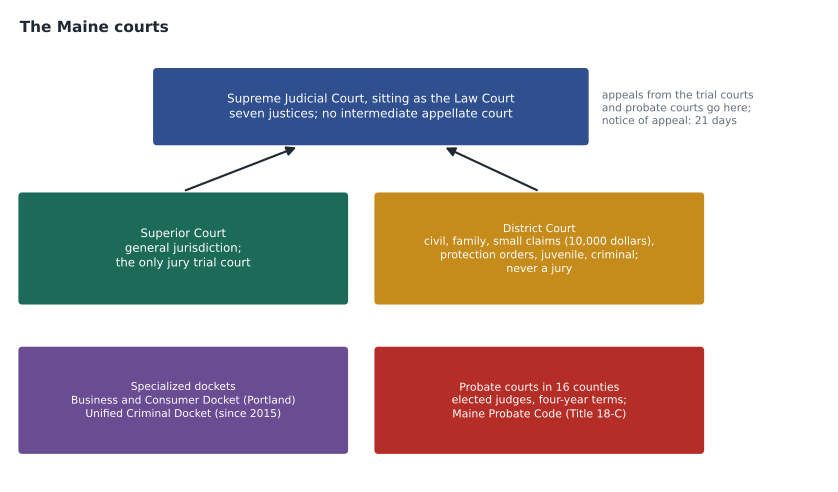
The Maine Supreme Judicial Court is the state's highest court. It has seven justices, including the Chief Justice. When it hears appeals it sits as the Law Court, and Maine appellate decisions are cited to the Law Court by their year and a sequential number, such as a decision cited as 2026 ME followed by a number. Maine has no intermediate appellate court, so the Law Court hears appeals directly from the trial courts. That structure gives the court a broad docket and makes its decisions the main source of Maine common law.
The Supreme Judicial Court also has administrative and rulemaking roles. It adopts the rules of civil and criminal procedure, evidence, probate procedure and appellate procedure, along with the Bar Admission Rules and the Maine Bar Rules, and it oversees the Judicial Branch. A new lawyer reads its rule amendments carefully, because they take effect on announced dates and often change practice in small but important ways.
The trial courts
Maine has two statewide trial courts. The Superior Court is Maine's court of general jurisdiction and the only Maine court that holds jury trials. It hears civil cases of any size, serious criminal cases and appeals from certain agency and local government decisions. The District Court hears civil cases, family matters, small claims, protection from abuse and harassment cases, juvenile cases, civil violations and many criminal matters, but it never holds a jury trial. A civil case in which a party wants a jury must be in the Superior Court or be removed there.
Criminal cases are handled through the Unified Criminal Docket, which since 2015 has combined the criminal work of the Superior and District Courts in each county into one docket. A criminal case moves through one process, and a defendant who wants a jury trial has it in the Superior Court.
Maine also has a Business and Consumer Docket, a specialized statewide docket based in Portland for complex business and consumer cases. Cases are transferred to it on application. Its procedures include active case management and presumptive discovery limits: thirty interrogatories, thirty requests for production, twenty requests for admission and five depositions per side, unless the judge orders otherwise.
The probate courts
Maine's probate courts are different from the rest of the system. Each of Maine's sixteen counties has its own probate court, and the probate judges are elected in partisan county elections for four-year terms. Most serve part time and may keep a private practice, subject to limits on practicing in their own court. Probate courts handle estates, guardianships and conservatorships, adoptions, name changes and some trust matters, under the Maine Probate Code in Title 18-C and the Maine Rules of Probate Procedure. Lesson 10 covers probate law in more detail.
Judges and selection
Justices of the Supreme Judicial Court and judges of the Superior and District Courts are appointed by the Governor and confirmed by the Maine Senate for seven-year terms, and they may be reappointed. Probate judges, as noted, are elected. Maine has no judicial retention elections for its appointed judges.
| Court | Main work | Jury? | Judges |
|---|---|---|---|
| Supreme Judicial Court (Law Court) | Appeals, rules, oversight of the bar | No | Seven justices, appointed |
| Superior Court | General civil and serious criminal cases, appeals from agencies | Yes, the only jury trial court | Appointed |
| District Court | Civil, family, small claims, protection orders, juvenile, criminal matters | Never | Appointed |
| Probate courts (16 counties) | Estates, guardianships, adoptions, name changes | No | Elected for four-year terms |
Key civil procedure rules
The Maine Rules of Civil Procedure follow the structure of the federal rules, so a lawyer who knows the federal rules can find the matching Maine rule quickly. The details often differ. A defendant must answer within twenty days after service of the summons and complaint. Discovery reaches any matter, not privileged, that is relevant to the subject matter of the pending action, a broader formula than the federal rule's relevance and proportionality test, and Maine has no general requirement of initial disclosures. A Maine lawyer serves discovery requests rather than waiting for automatic exchanges.
Review of government decisions has its own rules. Rule 80B governs review in the Superior Court of action or failure to act by a governmental body, such as a town planning board, and the complaint is generally due within thirty days after notice of the action. Rule 80C governs review of final agency action under the Maine Administrative Procedure Act. Family matters in the District Court follow a separate chapter of the civil rules, with case management conferences, financial statements and parent education requirements.
Small claims cases are heard in the District Court without a jury under simplified procedures. Beginning January 1, 2026, the small claims limit is 10,000 dollars. Small claims are useful for landlords, tenants and small businesses, and new lawyers often handle them for clients who need quick, inexpensive resolution.
Maine has moved to electronic filing. The Maine Rules of Electronic Court Systems govern filing through the Judicial Branch's system, and rule amendments effective January 31, 2026 extended the rules as more case types moved online. A new lawyer should register for electronic filing early and read the rules for each court and case type, because some matters may still require paper filings.
Appeals and evidence
An appeal to the Law Court begins with a notice of appeal filed in the trial court within twenty-one days after entry of the judgment under Rule 2B of the Maine Rules of Appellate Procedure. Missing that deadline usually ends the appeal, so Maine lawyers calendar it the day judgment is entered.
The Maine Rules of Evidence also track the federal rules in structure with their own differences. Two recent amendments show how the rules change. Rule 804(b)(6), adding a hearsay exception for statements offered against a party that wrongfully caused the declarant's unavailability, took effect on October 14, 2025. New Rule 902(13) and (14), allowing certain electronic records and data copied from electronic devices to be authenticated by certification, took effect on November 1, 2026.
Worked problem
Choosing a court
Haskell's client, Mrs. Ouellette (an invented client), wants to sue a contractor for 18,000 dollars over a leaking roof and wants a jury. Where should the case be filed, and what deadlines follow?
Show solution
- Consider small claims. The claim exceeds the 10,000-dollar small claims limit, so small claims is not available for the full amount.
- Consider the jury demand. Only the Superior Court holds jury trials, so the case belongs in the Superior Court.
- Note the defendant's deadline. The contractor must answer within twenty days after service.
- Plan discovery. Maine has no general initial disclosures, so Haskell should serve interrogatories and document requests promptly.
Answer: File in the Superior Court, expect an answer within twenty days of service and serve discovery early.
At the end of her day in court, Josie writes three lines in her notebook: the Law Court is the only appellate court; only the Superior Court has juries; probate judges are elected. She tapes the page inside her office desk drawer, next to the exam schedule. 'Those are for practice,' she tells Marchetti. 'Not for February.'
Common mistakes
MistakeMaine has an intermediate court of appeals.
InsteadAppeals go directly to the Supreme Judicial Court sitting as the Law Court.
MistakeThe District Court can hold a jury trial.
InsteadThe District Court never holds jury trials; the Superior Court is the only jury trial court.
MistakeMaine probate judges are appointed like other judges.
InsteadProbate judges are elected in each county for four-year terms.
MistakeMaine discovery follows the federal proportionality standard and initial disclosures.
InsteadMaine discovery reaches matters relevant to the subject matter and has no general initial disclosures.
MistakeThe small claims limit is 6,000 dollars.
InsteadThe small claims limit is 10,000 dollars beginning January 1, 2026.
Practice problems
Work each problem on paper first, then reveal the answer to check.
How long does a party have to file a notice of appeal to the Law Court?
Show answer
Twenty-one days after entry of the judgment.
Which Maine trial court holds jury trials?
Show answer
The Superior Court only.
What are the presumptive discovery limits on the Business and Consumer Docket?
Show answer
Thirty interrogatories, thirty requests for production, twenty requests for admission and five depositions.
How a civil case moves in the Superior Court
A typical civil case in the Superior Court follows a familiar path. The plaintiff files a complaint and serves it with a summons, and the defendant answers within twenty days or moves to dismiss. The court issues a scheduling order setting deadlines for amending pleadings, designating experts, completing discovery and filing dispositive motions. The parties exchange interrogatories, document requests and requests for admission, and they take depositions. Many cases go through alternative dispute resolution, such as mediation, before trial, and Maine's rules encourage or require it in many civil actions.
Motions for summary judgment in Maine follow a structured format. The moving party files a statement of material facts with record citations, and the opposing party must respond to each fact, admitting, denying or qualifying it with its own record citations. Facts not properly controverted may be deemed admitted. New Maine lawyers learn quickly that the statement of material facts, not the memorandum of law, is where summary judgment is usually won or lost.
If the case does not settle, it is tried to a jury if a party demands one in time, or to the judge. After judgment, a party who wants to appeal files a notice of appeal within twenty-one days, and the case goes directly to the Law Court.
Family matters in the District Court
Family cases follow their own track. A divorce or parental rights case begins with a complaint in the District Court, and the court sets a case management conference. The parties exchange financial statements and child support affidavits. Mediation is common and is often required before a contested hearing. Parents in cases involving children may be required to attend a parent education program. Family law magistrates handle many early stages, including case management and interim orders, and judges decide contested final hearings.
Because the District Court never holds jury trials, family cases are always decided by a judge or magistrate. That shapes how lawyers prepare. Evidence is presented to a judicial officer who hears many similar cases, and clear organization and credible witnesses matter more than dramatic presentation.
Reviewing local government decisions
Small Maine firms often represent clients before town boards: planning boards on subdivision applications, zoning boards of appeals on variances and select boards on licenses. When a client is unhappy with a final local decision, the path to court usually runs through Rule 80B. The complaint is filed in the Superior Court, generally within thirty days after notice of the decision, and the court reviews the record made before the local board rather than holding a new trial. Because the record matters so much, lawyers who appear before local boards make sure the board hears all the evidence they may later need in court.
Review of state agency action follows Rule 80C and the Maine Administrative Procedure Act. The structure is similar: a petition in the Superior Court, review on the agency record and deference to the agency's findings of fact if supported by substantial evidence. Deadlines and procedures differ in details, so a lawyer should read both the rule and any statute specific to the agency.
Practical habits for court practice
Haskell gives Josie three habits for her first year in Maine courts. First, calendar every deadline the day it is triggered: the answer date when a complaint is served, the appeal date when a judgment is entered, the 80B date when a town decision is announced. Second, read the current version of the rules before every filing, because Maine amends its rules regularly. Third, learn the clerks. Clerks in each courthouse know local practices, and a polite call can save a rejected filing.
Summary and key terms
- The Supreme Judicial Court has seven justices and sits as the Law Court; there is no intermediate appellate court.
- The Superior Court is the only jury trial court; the District Court never has a jury.
- Sixteen county probate courts have elected judges serving four-year terms.
- Maine answers are due in twenty days, discovery reaches the subject matter and there are no general initial disclosures.
- Notices of appeal are due in twenty-one days, and the small claims limit is 10,000 dollars from January 1, 2026.
- Law Court
- The Supreme Judicial Court when it sits to hear appeals.
- Unified Criminal Docket
- The combined criminal docket of the Superior and District Courts in each county.
- Business and Consumer Docket
- Maine's specialized statewide docket for complex business and consumer cases.
- Rule 80B
- The Maine civil rule governing Superior Court review of governmental action.
Lesson quiz · 5 questions
Score 60% or more to complete this lesson.
Create a free account to save your progress, take quizzes and earn a certificate.