
BAR-220 · Lesson 4 of 12 · 18 min
The Maine bar exam: the UBE, scoring and the 270 passing score
▶ Video coming soon A video version of this lesson is on the way.
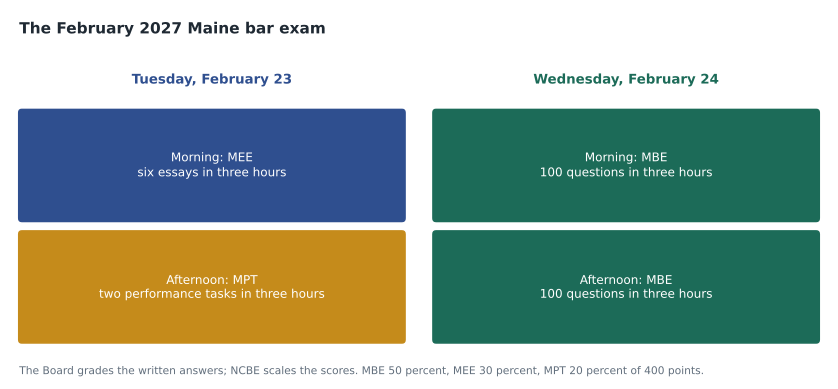
At their third session Marchetti draws two columns on the whiteboard and labels them Tuesday and Wednesday. 'Tuesday is writing,' she says. 'Six essays in the morning, two performance tests in the afternoon. Wednesday is the MBE: one hundred multiple-choice questions in the morning and one hundred in the afternoon. Those are your days, February 23 and 24. Maine has given this same exam since it adopted the Uniform Bar Examination, and it will keep giving it until February 2028. You are not sitting the last one. That gives you a safety net that some of your friends in other states do not have.'
This lesson describes the legacy Uniform Bar Examination as Maine gives it: its three parts, how the score is built, what Maine's passing score of 270 means and how results are released. Lesson 5 covers the NextGen exam that replaces it in July 2028.
The three parts
Rule 10(c) of the Maine Bar Admission Rules provides that the bar exam is the Uniform Bar Examination prepared by NCBE. The legacy UBE has three parts. The Multistate Essay Examination (MEE) consists of six essay questions answered in three hours. The Multistate Performance Test (MPT) consists of two performance tasks answered in three hours. The Multistate Bar Examination (MBE) consists of two three-hour sessions of 100 multiple-choice questions each. A score that other jurisdictions will accept as a UBE score requires sitting all three parts in the same administration in the same jurisdiction.
The MBE's 200 questions include 175 scored questions and 25 unscored pretest questions, mixed together so that examinees cannot tell them apart. The scored questions cover seven subjects in equal shares of 25 each: civil procedure, constitutional law, contracts, criminal law and procedure, evidence, real property and torts. The MBE tests generally accepted principles of law and the Federal Rules of Civil Procedure and Federal Rules of Evidence, not the law of Maine or any other state.
The MEE asks examinees to analyze facts and write organized answers. Beginning with the July 2026 exam, NCBE removed four subjects from the MEE: conflict of laws, family law, trusts and estates, and secured transactions. For the February 2027 exam the MEE can test the seven MBE subjects and business associations, which includes agency, partnerships, corporations and limited liability companies. Family law and trusts and estates can still appear on the MPT, where the needed law is supplied in the library.
The MPT tests lawyering skills rather than memorized law. Each task gives a file of facts, such as an interview transcript, letters and documents, and a library of cases and statutes, often from an invented jurisdiction. The examinee must produce a document such as an objective memorandum, a persuasive brief, a client letter or a set of contract provisions, working only from the materials provided.
How the score is built
The legacy UBE produces a single combined score on a 400-point scale. The MBE counts for 50 percent of the total, the MEE for 30 percent and the MPT for 20 percent. NCBE scores the MBE and converts the number of correct answers into a scaled score through equating, a statistical process that adjusts for small differences in difficulty between exam forms. A scaled MBE score of 140 in February 2027 therefore means the same level of performance as 140 in July 2026.
Rule 10(c) provides that the Board grades the written answers and NCBE scales the scores. Maine graders, working from NCBE's grading materials, read and rank the essays and performance tests. Graders judge answers relative to one another rather than against a fixed checklist, which is why a clear, well-organized answer that reaches a sound conclusion can outscore a longer answer that lists every rule. The raw written scores are then scaled to the MBE: they are placed on the same scale as the MBE scores of the same group of examinees. This step keeps the written score steady even if a group of graders is a little strict or a little lenient.
The combined score is the sum of the scaled MBE score and the scaled written score, each reported on a 200-point scale. Strength in one part can make up for weakness in another. Maine does not set a separate minimum for each part. Only the combined score decides the result.
Maine's passing score
NCBE's jurisdiction information lists Maine's passing score on the legacy UBE as 270, the most common passing score among UBE jurisdictions. Maine's own rule is worded differently from some states' rules. Rule 10(c) does not write a number into the rule; instead it provides that the Board sets the passing score before each exam. In practice the Board has used 270, but a careful applicant checks the Board's announcement for the specific exam rather than assuming. The rule also provides that the score certified by NCBE is final, so there is no regrading or appeal of a score.
The difference matters for transfer applicants too. Under Rule 11B, as Lesson 11 explains, a transferred score must meet Maine's current passing score. An applicant who earned 268 in a state that passes at 266 has passed there but would not meet Maine's 270.
| Score element | Scale or weight | Maine detail |
|---|---|---|
| MBE | 50 percent, scaled to 200 | Scored and equated by NCBE |
| MEE | 30 percent | Graded by the Board, scaled to the MBE |
| MPT | 20 percent | Graded by the Board, scaled to the MBE |
| Combined UBE score | 400 points | Passing score set by the Board before each exam; published as 270 |
| Finality | Not applicable | The NCBE-certified score is final |
Reading a score report
A score report shows the scaled MBE score, the scaled written score and the combined UBE score. Applicants who pass usually see only the result and the total. Applicants who fail receive more detail and can use it to plan the next attempt. A failing score with a strong MBE and a weak written score calls for a different plan from the reverse.
Consider an invented example. Suppose an examinee scores 141 on the scaled MBE and 132 on the scaled written portion. The combined score is 273, which passes at 270. If the written score had been 127, the combined score would be 268, a fail by two points. Small differences in the written portion move the result, which is why Marchetti spends so much time on essay structure.
Worked problem
Working with scaled scores
Josie takes a full-length practice exam in mid-November 2026. Her estimated scaled MBE score is 141 and her estimated scaled written score is 137. Would that combined score pass in Maine, and where is her margin?
Show solution
- Add the two scaled scores: 141 plus 137 equals 278.
- Compare with the passing score the Board has published: 270.
- Measure the margin: 278 minus 270 equals 8 points.
- Translate the margin into work: eight points spread across two parts is a comfortable but not large cushion, and practice estimates are rough.
Answer: An estimated 278 would pass by about eight points. Josie should protect the margin with timed essays and full MBE sets rather than treat the result as settled.
Results and retakes
Rule 10(e) requires the Board to release results within seventy-five days after the exam. For February 2027, that means results by early May. The Board notifies applicants and publishes the list of successful applicants. An applicant who passes but whose character and fitness review is not finished must wait for the review before receiving a certificate of qualification.
Rule 10(f) places no limit on the number of attempts. An applicant who does not pass can file in the next window; for a February examinee who learns the result in early May, the July window closes on May 20, so the decision to retake must be made quickly. As Lesson 2 noted, a failed Maine exam within five years makes an applicant ineligible for admission on motion later, so a lawyer who expects to qualify on motion in a few years should think about that rule before sitting.
Exam-day logistics
The Board announces the exam location, reporting times, permitted items and laptop rules for each administration. Applicants who type their written answers must install and register NCBE-approved software by the deadline the Board sets. An applicant who misses the software deadline may have to handwrite. Josie writes the software deadline on her source file the day she receives the instructions.
'People lose points in the parking lot,' Marchetti says. 'Know where you are going, know when you have to be there and know what you can bring. Then you can spend your energy on the questions.'
Common mistakes
MistakeMaine's rule fixes the passing score at 270 forever.
InsteadRule 10(c) leaves the passing score to the Board, which sets it before each exam; the published figure has been 270.
MistakeEach part of the UBE must be passed separately.
InsteadOnly the combined 400-point score decides the result.
MistakeThe MEE still tests family law and trusts and estates.
InsteadNCBE removed those subjects, along with conflict of laws and secured transactions, from the MEE beginning in July 2026.
MistakeA failing score can be appealed for regrading.
InsteadUnder Rule 10(c) the NCBE-certified score is final.
MistakeFebruary 2027 is Maine's last legacy UBE.
InsteadMaine gives the legacy UBE through February 2028 and NextGen from July 2028.
Practice problems
Work each problem on paper first, then reveal the answer to check.
How are the three parts of the legacy UBE weighted?
Show answer
MBE 50 percent, MEE 30 percent, MPT 20 percent.
Within how many days must the Board release results?
Show answer
Seventy-five days after the exam.
An examinee scores 136 on the scaled MBE and 135 on the scaled written portion. Does the combined score meet 270?
Show answer
Yes. The combined score is 271.
Strategy for each part
Each part of the exam rewards a different kind of preparation. The MBE rewards volume and review: working thousands of practice questions under time pressure and studying every explanation, especially for questions answered correctly by luck. A common target is about 1.8 minutes per question, which leaves a few minutes at the end of each session to return to marked questions. An examinee who falls behind should guess, mark the question and move on rather than spend five minutes on one item.
The MEE rewards organization. Graders read many answers quickly, so headings that track the call of the question, a clear statement of each rule and a short application to the facts make an answer easy to reward. With six essays in three hours, an examinee has about thirty minutes for each, including a few minutes to read and outline. Answers that run long on the first essay often leave the last one unfinished, and an unfinished essay costs far more than a slightly shorter answer on an easy one.
The MPT rewards reading and following instructions. The task memo tells the examinee what to write, for whom and in what format. The file contains the facts, some of them irrelevant. The library contains the law, and the examinee must use only that law. With two tasks in three hours, an examinee has about ninety minutes for each. Many examinees spend roughly half the time reading and organizing and half writing. A well-organized answer that follows the requested format usually earns more than a longer answer that ignores the instructions.
Balancing the two days
Because the MBE is half the score and the written portion is the other half, neither can be neglected. An examinee who is strong on multiple-choice questions may be tempted to spend all study time there; an examinee who writes well may be tempted to skip MBE sets. The scoring formula punishes either choice. A balanced plan includes timed MBE sets several times a week, at least two timed essays a week and a full MPT every week or two, with full simulations in the final month.
Marchetti recommends that Josie track her progress in each part separately. She records her MBE percentage correct by subject, notes which essay subjects give her trouble and times each MPT. By December she can see that her contracts and real property MBE scores lag her other subjects and that her MPT answers run long. Her plan for January responds to both.
What the score report cannot tell you
A combined score near the passing line can come from very different profiles. One examinee may have a strong MBE and weak essays; another, the reverse. A practice score estimate, especially one built from a single simulated exam, has a wide margin of error. That is why Marchetti treats Josie's mid-November estimate of 278 as encouraging but not decisive. The goal in the remaining months is not to protect a number but to make each part reliably strong, so that a bad morning on one part does not decide the result.
A note on the passing score
Maine's choice to have the Board set the passing score before each exam rather than write it into the rule gives the Board flexibility, especially during the move to NextGen. For a legacy examinee in 2027, the practical message is simple: read the Board's announcement for the exam and plan to exceed the published score comfortably. An examinee who aims for exactly 270 has no margin for an off day.
Summary and key terms
- Maine gives the legacy UBE: six MEE essays and two MPTs on Tuesday, 200 MBE questions on Wednesday.
- The MBE is 50 percent, the MEE 30 percent and the MPT 20 percent of a 400-point score.
- The Board grades the written answers and NCBE scales them to the MBE.
- The Board sets the passing score before each exam; it has been published as 270.
- Results come within seventy-five days, the certified score is final and there is no limit on attempts.
- Scaled score
- A score converted to a common scale so that it means the same thing across exam forms or groups.
- Equating
- The statistical process that adjusts MBE scores for differences in difficulty between exam forms.
- MEE
- The Multistate Essay Examination, six essays answered in three hours.
- MPT
- The Multistate Performance Test, two skills tasks answered from a supplied file and library.
Lesson quiz · 5 questions
Score 60% or more to complete this lesson.
Create a free account to save your progress, take quizzes and earn a certificate.